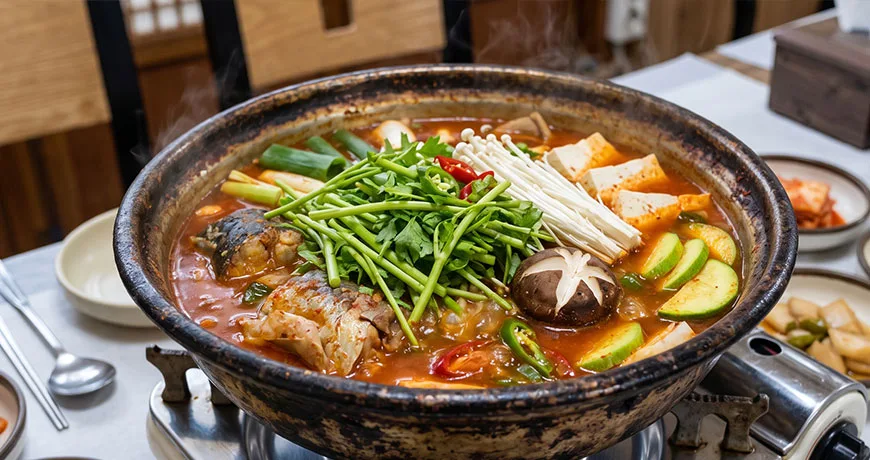
Megimaeuntang is an advanced biochemical freshwater matrix designed to capture the immense subcutaneous lipids and ultra-delicate hydrated myofibrils of the benthic catfish (Megi) within a highly viscous capsaicin emulsion. Unlike the dense, firm flesh of the Mandarin fish (Ssogari), catfish muscle fibers are interwoven with loose connective tissue and rich fats; if subjected to a prolonged, aggressive boil, the meat will completely disintegrate into an unappetizing mush. Therefore, strict thermodynamic staging is required: a hyper-viscous broth—thickened by the amylopectin of potatoes, Sujebi (wheat dough), and Gochujang—must be fully constructed before the catfish is introduced for a delicate, brief poaching phase. To neutralize the heavy geosmin (muddy off-notes) embedded in the skin’s thick mucin layer, the fish undergoes brutal osmotic abrasion with coarse salt, followed by chemical binding from Doenjang’s fermented peptides. Finally, a finishing strike of hydroxy-alpha-sanshool (from Sancho or Chopi powder) electrochemically hijacks the palate, flawlessly overriding any lingering freshwater funk with a wild, tingly euphoria.
- ⏱️ Total: 55 mins | Prep: 20 mins (Osmotic mucin purging and physical abrasion) | Cook: 35 mins
- 🍳 Difficulty: High (Requires strict protection of delicate catfish myofibrils against syneresis and absolute mastery of geosmin masking)
- 🌶️ Profile: Profoundly Heavy Lipid Umami, Fiery Heat, and Tingly Botanical Wildness
- 🍚 Focus: Osmotic Mucin Purging, Viscous Emulsification, & Hydroxy-alpha-sanshool Masking
- 🍶 Pairing: Ice-cold Somaek (Soju + Beer bomb) engineered with a highly carbonated light lager like Terra
Ingredients (3–4 servings)
- High-Density Lipid & Hydrated Protein Matrix: 1–2 Fresh Catfish (Megi – approx. 800g. MUST be violently scrubbed with coarse salt to osmotically strip the thick, slimy surface mucin. Gutted, spinal blood removed, and chopped into large steaks)
- Porous Gel & Starch Matrix: 2 Potatoes (cut into half-moons), 150g Daikon Radish (thickly sliced), 100g Wheat Flour Dough (Sujebi – critical for starch gelatinization)
- Geosmin-Masking Solvent: 1.2L Anchovy-Kelp Broth
- Peptide & Capsaicin Binder: 3 tbsp Gochugaru (Chili Flakes), 2 tbsp Gochujang (Chili Paste – essential for increasing viscosity and physically blocking muddy notes), 1.5 tbsp Traditional Doenjang (Soybean Paste), 2 tbsp Soup Soy Sauce, 2.5 tbsp minced garlic, 1 tsp minced ginger, 2 tbsp Rice Wine
- Aromatic Botanical Catalyst: 10 Perilla Leaves (Kkaennip), 1 handful Water Dropwort (Minari), 1 stalk Green Onion, 2 Cheongyang green chilies, 1/2 pack Enoki mushrooms, 1 tsp Sancho or Chopi Powder (Absolutely mandatory)
Allergy Information Contains: Fish (Catfish), Soy, Wheat (from Doenjang, Gochujang, Soy Sauce, Sujebi Dough)
Equipment High Thermal Mass Cast Iron Pot or Wide Stew Pan, Coarse Salt, Cutting Board, Knife
Cooking Instructions
- Osmotic Mucin Purging: The thick slime layer coating the scaleless catfish is saturated with geosmin (muddy flavor). Coat the fish in coarse salt and rigorously scrub it until the skin feels rough and the slime coagulates. Rinse thoroughly under cold running water. This physical and osmotic purging is non-negotiable.
- Solvent & Emulsion Construction: In a heavy pot, bring the broth, potatoes, and radish to a boil over high heat. Dissolve the Gochujang, Doenjang, chili flakes, garlic, and ginger into the solvent. You must allow this matrix to boil down slightly before adding the fish; the starches from the potato and chili paste need to gelatinize, creating a hyper-viscous, thick base.
- Lipid Fusion & Critical Poaching: Once the red, viscous broth is at a rolling boil, gently introduce the cleaned catfish chunks. Leave the lid open to allow volatile odors to escape. Reduce the heat to medium and poach the fish for strictly 10–15 minutes. The abundant subcutaneous fat of the catfish will melt into the broth, creating a heavy macro-emulsion, while the delicate meat cooks gently without falling apart.
- Starch Gelatinization: When the fish is halfway cooked, tear thin, bite-sized pieces of the Sujebi dough into the boiling broth to maximize the final rheological viscosity of the stew.
- Sanshool & Terpene Finish: Once the Sujebi turns translucent, and exactly 1 minute before turning off the heat, crown the stew heavily with green onions, chilies, enoki mushrooms, Minari, and torn Perilla leaves. Turn off the heat and instantly scatter 1 tsp of Sancho powder over the surface. The hydroxy-alpha-sanshool will instantly activate upon contact with the hot broth, engineering a powerful sensory override.
💡 Professional Culinary Tips
- Hydrodynamic Fragility of Catfish Myofibrils: Unlike firm river fish, catfish meat is structurally weak and excessively fatty. Boiling catfish for 30 minutes to “extract flavor” is a catastrophic error—the flesh will dissolve into a murky, unpalatable paste. The thermodynamic law here dictates that the stock and vegetable emulsion must be entirely built first, leaving the fish to be carefully poached in the final 15 minutes to preserve its pillowy texture.
- Physical Blocking via High-Viscosity Emulsion: While clear marine soups (like Cod) avoid Gochujang to maintain clarity, catfish demands it. The glutinous starch of Gochujang, combined with potato amylopectin, creates a thick, sticky emulsion. This viscous fluid physically coats the tongue’s taste receptors, creating a mechanical barrier that prevents the detection of trace amounts of muddy geosmin.
- The Molecular Strike of Sanshool: Sancho (or Chopi) powder is not merely an aromatic; it is a neurological tool. Its active compound, hydroxy-alpha-sanshool, triggers a distinct tingling, numbing sensation (paresthesia) on the lips and tongue. This intense tactile stimulation effectively “hijacks” the sensory pathways in the brain, completely erasing any lingering perception of freshwater mud.
🍶 Gastronomic Pairing
- Biochemical Palate Cleansing: When the heavy, unctuous emulsion of the catfish subcutaneous fat, the sticky Sujebi starch, and the electrifying tingle of the Sancho completely saturate your oral mucosa, pair this untamed stew with an ice-cold Somaek (Soju and Beer bomb) engineered with a highly carbonated light lager like Terra. The aggressive effervescence and refined ethanol dynamically shear away the heavy lipid and starch barrier from your tongue. This acts as a surgical solvent, instantly resetting your taste receptors and providing a brilliant fluid-dynamic contrast to the dense, wild stew.
Nutrition Facts (Estimated)
Total Content : Approx. 750g (1 serving, excluding bone weight)
Calories : 420 kcal (Excluding rice, including Sujebi/Potato)
– Sodium : 1,480mg (Elevated due to the necessity of Doenjang/Gochujang masking)
– Total Carbohydrate : 38.0g (Starch polysaccharides from potato, Sujebi, and Gochujang)
– Sugar : 4.5g
– Total Fat : 14.0g (High concentration of natural subcutaneous catfish lipids)
– Saturated Fat : 3.5g
– Cholesterol : 95.0mg
– Protein : 34.0g (Delicate hydrated myofibrillar protein)
– Dietary Fiber : 5.5g
*Daily Values are based on a 2,000 calorie diet and standard Korean nutritional reference values.
**Nutritional values are calculated based on original ingredients; substitutions may alter specific macronutrients.
Origins and Food Culture of Spicy Catfish Stew (Megimaeuntang)
1. Historical Lineage: Classical Treatises (Dongui Bogam, Nanho Eomok) and “Jeom-eo” (鮎魚) Medicine
- Lacking scales and protected by a thick, slippery coat of mucus, the Far Eastern catfish was historically documented in classical Hanja texts as Jeom-eo (鮎魚, “slimy fish”) or Jong-eo (鯇/鱨), serving as one of the most accessible and nourishing freshwater staples for peninsular communities living along major river systems.
- In Heo Jun’s 1613 medical compendium Dongui Bogam, the catfish was celebrated as an elite therapeutic food: “It is warm in nature, sweet, and non-toxic; it resolves water swelling (利水消腫), promotes smooth urination, invigorates vital energy, and cures hemorrhoids.” Because of its edema-reducing and diuretic properties, it was traditionally decocted for postpartum mothers experiencing persistent swelling and individuals suffering from physical exhaustion. Later, 19th-century scholar Seo Yu-gu’s Nanho Eomok praised the fish’s succulent flesh and rich oiliness, designating it as one of the finest edible river catches of Joseon.
2. The Culinary Science of Mucus Scrubbing and Geosmin-Neutralizing Fermentation
- Because benthic catfish reside in muddy river bottoms and secrete heavy mucin glycoproteins to protect their scaleless skin, the culinary success of Megimaeuntang depends on meticulous pre-treatment rather than heavy masking agents.
- Traditional cooks vigorously rubbed the skin with rough pumpkin leaves or coarse solar sea salt to mechanically slough off the unctuous mucus layer. During cooking, master kitchens balance red pepper flakes with aged fermented soybean paste (doenjang) and red chili paste; the fermented soybean peptides chemically bind and volatilize geosmin (mud odor), while the addition of tiny freshwater shrimp (toha) and hand-torn wheat dough flakes (sujebi) produces a thick, glossy colloidal broth with exceptional savory depth.
3. River Gateways of the Imjin, Namhan, and Soyang Rivers, and River Foraging (Cheonlyeop) Heritage
- Deeply rooted along major river basins—such as the Imjin and Hantan rivers in Paju and Yeoncheon, the Namhan River in Yangpyeong and Yeoju, Lake Soyang in Chuncheon, and the Geum River in Gongju—where boat ferries and rocky shoals supported vibrant recreational net-fishing and foraging traditions (Cheonlyeop).
- Originating as rustic riverside feasts where villagers hung cast-iron cauldrons over open wood fires to simmer freshly caught catfish with wild river herbs, pumpkin greens, and spoonfuls of village chili paste, Megimaeuntang has evolved into a celebrated staple of riverside dining destinations. Standing as an immortal symbol of working-class restorative comfort, generous communal spirit, and peninsular aquatic gastronomy, it remains a beloved national soul food.
The Silken Collapse of Riverine Amur Catfish Meat, the Lip-Clinging Extraction of Dermal Gelatin, and the Incandescent Resonance of Fermented Paste and Ditch Shrimp: A Refined Portrait of Megimaeuntang
Megimaeuntang (Spicy Catfish Stew) stands as the uninhibited, biologically rich, and deeply restorative summit of Korea’s benthic freshwater (tangban) gastronomy. Centered upon the nocturnal Amur catfish (Silurus asotus or Megi) navigating the tranquil depths and muddy margins of Korea’s major river systems, the preparation begins with rigorous mechanical sanitation. Because catfish possess scaleless, slime-secreting skins that trap benthic sediments, the carcass is vigorously scoured with coarse solar sea salt and wheat flour to physically strip away mucosal films (desliming), followed by careful evisceration to excise the bitter bile sac and pulmonary gills before sectioning into thick, bone-in steaks. Anchored inside a heavy earthenware pot or wide metal casserole upon a generous bedrock of thinly sliced winter radish, braised radish greens (siraegi), and handfuls of lively freshwater ditch shrimp (toha), the pot establishes an extraordinary terrestrial-aquatic flavor foundation. Flooded with a foundational dried kelp and anchovy stock dissolved with an assertive seasoning paste of sun-dried red chili powder (gochugaru), aged rustic soybean paste (doenjang), a touch of red chili paste (gochujang), soup soy sauce, crushed garlic, and fresh ginger, the stew is brought to an aggressive tableside boil. As the catfish’s rich subcutaneous lipids liquefy into the bubbling crimson broth, paper-thin hand-pulled wheat dough flakes (sujebi), wild water parsley (minari), aromatic crown daisy (ssukgat), fresh perilla leaves (kkaennip), and roasted perilla seed powder are mounded over the surface, creating an intoxicating harmony between freshwater benthic potency and fermented Korean seasoning craft.
Confronting the boiling cauldron tableside as terracotta-colored bubbles froth vigorously around thick, glistening segments of catfish releases an immediate, deeply comforting olfactory charge: the rich, buttery perfume of slow-extracted catfish lipids mingles seamlessly with the deep, bready savor of fermented doenjang, the toasted nuttiness of crushed perilla seeds, the sharp aroma of wild perilla leaves, and the brisk, pine-fresh fragrance of wild crown daisy and water parsley. Taking the first sip delivers an opulent revelation across the oral mucosa: the dense broth, fortified with the natural asparagine of braised greens, sweet succinic acids from the radish, bone-leached amino acids, and micro-emulsified catfish oils, coats the palate with an unctuous, velvet-like viscosity. Gliding effortlessly down the esophagus, it dispels internal chills and awakens dormant perspiration in an exhilarating wave of deep metabolic warmth. Biting into a thick segment of catfish reveals meat whose muscle fibers part with zero resistance, collapsing across the tongue with a warm, custard-like creaminess that discharges sweet, unctuous juices. Concurrently, the thick, gelatin-rich skin clings to the lips with a luxurious, viscoelastic chew (jjondeuk). The whole freshwater ditch shrimp burst between the teeth with a delightful, brittle crunch, while the hand-torn sujebi dough flakes provide a buoyant, chewy give that drinks in the seasoned stock. Steeping a bowl of warm white rice into the reduced crimson broth and crowning each spoonful with a crisp cube of aged radish kimchi completes an unforgettable ritual of physical rejuvenation, riverbank nostalgia, and profound gastronomic catharsis.
The enduring majesty of Megimaeuntang lies in its historical lineage—codified in Heo Jun’s 17th-century medical compendium Dongui Bogam under the entry Jeom-eo (鮎魚), where catfish is recorded as a sweet, warming, non-toxic restorative capable of clearing systemic edema, promoting healthy urination, and revitalizing fatigued livers. Historically harvested during riverside foraging excursions (cheonlyeop) along the rocky, reed-lined currents of the Han, Geum, and Nakdong Rivers, where village fishermen tossed freshly caught catfish straight into bubbling dockside cauldrons of chili, bean paste, and hand-pulled dough, this dish evolved into an iconic centerpiece of suburban riverbank dining colonies. Uniting unctuous benthic protein with the microbial depth of fermented soybean paste, sweet river shrimp, and sun-dried greens, a steaming cauldron of spicy catfish stew remains an irreplaceable monument of sustainable freshwater stewardship, rustic comfort, and brilliant Korean culinary craftsmanship.
Editor’s Review
1. A Dynamic Harmony of Zero-Resistance Catfish Softness, Viscoelastic Dermal Gelatin, Brittle Shrimp Snap, and Viscoelastic Sujebi Elasticity
The structural architecture inside the vessel delivers an extraordinary, four-tiered choreography between siluriform myofibrillar proteins, heat-denatured dermal connective tissue sheets, brittle whole-carcass shrimp carapaces, and a hydrated wheat gluten matrix. Unlike predatory perciforms with taut, springy muscle sheets, the white meat of the Amur catfish features fine myofibrillar bundles with low connective tissue cross-linking, resulting in an ethereal, custard-soft flaking that dissolves across oral membranes with zero tooth resistance. In luxurious contrast, the thick, scaleless dermal layer hydrolyzes into an unctuous, viscoelastic gelatin sheath that clings to the lips with rich oral lubrication. The tiny freshwater ditch shrimp burst between the teeth with an audible, brittle crunch, while the hand-pulled sujebi flakes supply a slippery, viscoelastic give that absorbs the savory stock like an organic sponge, ensuring an impeccably balanced, non-fatiguing mouthfeel from the first steaming sip to the last.
2. Catfish Lipid O/W Micro-Emulsification, Dermal Type I Collagen Hydrolysis, IMP-Glutamate-Glycine Umami Synergism, and Doenjang Melanoidin / Perillaldehyde Geosmin Deodorization Kinetics
Megimaeuntang represents an exacting study in siluriform fish biochemistry, lipid colloid thermodynamics, and flavor volatile mitigation. Unlike lean freshwater fish, Silurus asotus accumulates dense subcutaneous and perivisceral lipid deposits rich in mono- and polyunsaturated fatty acids (oleic and palmitoleic acids). Simmering between 85°C and 95°C under convective shear forces liberates these lipids into microscopic droplets; water-soluble sarcoplasmic proteins and soy proteins from the seasoning paste act as amphiphilic stabilizers, establishing an oil-in-water (O/W) micro-emulsion that endows the broth with a velvety, opaque body. Concurrently, insoluble Type I collagen densely woven within the scaleless skin and cranial cartilage hydrolyzes into water-soluble gelatin polypeptides, elevating fluid dynamic viscosity. Broth savor is driven by an exponential multi-pathway biochemical synergy: muscle-derived inosine monophosphate (5′-IMP) from the catfish converges with free glycine and arginine from the freshwater ditch shrimp, alongside natural free glutamates from the sun-dried chili, braised radish, and aged doenjang, triggering an intense activation across human oral T1R1/T1R3 umami heterodimers. In the pre-treatment phase, the salt-and-flour scouring mechanically strips away mucosal biofilms carrying mud-derived volatiles. During thermal boiling, high-molecular-weight melanoidin polymers and colloidal soy peptides in doenjang physically adsorb and trap benthic off-compounds—principally geosmin and 2-methylisoborneol (2-MIB). Simultaneously, perillaldehyde from fresh perilla leaves, alkylpyrazines from roasted perilla powder, allicin from garlic, and gingerols from ginger chemically sequester trace off-volatiles, yielding a pure, deeply comforting, and richly roasted aromatic profile.
3. The Pan-Korean Cheonlyeop Riverine Heritage, Dongui Bogam Restorative Lore, and the Sovereign Apex of Benthic Freshwater Gastronomy
Born out of ancient riverbank foraging traditions and lauded in classical Korean medicine as a sovereign tonic for exhausted organs, Megimaeuntang represents the undisputed zenith of benthic fish cookery in the national canon. Transcending the austere minimalism of clear freshwater broths by marrying unctuous, fat-rich river meat with artisanal soybean paste, wild river shrimp, and hand-pulled dough, this bubbling crimson centerpiece captures the wild vitality of Korea’s inland riverways, standing as an enduring sanctuary of environmental authenticity, communal generosity, and brilliant culinary artistry.