
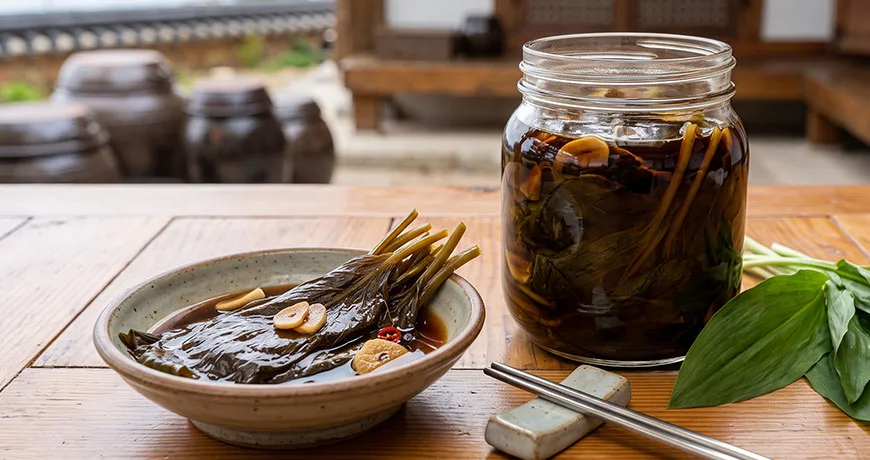
Myeonginamuljangajji is a noble record of spring, capturing the broad, vibrant leaves of the Victory Onion (wild alpine leek) that brave the deep mountains and harsh sea winds of Ulleungdo. As the elegantly simmered soy broth quietly permeates the leaves, the plant’s distinctive, deep wild garlic aroma blossoms alongside the broth’s clear, sweet acidity. Dealing with the delicate leaf and the sturdy stem requires a meticulously controlled infusion temperature, allowing the resilient fibers to soften without compromising the leaf’s fragile beauty. When wrapped around a rich piece of grilled meat, the interplay of savory juices and the fragrant, wild allium note delivers one of the most mesmerizing and commanding culinary experiences in Korean dining.
- ⏱️ Total Time: 3–5 Days | Prep: 20 Mins | Cook & Ferment: Initial temperature-controlled infusion, followed by a secondary boil and cold aging on day 3
- 🍳 Difficulty: Low-Medium (Requires 80°C thermal control to balance the differing textures of the stem and leaf)
- 🌶️ Profile: A lingering, deeply elegant wild garlic aroma woven into a bright, sweet-and-sour soy matrix
- 🍚 Core Process: Delicate Cleansing, Alternating Layering, 80°C Controlled Infusion
- 🍶 Pairing: Premium charcoal-grilled pork belly (Samgyeopsal), thick Hanwoo ribeye, cold buckwheat noodles
Physicochemical & Sensory Matrix
- Baseline Salinity: 5.0% ~ 6.0% (Perfectly calibrated to cut through heavy fats and elevate savory meats)
- pH Equilibrium: 3.8 ~ 4.2 (A bright acidic buffer forged by apple vinegar and plum extract that protects the wild aroma)
- Textural Crunch Index: [■■■□□] (A harmonious duality of smooth, tender leaves and slightly crisp, snappy stems)
- Umami Density: 8.5 / 10 (A multi-dimensional flavor born from the plant’s inherent allium amino acids and brewed soy)
- Shelf Stability: Peaks after 3 days; retains its flavor and texture for over 6 months refrigerated
- Aroma Profile: Elegant Wild Garlic (Allium) | Aromatic Brewed Soy | Subtle Fruity Plum
Ingredients (Yields 1 Medium Airtight Glass Container)
- Primary Plant Matrix: 500g Premium Victory Onion / Wild Garlic Leaves (Myeonginamul) with broad leaves and plump stems
- Aromatic Broth Matrix: 1.5 Cups Brewed Soy Sauce, 1.5 Cups Purified Water, 1 Cup Unrefined Sugar, 1 Cup Apple Vinegar, 0.5 Cup Plum Extract (Maesil-cheong), 0.5 Cup Cooking Wine
- Aromatic Catalyst: 1 Sheet Dried Kelp (10x10cm), 1 Dried Shiitake Mushroom, 1 Dried Red Chili, 0.5 tsp Whole Black Peppercorns
Allergy Information
- Contains: Soy, Wheat (inherent in brewed soy sauce)
Equipment Stainless Steel Saucepan, Heat-resistant Glass Airtight Container, Wire Mesh Strainer, Soft Cotton Cloth (Cheesecloth)
Cooking Instructions
- Delicate Cleansing: Soil easily hides between the broad leaves of wild garlic. Wash them meticulously, one by one, under running water. Neatly trim about 0.5cm off the tough, discolored ends of the stems with a knife. Lay them on a strainer to dry completely, gently wiping away any residual moisture with a soft cloth.
- Alternating Layering: When packing the dried leaves into the glass container, stack them in bundles of 10, alternating the direction of the stems and leaves (head-to-tail) for each bundle. If stacked in only one direction, the stems will pile up unevenly, preventing the broth from soaking in uniformly.
- Simmering & Acidity Preservation: In a saucepan, combine the water, soy sauce, sugar, cooking wine, kelp, shiitake, red chili, and peppercorns. Bring to a gentle simmer over medium heat. Once fragrant, remove the kelp and turn off the heat. Immediately after the violent bubbling stops, stir in the apple vinegar and plum extract to lock their bright, volatile acidity into the broth.
- 80°C Controlled Infusion: Allow the hot broth to cool for 2 to 3 minutes until it reaches approximately 80°C. Pour this carefully temperature-controlled broth evenly over the alternating layers of leaves. Place a small dish or pressing stone on top to keep them submerged.
- Secondary Simmering & Aging: Let the container cool completely at room temperature, then refrigerate. On the third day, carefully drain only the broth into a pot, bring it to a boil, and allow it to cool completely before pouring it back over the leaves. In the cold refrigerator, the profound wild aroma and the savory broth become beautifully one.
💡 Professional Culinary Tips
- 1. The Aesthetics of 80°C: Victory Onion leaves present a duality: the leaves are fragile, while the stems are tough. Pouring violently boiling (100°C) broth will shock the leaves, turning them yellow and tough. Conversely, entirely cold broth fails to penetrate the sturdy stems. Pouring the broth at a gently cooled 80°C is the ultimate chef’s compromise—it breaks down the tough pectins in the stem just enough while preserving the vivid, green vitality of the delicate leaf.
- 2. Preventing Acidity Volatilization: The distinct, lingering aroma of wild garlic can sometimes feel heavy. By reserving the vinegar and plum extract until after the heat is turned off, their refreshing organic acids are protected from evaporation. This creates an elegant veil of acidity that beautifully balances the deep allium notes and enlivens the palate.
- 3. Deepening Flavors via Secondary Simmering: Re-boiling the diluted broth on the third day and pouring it back only after it has completely cooled is a vital step. It purifies the brine, maximizing shelf stability while firming up the cellular structure of the leaves for months to come.
🍶 Gastronomic Pairing
- An Elegant Herb to Master Fats: Present this aged preserve alongside thick cuts of premium charcoal-grilled pork belly (Samgyeopsal) or heavily marbled Hanwoo ribeye. As you wrap a piece of beautifully seared meat in the broad, savory leaf, the clear acidity and deep wild garlic aroma instantaneously wash away the heavy, oily richness. This is the ultimate culinary ensemble, elevating the savory umami of the meat to its absolute peak in Korean dining.
Nutrition Facts (Estimated)
Total Content : Approx. 20g (5-6 leaves)
Calories : 22 kcal (Leaf dietary fiber and infused broth sugars)
– Sodium : 390mg (Optimally calibrated to pair with unseasoned grilled meats)
– Total Carbohydrate : 4.5g
– Sugar : 3.0g
– Total Fat : 0.0g
– Saturated Fat : 0.0g
– Cholesterol : 0.0mg
– Protein : 0.6g
– Dietary Fiber : 1.3g
*Daily Values are based on a 2,000 calorie diet and standard Korean nutritional reference values.
**Nutritional values are calculated based on original ingredients; substitutions may alter specific macronutrients.
Origins and Food Culture of Pickled Victory Onion (Myeonginamuljangajji)
1. Historical Lineage: “Gakbon” (茖本) in the Dongui Bogam and Joseon Treatises
- Native to the frigid alpine crags of the Korean peninsula, the wild mountain allium has sustained mountain communities since antiquity, cataloged in classical literature under the Hanja names Gakbon (茖本) or Sansan (山蒜).
- In Heo Jun’s monumental 1613 medical compendium Dongui Bogam, Gakbon was documented as “warm in nature, pungent, and non-toxic; it warms the spleen and stomach, assists digestion, halts abdominal chills and cramps, and relieves stagnation.” Agrarian texts like Seo Yu-gu’s early 19th-century encyclopedia Imwon Gyeongjeji recorded methods for blanching the harvested spring foliage or burying it in soy sauce for long-term pantry storage, recognizing its restorative value as wild mountain medicine.
2. The 1882 Ulleungdo Resettlement Decree and the Legend of Saving Lives (命)
- The culinary name Myeonginamul (“leaf that preserves life”) originated from the late 19th-century resettlement of Ulleung Island. In 1882 (the 19th year of King Gojong’s reign), the Joseon court lifted centuries of sea-isolation policies (gongdo-jeongchaek) and dispatched pioneers to cultivate the volcanic island.
- Following a severe winter, the settlers faced starvation during the brutal spring famine (chungunggi). Desperate for sustenance, they climbed the rocky ridges, harvested the emerald shoots of wild allium emerging through snowbanks, boiled them, and subsisted on them until relief ships and new crops arrived. Surviving the famine, the settlers named the herb Myeongi (命荑), meaning “the sprout that saved our lives (命).” They cured vats of the leaves in salt and soy sauce, anchoring it as a regional cultural symbol of survival and resilience.
3. Ascendance in Modern K-BBQ Gastronomy and Terroir Differentiation
- For generations an insular specialty of Ulleungdo, Myeonginamuljangajji emerged in the early 2000s as a sought-after staple of high-end Korean barbecue dining nationwide.
- Its capacity to cut through marbled animal fats and enhance umami elevated it into a premium wrap (ssam), superseding ordinary lettuce and perilla leaves in luxury restaurants. Contemporary agriculture distinguishes between two recognized varieties: the indigenous Ulleung-jong (characterized by broad, round, tender leaves) and the alpine Odaesan-jong from Gangwon Province (featuring slender, intensely aromatic dark foliage). Blending mountain foraging lore with contemporary dining culture, Pickled Victory Onion remains an enduring monument to peninsular ecological resilience, seasonal wisdom, and gastronomic harmony.
The Broad Emerald Leaves of Mountain Alliums Bursting from Thawing Glaciers to Nourish Famished Pioneers on Ulleung Island, Taming Wild Sulfur Volatiles in Chilled Soy-Vinegar Brine into a Translucent, Silken Wrap: A Refined Portrait of Traditional Myeonginamuljangajji
Myeonginamuljangajji (Pickled Victory Onion Leaves in Seasoned Soy Sauce) represents an aristocratic herald of wild spring foraging, celebrated as an indispensable partner to modern Korean barbecue. Centered on the tender, lanceolate foliage of Allium victorialis (or Allium microdictyon)—gathered at the edge of snowmelt in early spring from the volcanic slopes of Ulleung Island and deep subalpine ridges—this preserve carries a legendary heritage: its historical name, myeong-i, honors the hardy leaves that sustained early settlers through freezing famine. Belonging to the allium family alongside garlic and scallions, victory onion stores its organic sulfur reserves within the broad lamina of its aerial leaves rather than relying solely on underground bulbs, marrying a gentle allium warmth with the dewy sweetness of mountain herbs. Lacking the prickly hairs of perilla or the tough woody fibers of mature briers, the tender spring leaves hydrate pliantly in a boiled-and-cooled marinade of brewed soy sauce, fermented vinegar, cane sugar, and water. During undisturbed cold maturation, the bright emerald chlorophyll shifts into a dignified, translucent olive-amber, threading deep amino acids and crisp acetic acid along the parallel veins.
Lifting several amber-stained leaves with chopsticks reveals a glossy, translucent drape holding savory brine through gentle surface tension. Approaching the nose, the rich, malty peptide aroma of brewed soy sauce is lightened by a volatile breeze of fermented vinegar, underlaid not by the eye-stinging burn of raw garlic, but by a mellow, dewy woodland perfume with sweet allium undertones. Draped around a sizzling, golden rasher of grilled pork belly (samgyeopsal) or a marbled ribbon of charcoal-seared beef, the leaf folds effortlessly around the meat like fine silk. Biting down yields an elegant textural resistance: the parallel venation gives way with a supple, clean shear, discharging trapped, chilled brine that cuts through molten pork lard like a scalpel. The savory depth of soy umami, the bright prick of vinegar, and the concentrated sweetness of the cured leaf integrate seamlessly with the caramelized animal proteins, leaving the palate entirely refreshed.
The cultural identity of Myeonginamuljangajji lies in the domestic foresight that transformed a historic survival wildcraft into an enduring table companion. By tempering raw sulfur pungency within a sweet-savory acidic brine, traditional craftsmanship retained the supple grace of forest foliage while creating the ultimate physiological foil to heavy meats. A lustrous platter of pickled victory onion leaves remains a shining emblem of botanical refinement and balanced harmony on the Korean table.
Editor’s Review
1. Parallel Venation Tensile Mechanics and Silky Wrapping Rheology
Myeonginamuljangajji exhibits a unique monocotyledonous leaf architecture that sets it apart from reticulate dicot greens:
- Supple Shear Resistance Along Parallel Bundles: The leaf is structurally organized around parallel vascular bundles running from the petiole to the apex. Preserved through cold osmotic curing, these cellulose fibers maintain elasticity without collapsing into stringiness, providing a clean, tender shear against dental pressure when wrapped around dense meats.
- Hydrophobic Cuticular Shielding and Silky Mouthfeel: The smooth cuticular layer prevents waterlogged cellular maceration, allowing the pickled leaves to glide smoothly across the tongue without clinging, delivering a refined, silken oral wrap.
2. Attenuated Organosulfur Kinetics and Multi-Modal Acid-Sugar Buffering
The delicate garlic aroma and rounded flavor profile of Myeonginamuljangajji are dictated by subtle sulfur biochemistry and sensory suppression:
- Mild Thiosulfinate Cleavage: The primary aroma precursors are alliin and methiin. Upon cell disruption, endogenous alliinase produces allicin and methyl allyl thiosulfinates. The presence of methyl groups lowers volatility and lingual stinging compared to whole garlic cloves, creating a softer, sweeter aromatic bouquet.
- TRPV1 Sensory Buffering: The low-pH acetic acid medium (pH 3.6–4.0) alongside dissolved sucrose and soy-derived free glutamates exerts multi-modal cross-suppression on lingual TRPV1 pain receptors, buffering sharp sulfur sting into a clean, warming, and appetizing finish.
- Water Activity (Aw) Depression: The hypertonic balance of sodium chloride and dissolved sugars depresses internal water activity (Aw) below 0.85, arresting spoilage pathways and safeguarding leaf elasticity across months of cellar storage.
3. Interfacial Porcine Lipid Cleavage and Oral Deodorization Dynamics
Myeonginamuljangajji functions as an indispensable biological degreaser alongside rich meats:
- Acidic Disruption of Hydrophobic Fats: Saturated animal fats coat the tongue with a stubborn lipid layer that desensitizes taste receptors. The organic acetic acid in the pickle lowers interfacial surface tension, rapidly dispersing and clearing the grease film to restore sensory acuity.
- Suppression of Postprandial Breath Odors: In contrast to the heavy diallyl sulfides of bulb garlic, the methylsulfonyl-leaning degradation pathways of victory onion foliage leave significantly fewer persistent breath volatiles (halitosis), offering a cleaner finish after indulgent dining.