
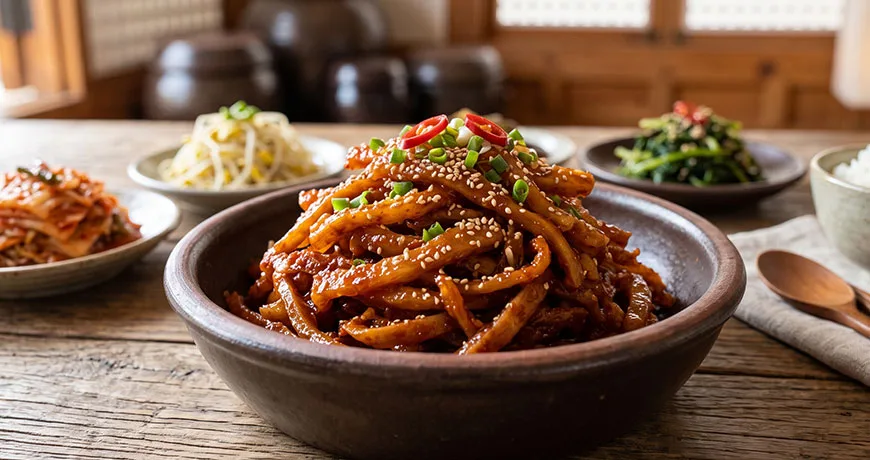
Mumallaengijangajji is the alchemy of time and nature, where Korean radishes, having surrendered their moisture to crisp winter winds and clear sunlight, are gently reawakened by a deeply simmered, time-honored soy broth. Watching the intensely shriveled radishes absorb the warm broth to resurrect their vibrant, percussive crunch is a testament to the elegant communion between the ingredients and the chef. By exercising utmost restraint during the rehydration process and employing the rich, glossy viscosity of rice syrup, this humble pantry staple is elevated into a sophisticated preserve. It brings an undeniable vitality to the dining table, filling the palate with the deep, comforting nostalgia of autumn and winter.
- ⏱️ Total Time: 3–4 Days | Prep: 30 Mins (Gentle cleansing and restrained hydration) | Cook & Ferment: Simmering broth and 3 days of cold aging
- 🍳 Difficulty: Low (Requires strict control over rehydration time and broth viscosity)
- 🌶️ Profile: An overwhelmingly satisfying, rhythmic crunch enveloped in a deep, savory soy umami and the gentle sweetness of rice syrup
- 🍚 Core Process: Controlled Hydration, Simmering for Viscosity, Lukewarm Infusion
- 🍶 Pairing: Warm, soothing scorched rice soup (Nurungji), freshly steamed pork belly (Suyuk), unseasoned toasted green laver (Paraegim)
Physicochemical & Sensory Matrix
- Baseline Salinity: 5.0% ~ 6.0% (A steadfast salinity that preserves the radish without masking its natural sweetness)
- pH Equilibrium: 4.5 ~ 4.8 (A subtle, elegant acidity introduced by plum extract that lifts the heavy soy notes)
- Textural Crunch Index: [■■■■■] (An extreme, percussive crunch uniquely characteristic of sun-dried root vegetables)
- Umami Density: 8.2 / 10 (A deeply resonant umami born from the synthesis of natural radish sugars and brewed soy sauce)
- Shelf Stability: Peaks after 3 days; retains its phenomenal crunch for over 3 months refrigerated
- Aroma Profile: Sun-dried Earthy Radish | Roasted Soy Melanoidins | Subtle Shiitake Depth
Ingredients (Yields 1 Medium Airtight Glass Container)
- Primary Plant Matrix: 200g Premium, pristine Sun-dried Radish Strips (Mumallaengi)
- Aromatic Broth Matrix: 1.5 Cups Brewed Soy Sauce, 1.5 Cups Purified Water, 1 Cup Rice Syrup (Jocheong), 0.5 Cup Plum Extract (Maesil-cheong), 0.5 Cup Cooking Wine
- Aromatic Catalyst: 1 Sheet Dried Kelp (10x10cm), 2 Dried Shiitake Mushrooms, 2 Dried Red Chilies, 0.5 tsp Whole Black Peppercorns
Allergy Information
- Contains: Soy, Wheat (inherent in brewed soy sauce)
Equipment Stainless Steel Saucepan, Heat-resistant Glass Airtight Container, Wire Mesh Strainer, Soft Cotton Cloth (Cheesecloth)
Cooking Instructions
- Gentle Hydration: Briefly rinse the dried radish strips under cold running water just to remove surface dust. Soak them in fresh cold water for exactly 10 minutes—no longer—just to relax their outer tension. Instantly remove them and squeeze with absolute force using a cheesecloth to expel all excess water, preserving their dense, rigid core.
- Simmering for Viscosity: In a saucepan, combine the water, soy sauce, cooking wine, kelp, shiitake, red chilies, and peppercorns. Bring to a gentle simmer over medium heat. Once the deep aromas bloom, remove the kelp and mushrooms. Stir in the rice syrup and simmer gently on low heat until the broth achieves a glossy, slightly viscous texture.
- Warm Infusion of Aromatics: Turn off the heat and immediately stir in the plum extract to impart a delicate, fruity fragrance. Allow the boiling liquid to rest until it cools to a comforting, lukewarm temperature (approximately 60°C).
- Soaking the Roots: Neatly pack the intensely chewy radish strips into the glass container. Pour the warmly cooled soy broth over them. The gentle heat coaxingly opens the dehydrated plant fibers, allowing the rich broth to seep deeply into every crevice and breathe life back into the roots.
- Time-honored Aging: Wait for the container to reach room temperature, then seal and refrigerate for 3 days. Over this quiet period of aging, the pale radish strips will absorb the marinade, blossoming into a brilliant, glistening amber delicacy.
💡 Professional Culinary Tips
- 1. Restraint in Hydration: Soaking the dried radish for too long is a fatal error; it completely destroys the signature rhythmic crunch, turning the strips into flavorless, mushy sponges. Limiting the soak to just 10 minutes merely softens the exterior, forcing the radish to rehydrate using the rich soy broth rather than plain water, which is the ultimate secret to its magnificent texture.
- 2. Viscosity via Rice Syrup: Utilizing traditional rice syrup instead of plain sugar increases the viscosity of the broth. This prevents the salt from piercing too sharply into the vegetable and coats each strip in a protective, glossy glaze that prevents it from drying out over long periods of refrigeration.
- 3. The Nuance of Lukewarm Broth: Pouring boiling broth will inadvertently cook the thinly sliced radish, ruining its crunch, while ice-cold broth fails to penetrate the tightly contracted dried fibers. Employing a broth cooled to around 60°C is a precise, thoughtful technique that naturally and gently relaxes the cellular structure for optimal flavor absorption.
🍶 Gastronomic Pairing
- An Elegant Variation in Texture: Serve this preserve alongside a warm, comforting bowl of simmered scorched rice soup (Nurungji). As the soft, roasted grains melt on your tongue, the sharp, percussive snap of the radish creates an exhilarating contrast that maximizes culinary joy. It is also an impeccable companion to freshly steamed pork belly (Suyuk), where the preserve’s vibrant crunch and sweet soy notes elegantly slice through the rich, heavy fats of the meat.
Nutrition Facts (Estimated)
Total Content : Approx. 30g
Calories : 35 kcal (Concentrated root sugars and complex syrup polysaccharides)
– Sodium : 410mg (A reliable salinity for long-term preservation)
– Total Carbohydrate : 8.5g
– Sugar : 4.5g
– Total Fat : 0.0g
– Saturated Fat : 0.0g
– Cholesterol : 0.0mg
– Protein : 0.6g
– Dietary Fiber : 2.5g (Highly concentrated insoluble fiber from the sun-drying process)
*Daily Values are based on a 2,000 calorie diet and standard Korean nutritional reference values.
**Nutritional values are calculated based on original ingredients; substitutions may alter specific macronutrients.
Origins and Food Culture of Pickled Dried Radish (Mumallaengijangajji)
1. Historical Lineage: “Geonchae” (乾菜) in the Jeungbo Sallim Gyeongje and Joseon Preservation Treatises
- Korean cultivation of radish (Raphanus sativus) dates back over a millennium, forming the agrarian backbone of winter kimchi and pantry preserves. Classical Joseon agrarian texts contain extensive documentation on slicing and preserving harvested late-autumn radishes under headings such as Geonchae (乾菜), Geonmu (乾菁), or Mumallaengi-ji.
- Yu Jung-im’s Jeungbo Sallim Gyeongje (1766), Seo Yu-gu’s early 19th-century encyclopedia Imwon Gyeongjeji, and Lady Yi’s Gyuhap Chongseo (1809) detailed methods for carving autumn radishes into thick strips, sun-drying them on woven straw mats, storing them in earthen vessels, and dressing them with soy sauce, vinegar, or chili paste. In an era when fresh green produce was unavailable during freezing winters, harnessing solar energy and freezing winds allowed households to secure essential vitamins and minerals through early spring.
2. The Post-Kimjang Surplus and the Science of Sun-and-Frost Dehydration
- Mumallaengi historically originated as a domestic thrift measure immediately following the early-winter Kimjang season. Surplus radishes remaining in the frost-touched fields were harvested, cut into batons, and spread across straw mats (chaeban) to undergo repeated cycles of freezing under nighttime sub-zero temperatures and thawing under daytime sun.
- This natural freeze-drying and solar evaporation concentrated intrinsic root sugars and compacted the hemicellulosic cell-wall architecture. Stored inside breathable paper linings or hung in wicker baskets, properly dried radish resisted microbial spoilage without refrigeration, providing an enduring reserve of vegetables for rural farming communities.
3. The Symbiosis with Dried Chili Leaves and the Evolution of Modern Bossam Gastronomy
- The culinary identity of Mumallaengijangajji is distinguished by its pairing with Gochu-nip—the green foliage of chili pepper plants gathered before the first autumn frost and blanched and dried for winter. The herbal astringency of the leaves cuts through the dense sweetness of the dried root, while replenishing vitamins A and C to establish an integrated nutritional balance.
- In modern Korean food culture, Mumallaengijangajji evolved into the signature companion for boiled pork belly (bossam), providing an acoustic crunch that cuts through rich animal collagen, and served as the conceptual foundation for the spicy squid-and-radish accompaniment of Tongyeong’s famous Chungmu Gimbap. Embodying the ancestral capacity to extract gastronomic brilliance from simple wind and sun, Pickled Dried Radish stands as an enduring monument to Korean slow-food ingenuity, ecological frugality, and preservation mastery.
Expelling Intracellular Fluids of Late-Autumn Radishes Beneath Biting Freezing Winds, Infusing Desiccated Cell Walls with the Dense Warmth of Brewed Soy and Grain Syrups into an Acoustic Chew: A Refined Portrait of Traditional Mumallaengijangajji
Mumallaengijangajji (Pickled Dried Radish Strips in Seasoned Soy and Chili Paste) stands as a monument to dehydration and rehydration within Korea’s preserved vegetable heritage. Centered upon firm, sugar-rich Korean radishes harvested in late November, the roots are cut into thick batons and spread across drying racks under dry winter winds and clear solar radiation. Composed of more than 90% water, fresh radishes stored through sub-zero winters risk freezing or succumbing to internal pithiness. Ancestral cooks countered this vulnerability through aggressive solar dehydration: drying out the free water until the batons shrivel into tough, wrinkled strips known as mumallaengi. During this winter cure, sugars and minerals consolidate while cellulose cell walls flatten into a dense, leather-like lattice. Reawakened by a swift rinse and brief soaking in cold water, then kneaded into a viscous glaze of aged dark soy sauce, barley malt syrup (jocheong), sun-dried chili flakes, fermented fish sauce, and crushed alliums, the collapsed fibrous chambers drink in savory peptides, achieving a springy, acoustic resistance unavailable in fresh produce.
Lifting several glistening, amber-crimson ribbons of Mumallaengijangajji with chopsticks reveals the textured grooves of the shriveled root coated in a glossy, clinging syrup. Approaching the nose, the deep, malty umami of aged soy sauce and fermented anchovy is pierced by a warm, toasted earthiness unique to solar-cured radish, accented by the sharp, invigorating warmth of garlic and dried red chilies. Biting down with the molars yields a striking masticatory rhythm: an authoritative, dense snap (ododok) resonates through the skull, bypassing both the watery crunch of raw radishes and the soft give of cooked pickles. The dense, compacted fibers push back resiliently against tooth shear before yielding, discharging a concentrated surge of savory brine and natural vegetal sweetness trapped within the rehydrated pores. The persistent heat of the chili flakes and the savory baseline of the cured seafood paste integrate seamlessly, building an addictive savor that coats the tongue. Positioned beside tender slices of boiled pork belly (bossam), charcoal-grilled beef, or a warm bowl of toasted rice porridge (nurungji), this resilient pickle delivers rhythmic clarity and deep comfort.
The cultural identity of Mumallaengijangajji is rooted in the agrarian discipline that turned seasonal scarcity into a textural triumph. By stripping away volatile cellular moisture and replenishing it with aged fermentation broths, traditional culinary artisans elevated humble dried root fibers into a vibrant, rhythmically complex table companion that continues to anchor the Korean winter table.
Editor’s Review
1. Controlled Parenchymal Rehydration and Lamellar Cell-Wall Acoustic Mechanics
Mumallaengijangajji occupies a singular textural niche defined by the physical hysteresis of dehydration and rehydration:
- Irreversible Cell-Wall Consolidation: Exposing fresh radish strips to sub-zero winds and solar heat purges over 85% of intracellular water, causing parenchymal cell walls to collapse. The cellulose microfibrils and hemicellulose matrices draw tightly together, forming an ultra-dense, multi-layered lamellar network.
- Restricted Hydration Swelling: When briefly rinsed and plunged into a hypertonic marinade, the shriveled tissue undergoes restricted rehydration rather than returning to full turgor. This controlled swelling hydrates the capillary channels without softening the cell walls, ensuring an elastic, rubbery pushback against dental shear that culminates in an audible, high-frequency snapping fracture (ododok).
2. Isothiocyanate Attenuation, Maillard Precursor Condensation, and Aw Suppression
The complex aroma and long-term shelf stability of Mumallaengijangajji stem from non-enzymatic browning pathways and hypertonic solute mechanics:
- Volatilization of Pungent Precursors: Fresh radish pungency—driven by 4-methylthio-3-butenyl isothiocyanate (MTBITC) generated via myrosinase cleavage—volatilizes during open-air dehydration. Concurrently, concentrated endogenous monosaccharides and free amino acids engage in slow non-enzymatic browning (early Maillard reactions), yielding savory, malty volatiles (such as methional and dimethyl sulfide derivatives) that define the cured root’s aroma.
- Hypertonic Hydrocolloid Matrix and Water Activity (Aw) Depression: The viscous combination of maltose syrup, brewed soy sauce, and solar sea salt forms a high-osmolarity glaze that binds residual free water. Depressing system water activity (Aw) to 0.70–0.75 erects an impenetrable hurdle against bacterial, fungal, and yeast proliferation without thermal sterilization.
3. Concentrated Insoluble Dietary Fiber and Bile Acid Chelation Dynamics
Beyond its sensory appeal, Mumallaengijangajji functions as an active metabolic counterweight against high-protein, high-fat dining:
- Dense Fiber Entrapment: On a dry-weight basis, mumallaengi concentrates insoluble cellulose and lignin more than tenfold compared to fresh radish. During mastication and digestion, this compacted fibrous network binds excess bile acids and unesterified free fatty acids generated during rich meat feasts, facilitating their elimination.
- Masticatory Trigeminal Activation: The prolonged mechanical chew required to break down the dense fibers continuously stimulates lingual trigeminal pathways. This drives copious saliva and digestive juice secretion, accelerating the gastrointestinal processing of heavy feasts.