
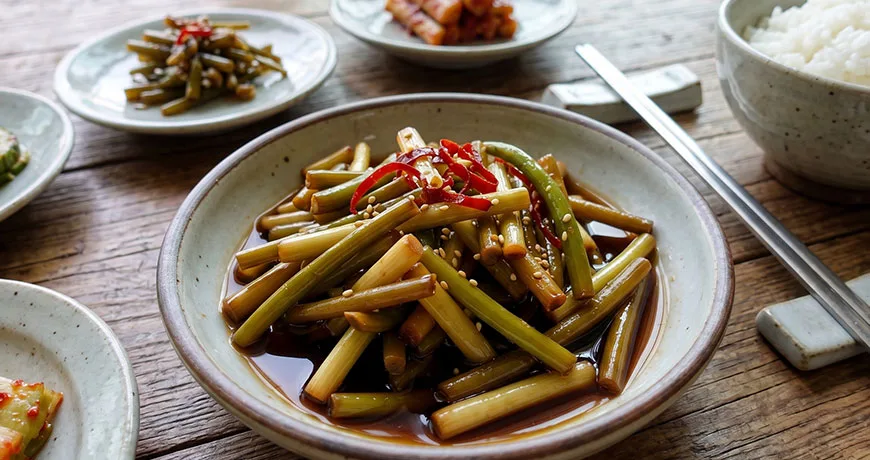
Maneuljongjangajji is a vibrant chronicle of early summer, capturing the robust vitality of the garlic plant as its energy surges above ground into tender green shoots. When these plump, lively stems are embraced by a delicately simmered soy broth, the intense heat lightly sears their exterior, sealing in a resounding crunch. Over time, the aggressive, sharp allium notes are gracefully mellowed into a sweet, deep, and savory finish. Providing a musical snap with every bite, this elegant preserve effortlessly awakens a palate fatigued by the approaching summer heat.
- ⏱️ Total Time: 3–4 Days | Prep: 15 Mins | Cook & Ferment: Initial hot infusion, followed by a secondary boil and cold aging on day 3
- 🍳 Difficulty: Low (Requires uniform trimming and precise thermal control of the broth)
- 🌶️ Profile: A percussive, crisp snap followed by a gentle, sweet garlic aroma woven into a bright soy acidity
- 🍚 Core Process: Delicate Trimming, Slow-simmering Broth, Hot Infusion Technique, Time-honored Aging
- 🍶 Pairing: Pan-fried dried shrimp, charcoal-grilled pork belly, rice steeped in warm green tea (Ochazuke)
Physicochemical & Sensory Matrix
- Baseline Salinity: 4.5% ~ 5.5% (A gentle saltiness harmonized to elevate the stem’s natural sweetness)
- pH Equilibrium: 3.8 ~ 4.2 (A transparent, light acetic matrix forged by naturally fermented vinegar)
- Textural Crunch Index: [■■■■□] (A highly satisfying, clean snap that yields easily without being stringy or tough)
- Umami Density: 7.4 / 10 (A solid foundation of brewed soy and kelp enriched by the fresh vegetable juices)
- Shelf Stability: Peaks after 3 days; maintains its lively crunch for over 3 months refrigerated
- Aroma Profile: Gracefully Mellowed Allium | Aromatic Brewed Soy | Clean Acetic Brightness
Ingredients (Yields 1 Medium Airtight Glass Container)
- Primary Plant Matrix: 500g Fresh, plump Garlic Stems (Maneuljong) with a vibrant green hue
- Aromatic Broth Matrix: 1.5 Cups Brewed Soy Sauce, 1.5 Cups Purified Water, 1 Cup Unrefined Sugar, 1 Cup Naturally Fermented Vinegar (Apple/Brown Rice)
- Aromatic Catalyst: 1 Sheet Dried Kelp (10x10cm), 1 Dried Shiitake Mushroom, 0.5 tsp Whole Black Peppercorns
Allergy Information
- Contains: Soy, Wheat (inherent in brewed soy sauce)
Equipment Stainless Steel Saucepan, Heat-resistant Glass Airtight Container, Wire Mesh Strainer, Cutting Board and Knife
Cooking Instructions
- Delicate Trimming: Wash the garlic stems thoroughly under running water. Decisively cut off the bulbous flowering ends and the thin, fibrous tips above them. Slice the remaining smooth, firm stalks into uniform, elegant 4-5cm lengths. Lay them on a strainer to dry completely.
- Slow-simmering the Broth: In a saucepan, combine the water, soy sauce, sugar, kelp, shiitake, and peppercorns. Bring to a gentle simmer over medium heat to awaken the earthy aromas. Once the broth is fragrant, remove the kelp and mushroom to keep the liquid pristine.
- Preservation of Acidity: Immediately after turning off the heat, stir in the vinegar. Adding it off the heat ensures the delicate, volatile organic acids are protected, locking a pure, transparent tang into the broth.
- Hot Infusion: Pack the dried garlic stems neatly into the heat-resistant container. Without hesitation, pour the near-boiling broth directly over them. This sudden thermal shock lightly sears the outer pectin, preventing the stems from becoming tough and securing their vibrant crunch.
- Secondary Simmering & Aging: Allow the container to cool completely at room temperature, then refrigerate. On the third day, carefully drain only the broth into a pot, bring it to a boil, and let it cool completely to room temperature before pouring it back over the stems. This vital second infusion ensures enduring texture and profound flavor across the seasons.
💡 Professional Culinary Tips
- 1. The Aesthetics of Trimming: The bulbous seed pods (flower buds) and the wispy tips at the end of the garlic stems will muddy the soy broth and leave an unpleasant, stringy texture on the palate. A chef’s basic refinement lies in ruthlessly discarding these ends to utilize only the firm, smooth core of the stalk.
- 2. Temperature Precision for Retaining Crispness: Pouring boiling broth on the first day is a precise technique that causes the plant’s cell walls to momentarily contract. Instead of cooking the stems to mush, this sudden heat fortifies the structural integrity, ensuring that each piece yields a delightful, resounding snap when bitten.
- 3. Deepening Flavors via Secondary Simmering: Re-boiling the diluted broth on the third day and pouring it back only after it has completely cooled is a critical purification ritual. It recalibrates the balance altered by the stems’ natural moisture, granting the preserve microbiological stability and a steadfast, elegant crunch for months to come.
🍶 Gastronomic Pairing
- A Lively Rhythm on the Palate: Serve this vibrant preserve alongside thick cuts of charcoal-grilled pork belly. As the heavy, savory fats coat your tongue, the garlic stem’s clear acidity and percussive crunch elegantly wash away the richness, flawlessly restoring balance to your palate. It is equally sublime when lightly tossed with stir-fried dried shrimp or served with Ochazuke (rice steeped in warm green tea) for a humble yet remarkably sophisticated meal.
Nutrition Facts (Estimated)
Total Content : Approx. 25g
Calories : 15 kcal (Stem dietary fiber and infused broth sugars)
– Sodium : 350mg (Mild, approachable salinity)
– Total Carbohydrate : 3.5g
– Sugar : 2.0g
– Total Fat : 0.0g
– Saturated Fat : 0.0g
– Cholesterol : 0.0mg
– Protein : 0.5g
– Dietary Fiber : 1.1g
*Daily Values are based on a 2,000 calorie diet and standard Korean nutritional reference values.
**Nutritional values are calculated based on original ingredients; substitutions may alter specific macronutrients.
Origins and Food Culture of Pickled Garlic Stem (Maneuljongjangajji)
1. Historical Lineage: “Santae” (蒜苔) in Joseon Agricultural Treatises
- In classical Korean agricultural literature, the emerging flower scape of the garlic plant was documented under the classical Hanja names Santae (蒜苔) or Sangyeong (蒜莖), long treasured as an indispensable late-spring foraging crop.
- Late Joseon agrarian compendiums—notably Seo Yu-gu’s early 19th-century encyclopedia Imwon Gyeongjeji and Yu Jung-im’s Jeungbo Sallim Gyeongje (1766)—recorded detailed recipes for boiling, seasoning, and pickling harvested garlic scapes in salt, fermented soy sauce, and soybean paste. Transforming what was an agricultural by-product into a year-round pantry staple reflected ancestral ingenuity in seasonal preservation.
2. The Agrarian Necessity of Descaping and Thermal Shock Preservation Science
- Harvesting garlic scapes is rooted in the agricultural necessity of “descaping” (maneuljong-ppopgi). In May, as garlic plants produce aerial scapes to bloom, they draw essential photosynthates away from the root. To force the plant’s metabolic energy down into the subterranean bulb, farming communities walked the rows daily to pluck each scape by hand.
- Facing massive gluts of scapes within a two-week window, households perfected the hot-brine pickling method. Because raw garlic scapes possess a smooth, hydrophobic cuticular layer that repels cold liquid, pouring boiling brine breaks surface tension, driving the savory marinade into the core vascular bundles while preventing surface molds and spoilage under cellar storage.
3. Regional Heritage of Southern Garlic Belts and the Zero-Waste Ethos
- Across the premier garlic terroirs of South Korea—including Changnyeong, Namhae, Goheung, Uiseong, and Jeju Island—Pickled Garlic Stem has long stood as an iconic regional dish. Culinary variations range from clear soy-vinegar curing (ganjang-maneuljongjangajji) to thick, fiery red-pepper paste immersion (gochujang-maneuljongjangajji).
- What began as a seasonal farming surplus was elevated into a cherished nationwide side dish, frequently featured in home lunchboxes and modern barbecue tables. Embodying the sustainable zero-waste philosophy of peninsular agriculture, Pickled Garlic Stem remains an enduring monument to Korean domestic resourcefulness, seasonal wisdom, and slow-food pickling brilliance.
Subterranean Bulbs, Taming Searing Sulfur Volatiles with Chilled Soy-Vinegar Brine to Seal an Acoustic Crunch: A Refined Portrait of Traditional Maneuljongjangajji
Maneuljongjangajji (Pickled Garlic Scapes in Seasoned Soy Sauce) represents an agile, structurally ingenious triumph of spring preservation in Korean culinary practice. Centered on the tender flower stalks (maneuljong) plucked from garlic beds in late spring to redirect vital nutrients toward the subterranean bulbs, this preserve transforms a seasonal byproduct into a long-lasting pantry staple. While inheriting the vital sulfur pungency of the garlic root, raw scapes quickly transpire after harvest, turning tough and stringy if left exposed. Ancestral cooks resolved this vulnerability by cutting the stalks into uniform cylinders and steeping them in a boiled-and-cooled marinade of brewed soy sauce, fermented vinegar, sugar, and water. During undisturbed cellar curing, harsh allicin sting gently diffuses into the sweet-savory brine, shifting the bright emerald rods into an aristocratic olive drab while locking their cellular turgor into a resilient, snappy state.
Lifting several amber-tinted scapes with chopsticks reveals a smooth exterior glistening under a savory sheen. Approaching the nose, the deep, fermented maltiness of brewed soy sauce is brightened by the volatile tang of acetic acid, anchored by the clean, herbaceous warmth of cured alliums. Clamping down with the molars triggers an immediate acoustic reward: an authoritative, high-density snap resonates through the jaw as pressurized cellular walls rupture cleanly under tooth shear. Trapped chilled brine floods the mouth, mingling the soy’s mineral umami and the vinegar’s crisp prick with the scape’s concentrated natural sweetness. A gentle, radiant allium warmth blooms across the palate without the acrid, lingering sting of raw garlic. Stationed beside sizzling ribbons of pork belly (samgyeopsal) or oily broiled fish, a single piece of pickled garlic scape slices through cloying animal fats like a scalpel, leaving the palate crisp, balanced, and rejuvenated.
The cultural identity of Maneuljongjangajji is rooted in the pragmatic ecology of traditional agriculture, which embraced every edible stage of crop growth. By moderating raw botanical heat through osmotic and acidic balance, this glistening preserve remains a clean, indispensable counterbalance that brings rhythm, texture, and bright clarity to the Korean feast.
Editor’s Review
1. Radial Vascular Bundle Architecture and Acoustic Shear Fracture Mechanics
Maneuljongjangajji exhibits a distinct linear masticatory profile rooted in the plant’s stem morphology:
- Concentric Vascular Ring Resistance: The scape’s cross-section features longitudinal vascular bundles reinforced with cellulose and hemicellulose arranged in dense concentric circles. The osmotic balance maintains this cellular framework without thermal collapse, generating an audible, crisp snap (ajak) when teeth sheer across the parallel fibers.
- Capillary Fluid Retention: Empty parenchymal intercellular voids act as microscopic fluid reservoirs, holding trapped soy-vinegar marinade until oral compression triggers an instant, refreshing hydraulic release.
2. Cuticular Solute Penetration Kinetics, Allicin Attenuation, and Pectin Integrity
The crisp texture and rounded warmth of Maneuljongjangajji are governed by barrier diffusion and organic sulfur redistribution:
- Osmotic Infiltration Across Cutin Polymers: The smooth surface is sheathed in a hydrophobic cutin wax layer that moderates fluid exchange. This protective barrier slows down solute penetration, preventing osmotic shock and cellular collapse while allowing sodium, sugars, and organic acids to equilibrate evenly throughout the cylindrical tissue.
- Allicin Attenuation: Upon tissue cutting, alliinase converts alliin into volatile allicin. Over extended liquid immersion, the low-pH marinade buffers these unstable thiosulfinates into milder diallyl sulfide compounds, muting lingual TRPV1 receptor stinging and converting sharp pungency into an appetizing warmth.
- Acidic Pectin Stabilization: The acidic medium (pH 3.6–4.0) inhibits pectolytic enzymes and halts the beta-elimination of middle-lamella pectins, ensuring that the vegetable maintains its dense mechanical firmness across months of storage.
3. Interfacial Lipid Dispersion and Gastro-Functional Fiber Mechanics
Maneuljongjangajji serves as an agile physiological counterweight to heavy, fat-rich banquets:
- Acidic Emulsification of Saturated Fats: Saturated animal fats coat lingual papillae in a stubborn hydrophobic film. The low-pH acetic acid solution reduces the surface tension of these lipids, emulsifying and flushing the greasy residue from the oral mucosa.
- Digestive Regulation via Insoluble Fiber: Abundant cellulose and hemicellulose stimulate gastrointestinal peristalsis, easing the metabolic load of high-protein, calorie-dense dining while promoting gut motility.