
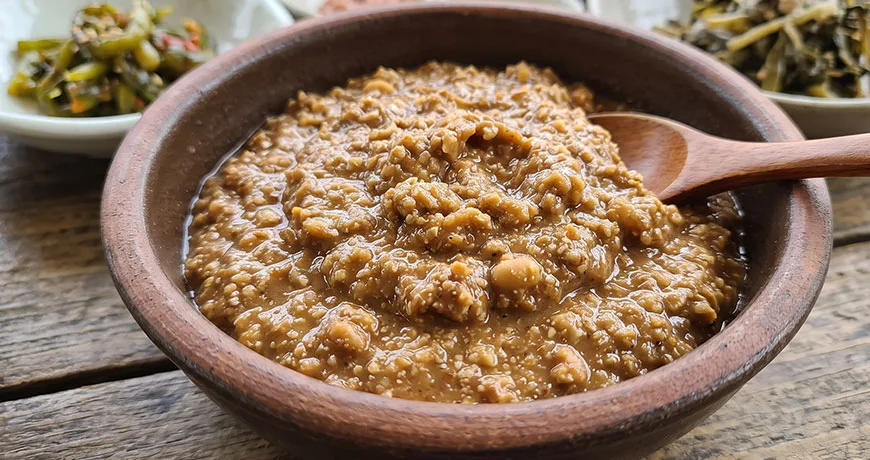
Kkaenmukjang is an extraordinarily rare hybrid fermentation matrix that goes far beyond recycling. It takes Kkaenmuk—the defatted seed cake (dregs) left over after high-pressure extraction of sesame or perilla oil—and subjects its dense residual plant proteins (globulins) and insoluble dietary fibers to intense protease hydrolysis via Bacillus subtilis. Because the defatted lignocellulose matrix of the seed cake is rock-hard and devoid of moisture, it must first be thermally and mechanically softened before being fused with boiled soybeans or Meju (fermented soybean) powder, which acts as the primary microbial incubator. Aging this heterogeneous mixture in a high-salt osmotic environment for several months allows the trace unsaturated lipids remaining in the seed cake to undergo controlled oxidation. This yields a profoundly earthy, thick, and brutally savory paste exploding with nutty peptides that completely eclipses standard Doenjang.
- ⏱️ Total: 2–3 Months | Prep: 1 Day (Seed cake hydration & soybean thermal hydrolysis) | Cook & Ferment: 2–3 Months (Natural Aging)
- 🍳 Difficulty: Extreme (Requires mastery of moisture-balancing highly hydrophilic defatted cakes and synchronizing heterogeneous fermentation matrices)
- 🌶️ Profile: Aggressively Nutty, Earthy, with a Profoundly Savory Peptide Umami and Subtle Bitter Finish
- 🍚 Focus: Mechanical Crushing, Lignocellulose Softening, Heterogeneous Matrix Fusion, & Solid-State Proteolysis
Physicochemical & Sensory Matrix
- Baseline Salinity: 15.0% ~ 18.0% (Halophilic Osmotic Barrier for High-Moisture Block)
- pH Equilibrium: 5.2 ~ 5.5 (Proteolytic & Mild Organic Acid Buffered)
- Viscosity Index: [■■■■■] (Ultra-High Viscoelasticity / Dense Clay-like Paste)
- Umami Density (T1R1/T1R3 Synergy): 9.7 / 10 (Soy Glutamic Acid × Defatted Seed Peptide Synergy)
- Aging Horizon: 60 ~ 90+ Days (Solar Ambient Solid-State Fermentation)
- Aroma Profile: Alkylpyrazines (Intense Nutty) | Earthy Tannins | Controlled Oxidized Lipids
Ingredients (Yields 1 Medium Traditional Crock)
- Defatted Plant Protein Matrix: 500g Kkaenmuk (Pure defatted sesame or perilla seed cake left after traditional oil pressing—usually solid as a rock; must be pulverized)
- Protease Incubator Matrix: 500g White Soybeans (Soaked overnight and deeply boiled until they easily mash between fingers) OR 300g Traditional Meju (Fermented Soybean) Powder
- Osmotic Solvent Matrix: 1.5L Purified Water (boiled and cooled), 350g Coarse Solar Sea Salt (Aged 3+ years; targeting a strict 15–18% salinity environment)
- Antimicrobial Catalyst: 3 tbsp Chili Seed Powder (Provides a capsaicin barrier against rogue bacteria and adds a sharp, rustic heat)
Allergy Information Contains: Sesame/Perilla, Soy
Equipment Microporous Earthenware Crock (Onggi), Heavy Pestle or Heavy-duty Blender, Cheesecloth, Large Mixing Basin
Cooking Instructions
- Mechanical Crushing: Using a heavy pestle or blender, aggressively pulverize the rock-hard seed cake blocks into a coarse powder. Maximizing the surface area is mathematically essential for the subsequent hydration and enzymatic attack phases.
- Hydration & Thermal Softening: Sprinkle a small amount of warm water over the pulverized seed cake, cover, and let it rest overnight. The extremely hydrophilic defatted matrix will absorb the moisture and swell, allowing its tough lignocellulose cell walls to relax into a pliable state accessible to microbes.
- Thermal Hydrolysis of Soybeans: Boil the soaked soybeans until completely soft. Heat denatures the complex soy proteins, preparing them for rapid enzymatic cleavage. Drain the water and coarsely mash the beans.
- Heterogeneous Matrix Fusion: In a massive basin, combine the hydrated seed cake, mashed soybeans (or Meju powder), and chili seed powder. Vigorously knead them together. Gradually pour in the prepared salt brine, adjusting the moisture until the matrix achieves the dense, heavy viscoelasticity of wet clay.
- Anaerobic Compacting & Halophilic Fermentation: Transfer the heavy paste into a sanitized earthenware crock. As you build the layers, press down with your fists to forcefully compact the paste, eliminating all microscopic air pockets (anaerobic compacting). Smooth the top and blanket it with a thick layer of coarse salt for an osmotic seal. Cover and age in a well-ventilated, sunny area for 2–3 months to drive proteolysis and controlled lipid oxidation.
💡 Professional Culinary Tips
- The Hydrophilic Physics of Defatted Cake: Because the oil has been forcibly extracted, Kkaenmuk acts like a massive dry sponge. It demands significantly more hydration than standard boiled soybeans. Failing to provide adequate initial moisture will result in a “fermentation deadlock,” where the paste dries out completely in the crock and all microbial activity halts.
- Controlling Lipid Oxidation: The trace polyunsaturated fats remaining in the seed cake will quickly turn rancid and foul-smelling if exposed to oxygen. This is why aggressive physical compaction to remove internal air pockets, combined with a flawless salt seal on the surface, is an immutable law of this recipe.
- The Biochemical Necessity of the Soybean Incubator: The seed cake alone lacks the ideal microbial environment to sustain a massive Bacillus subtilis bloom. The boiled soybeans or Meju act as a high-powered incubator. Furthermore, the massive glutamic acid payload generated by the soy proteins elegantly masks the slightly bitter, astringent tannins present in the seed hulls, forging perfect flavor symmetry.
🍶 Gastronomic Pairing
- Biochemical Palate Cleansing: Aged Kkaenmukjang is best experienced raw, not boiled. Scoop a small amount of this potent paste onto freshly steamed Barley Rice, wrapped neatly inside gently Steamed Pumpkin Leaves or Cabbage. The high water content and soft pectin of the steamed leaves buffer the aggressive salinity and coarse texture of the paste. Pair this rustic bite with a bowl of chilled, Unfiltered Traditional Makgeolli (Rice Wine). The live lactic acid and carbonation mechanically shear through the heavy, nutty lipid film left on your tongue, completely resetting your palate.
Nutrition Facts (Estimated)
Total Content : Approx. 20g (1 tbsp)
Calories : 45 kcal (High-density plant protein & dietary fiber matrix)
– Sodium : 680mg (High salinity required for osmotic microbial defense)
– Total Carbohydrate : 5.0g (Complex polysaccharides from seed cake and soy)
– Sugar : 0.5g (Trace reducing sugars from enzymatic breakdown)
– Total Fat : 1.5g (Trace residual unsaturated lipids surviving the oil pressing)
– Saturated Fat : 0.2g
– Cholesterol : 0.0mg (100% Vegan matrix)
– Protein : 3.5g (Highly bioavailable peptides and free amino acids via proteolysis)
– Dietary Fiber : 2.5g (Ultra-dense insoluble lignocellulose from seed hulls)
*Daily Values are based on a 2,000 calorie diet and standard Korean nutritional reference values.
**Nutritional values are calculated based on original ingredients; substitutions may alter specific macronutrients.
Origins and Food Culture of Sauce Made from Sesame Dregs and Boiled and Fermented Soybeans (Kkaenmukjang)
1. Agrarian Wisdom and Zero-Waste Lineage: Traditional Upcycling of Oil Cakes in Joseon Treatises
- The solid residues left after expelling oil from sesame or perilla seeds (yubak, 油粕) were historically used as organic fertilizer or animal feed, but during periods of harvest shortfall, peninsular peasants recognized them as an invaluable reservoir of concentrated vegetable protein, healthy lipids, and dietary minerals.
- Classical agrarian treatises, including Hong Man-seon’s early 18th-century Sallim Gyeongje and Seo Yu-gu’s 19th-century encyclopedia Imwon Gyeongjeji (Jeongjo-ji), documented ingenious domestic recipes for fermenting oil cakes alongside whole soybeans to create savory pastes and stews during lean winter months. This culinary innovation represents one of the world’s earliest documented practices of gastronomic upcycling, turning agricultural processing byproducts into an elite fermented functional food.
2. The Biochemical Kinetics of Accelerated Bacillus Fermentation and Lignan Liberation
- The culinary mastery of Kkaenmukjang hinges upon the thermodynamic management of traditional ondol (underfloor heating) fermentation to break down dense seed structures.
- Hardened, defatted seed dregs were pulverized and mixed with freshly simmered yellow soybeans, placed in the warmest corner of the floor (40–45°C), and covered with dry rice straw for two to three days. Powerful amylases and proteases secreted by wild Bacillus subtilis broke down complex proteins into savory polyglutamic acid mucilage. This hydrothermal microbial breakdown ruptured the seed coats, releasing bound lignans and phenolic compounds without allowing rancidity, yielding a mellow, nutty, and highly digestible fermented paste.
3. Inland Mountain Terraces of Chungcheong and Gyeongsang Provinces and the Soul of Winter Stews
- Kkaenmukjang developed primarily across the rugged, mountainous inland valleys of Chungcheong Province (Danyang, Jecheon) and northern Gyeongsang Province (Andong, Yeongju, Bonghwa), where arable land for soybean cultivation was scarce compared to southern plains.
- During the biting cold of winter, households simmered earthenware crocks of dried radish greens (siraegi) or sour aged kimchi with a few spoonfuls of Kkaenmukjang in anchovy stock, crafting Kkaenmukjang-jjigae to nourish hardworking farming families with essential calories and warmth. Today, celebrated as a triumph of zero-waste slow food and ancestral sustainability, Kkaenmukjang remains an immortal cultural monument to Korean rural resourcefulness, fermentation heritage, and deep domestic warmth.
The Concentrated Nutty Resilience of Pressed Seed Cakes, the Microbial Warmth of Fermented Soybeans, and the Agrarian Wisdom of Upcycled Sustenance: A Refined Portrait of Kkaenmukjang
Kkaenmukjang (Sauce/Stew Made from Sesame or Perilla Dregs and Fermented Soybeans) stands as one of the most resourceful, deeply nutty, and rustic achievements of traditional Korean rural gastronomy. Centered upon kkaenmuk—the dense, dehydrated oil-cake residue left behind after pressing sesame or perilla seeds for their oil—this inland comfort staple (treasured across the mountainous pockets of Chungcheong and Jeolla Provinces) reimagines agricultural byproducts through biological fermentation. The dry, rock-hard oil press-cake is pulverized in stone mortars into a coarse meal, then married with freshly boiled yellow soybeans. Inoculated with wild Bacillus subtilis from clean rice straw and set in a warm earthen room for two to three days, the mixture ferments rapidly in a manner reminiscent of cheonggukjang. As sticky strands of mucilage form across the softening legumes, the mash is seasoned with sea salt, red chili powder, and garlic. Simmered inside a heavy earthenware pot (ttukbaegi) with rice-rinse water or dried anchovy stock, dried radish greens (siraegi), aged kimchi, and tofu, it thickens into a hearty, porridge-like stew. Defying the assumption that oil dregs are mere waste, the residual lipids in the crushed seeds bind with the amino-rich fermented soy to produce a profound, full-bodied savory depth that neither standard doenjang nor quick-fermented cheonggukjang can replicate alone.
When an earthenware pot of Kkaenmukjang bubbles thickly tableside, the rising steam delivers an unmistakable olfactory footprint: the deeply toasted, concentrated aroma of pressed oil seeds layered over the warm, rustic funk of fermented soybeans and the mineral scent of dried greens. Spooning up a mouthful reveals an immediate departure from thin, fluid broths. The finely ground seed meal and soft bean cotyledons form a thick, textured suspension that coats the oral cavity with substantial density. Chewing introduces a pleasant, powdery graininess from the seed hulls, followed swiftly by a wave of peptide-rich umami that cuts through any vegetal bitterness. Braised kimchi and tender radish greens provide bursts of moisture and bright acidity, preventing the lipid-dense broth from feeling heavy. Ladled over warm barley rice and eaten in generous mouthfuls, Kkaenmukjang offers an unvarnished encounter with traditional country sustenance, turning humble agricultural scraps into an deeply restorative and soul-warming meal.
The cultural identity of Kkaenmukjang is rooted in the zero-waste ethos of traditional farming communities. In eras when even a few drops of sesame oil were a treasured luxury, rural households refused to discard the nutrient-dense press-cake, pairing it instead with legume fermentation to secure vital proteins, fats, and dietary minerals through the harsh winter months. Elevating overlooked byproducts into an intensely satisfying, earthy centerpiece, a hot pot of Kkaenmukjang represents the pragmatic genius, thrift, and enduring soul of Korea’s rural hearth.
Editor’s Review
1. Coarse Seed Hull Particulates, Velvety Bacillus Soy Breakdown, and Fibrous Radish Greens in a High-Density Multi-Phase Texture
Kkaenmukjang delivers a distinct, rustic mouthfeel driven by a heterogeneous, multi-phase dispersion. The finely crushed seed hulls (testa) of the sesame or perilla cake do not dissolve during simmering; instead, they remain suspended as micro-granules that provide a distinctive, earthy friction against the tongue and palate. Softening this particulate roughness is the creamy, hydrated matrix of boiled soybeans, whose cell walls have been broken down by short-term Bacillus fermentation. Interspersed with the long, fibrous chew of rehydrated radish greens (siraegi) and braised kimchi, the dish achieves a robust textural density that feels hearty, filling, and comforting without artificial starches or thickeners.
2. Lignan Antioxidant Thermal Stability, Bacillus Proteolytic Breakdown, and Insoluble Fiber Volatile Adsorption
The flavor stability and physical behavior of Kkaenmukjang are governed by specialized lipid and carbohydrate interactions:
- Thermal Oxidation Defense via Lignans: Despite undergoing intense mechanical pressing, residual oil cakes retain 10–15% bound lipids along with concentrated levels of potent natural lignans, notably sesamol, sesamolin, and sesamin. These phenolic antioxidants remain resilient against thermal degradation during extended simmering, shielding residual unsaturated fatty acids from oxidative rancidity and preserving a clean, roasted seed bouquet.
- Rapid Proteolysis & Umami Release: Inoculation with wild Bacillus subtilis at 40–45°C drives rapid enzymatic cleavage of dense soybean globulins into short peptides and free glutamates within 48 to 72 hours. This produces a savory backbone that counterbalances the bitter tannins present in seed husks.
- Aroma Moderation via Insoluble Fiber: The insoluble dietary fibers (cellulose, lignin) making up over 20% of the seed cake function as a porous physical adsorbent. During boiling, they trap overly pungent volatile amines and short-chain fatty acids from the quick fermentation, ensuring that the stew retains a warm, nutty profile rather than an aggressive ammonia bite.
3. Pragmatic Zero-Waste Fermentation and Rural Protein Security
Kkaenmukjang stands as a classic paradigm of upcycled culinary bio-processing. By utilizing microbial fermentation to convert a dense, fibrous byproduct of oil production into a digestible, bioavailable source of amino acids and healthy fats, traditional rural cooks transformed a potential waste stream into an indispensable winter survival staple. Honest, unpretentious, and structurally substantial, it remains an enduring benchmark of ecological resourcefulness in traditional Korean gastronomy.