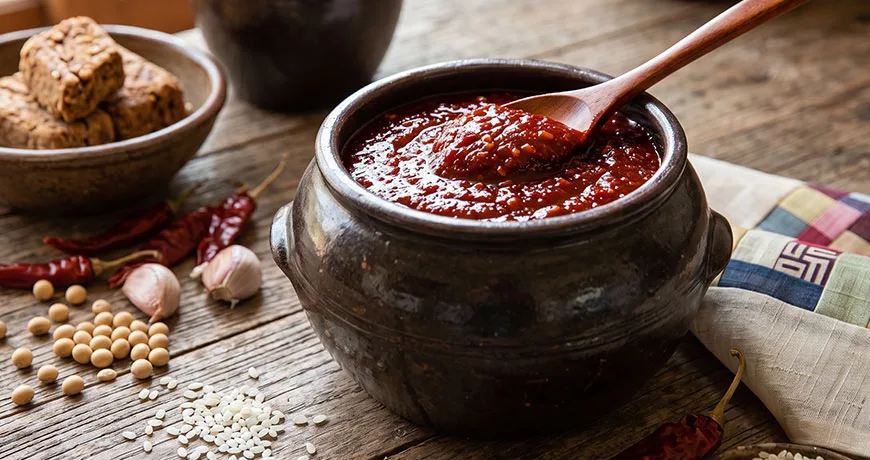
Traditional Gochujang is a highly complex, hybrid fermentation matrix. It simultaneously harnesses carbohydrate engineering—using malt amylase to enzymatically saccharify the dense amylopectin of glutinous rice into sweet maltose—and protein hydrolysis, where Bacillus subtilis microbes in fermented soybean powder (Meju) cleave proteins into savory free amino acids. The piercing thermal heat of capsaicin from fine red chili powder binds with the heavy, viscoelastic syrup, creating an emulsion supported by a profound glutamic acid baseline. Shielded from putrefaction by a high-salt osmotic barrier, this paste must undergo at least six months of non-enzymatic browning (Maillard reaction) and moisture evaporation inside a breathable microporous earthenware crock (Onggi) under solar ultraviolet rays. Only then does it mature into the ultimate, dense chili-peptide elixir.
- ⏱️ Total: 6+ Months | Prep & Saccharification: 8 hrs | Cook & Ferment: 6+ Months (Natural Aging)
- 🍳 Difficulty: Extreme (Requires precision thermal control of amylase enzymes, microbial preservation, and halophilic aging)
- 🌶️ Profile: Deep, Heavy Maltose Sweetness Followed by Explosive Umami and Piercing Capsaicin Heat
- 🍚 Focus: Enzymatic Saccharification, Protein Hydrolysis, Thermal Reduction, & Solar Maillard Aging
Ingredients (Yields 1 Medium Traditional Crock)
- Amylopectin Matrix: 1kg Fine Glutinous Rice Flour (Chapssal – the high-density starch base for saccharification)
- Amylase Enzyme Catalyst: 500g Traditional Malt Barley (Yeotgireum), 4L Warm Purified Water (for enzyme extraction)
- Reducing Sugar Binder: 1kg Rice Syrup (Jocheong – for texture fixing and gloss coating)
- Protein & Enzyme Matrix: 500g Fermented Soybean Powder (Meju – specifically milled for Gochujang to provide protease enzymes)
- Capsaicin & Pigment Matrix: 1.2kg Fine Sun-dried Red Chili Powder (Taeyangcho Gochugaru)
- Osmotic Matrix: 400–500g Coarse Solar Sea Salt (Aged 3+ years; applied for final salinity calibration and microbial defense)
Allergy Information Contains: Soy (Fermented Soybean Powder)
Equipment Rice Cooker (or precision water bath), Heavy Cast-Iron Cauldron or large pot, Fine Cheesecloth, Microporous Earthenware Crock (Onggi)
Cooking Instructions
- Enzyme Extraction: Soak the malt barley in 4L of warm water (approx. 40°C) for 30 minutes, then vigorously knead by hand to extract the amylase enzymes. Strain the milky liquid through a fine cheesecloth, discarding the husks. Let the liquid settle for 2 hours, then carefully decant only the clear, enzyme-rich supernatant.
- Gelatinization & Saccharification: In a rice cooker, thoroughly whisk the glutinous rice flour into the clear malt extract until smooth. Set the temperature to a strict 60–65°C and incubate for 4–6 hours. The amylase will aggressively dismantle the complex polysaccharide chains into simple maltose and glucose. (The liquid will become thin, clear, and intensely sweet.)
- Thermal Reduction: Transfer the saccharified rice liquid to a heavy cauldron. Boil over high heat to thermally denature the enzymes and halt their activity. Reduce the heat and stir constantly until the water evaporates by a third, leaving a thick, viscous syrup. Whisk in the rice syrup until fully dissolved. Turn off the heat and allow the matrix to cool completely to room temperature.
- Peptide & Capsaicin Fusion: Once the syrup is entirely cool, whisk in the fermented soybean powder to initiate proteolysis. Next, fold in the fine chili powder to construct the capsaicin emulsion. As the chili powder absorbs moisture, the matrix will rapidly develop a thick, heavy viscoelasticity.
- Osmotic Stabilization: Fold in the coarse sea salt to establish the final salinity barrier. (The paste must taste aggressively salty at this stage to prevent spoiling during aging.) Leave at room temperature for 24 hours, stirring occasionally until the salt crystals are entirely dissolved.
- Solar UV & Maillard Aging: Sanitize and dry the earthenware crock (Onggi), and fill it to 80% capacity with the Gochujang. Blanket the surface with a thick, white layer of coarse salt to create an impenetrable osmotic seal against airborne mold. Cover with a breathable lid. Expose the crock to direct sunlight on clear days to induce solar Maillard browning and moisture evaporation for a minimum of 6 months.
💡 Professional Culinary Tips
- The Physics of Enzyme Denaturation: Pouring the fermented soybean powder and chili powder into the saccharified syrup while it is still hot is a catastrophic failure. Heat instantly obliterates the beneficial Bacillus microbes and proteases in the soy powder, while simultaneously oxidizing the capsaicin and red pigments, turning the vibrant chili powder into a muddy, flavorless brown paste.
- The 60°C Amylase Threshold: During the rice saccharification, if the temperature breaches 70°C, the malt enzymes cook and die. If it drops below 50°C, lactic acid bacteria hijack the matrix and sour the batch. Propping the lid of a rice cooker open slightly on the ‘Keep Warm’ setting is a traditional hack to perfectly target the 60–65°C biochemical window.
- Microporous Respiration of Onggi: Aging Gochujang in a sealed plastic container will cause it to putrefy or explode from trapped fermentation gases. Onggi clay contains microscopic pores acting as a semi-permeable membrane—locking liquid inside while allowing oxygen to penetrate and water vapor to escape. This micro-respiration is mandatory for concentrating the deep peptide umami over time.
🍶 Gastronomic Pairing
- Biochemical Palate Cleansing: The profound glutamic acid and sharp capsaicin of a properly aged Gochujang require no complex masking. To experience the raw molecular power of this paste, place a spoonful directly over a bowl of steaming, freshly gelatinized white rice, and finish with a few drops of roasted Toasted Sesame Oil. The unsaturated lipids and pyrazine aromatics of the oil gracefully mellow the fiery capsaicin heat, creating a primal, explosive carbohydrate-lipid-peptide synergy on the palate.
Nutrition Facts (Estimated)
Total Content : Approx. 20g (1 tbsp)
Calories : 45 kcal (High-density carbohydrate & fermented peptide matrix)
– Sodium : 450mg (High salinity designed for osmotic stabilization)
– Total Carbohydrate : 9.0g (Saccharified glutinous rice amylopectin and syrup polysaccharides)
– Sugar : 5.0g (Natural maltose and reducing sugars)
– Total Fat : 0.5g (Trace lipids from chili powder and soybeans)
– Saturated Fat : 0.1g
– Cholesterol : 0.0mg (100% Vegan fermented matrix)
– Protein : 1.0g (Free amino acids from hydrolyzed Meju protein)
– Dietary Fiber : 1.0g (Chili powder and Meju cellulose)
*Daily Values are based on a 2,000 calorie diet and standard Korean nutritional reference values.
**Nutritional values are calculated based on original ingredients; substitutions may alter specific macronutrients.
Origins and Food Culture of Red Chili Paste (Gochujang)
1. The Introduction of New World Chilies and Historical Lineage: Jibong Yuseol and Jeungbo Sallim Gyeongje
- Red chili peppers were introduced to the Korean peninsula around the late 16th to early 17th century around the Imjin War, entering via maritime trade routes and initially documented under names such as Waecho, Nammancho, or Beoncho. In his seminal 1614 encyclopedia Jibong Yuseol, scholar Yi Su-gwang provided the earliest surviving written account of the pungent botanical.
- Prior to the arrival of red chilies, peninsular kitchens prepared a pungent paste known as Chojang (椒醬) using native Sichuan pepper (chopi), wild mountain pepper (sancho), ginger, black pepper, and fermented soybeans. Fusing dried red chilies with this preexisting soy-ferment tradition triggered a revolutionary culinary evolution. The early 18th-century medical text Sumun Saseol by royal physician Yi Si-pil explicitly recorded the distinct “Sunchang Gochujang Method,” and Yu Jung-im’s 1766 agrarian compendium Jeungbo Sallim Gyeongje formally codified the standardized recipe combining red chili powder, fermented meju powder, and glutinous rice flour, cementing Gochujang as a unique national heritage.
2. The Culinary Science of Dual Saccharification, Lipid Emulsification, and Onggi Thermodynamics
- The technical pinnacle of Gochujang lies in its dual fermentation thermodynamics, where carbohydrate saccharification and protein proteolysis occur harmoniously alongside lipid-capsaicin emulsification within a single vessel.
- Instead of using simple sugar syrups, traditional cooks combine warm rice porridge with barley malt water, using active amylases to generate maltose before folding in fermented soybean powder and fine sun-dried chili flakes. While fungal and bacterial proteases cleave soy proteins into savory amino acids, the microscopic micropores of breathable earthenware crocks (onggi) permit controlled gas exchange without moisture loss, keeping aerobic cultures active while evening out ambient thermal fluctuations. Over months of solar maturation, reducing sugars and amino acids undergo non-enzymatic Maillard browning, yielding the paste’s hallmark deep-crimson hue and rich aromatic complexity.
3. Sunchang Royal Tribute Heritage and the Sovereign Symbol of Global “K-Spicy”
- Nestled in the fertile river basin of the upper Seomjin River with its mild humid microclimate and indigenous microbial biodiversity, Sunchang in Jeollabuk-do flourished as the most prestigious historical center of Gochujang craftsmanship, renowned for providing royal tribute pastes to the Joseon sovereign court.
- Completing the sacred triad of Korean fermented seasonings alongside Ganjang (soy sauce) and Doenjang (soybean paste), Gochujang embodies the fiery, resilient spirit and heartfelt warmth of Korean dining culture. Designated as a National Intangible Cultural Property and inscribed on the UNESCO Representative List of the Intangible Cultural Heritage of Humanity under the collective tradition of “Knowledge and practices related to Jang making in the Republic of Korea,” Gochujang shines globally as an immortal monument to sustainable gastronomy, artisanal patience, and the living soul of Korean culinary identity.
The Brilliant Capsaicin of Sun-Dried Chilies, the Enzymatic Maltose of Saccharified Rice, and the Deep Proteolytic Umami of Fermented Soy Mash: A Refined Portrait of Gochujang
Gochujang (Traditional Korean Red Chili Paste) is the dense, glossy foundation of Korean seasoning, uniting grain sweetness, microbial depth, and sustained heat. Rather than relying on simple blends of chili and vinegar, this fermented paste begins with carbohydrate chemistry: short-grain glutinous rice is steamed and gently incubated with malted barley water (yeotgireum). Overnight, endogenous diastase enzymes break down the rice starches into a sweet maltose syrup. This liquid is simmered down to an amber glaze in a cauldron, cooled, and thoroughly blended with finely pulverized fermented soybean blocks (meju-garu), vibrant sun-dried red chili powder (taeyangcho gochugaru), and coarse solar sea salt. Packed into breathable earthenware crocks (onggi) and set on sunlit terraces (jangdokdae), the mixture matures through changing seasons. Free from industrial thickeners or added sugars, the paste integrates sweetness, salinity, savory umami, and fire into a cohesive, velvety condiment that anchors everyday Korean cooking.
Lifting the lid of a seasoned crock to scoop out a dollop reveals an immediate, deeply appetizing aromatic profile: the earthy, fermented bouquet of aged soy mash intertwined with the roasted warmth of dried chilies and the mellow grain scent of reduced maltose. Resting a taste on the tongue demonstrates its unique rheological balance. The viscous crimson paste spreads smoothly across oral tissues with a soft, shear-thinning glide. Natural grain sweetness registers first, quickly met by the clear, mineral salinity of sea salt. A wave of savory glutamates follows, anchored by the slow-blooming, radiant warmth of capsaicin that gently stimulates the palate. Whether dissolved into boiling stews to provide body, or tossed into bibimbap and stir-fries to bind disparate ingredients, Gochujang serves not merely as a heat source, but as a stabilizing culinary anchor.
The significance of Gochujang lies in the creative domestication of the New World chili pepper, which arrived on the Korean peninsula around the turn of the 17th century. Rather than using it merely as a raw, desiccated spice, Korean cooks integrated chili into long-standing traditions of soybean fermentation and enzymatic grain saccharification. Documented in 18th-century treatises like Somun Saseol and Jeungbo Sallim Gyeongje, Gochujang represents a thoughtful culinary adaptation, transforming foreign heat into an indispensable everyday staple.
Editor’s Review
1. A Balance of Particulate Suspensions, Viscoelastic Starch Polymers, and Shear-Thinning Flow
Gochujang functions as a classic non-Newtonian pseudoplastic fluid system, balancing suspended insoluble particles within a dense polymeric liquid. Dextrins and amylopectin chains from the malt-hydrolyzed rice create a viscoelastic matrix that gives the paste body and cohesion. Dispersed evenly within this network are fine insoluble cell-wall fragments from milled chili skins and micro-particulate soy proteins. Under static conditions, the paste holds its form firmly on a spoon; when subjected to oral shear between the tongue and palate, the entangled polymers align, causing viscosity to drop significantly (shear-thinning). This allows the paste to melt smoothly without a gritty or chalky mouthfeel, coating oral tissues evenly.
2. Amylase Saccharification Dynamics, Bacillus Proteolysis, Capsaicin Entrapment, and Osmotic Halotolerance
The biochemical balance of Gochujang relies on sequential enzymatic and microbial actions:
- Enzymatic Saccharification: Sprouted barley α-amylase (endo-cleaving) and β-amylase (exo-cleaving) hydrolyze the α-(1→4) and α-(1→6) glucosidic linkages of glutinous rice starch, producing maltose, glucose, and maltodextrins. This provides clean, balanced sweetness without sucrose.
- Proteolytic Umami Release: During crock maturation, proteases secreted by Bacillus subtilis and Aspergillus oryzae break down soybean globulins (glycinin) into small peptides, free glutamic acid, and aspartic acid, establishing an umami baseline.
- Capsaicin Entrapment & Sustained Release: Lipophilic capsaicinoids from the chili powder are physically embedded within the hydrophobic micro-domains of the starch-protein colloidal matrix. This slows the rate at which capsaicin contacts mucosal TRPV1 receptors, tempering sharp initial pain into a sustained, rounded warmth.
- Saline Microbial Stabilization: A salinity level of 10–12% generates sufficient osmotic pressure to suppress putrefactive bacteria while allowing salt-tolerant lactic acid bacteria (Tetragenococcus halophilus) and yeasts (Zygosaccharomyces rouxii) to slowly mature secondary flavor volatiles.
3. Sunchang Microclimate and the Fermented Triumvirate
Alongside Ganjang (soy sauce) and Doenjang (soybean paste), Gochujang completes the traditional trinity of Korean fermented staples. Regions such as Sunchang, located in a humid river basin ideal for the natural propagation of beneficial fermentation flora, became historically recognized for their steady aging conditions. By refining intense capsaicin heat through the softening effects of grain saccharification and soy proteolysis, Gochujang remains a practical, versatile seasoning in Korean culinary practice.