
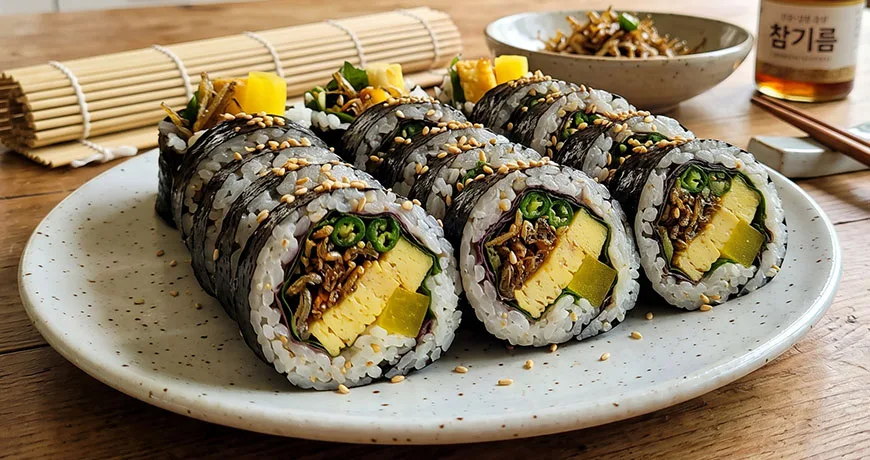
An addictive and savory gimbap roll filled with sweet, spicy, and crispy stir-fried tiny anchovies, balanced with the sharp kick of Cheongyang chili peppers and fresh perilla leaves.
⏱️ Prep: 20 mins | Cook: 15 mins | 🍳 Moderate | 🌶️ Spicy | 🐟 High Protein
Ingredients (2-3 servings)
- Main Ingredients: 2–3 bowls of warm cooked white rice, 4–5 sheets of dried seaweed for gimbap (gim), 1 cup (approx. 50g) tiny dried anchovies (jan-myeolchi), 2–3 Cheongyang chili peppers (finely chopped), 2 eggs, 4 pickled radish strips (danmuji), 8–10 fresh perilla leaves
- Anchovy Seasoning: 1 tbsp soy sauce, 1.5 tbsp oligofructose (or corn syrup), 1 tbsp mirin (cooking wine), 1/2 tsp minced garlic, 1/2 tsp red pepper powder (gochugaru, or gochujang), 1/2 tbsp sesame oil
- Rice Seasoning: 1.5 tbsp sesame oil, 1/2 tsp salt, 1 tbsp toasted sesame seeds
Allergy Information
- Contains: Fish (Anchovies), Eggs, Soy (Soy sauce), Sesame
Equipment
- Gimbap Bamboo Mat (Gimbal), Frying Pan, Paper Towel, Knife, Cutting Board
Cooking Instructions
- Stir-Frying Anchovies: Lightly toast the tiny dried anchovies in a dry pan for 1–2 minutes over medium heat to evaporate moisture and fishy odors. Drizzle in a bit of cooking oil, add the chopped chili peppers and anchovy seasoning, and stir-fry quickly until the sauce thickens and coats the anchovies. Set aside to cool.
- Preparing Other Fillings: Beat the eggs with a pinch of salt and fry into a thick omelet (jidan), then slice into thick strips. Wipe off excess moisture from the pickled radish (danmuji) with paper towels. Thoroughly wash and dry the perilla leaves.
- Seasoning the Rice: In a bowl, gently mix warm cooked rice with sesame oil, salt, and toasted sesame seeds using a slicing motion with a spatula. Let it cool slightly.
- Rolling the Gimbap: Lay a sheet of dried seaweed on a bamboo mat. Spread a thin, even layer of seasoned rice over 3/4 of the sheet. Place 2 perilla leaves flat over the rice, then top with the stir-fried anchovies inside the leaves, along with egg strips and pickled radish. Roll tightly using the bamboo mat.
- Slicing and Serving: Lightly brush sesame oil on the surface of the roll, then slice into bite-sized pieces (1.5–2 cm thick) using a sharp knife and serve on a plate.
💡 Cooking & Pairing Tips
- Dry Toasting for Maximum Crispness: Toasting the dried anchovies in a dry pan before adding oil and sauce scientifically eliminates fishy moisture, ensuring a delightfully crispy and crunchy texture.
- Wrapping with Perilla Leaves: Enclosing the stir-fried anchovies within perilla leaves prevents sauce and tiny bones from making the rice soggy, while adding a refreshing herbal flavor that cleanly balances the sweet and spicy taste.
- Perfect Food & Beverage Pairing: Pairs wonderfully with a warm bowl of fish cake soup (eomuk-guk) or classic Korean ramyeon. To drink, it goes exceptionally well with iced green tea or a cold lager beer.
Storage Instructions
- Gimbap is best enjoyed fresh on the day it is made. If storing leftovers, wrap tightly and refrigerate for up to 1 day. Reheat in a pan by dipping sliced pieces in beaten egg and pan-frying lightly over low heat.
Nutrition Facts (Estimated)
- Total Content : Approx. 600g (2-3 servings total)
- Calories : 850 kcal total (approx. 142 kcal per 100g / 283 kcal per 1 serving)
– Sodium : 1,150mg (58%)
– Total Carbohydrate : 120g (36%)
– Sugar : 12g (12%)
– Total Fat : 24g (37%)
– Trans Fat : 0g
– Saturated Fat : 4.5g (23%)
– Cholesterol : 180mg (60%)
– Protein : 38g (69%)
– Calcium : 320mg (32%)
Editor’s Review
1. Fine Dining Perspective: Thermal Dehydration and Hydrophobic Barrier Dynamics: This dish showcases a brilliant application of moisture control and structural layering within the art of Korean rolled rice. Dry-toasting tiny dried anchovies (jan-myeolchi) volatilizes residual ocean moisture and fishy amines, laying the foundation for a glass-like crunch once glazed in soy, oligofructose, and chili. Crucially, wrapping these sauced anchovies within fresh perilla leaves creates a functional hydrophobic barrier. This prevents the sweet-spicy glaze from migrating into the rice matrix and causing sogginess, ensuring that every bite retains its crisp textural integrity.
2. Sensory Exploration: A Symphony of Fiery Kick, Shattering Crunch, and Herbal Relief: The first bite yields a soft, sesame-scented entry through delicate seaweed and warm rice, instantly giving way to the dramatic, shattered crunch of caramelized anchovies. A sharp, fiery burst of Cheongyang chili ignites the palate, but is immediately tempered by the refreshing, anise-like herbal aroma of perilla leaf and the soft, comforting cushion of egg jidan. The sweet-sour snap of pickled radish (danmuji) provides a clean, acidic baseline that balances the lingering heat and nutty sesame finish.
3. Symbolic Praise: The Nostalgic Soul of the Korean Pantry Roll: Myeolchigimbap elevates a cherished everyday side dish (banchan) into a complete, portable feast. Deeply rooted in Korean picnic and lunchbox culture, it demonstrates the resourceful genius of home cooking: turning humble dried seafood from the pantry into an addictive, high-protein delicacy. It honors the timeless tradition of rolling love, warmth, and balanced nutrition into a single, hand-crafted roll meant to be shared.
4. Poetic Imagery: A Mosaic of Ocean and Earth Encased in Jet-Black Silk: Sliced into cross-sections, each piece presents a striking, mosaic-like medallion. A rim of glossy black seaweed cradles pristine white rice studded with toasted sesame seeds, encircling a vibrant emerald ring of perilla leaf. Inside this green cocoon lie golden-brown glazed anchovies, bright yellow egg, and radiant radish, resembling a meticulously crafted stained-glass jewel that bridges the bounty of the sea with the harvest of the field.
5. The Critic’s Verdict: The Masterpiece of Textural and Spicy Equilibrium: True culinary mastery often reveals itself in the harmonious contrast of bold flavors within a simple format. Myeolchigimbap stands as a triumphant triumph of Korean casual dining, proving that when fiery spice, sweet glaze, crisp crunch, and herbal freshness are unified with technical intention, the humble gimbap roll is elevated into an irresistible, soul-satisfying classic.