
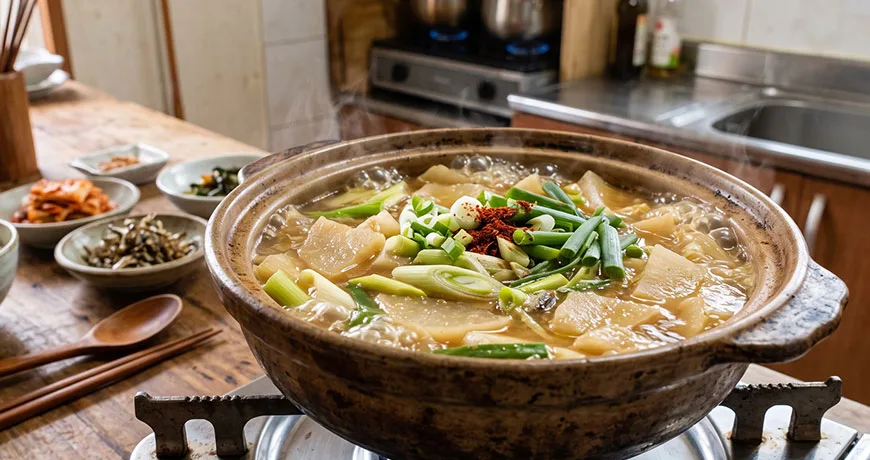
Mudoenjangguk is a precision thermodynamic soup engineered to force the thermal hydrolysis of plant pectin (from radish) within a hypertonic colloidal suspension (fermented soybean paste). As the hard cellulose structure of the radish is subjected to sustained kinetic heat, its pectin networks degrade. This process leaches the radish’s intracellular reducing sugars and diastase enzymes out into the solvent, biochemically diluting and balancing the heavy, earthy salinity of the Doenjang. Simultaneously, the hypertonic broth forcefully osmoses back into the softened radish, flavoring it from the inside out. The water-soluble inosinate from the anchovy broth binds with the high-density glutamates of the fermented soybeans to create an explosive umami synergy. The regional Jeju addition of young green garlic leaves (Put-maneul-dae) introduces volatile sulfur compounds at the very end of cooking, acting as a sharp, biochemical palate cleanser that cuts through the dense fermented profile, yielding an exceptionally “refreshing” and mild finish.
⏱️ Total: 30 mins | Prep: 10 mins | Cook: 20 mins | 🍳 Difficulty: Low (Requires pectin degradation and colloidal suspension balance) | 🌶️ Profile: Earthy, Savory, Mildly Sweet, and Refreshing | 🍚 Focus: Pectin Hydrolysis, Colloidal Suspension, & Osmotic Exchange
Ingredients (2 servings)
- Pectin & Reducing Sugar Matrix: 200g Daikon Radish (cut into 3cm squares, 0.5cm thick, or julienned)
- Colloidal Umami Binder: 2.5 tbsp Doenjang (Korean fermented soybean paste)
- Aqueous Amino Acid Solvent: 1L Anchovy-Kelp Broth (or light beef broth)
- Volatile Aromatic Catalyst: 1 handful of Green Garlic leaves (Put-maneul-dae) or scallions (cut into 5cm lengths), 0.5 tsp minced garlic
- Starch Matrix: 2 bowls of warm, cooked white rice
Allergy Information Contains: Soy, Wheat (from Doenjang), Fish (Anchovy broth)
Equipment High Thermal Mass Pot or Ttukbaegi, Fine Mesh Strainer (for the paste), Knife, Cutting Board
Cooking Instructions
- Solvent Heating & Colloidal Suspension: Heat the anchovy broth over high heat. Before it reaches a rolling boil, place a fine mesh strainer in the liquid and dissolve the Doenjang through it. This ensures the fermented soybean proteins and starches disperse evenly, creating a smooth, stable colloidal suspension without large, unpalatable lumps.
- Thermal Hydrolysis of Pectin: Once the hypertonic broth is boiling, add the sliced radish. Reduce the heat to medium and maintain a steady simmer for at least 15 minutes. The sustained heat physically breaks down the rigid pectin holding the plant cells together, turning the radish beautifully translucent and soft. The sweet cellular sap is extracted into the broth while the savory soy liquids absorb into the root.
- Aromatic Infusion: When the radish reaches its yielding point (soft enough to cut easily with the side of a spoon), add the green garlic leaves (or scallions) and minced garlic.
- Thermodynamic Flavor Preservation: Volatile sulfur compounds—responsible for the sharp, appetizing aroma of garlic and onions—evaporate very rapidly under high heat. Boil the green garlic for only 1–2 minutes, just enough to wilt the fibers, ensuring these critical aromatic catalysts remain trapped in the soup rather than vaporizing into the air.
- Rheological Integration: Serve hot alongside bowls of warm white rice. The completely softened, gelatinous radish provides a melt-in-the-mouth textural contrast against the chewy amylopectin of the rice.
💡 Professional Culinary Tips
- Chemistry of Radish Pectin: Boiling radish in pure water versus boiling it in a hypertonic (high-salt) Doenjang broth yields different structural results. The high salinity of the Doenjang accelerates the osmotic extraction of moisture from the radish, allowing it to soften quickly while paradoxically maintaining its structural integrity, preventing it from turning into mush.
- The Umami Equation: The combination of anchovies (high in inosinic acid) and Doenjang/Kelp (high in glutamic acid) creates a multiplicative umami effect on the tongue’s taste receptors. The natural reducing sugars extracted from the radish biochemically mask the sharp edges of the sodium, resulting in a flavor profile that Koreans describe as Siwonhada (refreshing and deeply clearing).
- The Biochemical Role of Green Garlic: Green garlic (the young stalks before the bulb matures) is a staple in Jeju island’s spring cuisine. It contains allyl isothiocyanate and other organosulfur compounds. When introduced to the hot broth, these volatile molecules vaporize upwards, forcefully stimulating the olfactory receptors and cleanly cutting through the heavy, sometimes muddy aroma of the fermented soybeans.
Nutrition Facts (Estimated)
Total Content : Approx. 450g (1 serving, excluding rice)
Calories : 95 kcal
– Sodium : 820mg (Variable depending on Doenjang salinity)
– Total Carbohydrate : 14.0g
– Sugar : 4.0g
– Total Fat : 2.5g
– Saturated Fat : 0.5g
– Cholesterol : 5.0mg
– Protein : 6.0g
– Dietary Fiber : 3.5g
*Daily Values are based on a 2,000 calorie diet and standard Korean nutritional reference values.
**Nutritional values are calculated based on original ingredients; substitutions may alter specific macronutrients.
Origins and Food Culture of Radish Soybean Paste Soup (Mudoenjangguk)
1. Ancient Fermentation Roots: The Legacy of “Tojangguk” Across Korean Banchan
- Tracing its roots back over a thousand years to the Three Kingdoms era, where historical chronicles such as the Samguk Sagi record fermented soybean pastes (jang and si), this dish represents the purest, most continuous expression of Tojangguk (clear soybean paste soup) documented in Joseon agricultural texts like Sallim Gyeongje.
- Embodying the rustic ingenuity of rural domestic dining, households relied on fresh radishes pulled from kitchen gardens, crockpot-aged doenjang, and dried anchovies to anchor the family meal throughout all four seasons.
2. The Culinary Science of Radish Extraction and Jeju Island’s Green Garlic Scapes
- The hallmark of authentic preparation lies in sieving the fermented paste into simmering stock to achieve a clean, silt-free broth, then gently simmering thinly sliced radish from the start so its natural plant sugars (glucose and fructose) dissolve slowly to temper the saltiness of the soybean paste.
- On coastal Jeju Island, where mild sea breezes nurture tender early-spring alliums, cooks developed a distinctive regional variation by tossing in coarsely cut green garlic scapes (pungmaneul-dae), infusing the gentle soup with a crisp, herbal brightness and subtle allium sweetness.
3. The Aesthetic of “Simsim” (Gentle Understatement) and Restorative Home Comfort
- Championing Korea’s culinary concept of simsim-han mat—a savory profile that deliberately avoids aggressive salt or intense heat in favor of clean, natural restraint—it embodies the ancient philosophy of food therapy (singnyo), using gentle broth to calm the internal organs.
- Traditionally enjoyed by folding a bowl of warm steamed white rice or barley into the steaming soup with a side of kimchi, Mudoenjangguk stands as an enduring cultural emblem of motherly devotion, rustic minimalism, and the restorative warmth of everyday Korean home gastronomy.
The Translucent Nectar of Frost-Sweetened Radish and the Ancient Resonance of Fermented Soy: A Refined Portrait of Mudoenjangguk
Mudoenjangguk (Radish Soybean Paste Soup) stands as the gentle, restorative, and quintessentially comforting summit of Korea’s everyday breakfast (tangban) gastronomy. Dense native Korean radish (mu)—having accumulated abundant cellular sugars and crisp moisture under autumn frosts—is thickly sliced into translucent batons and simmered within a golden broth brewed from dried anchovies and kelp (or rich beef brisket stock). Seasoned cleanly with artisanal fermented soybean paste (doenjang) strained through a fine sieve, the soup is cooked gently until the radish turns clear, glass-like, and tender. In regional variations, notably on Jeju Island, vibrant young green garlic stalks (pungmaneul-dae) are snapped directly into the pot, contributing a delicate, allium-scented sweetness. Deliberately eschewing heavy animal tallows and fiery spices, this dish orchestrates the pure umami of fermented legumes and the crisp mineral moisture of subterranean roots into a soothing, effortlessly digestible bowl.
Lifting a ceramic spoon brimming with golden broth and a shimmering, broth-saturated piece of radish awakens the palate with a grounding perfume: the earthy, fermented complexity of aged soybean paste mingles harmoniously with the sweet, clean aroma of gently simmered roots. The first sip glides across the tongue with zero resistance, delivering a wave of mild, deeply satisfying savory clarity (simsim-hago siwonhan mat). Sinking your teeth into the warm radish requires no mastication; it yields effortlessly to the softest pressure of the tongue, bursting with stored vegetal nectar and savory stock. When accented with Jeju-style young green garlic, a whisper of crisp allium brightness cuts through the rich soy baseline, leaving the throat completely soothed and the body grounded in warm, restorative comfort.
The enduring majesty of Mudoenjangguk lies in its therapeutic functionalism—harnessing the digestive enzymes and cooling hydration of native radishes to cleanse the digestive tract and warm the core at dawn. Tracing its lineage from the rustic coastal hearths of Jeju Island to the tranquil family breakfast tables of the mainland, a steaming bowl of radish soybean paste soup remains an irreplaceable monument of agrarian wisdom, maternal tenderness, and comforting culinary purity.
Editor’s Review
1. A Dynamic Harmony of Yielding Radish Tenderness, Velvety Fermented Broth Body, and Crisp Allium Accents
The textural landscape inside the bowl delivers extraordinary comfort and effortless digestion. Prolonged simmering breaks down the tough structural cellulose of the radish, transforming each slice into a delicate, juice-swollen sponge that dissolves smoothly across the palate. The broth, enriched by micro-particles of fermented soybean solids, provides a velvety lubricant that knits the meal together. The tender fibrous bite of blanched green garlic stalks introduces a gentle structural contrast, ensuring a clean, non-saturating mouthfeel from the first sip to the last.
2. Protopectin Thermal Solubilization, Endogenous Diastase Kinetics, Bacillus Proteolytic Peptides, and Inosinate-Glutamate Synergism
Mudoenjangguk represents an exacting study in plant cellular histology, digestive enzymology, and fermented umami thermodynamics. Gentle simmering triggers the irreversible thermal cleavage of insoluble protopectin within the radish middle lamella into water-soluble pectin, allowing individual plant cells to slide apart into a meltingly soft mouthfeel without disintegrating into mush. Radish-borne endogenous diastase (amylase) and peroxidases survive long enough during initial heating to assist gastric starch breakdown, accelerating gastric emptying and relieving gastrointestinal pressure. Concurrently, free glutamates and small-chain bioactive peptides yielded by Bacillus subtilis during soybean fermentation bind synergistically with nucleotide inosinate (IMP) from the dried anchovy stock, exponentially amplifying umami perception across oral receptors without requiring excess sodium. Meanwhile, alliin in the green garlic stalks is enzymatically converted into sweet allyl sulfides, rounding out the soup’s aromatic finish.
3. The Agrarian Heritage of Jeju Island and the Timeless Zenith of Korean Restorative Breakfast Gastronomy
Reflecting the seasonal adaptability of Jeju and southern coastal communities who enriched humble pots of bean paste broth with wild-foraged roots and early-spring green garlic stalks, Mudoenjangguk captures the holistic soul of Korean food culture. Elevating everyday pantry staples into an indispensable morning tonic through patient thermal control and biological fermentation, this pristine classic serves as an enduring sanctuary of restorative wellness, domestic warmth, and brilliant culinary restraint.