
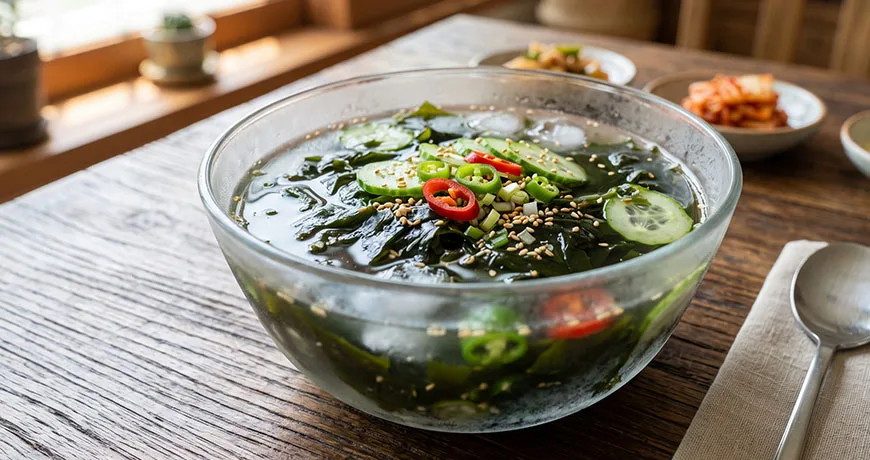
Miyeoknaengguk stands in exact thermodynamic opposition to hot seaweed soups. It is a cold-temperature molecular gastronomy matrix engineered to strictly suppress the release of alginic acid (alginate) from brown algae. If simply soaked and placed in cold water, raw seaweed will continuously leach a viscous, slimy mucin, ruining the crystalline texture of the cold broth. To prevent this, the hydrated seaweed is subjected to a 10-second flash-blanch in boiling water. This immediate kinetic heat coagulates the surface pectin, locking the alginate inside the cellular walls. The structurally stabilized seaweed and crisp cellulose from julienned cucumbers are then suspended in a highly acidic, pH 3–4 solvent constructed from acetic acid (brewed vinegar) and sucrose (sugar). Because liquid lipids (like sesame oil) coagulate and form unappetizing slicks in ice-cold environments, crushed sesame seeds are used instead to gently disperse microscopic fats. This soup is the ultimate summer palate cleanser.
- ⏱️ Total: 20 mins | Prep: 15 mins (Flash-blanching & ice-shocking alginate control) | Cook: 5 mins
- 🍳 Difficulty: Low (Requires precision in pH balancing and strict timing for thermal shock)
- 🌶️ Profile: Sharply Refreshing, Sweet-and-Sour Acidity with Crisp Marine Minerality
- 🍚 Focus: Alginate Flash-Blanching, Acetic Acid Solvent Construction, & Lipid Coagulation Prevention
Ingredients (3–4 servings)
- Alginate & Cellulose Matrix: 15g Dried Wakame (Miyeok – Must be hydrated in cold water for 10 minutes, then strictly flash-blanched in boiling water for 10 seconds to create a mucosal barrier), 1/2 Cucumber (julienned – for hydration and structural crunch)
- Acetic Acid & Sucrose Solvent: 600ml Cold Purified Water, 6 tbsp Natural Apple Cider or Brown Rice Vinegar (Acetic acid source), 4 tbsp White Sugar (Sucrose – required to round off the sharp acidity), 2 tbsp Traditional Soup Soy Sauce (Guk-ganjang – Glutamate binder), 1 tbsp Sea Salt (for electrolyte balance), 2 cups Ice Cubes
- Aromatic Catalyst: 1/4 Onion (sliced paper-thin and submerged in ice water to leach out pungent allyl sulfides), 1 Cheongyang green chili, 1 Red chili
- Lipid Dispersion Agent: 1 tbsp Roasted Sesame Seeds (Crushed in a mortar just before serving. Liquid sesame oil is omitted or limited to a single drop to prevent cold coagulation slicks)
Allergy Information Contains: Soy (from Soy Sauce)
Cooking Instructions
- Flash-Blanching & Thermal Shock: Hydrate the dried seaweed in cold water for 10 minutes, then knead gently to wash. Bring a pot of water to a rolling boil. Drop the hydrated seaweed in for exactly 10 seconds. As soon as it turns a vibrant, vivid green, remove it immediately and plunge it into an ice bath (Thermal Shock). This rapid temperature shift permanently contracts the cellular walls, trapping the slimy alginate inside and ensuring the broth remains crisp and watery.
- Allyl Sulfide Purging: Submerge the thinly sliced onions in cold water for 5 minutes. This hydro-extraction pulls the harsh, spicy sulfur compounds (allyl sulfides) out of the onion, leaving only its crisp structural turgor pressure.
- Acidic Solvent Construction: In a mixing bowl, combine the cold purified water, soup soy sauce, brewed vinegar, sugar, and salt. Use a whisk to ensure the sucrose and electrolytes are completely dissolved (dissolution). The acetic acid from the vinegar and the glutamate from the soy sauce bind to create a deeply refreshing, sweet-and-sour base solvent.
- Matrix Assembly & Cooling: In a large serving bowl, combine the thoroughly squeezed blanched seaweed, julienned cucumbers, purged onions, and sliced chilies. Pour the prepared acidic solvent over the matrix and add the ice cubes to drop the temperature below 4°C.
- Lipid Dispersion Finish: Crush the roasted sesame seeds directly over the surface. By omitting liquid sesame oil, you prevent saturated fats from coagulating in the ice water, allowing the crushed seeds to provide just enough microscopic plant lipids to round out the flavor.
💡 Professional Culinary Tips
- Thermodynamic Necessity of Blanching: A common amateur mistake in making cold seaweed soup is simply soaking the dried seaweed and throwing it into the broth. Unblanched seaweed will slowly bleed alginic acid even in ice water, turning the crisp soup into a viscous, snot-like gel. A 10-second flash-blanch acts as a biochemical sealant, coagulating the surface pectin and locking the slime inside.
- Lipid Coagulation in Cold Solvents: While toasted sesame oil is essential for hot Miyeokguk, introducing it to a 4°C ice bath causes its fatty acids to coagulate (solidify). This forms an unappetizing white film that coats the palate with a greasy barrier, completely ruining the refreshing acidity of the soup. Crushed sesame seeds are the correct molecular alternative for cold broths.
- Molar Ratio of Acetic Acid and Sucrose: The soul of this solvent is the chemical tug-of-war between acid and sugar. Acetic acid alone will cause a painful, astringent bite. By introducing sucrose at roughly 70-80% the volume of the vinegar, the sharp edges of the acid are molecularly “rounded,” creating a highly addictive, drinkable sweet-and-sour profile.
🍶 Gastronomic Pairing
- Biochemical Palate Cleansing: When the hyper-crisp cellulose of the cucumber and the razor-sharp, ice-cold acetic acid solvent hit your palate, pair this cooling matrix with a chilled New Zealand Sauvignon Blanc. The wine’s tartaric acid structurally resonates with the soup’s acetic base, while its green, herbaceous pyrazine notes perfectly align with the cucumber and seaweed minerality, instantly reviving taste receptors exhausted by the summer heat.
Nutrition Facts (Estimated)
Total Content : Approx. 300g (1 serving)
Calories : 65 kcal (Ultra-low calorie cooling matrix)
– Sodium : 850mg (Attributed to soy sauce and salt electrolytes)
– Total Carbohydrate : 14.0g (Sucrose and polysaccharides from seaweed/cucumber)
– Sugar : 10.0g (Added sugars essential for acidic solvent balance)
– Total Fat : 0.5g (Trace amounts of unsaturated plant lipids from crushed sesame)
– Saturated Fat : 0.1g
– Cholesterol : 0.0mg (100% Vegan Matrix)
– Protein : 1.5g (Plant-based proteins from seaweed and vegetables)
– Dietary Fiber : 3.5g (Alginate and cellulose)
*Daily Values are based on a 2,000 calorie diet and standard Korean nutritional reference values.
**Nutritional values are calculated based on original ingredients; substitutions may alter specific macronutrients.
Origins and Food Culture of Chilled Seaweed Soup (Miyeoknaengguk)
1. Historical Lineage: Joseon Dongui Bogam, Sallim Gyeongje, and the Heritage of Summer “Naengban”
- The cultural tradition of consuming chilled soups (naeng-guk or naeng-gaeng) and steeping cooked grains in cold broth (naengban) dates back to ancient peninsular summers; for coastal communities lacking fresh inland agricultural vegetables during seasonal droughts, foraged seaweeds represented an essential source of vitality and moisture.
- In Heo Jun’s 1613 medical compendium Dongui Bogam, sea mustard was documented under the classical Hanja names Haedae (海帶) or Gonpo (昆布), praised because “its nature is cold, its flavor salty, and it is non-toxic; it eliminates oppressive, feverish chest heat (除熱煩), disperses accumulated stagnant qi, and promotes smooth urination.” Furthermore, 18th-century agrarian encyclopedias such as Jeungbo Sallim Gyeongje and the seasonal folklore compendium Dongguk Seshigi record aristocratic households preparing chilled broths of seaweeds, cucumbers, and water-shield (sunchae) seasoned with clear soy sauce and vinegar during the three dog days of summer (Sambok), proving its long pedigree as an elite cooling tonic.
2. The Culinary Science of Alginate Gel Control and Acetic Acid Non-Thermal Thermodynamics
- Prepared entirely without heat, Miyeoknaengguk showcases an ingenious mastery of non-thermal biochemistry, utilizing acetic acid (vinegar) and salinity (soy sauce and salt) rather than flame to transform food textures.
- Allowing dried seaweed to hydrate too long causes excessive leakage of slippery alginates, resulting in a mucilaginous, unpalatable broth. Master cooks hydrate the seaweed briefly, flash-poach it in boiling water for merely 10 to 20 seconds to fix its emerald chlorophyll, and immediately shock it in ice water. When tossed with vinegar, the acetic acid interacts with cell-wall pectins, causing the cellular structure to contract and lock in a firm, springy chew that prevents the ribbons from turning mushy or slimy in the cold soup.
3. The Life-Sustaining Water of Coastal Laborers and the Soul of Southern “Mulhoe” Culture
- For agrarian peasants weeding sun-scorched rice paddies and haenyeo divers or fishermen braving the southern tides, bowls of ice-cold seaweed soup seasoned with sea salt and vinegar were literal life-preservers that instantly replenished lost electrolytes and lowered core body temperature.
- On Jeju Island, this tradition evolved into regional specialties where freshly harvested seaweeds were whisked with fermented soybean paste (doenjang), vinegar, and raw fish to create legendary bowls like Jari-mulhoe and Doenjang Miyeoknaengguk. In the central provinces, it solidified into the pristine clear soy sauce-vinegar profile celebrated today. Standing as the cooling antithesis to fiery meat soups, Chilled Seaweed Soup remains an immortal cultural monument to Korean summer ingenuity, marine foraging, and restorative thermal equilibrium.
The Silken Viscoelasticity of Hydrated Brown Sea Mustard, the Fracturing Turgor of Fresh Summer Cucumber, and the Piercing Respiration of Icy Acetic Consommé: A Refined Portrait of Miyeoknaengguk
Miyeoknaengguk (Chilled Seaweed Soup) stands as the pristine, invigorating, and biologically restorative summit of Korea’s cold-soup (naengguk) gastronomy. Serving as an essential antidote to the suffocating heat and humidity of the midsummer dog days (Sambok), this dish completely eschews prolonged combustion, marshaling the thermodynamic power of sub-zero temperatures and natural organic acids to recalibrate the body’s internal homeostasis. Centered upon choice brown sea mustard (Undaria pinnatifida or Miyeok) harvested from the pristine archipelago of the southern coast and sun-cured into dark ribbons, the preparation begins with patient cold-water rehydration to revive its flexible cellular matrix. Subjected to a fleeting one-second thermal blanch in boiling water to fix its chlorophyll into a luminous emerald green before being plunged into an ice-water bath to lock in springy elasticity, the seaweed is pressed dry and sliced into delicate ribbons. It is then dressed directly with artisanal soup soy sauce (Joseon ganjang), crushed garlic, solar sea salt, and aged persimmon or cider vinegar, allowing the savory salinity and brisk acidity to penetrate deep into the algal membranes. Layered inside a chilled porcelain or glass bowl with julienned white cucumbers (baek-oi), gossamer rounds of green Cheongyang chilies, and red peppers, the vessel is flooded with ice-cold spring water (or a delicately chilled kelp infusion) and crowned with cracked ice cubes and toasted sesame seeds. Wholly devoid of greasy animal tallows, this dish captures the pure, unmasked polysaccharides of coastal algae and the crisp hydration of summer cucurbits within a near-freezing aqueous matrix, delivering an austere masterclass that cools the palate and revives fatigued organs with crystalline vitality.
Confronting the glistening glass vessel as floating ice cubes clink against the rim to reveal emerald folds of sea mustard, pale jade cucumber ribbons, and crimson chili rings, lifting a deep spoonful releases an immediate, deeply electrifying olfactory charge: the sharp, mouth-watering perfume of fermented acetic acid mingles seamlessly with the brisk, pine-clean aroma of sliced cucumber, the sweet sulfurous warmth of raw garlic, and the nutty fragrance of crushed toasted sesame. Taking the first sip delivers an unadorned revelation across the oral mucosa: chilled to the edge of frost, the clarified acidic broth floods the tongue with silk-like softness, gliding effortlessly down the esophagus to soothe heat-inflamed tissues and awaken dormant vitality in an exhilarating wave of what Korean gastronomy reveres as siwonhan mat—the sensation of profound, soul-cleansing lightness and thermal relief. Gliding across the palate, the slippery sea mustard blades yield with a supple, viscoelastic chew (taenggeul) that discharges clean marine minerals, while the chilled cucumber ribbons fracture between the teeth with an energetic, audible snap (ajak), bursting with sweet botanical water. The brisk spark of green chili enlivens the palate, preventing sensory fatigue. Steeping a bowl of cold barley rice or white rice into the icy broth and swallowing each spoonful with a bite of ripe summer kimchi completes an unforgettable ritual of metabolic renewal, summer solace, and profound gastronomic catharsis.
The enduring majesty of Miyeoknaengguk lies in its historical lineage—codified in the late 19th-century aristocratic cookbook Siui Jeonseo as Changguk (暢國, literally “the soup that opens and unclogs the senses with refreshing clarity”) and practiced across agrarian villages where farmers harvesting under the blistering midday sun mixed well-drawn water with dried seaweed and vinegar to stave off heat exhaustion. Standing in direct philosophical counterpoint to the hot, perspiration-inducing broths of Iyeolchiyeol (governing heat with heat), this chilled elixir provided instant metabolic cooling and vital electrolyte restoration. Uniting whole algal nutrients with the crisp purity of summer garden vegetables, a frosted bowl of chilled seaweed soup remains an irreplaceable monument of zero-combustion seasonal adaptation, agrarian resilience, and brilliant Korean culinary craftsmanship.
Editor’s Review
1. A Dynamic Harmony of Silken Algal Viscoelasticity, High-Turgor Cucumber Fracture, Toasted Sesame Crunch, and Frictionless Cryogenic Fluidity
The structural architecture inside the vessel delivers an extraordinary, four-tiered choreography between flexible marine structural polysaccharides, the rigid cell walls of hydrated cucurbits, whole-seed brittle friction, and an ultra-low-viscosity aqueous matrix resting near freezing (0–4°C). Rehydrated and flash-blanched, the sea mustard blades feature a surface layer of hydrated alginic acid that glides across oral membranes with frictionless, velvety ease, providing a supple, non-fibrous elasticity. Counterbalancing this, the julienned cucumbers—reinforced by osmotic salinity and near-freezing temperatures—maintain exceptionally high cellular turgor, fracturing under tooth pressure with a clean, audible snap (ajak) that floods the mouth with cool botanical water. Floating toasted sesame seeds supply a light, brittle crunch that punctuates oral transit, while the ice-cold, vinegar-brightened broth acts as a lubricating fluid layer, ensuring an impeccably balanced, non-fatiguing mouthfeel from the first frosted sip to the last.
2. Near-Freezing Cucurbit Turgor Preservation, Cold Alginate-Fucoidan Solubilization Rheology, Acetic Acid OTOP1 Salivary Reflex, and Terpene-Allicin Volatile Masking Kinetics
Miyeoknaengguk represents an exacting study in plant tissue osmotic thermodynamics, algal hydrocolloid physics, and sensory neurobiology. In white cucumbers, exposure to an ice-cold (0–4°C), mildly saline environment preserves cellular membrane semi-permeability and locks in intracellular turgor pressure, preventing pectolytic degradation and maintaining supreme structural crispness. Concurrently, the algal cell wall polysaccharides—principally alginic acid and sulfated fucoidan—undergo spontaneous cold-water hydration, forming an open, viscoelastic polymer network that increases the liquid’s micro-viscosity just enough to round off the sharp sensory edges of salt and vinegar. Broth vibrancy is driven by acetic acid (CH3COOH), which rapidly lowers oral pH to 3.5–4.0, activating OTOP1 proton channels on acid-sensing taste cells; this triggers immediate gustatory-salivary reflexes and stimulates gastric motility to counteract summer digestive torpor. Furthermore, trace volatile marine off-notes typical of rehydrated algae—principally dimethyl sulfide (DMS) and trimethylamine (TMA)—are protonated into non-volatile salts within the mildly acidic medium. Concurrently, the cucumber’s 2,6-nonadienal (cucumber alcohol), garlic’s allyl sulfides, and volatile acetate esters chemically sequester and mask trace fishy aromas, resulting in an immaculate, pristine bouquet.
3. The Siui Jeonseo Changguk Lineage and the Sovereign Apex of Korean Cryogenic Tangban
Dispensing entirely with heat to harness the restorative power of cold well water, artisanal vinegars, and coastal brown seaweeds, Miyeoknaengguk represents the pinnacle of thermal subversion in Korean food history. Serving as the functional antithesis to boiling dog-days restoratives, this crystal-clear, frost-kissed centerpiece cools overheated blood, replenishes depleted cellular electrolytes, and revives the exhausted spirit, standing as an enduring sanctuary of environmental authenticity, seasonal discipline, and brilliant Korean culinary artistry.