
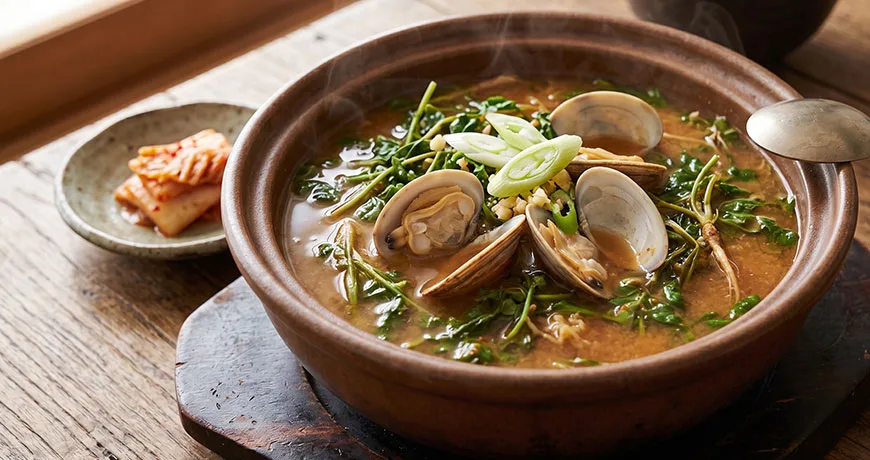
Naengidoenjangguk is an early-spring molecular matrix that diffuses the volatile organic compounds (VOCs) and profound earthy terpenes concentrated in the taproots of wild-foraged Shepherd’s Purse (Naengi) into a dense, colloidal suspension of fermented soybean peptides (Doenjang). Once an aqueous umami solvent is constructed from the inosinate of dried anchovies and the glutamate of kelp, the robust amino acids of traditional soybean paste are dissolved to create an explosive ternary umami synergy. The engineering of this soup strictly demands “staggered anatomical cooking.” The rigid cellulose of the plant’s taproot must be introduced early, utilizing thermal hydrolysis to collapse its tough structure and leach its deep earthy flavors into the broth. Conversely, the delicate, leafy greens are flash-poached in the final 60 seconds at a sub-boiling threshold. This precise thermodynamic control prevents the thermal degradation of the fragile spring aromatics, delivering a profoundly savory broth crowned with an untamed, herbaceous vibrancy.
- ⏱️ Total: 35 mins | Prep: 15 mins (Meticulous physical soil purging from root crevices) | Cook: 20 mins
- 🍳 Difficulty: Medium-High (Requires extreme care in root abrasion and absolute thermal control to prevent terpene degradation)
- 🌶️ Profile: Deeply Savory Fermented Umami Pierced by Sharp, Earthy Spring Terpenes
- 🍚 Focus: Physical Soil Abrasion, Root Cellulose Hydrolysis, & Leaf Terpene Preservation
- 🍶 Pairing: Chilled Sauvignon Blanc (Pyrazine-heavy) or Unsweetened Traditional Makgeolli
Ingredients (3–4 servings)
- Terpene & Cellulose Matrix: 150g Wild-Foraged Shepherd’s Purse (Naengi – Must possess thick, robust taproots. Using a paring knife, meticulously scrape away the black mud lodged in the crown where the root meets the leaves. Rinse gently to avoid damaging the fragrant root skin, then separate the roots from the leaves)
- Fermented Peptide Binder: 2.5 tbsp Traditional Soybean Paste (Doenjang – Strictly naturally fermented from soybeans and brine; commercial variants with wheat/sugar will ruin the matrix)
- Ternary Umami Solvent: 1.2L Rice Water (starchy water from washing rice, used to stabilize the emulsion), 1 piece Dried Kelp (Kombu), 10 Large Dried Anchovies (gutted)
- Textural & Amino Acid Matrix: 1/2 block Firm Tofu (cubed)
- Aromatic & Allyl Catalyst: 1/2 stalk Green Onion (sliced), 1 tsp minced garlic (strictly minimized so the allicin does not overpower the Naengi terpenes), 1 Cheongyang green chili
Allergy Information Contains: Soy (Doenjang, Tofu), Fish (Anchovy)
Equipment High Thermal Mass Earthenware Pot (Ttukbaegi) or Cast Iron Pan, Fine Mesh Strainer, Paring Knife, Mixing Bowl
Cooking Instructions
- Physical Soil Purging: Preparing the Naengi accounts for 90% of this recipe’s success. Black mud is tightly compacted in the crown connecting the leaves to the taproot. Carefully scrape this crevice with a paring knife. Agitate the plant gently in cold water until no grit remains, being careful not to strip the outer layer of the root where the terpenes reside. Once pristine, slice the plant to separate the thick roots from the delicate leaves.
- Solvent Base Extraction: Combine the rice water, kelp, and gutted anchovies in a pot. Heat over medium. Remove the kelp just before boiling (approx. 80°C) to prevent slimy alginate extraction. Boil the anchovies for an additional 10 minutes to extract the IMP, then discard them to finalize the clear solvent.
- Colloidal Suspension Construction: Submerge a fine mesh strainer into the boiling solvent and dissolve the Doenjang through it. Do not discard the soybean particulates left in the strainer; mash them through with a spoon. The trace amylopectin in the rice water will bind with the heavy soybean peptides, creating a stable, slightly viscous colloidal suspension.
- Root Cellulose Hydrolysis: Once the Doenjang broth reaches a rolling boil, add only the separated Naengi roots along with the cubed tofu. Boil for 3–4 minutes. This initial thermodynamic application forces the rigid root cellulose to collapse, releasing a powerful, earthy aroma directly into the solvent while the tofu absorbs the umami via osmosis.
- Leaf Terpene Preservation: Once the roots yield, introduce the minced garlic, scallions, chili, and the delicate Naengi leaves. Leave the pot uncovered to allow volatile sulfur compounds to escape, and boil for strictly 60 seconds. Kill the heat immediately. The residual heat will perfectly wilt the leaves without degrading their fragile, herbaceous terpenes.
💡 Professional Culinary Tips
- Anatomical Staggered Cooking: Chopping the entire Naengi plant and boiling it all at once is a fatal molecular error. By the time the dense root cellulose softens, the fragile leafy tops will have undergone severe thermal degradation, turning a sickly brown and emitting a dull, overcooked hay odor. Boiling the roots first and flash-poaching the leaves at the very end is the absolute thermodynamic law for preserving both texture and aroma.
- Minimalism of Allicin: While Korean soups typically utilize large quantities of minced garlic, Naengidoenjangguk is the exception. An overwhelming dose of allicin (the sulfur compound in garlic) will completely obliterate the elegant, bitter-earthy notes of the spring forage. Restrict garlic to a mere teaspoon—just enough to mask the fermented funk of the Doenjang, allowing the Naengi to dominate the olfactory profile.
- Emulsion Stabilization via Rice Water: Using starchy water from washing rice (Ssal-tteumul) instead of plain water is a deliberate physicochemical choice. The dissolved amylopectin acts as a natural thickening agent, preventing the heavy soybean protein particles from phase-separating (sinking to the bottom) and ensuring the savory compounds physically linger longer on the tongue’s taste receptors.
🍶 Gastronomic Pairing
- Biochemical Palate Cleansing: When the heavy, fermented peptides of the Doenjang and the intense earthy-herbaceous terpenes of the Naengi coat your oral mucosa, pair this spring matrix with a chilled New Zealand Sauvignon Blanc. The wine’s sharp tartaric acid cleanly slices through the heavy soybean body, while its signature pyrazine compounds (which give it a grassy/green bell pepper aroma) molecularly resonate with the Naengi, exponentially magnifying the fresh, untamed spring flavor of the very next spoonful.
Nutrition Facts (Estimated)
Total Content : Approx. 450g (1 serving)
Calories : 110 kcal (Excluding rice, ultra-low calorie, high-protein matrix)
– Sodium : 950mg (Attributed to the traditional Doenjang)
– Total Carbohydrate : 12.0g (Cellulose dietary fiber from Naengi and trace starches from rice water)
– Sugar : 2.0g
– Total Fat : 3.5g (Plant-based lipids from tofu)
– Saturated Fat : 0.5g
– Cholesterol : 0.0mg (100% vegan matrix if anchovy broth is substituted with kelp/mushroom)
– Protein : 9.0g (Plant-based peptide complex from Doenjang and Tofu)
– Dietary Fiber : 5.0g (High-density cellulose from wild roots and leaves)
*Daily Values are based on a 2,000 calorie diet and standard Korean nutritional reference values.
**Nutritional values are calculated based on original ingredients; substitutions may alter specific macronutrients.
Origins and Food Culture of Shepherd’s Purse Soybean Paste Soup (Naengidoenjangguk)
1. Historical Roots: Classical Treatises (Dongui Bogam, Sallim Gyeongje) and Wild Foraging
- Documented in classical East Asian medical texts under the Hanja name Jechae (薺菜), shepherd’s purse has sustained peninsular communities since antiquity as a vital foraged survival plant (guhwang) that provided essential vitamins and minerals during the lean post-winter transition.
- In Heo Jun’s 1613 medical compendium Dongui Bogam, shepherd’s purse was lauded as “warm in nature, sweet, and non-toxic; it fortifies the liver, clears the eyes (淸肝明目), harmonizes the five visceral organs, and eases urination.” Furthermore, 18th-century agrarian encyclopedias like Jeungbo Sallim Gyeongje describe seasonal rituals where families gathered the first tender wild greens in early spring to simmer restorative broths, dispelling winter-born indigestion and refreshing bodily qi across royal and common tables alike.
2. The Culinary Science of Whole-Plant Consumption and Flash Simmering
- Unlike cultivated leafy vegetables where roots are discarded, authentic shepherd’s purse culinary practice prioritizes the entire plant (Whole Food), as the fibrous taproots harbor the highest concentrations of aromatic essential oils, choline, and structural minerals. Cooks meticulously brush away clinging soil while keeping the roots intact.
- Master kitchens dissolve doenjang in cloudy rice wash water—using the starches to temper the pungent edge of the fermented paste—and simmer the base until rich; the shepherd’s purse is dropped in only during the final minutes of boiling. This delicate flash-simmering technique preserves the volatile terpenes and heat-sensitive vitamin C, ensuring the greens retain their vibrant aroma and crisp, bouncy root texture without turning bitter or limp.
3. The Harbinger of Spring and the Maternal Soul of Korean Comfort Dining
- As the freezing gales of winter relented, generations of Korean mothers and children ventured out with paring knives and woven baskets into sun-warmed meadows and terraced paddies to forage wild shepherd’s purse, transforming spring foraging into an enduring cultural emblem of seasonal rebirth.
- Foregoing expensive meats in favor of wild herbs and artisanal fermented paste, Naengidoenjangguk represents the epitome of rustic elegance. Embodying the taste of home, filial memory, and the tender maternal care that sustained families through hardship, it stands as an immortal monument to Korean agrarian gastronomy, holistic plant-based therapy, and heartwarming slow-food comfort.
The Verdant Terpene Awakening of Thawed Spring Roots, the Nutty Alchemy of Long-Aged Soybean Mash, and the Starch-Cushioned Solace of Rice Emulsion: A Refined Portrait of Naengidoenjangguk
Naengidoenjangguk (Shepherd’s Purse Soybean Paste Soup) stands as the pristine, invigorating, and biologically restorative summit of Korea’s early-spring botanical (tangban) gastronomy. Centered upon wild shepherd’s purse (Capsella bursa-pastoris or Naengi)—a resilient cruciferous field green that braves sub-zero frosts to thrust its taproots deep into thawing soil—the dish begins with meticulous foraging and cleansing discipline. Gathering the young rosettes before stem elongation, the tough outer leaves are trimmed and the fine taproots are gently scraped with a paring knife to purge mineral soils, preserving both the bitter-sweet root reserves and tender green crowns. Anchored within a heavy earthenware pot (ttukbaegi) or cast-iron vessel, the foundation is laid not with plain water, but with the starchy second-rinse water of raw white rice (tteumul), simmered alongside sun-dried anchovies, kelp, and sweet winter radish to construct a clean, oceanic-botanical stock. Through a fine-mesh sieve, years-aged artisanal soybean paste (doenjang)—rich with the complex, bready metabolites of Bacillus subtilis fermentation—is dissolved into the liquid alongside plump Manila clams or sun-dried baby shrimp. Brought to an energetic boil, the prepared shepherd’s purse is cast into the bubbling broth alongside cubes of firm tofu, minced garlic, scallions, and a sliver of fresh chili, cooked only until the greens wilt without collapsing their structural integrity. Completely rejecting greasy animal tallows, this dish harmonizes the untamed, mineral-rich vigor of wild spring weeds with the deep umami of fermented legumes through absolute thermodynamic gentleness, comforting the palate and awakening dormant metabolic systems with pristine seasonal vitality.
Confronting the boiling earthenware pot as amber froth bubbles vigorously around vivid jade leaves, ivory rootlets, and soft tofu, lifting a deep spoonful of the broth releases an immediate, deeply restorative olfactory charge: the toasted, earthy perfume of aged soybean mash mingles seamlessly with the sharp, terpene-bright fragrance of freshly pulled shepherd’s purse roots, the sweet sulfurous warmth of scallions, and the clean sea breeze of opening clams. Taking the first sip delivers an unadorned revelation across the oral mucosa: softened by the starch-rich rice broth, the savory paste glides over the palate with zero harsh sodium prickle, flowing effortlessly down the esophagus to soothe tired tissues and warm the digestive core with gentle, lingering heat. Biting into a sprig of shepherd’s purse delivers an extraordinary textural contrast: the tender leafy rosette collapses with a succulent vegetal give, while the central taproot fractures under the teeth with an energetic, audible snap (ajak), discharging concentrated streams of bittersweet, mineral-dense botanical nectar. The soft tofu provides a pillowy textural cushion, while sweet clam liquor balances the rustic fermented savor of the paste. Steeping a bowl of warm white rice into the aromatic broth and capping each spoonful with a crisp bite of fresh spring kimchi transforms the meal into an unforgettable ritual of metabolic renewal, domestic solace, and profound gastronomic catharsis.
The enduring majesty of Naengidoenjangguk lies in its historical lineage—codified in Heo Jun’s 17th-century medical compendium Dongui Bogam under the entry Jechae (薺菜), where shepherd’s purse is lauded as a sweet, non-toxic restorative capable of invigorating the liver, clearing congested five viscera, and sharpening clouded vision. Emerging from the seasonal rhythm of agrarian Korea, where villagers ventured into thawing paddy banks during early spring (Ipchun to Gyeongchip) to forage nutrient-dense wild roots and combat late-winter exhaustion, this humble soup nourished families through seasonal scarcity. Uniting primal botanical vigor with the microbial alchemy of fermented soybean mash, a steaming cauldron of shepherd’s purse soup remains an irreplaceable monument of wild-foraged sustainability, maternal comfort, and brilliant Korean culinary craftsmanship.
Editor’s Review
1. A Dynamic Harmony of Taproot Chew Elasticity, Delicate Leafy Yield, Pillowy Tofu Cushion, and Starch-Lubricated Broth Fluidity
The structural architecture inside the vessel delivers an extraordinary, four-tiered choreography between fibrous dicotyledonous taproots, heat-wilted leafy rosette cell walls, an amorphous soy protein hydrogel, and a starch-buffered colloidal fluid phase. Harvested before secondary lignification sets in, the tender central taproots of the shepherd’s purse preserve high cellular turgor; under brief convective boiling, they resist mechanical collapse, parting under tooth pressure with a clean, energetic snap that provides essential textural friction. Counterbalancing this, the delicate leafy blades soften rapidly, gliding across the tongue with tender, non-fibrous ease. Slabs of braised tofu supply a soft, pillowy cushion that absorbs the surrounding savory liquid, while suspended amylose and amylopectin granules from the rice-washing water increase the continuous phase’s dynamic viscosity, ensuring an impeccably balanced, non-fatiguing mouthfeel from the first steaming sip to the last.
2. Glucosinolate Myrosinase Cleavage Kinetics, Starch Colloid Salinity Buffering, IMP-Succinate-Glutamate Umami Synergism, and Choline-Mediated Hepatic Rejuvenation
Naengidoenjangguk represents an exacting study in plant defense biochemistry, carbohydrate colloid physics, and sensory neurobiology. Within intact shepherd’s purse tissues, glucosinolates and endogenous myrosinase enzymes remain compartmentalized; mechanical bruising during cleaning and the initial thermal shock disrupt cellular vacuoles, causing myrosinase to hydrolyze glucosinolates into volatile allyl isothiocyanate (AITC) and related organosulfur volatiles, which furnish the soup’s distinctive, invigorating spring aroma. The utilization of rice-washing water (tteumul) introduces micro-dispersed amylose and amylopectin polymers that physically adsorb and buffer harsh sodium ions and bitter legume polyphenols, softening oral astringency and smoothing perceived savor. Broth umami is governed by a profound three-way biochemical synergy: muscle-derived inosine monophosphate (5′-IMP) from the dried anchovies and succinic acid from the clams converge with high concentrations of free glutamic acid (Glutamate) leached from the fermented soybean mash, triggering an exponential activation across human oral T1R1/T1R3 umami heterodimers. Furthermore, high-molecular-weight melanoidin polymers from the aged doenjang physically sequester trace fishy amines (trimethylamine). Biologically, abundant reserves of endogenous choline, iron (Fe2+), calcium (Ca2+), and ascorbic acid promote hepatic lipid clearance and antioxidant defense, establishing an immaculate, restorative metabolic awakening mechanism to combat springtime fatigue (chungonjeung).
3. Thawing Earth Terroir, Agrarian Foraging Lore, and the Sovereign Apex of Botanical Restorative Gastronomy
Rooted in the ancient agrarian tradition of gathering wild, nutrient-dense field greens to replenish depleted winter pantries, Naengidoenjangguk represents the pinnacle of seasonal wild-plant cookery in Korean gastronomic history. Transforming humble foraged weeds into an iconic centerpiece of restorative comfort through the microbial depth of fermented soybean mash and soothing starch broths, this aromatic, amber-tinted classic captures the sacred transition from winter dormancy to spring renewal, standing as an enduring sanctuary of environmental authenticity, maternal care, and brilliant Korean culinary artistry.