
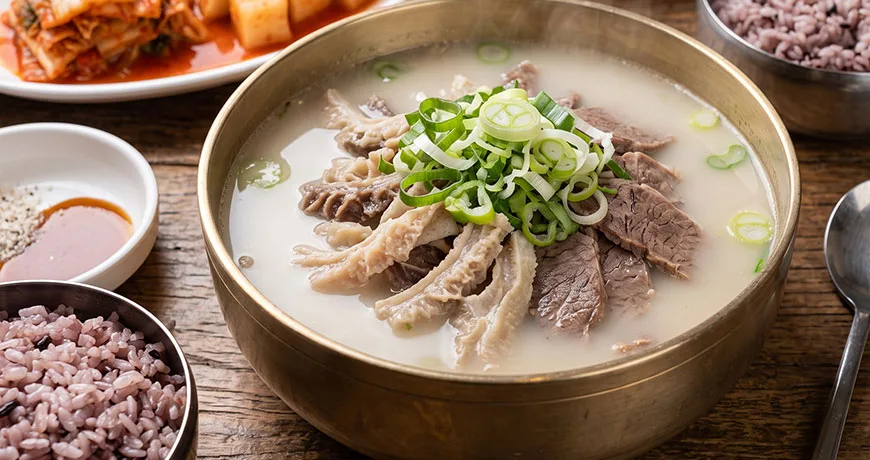
Yanggomtang is an intense biochemical extraction of a ruminant’s highly specialized fore-stomach (beef rumen and reticulum). It requires extreme physical scouring and prolonged thermal hydrolysis to break down the dense smooth muscle and mucosal linings into a yielding, gelatinous amino acid matrix. To neutralize the violent ruminant off-flavors derived from potent digestive enzymes and microbial fermentation, the stomach lining must be ruthlessly abraded using the mechanical friction of coarse salt and the chemical absorption of wheat gluten. Boiled to the precise boundary between elastic resistance and tender yielding, the stomach muscles are then integrated with a fiery payload of capsaicin and allyl compounds from garlic and green onions. This creates a heavy, sticky, emulsified colloidal broth that serves as a feral, high-efficiency stamina extraction, engineered to rapidly reconstruct human mucosal and muscular tissues.
- ⏱️ Total: 4 hrs | Prep: 1 hr 30 mins (Mucosal abrasion & purging) | Cook: 2 hrs 30 mins
- 🍳 Difficulty: Extreme (Requires strict odor masking and smooth muscle thermal control)
- 🌶️ Profile: Fiery, Viscous, with the Signature Crisp-Tender Tripe Bite
- 🍚 Focus: Thermal Hydrolysis, Mechanical Abrasion, & Lipid Emulsification
- 🍶 Pairing: High-proof traditional distilled Andong Soju (>40% ABV)
Ingredients (3–4 servings)
- Smooth Muscle & Collagen Matrix: 800g Beef Tripe (Rumen & Reticulum), 200g Beef Small Intestines (Gopchang)
- Mechanical Abrasion & Deodorization: 1 cup Coarse Sea Salt, 1 cup Wheat Flour (for mucin absorption), 0.5 cup Soju (for blanching), 1 slice Fresh Ginger, 1 tsp Whole Black Peppercorns
- Aqueous Solvent & Base: 2.5L Beef Bone Broth (Sagol) or Purified Water, 200g Korean Radish, 1 stalk Green Onion
- Seasoning Matrix (Capsaicin Binder): 2 tbsp Chili Oil, 4 tbsp Gochugaru (chili flakes), 3 tbsp Soup Soy Sauce (Guk-ganjang), 3 tbsp minced garlic, 1 tbsp minced ginger, Black pepper to taste
- Aromatic Finish: 1 handful Garlic Chives (Buchu), 1 stalk Green Onion (chopped), 2 Cheongyang green chilies
Allergy Information
- Contains: Beef, Wheat (from flour and soy sauce), Soy
Equipment
- Massive High Thermal Mass Cauldron or Stockpot, Cutting Board, Knife, Large Mixing Bowl
Cooking Instructions
- Mucosal Abrasion & Deodorization: Pour the flour and coarse salt over the beef tripe and knead aggressively like washing laundry. This brutal physical abrasion tears away the mucus and digestive fluids trapped within the villi. Rinse thoroughly in cold water. Blanch the tripe in boiling water with Soju, ginger, and peppercorns for 15 minutes to thermally coagulate and purge the water-soluble off-odor proteins. Discard this water entirely.
- Thermal Hydrolysis: Place the scrubbed tripe into a large pot with the bone broth, radish, and whole green onion. Simmer over medium heat for at least 2 hours. The continuous kinetic heat energy systematically severs the rigid peptide bonds of the dense smooth muscle, boiling it until it reaches its signature crisp-tender texture.
- Capsaicin Emulsification: Once tender, remove the tripe, slice it into bite-sized pieces, and rigorously massage it with the seasoning matrix (chili oil, chili flakes, garlic, ginger, soy sauce). This forces the hypertonic seasoning deep into the tissue via osmotic pressure. Return the seasoned tripe to the boiling broth and simmer for another 30 minutes, forging a flawless emulsion between the rendered visceral lipids and the capsaicin.
- Allyl Strike & Serving: Once the broth transforms into a thick, red colloidal state, introduce the chopped green onions, chilies, and garlic chives. Allow the residual heat to release their volatile allyl sulfides. Transfer to a Ttukbaegi (earthenware pot) and serve at a rolling boil.
💡 Professional Culinary Tips
- Mechanics of Flour-Salt Abrasion: The profound gamey odor of tripe is due to microbial fermentation fatty acids embedded in the villi structure. You must combine the sharp physical abrasion of salt crystals with the sticky, chemical absorption properties of wheat gluten to surgically rip this foul mucosal layer away from the muscle tissue.
- Smooth Muscle Denaturation Threshold: Beef tripe is dense smooth muscle, behaving differently than skeletal muscle. Boiling it for less than an hour results in catastrophic textural failure (it will be as tough as rubber tires). Boiling it past 3 hours annihilates its structural integrity, turning it to mush. Catching the 2-hour window where the proteins yield yet retain a snappy bite is paramount.
- Lipid Emulsification via Chili Oil: Utilizing chili oil in the seasoning paste, rather than relying solely on dry chili flakes, allows the water-soluble amino acids and visceral fats to form a highly stable emulsion. This prevents the fats from separating and bestows the broth with a heavy, uniformly viscous mouthfeel.
🍶 Gastronomic Pairing
- Biochemical Palate Cleansing: When the ultra-viscous tripe lipids and searing capsaicin heavily coat your oral mucosa, pair this dish with a shot of 40% ABV Andong Soju. The highly concentrated ethanol molecules act as a surgical solvent, physically dissolving the feral animal fats from your tongue and flawlessly resetting your taste receptors.
Nutrition Facts (Estimated)
Total Content : Approx. 600g (1 serving)
Calories : 426 kcal
– Sodium : 1296.0mg
– Total Carbohydrate : 10.1g
– Sugar : 0.3g
– Total Fat : 27.1g
– Saturated Fat : 10.7g
– Cholesterol : 383.3mg
– Protein : 34.9g
– Dietary Fiber : 11.4g
*Daily Values are based on a 2,000 calorie diet and standard Korean nutritional reference values.
**Nutritional values are calculated based on original ingredients; substitutions may alter specific macronutrients.
Origins and Food Culture of Beef Tripe Soup (Yanggomtang)
1. Joseon Court Medicine, Royal Offal Dining, and Classical Compendiums
- Rooted in the noble culinary traditions of the Joseon Dynasty royal court and aristocratic scholar (yangban) households, where cattle were prized agricultural partners and every anatomical part—from muscular cuts to the four complex stomachs—was treated with profound culinary and medicinal reverence.
- Documented in Heo Jun’s 1613 Dongui Bogam, where the cow’s first stomach (U-wi / 牛胃, or Yang) is lauded as “warm in nature, sweet, non-toxic, effectively tonifying bodily debility (補虛), fortifying the spleen and stomach (健脾胃), and arresting chronic wasting and dysentery.” Furthermore, 19th-century domestic compendiums such as Lady Bingheogak Yi’s Gyuhap Chongseo and the Jeungbo Sallim Gyeongje detail refined recipes for Yangtang (tripe soup simmered with radish and beef broth), confirming its prestigious heritage as an elite restorative tonic.
2. The Culinary Science of Mucosal Desquamation (Scraping) and Controlled Gelatinization
- Because the bovine rumen functions as a fermentation vat lined with rough conical papillae that harbor stubborn grassy odors, authentic preparation demands an arduous cleaning protocol: vigorously kneading the raw tripe with coarse sea salt and wheat flour to absorb residual mucus, followed by flash-blanching in boiling water so the tough black mucosal lining can be meticulously scraped off (scraping / kkan-yang) with a blunt knife.
- Simmering the cleaned ivory tripe alongside ginger, garlic, and rice wine over gentle heat for two to three hours achieves the dish’s hallmark mouthfeel—hydrolyzing dense collagen just enough to render the thick muscle tender and chewable while preventing it from overcooking into limp flaccidity, thus preserving its iconic springy, crisp chew.
3. Seoul’s Hadongkwan “Tripe Upgrade” and Market-Style Yangpyeong Haejangguk Lineages
- Popularized in modern Seoul gastronomy through century-old establishments like Hadongkwan (established in 1939 in Suha-dong), where discerning epicures routinely bypassed regular gomtang in favor of “Teuk” (special) or “Yang-chuga” (extra tripe) bowls, establishing tripe as an emblem of masculine vigor, stamina, and gastronomic sophistication.
- Concurrently, near major regional livestock trading hubs like Yangpyeong and Suwon, market cooks forged a bolder, rustic path: boiling fresh tripe, beef blood curd (seonji), and soybean sprouts in a fiery broth laced with chili oil and doenjang, creating the legendary Yangpyeong Haejangguk style. Today, whether enjoyed as a crystal-clear Seoul consommé or a blisteringly spicy market bowl, Yanggomtang stands as an enduring monument to Korean nose-to-tail culinary ingenuity and working-class restorative dining.
The Resilient Elasticity of Ruminant Muscle, the Golden Extraction of Bovine Marrow, and the Pungent Allium Resonance: A Refined Portrait of Yanggomtang
Yanggomtang (Slow-Simmered Beef Tripe and Marrow Broth Soup) stands as the aristocratic, structurally magnificent, and deeply restorative summit of Korea’s whole-carcass bovine (tangban) gastronomy. Centered upon the first and largest compartment of the ruminant stomach—the thick, dense muscular wall known as yang or yanggitmeori (the sovereign rumen), frequently paired alongside the honeycomb reticulum (beoljipyang)—the organ undergoes rigorous physical purging. The rough, dark keratinized mucosal papillae and volatile fermentation residues are meticulously abraded and stripped away using coarse solar sea salt and flour. Once rendered immaculate and ivory-pale, the tripe is immersed alongside beef brisket, marrow bones, and pelvic bones in pure spring water, coaxed through hours of gentle hydrothermal simmering until the structural fibers achieve a supple tenderness. Ladled through repeated convective tempering (toryeom) over cooked rice in a heavy earthenware bowl, and crowned with freshly sliced Welsh onions and cracked black pepper, this dish occupies a sacred middle ground between the crystalline restraint of royal brisket gomtang and the rugged warmth of countryside offal pots, uniting bioavailable mammalian lipids and dense structural proteins in absolute thermodynamic equilibrium.
Confronting the steaming bowl as soft plumes of ivory-and-golden steam ascend releases an immediate, deeply comforting olfactory charge: the rich, buttery perfume of slow-extracted bovine marrow and melted tallow mingles seamlessly with the brisk, sulfurous brightness of fresh alliums and the pungent, woody warmth of crushed black peppercorns. Seasoned transparently with sea salt and sipped directly from the vessel, the broth coats oral tissues in a dense, velvety fluid layer; laden with dissolved bone gelatin and marrow peptides, the unctuous stock glides effortlessly down the esophagus, delivering deep, restorative warmth to an exhausted digestive tract. Sinking your teeth into a ribbon of poached rumen reveals an extraordinary textural revelation: the meat resists the initial bite with a crisp, audible, springy snap (sagak) before yielding into an unctuous, viscoelastic chew that floods the palate with concentrated, sweet beef juices devoid of any barnyard off-notes. The broth-steeped rice grains provide a soothing starch foundation, while the crisp auditory crunch of fermented radish kimchi (kkakdugi) cuts cleanly through the lipid density, transforming the meal into an unforgettable ritual of metabolic rejuvenation and profound gastronomic catharsis.
The enduring majesty of Yanggomtang lies in its historic Seoul heritage—descended from the elite banquets of the Joseon Dynasty, where yang was prized above ordinary muscle cuts for royal hot pots (sinseollo), and later cultivated within the legendary downtown dining houses of Suha-dong and Da-dong. By transforming an anatomically complex, labor-intensive digestive organ into an iconic emblem of refined nourishment, a steaming cauldron of beef tripe soup remains an irreplaceable monument of zero-waste anatomical stewardship, patient thermodynamics, and dazzling Korean culinary craftsmanship.
Editor’s Review
1. A Dynamic Harmony of Crisp-Yet-Springy Rumen Viscoelasticity, Tender Brisket Flakes, and Gelatinous Broth Lubrication
The textural landscape inside the vessel delivers an extraordinary, tactile choreography between smooth digestive muscularis tissue, fibrous skeletal muscle, and a high-viscosity colloidal stock. The meticulously blanched and simmered rumen wall displays an engaging dual mouthfeel: an initial crisp resistance (sagak) that shatters cleanly under tooth pressure, immediately followed by a supple, gelatinous rebound that requires leisurely, satisfying mastication. This is dynamically counterbalanced by the delicate, fall-apart flakes of slow-poached beef brisket, which melt smoothly across oral membranes. Concurrently, the high-molecular-weight gelatin extracted from the bovine skeletal matrix elevates the dynamic viscosity of the broth, forming a protective fluid barrier over the rice grains that ensures an impeccably balanced, non-fatiguing mouthfeel from the first steaming sip to the last.
2. Rumen Muscularis Type I/III Collagen Cleavage, Volatile Fatty Acid (VFA) Mechanical Desorption, Nucleotide IMP-Glutamate Synergy, and Piperine Lipophilic Deodorization
Yanggomtang represents an exacting study in ruminant digestive histology, macromolecular thermodynamics, and flavor volatile mitigation. The sovereign rumen wall is composed of a massive smooth muscle layer (tunica muscularis) bound tightly by dense, cross-linked Type I and Type III collagen bundles and interspersed elastin sheets, which normally render the tissue unchewable under high-heat roasting. Sustained hydrothermal simmering between 85°C and 95°C for several hours gradually cleaves the heat-sensitive covalent cross-links of collagen into soluble gelatin polypeptides while keeping the heat-resistant elastin network intact, creating its signature springy, non-tough chew. The physical pre-treatment—abrading the cornified mucosal epithelium using the crystalline micro-edges of coarse salt and starch granules from flour—mechanically removes short-chain volatile fatty acids (VFAs, including butyric, valeric, and isovaleric acids) and sulfur compounds generated during microbial fermentation in the living rumen. Muscle-derived inosine monophosphate (IMP) from the brisket converges with the abundant free glutamates, glycine, and proline leached from the marrow bones, triggering an exponential activation of human oral T1R1/T1R3 umami heterodimers. Furthermore, piperine alkaloids from cracked black pepper and allicin volatiles from raw scallions chemically bind and mask trace lipid aldehydes (such as hexanal) while promoting peripheral vasodilation to enhance flavor reception.
3. Historic Seoul Gomtang Culture, Ruminant Anatomical Reverence, and the Zenith of Aristocratic Offal Gastronomy
Far from being regarded as a secondary cut, the bovine rumen has long occupied an exalted pedestal in Korean gastronomic history, prized for its pristine muscular density and ease of digestibility once properly mastered. Elevating a demanding organ through exhaustive mechanical purification and patient, slow-heat extraction into a restorative tonic worthy of both royal courts and bustling city markets, Yanggomtang stands as an enduring sanctuary of whole-animal resourcefulness, physiological comfort, and brilliant Korean culinary artistry.