
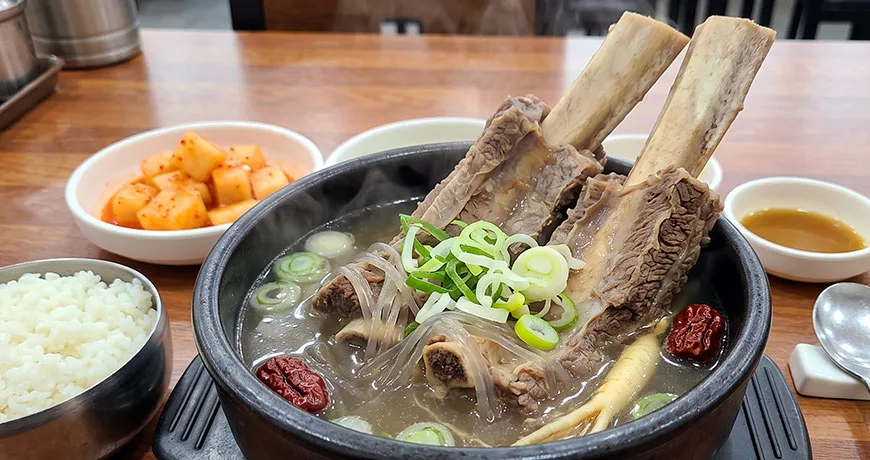
Wanggalbitang is a spectacular biochemical soup engineered to break down the massive, rigid connective tissues (fascia and tendons) anchoring jumbo beef ribs through precise, prolonged thermal hydrolysis. Subjecting these giant bones to a delicate 90–95°C thermodynamic convection slowly collapses the tough collagen into a yielding, viscoelastic gelatin matrix that tears effortlessly from the bone. As the colossal volume of animal lipids renders into the solvent, it fuses with the cooling reducing sugars leached from the collapsing pectin walls of daikon radish. Through relentless skimming (clarification), this heavy lipid suspension is refined into a highly dense yet crystal-clear golden consommé. At the bottom of the serving bowl, hydrated sweet potato starch noodles undergo rapid gelatinization as the boiling broth hits them, acting as a sponge for the savory lipids. This soup offers the ultimate carnivorous thrill—wrestling with a massive bone—contrasted with the refined elegance of a perfectly clear umami broth.
- ⏱️ Total: 3 hrs 30 mins | Prep: 1 hr (Osmotic blood purging) | Cook: 2 hrs 30 mins
- 🍳 Difficulty: High (Requires strict thermal control for jumbo rib collagen denaturation and broth clarification)
- 🌶️ Profile: Overwhelmingly Savory, Deeply Rich, and Clean
- 🍚 Focus: Macro-Fascia Thermal Hydrolysis, Lipid Clarification, & Sweet Potato Starch Gelatinization
- 🍶 Pairing: Chilled, dry traditional distilled Soju
Ingredients (3–4 servings)
- Macro-Collagen & Protein Matrix: 1.5kg Jumbo Beef Short Ribs (Wang-galbi, bones exceeding 15cm in length – submerged in cold water for 1 hour to purge blood proteins osmotically)
- Starch Gelatinization Matrix: 50g Glass Noodles (Dangmyeon, 100% sweet potato starch – hydrated in cold water for 30 mins)
- Aqueous Solvent & Clarifier: 4L Purified Water, 300g Daikon Radish (cut into large chunks), 1 whole Onion, 10 cloves Garlic, 2 White stalks of Scallion, 1 tsp Whole Black Peppercorns
- Ionized Sodium Binder: 2 tbsp Soup Soy Sauce (Guk-ganjang), Sea Salt to taste (for calibrating final salinity while preserving clarity)
- Aromatic & Allyl Finish: 2 Green stalks of Scallion (finely chopped), 1 Egg (separated and pan-fried for Hwangbaek Jidan garnish – optional)
Allergy Information Contains: Beef, Soy, Wheat (from Soy Sauce), Egg (garnish)
Equipment Massive High Thermal Mass Cauldron or Stainless Steel Stockpot, Ttukbaegi (earthenware bowl), Fine Skimmer, Kitchen Shears, Tongs
Cooking Instructions
- Initial Thermal Coagulation (Blanching): Submerge the osmotically purged jumbo ribs in a pot of aggressively boiling water for 10–15 minutes. The water-soluble myoglobin trapped deep within the massive bone marrow and muscle fibers will thermally coagulate, violently erupting as dark scum. Discard the water entirely and rigorously scrub the coagulated proteins off the bones under running cold water.
- Macro-Rib Thermal Hydrolysis: Place the cleaned jumbo ribs, 4L of purified water, radish chunks, onion, garlic, scallion whites, and peppercorns into a large stockpot. Bring to a boil over high heat, then immediately reduce to medium-low (90–95°C). Simmer with the lid slightly ajar for a minimum of 1 hour and 40 minutes to 2 hours. This sustained kinetic energy is mandatory to hydrolyze the exceptionally thick fascia into sticky gelatin.
- Lipid Clarification & Salinity Adjustment: Throughout the cooking process, relentlessly use a fine skimmer to remove the heavy yellow animal lipids rising to the surface. Once the meat shows signs of yielding easily from the bone, remove and discard the aromatic vegetables. Remove the radish and slice it into smaller squares. Season the clarified broth precisely with soup soy sauce and sea salt.
- Sweet Potato Starch Gelatinization: Place a portion of the hydrated glass noodles at the bottom of a pre-heated Ttukbaegi. When the boiling beef broth hits the sweet potato starch, it immediately triggers gelatinization, allowing the noodles to absorb the rich lipids like a sponge.
- Aromatic Finish & Serving: Arrange the colossal rib and sliced radish in the Ttukbaegi and pour the boiling, clarified broth over the top. Garnish heavily with the chopped scallions for a volatile allyl sulfide punch. Serve with tongs and shears, allowing the diner to experience the tactile satisfaction of detaching the hyper-tenderized meat from the giant bone at the table.
💡 Professional Culinary Tips
- Physicochemical Breakdown of Macro-Fascia: Jumbo ribs feature connective tissue exponentially thicker and tougher than standard soup ribs. While a pressure cooker accelerates cooking, it violently destroys the muscle fibers, turning the meat to mush and emulsifying the fat into a cloudy broth. Achieving the ultimate viscoelastic texture—where the meat retains its shape but slides effortlessly off the bone when cut with shears—requires the patience of slow thermal hydrolysis at atmospheric pressure for at least 2 hours.
- 90°C Critical Convection Control for Clarity: A violent, rolling boil forces the massive amount of rendered beef tallow to emulsify with the water, creating a milky, cloudy suspension (like Seolleongtang). The identity of Galbitang is a pristine, clear consommé. Maintaining a gentle 90–95°C simmer with minimal bubbling is the strict physical requirement to achieve this transparency.
- Lipid Absorption Kinetics of Sweet Potato Starch: Never boil the glass noodles directly in the main stockpot. The starch will leach into the broth, ruining its clarity and turning it into a viscous paste. Placing the hydrated noodles at the bottom of the individual serving bowls and pouring the boiling broth over them ensures perfect gelatinization while preserving the pristine clarity of the main soup matrix.
🍶 Gastronomic Pairing
- Biochemical Palate Cleansing: When the heavy, saturated animal lipids of the giant rib and the gelatinized starch thickly coat your oral mucosa, pair this intense dish with a shot of high-proof dry traditional distilled Soju (chilled in the freezer to increase its viscosity). The highly refined, high-concentration ethanol acts as a surgical solvent, sharply slicing through the lipid barrier on your tongue. This flawlessly resets your taste receptors, geometrically amplifying the crystalline, savory beef umami of the very next spoonful.
Nutrition Facts (Estimated)
Total Content : Approx. 850g (1 serving, excluding bone weight)
Calories : 560 kcal (Excluding rice)
– Sodium : 1,350mg
– Total Carbohydrate : 22.0g (Includes polysaccharides from sweet potato starch)
– Sugar : 4.0g (Reducing sugars from radish)
– Total Fat : 32.0g (High-density lipids native to beef ribs)
– Saturated Fat : 14.0g
– Cholesterol : 110.0mg
– Protein : 48.0g (Dense with highly bioavailable collagen peptides)
– Dietary Fiber : 3.0g
*Daily Values are based on a 2,000 calorie diet and standard Korean nutritional reference values.
**Nutritional values are calculated based on original ingredients; substitutions may alter specific macronutrients.
Origins and Food Culture of King Beef Rib Soup (Wanggalbitang)
1. Modern Gastronomic Evolution: The “Golf Club” Galbitang Phenomenon of the 1990s–2000s
- Departing from the conventional historical practice of chopping beef ribs into small two-inch segments, Wanggalbitang emerged during the late 1990s and early 2000s as a dynamic modern innovation in the competitive Korean dining market, designed to maximize diners’ visual awe and perceived value (Gasimbi).
- Because the massive 20-plus-centimeter bone shafts closely resemble the head and shaft of a golf driver, everyday diners affectionately dubbed the dish “Golf Club Galbitang” (Golf-chae Galbitang), sparking an explosive culinary trend that spread rapidly from suburban roadside barbecue bastions (such as Suwon and Pocheon) into a beloved nationwide dining staple.
2. The Culinary Science of Whole-Bone Butchery and Clear Consommé (Cheongtang)
- Unlike chopped ribs where bone marrow and cellular fluids leach out rapidly during boiling—often clouding the broth—cooking the rib shafts intact preserves the succulent internal juices inside the meat while allowing a slow, regulated release of marrow essence.
- Authentic master kitchens execute an arduous process: parboiling the giant bone racks to scrub away coagulated surface blood and bone saw dust, then simmering them in cast-iron cauldrons with radish, garlic, and scallions for over two hours. The cooked bones are set aside and the broth is chilled to thoroughly remove solidified tallow, achieving a soup that is pristine and golden-clear while the meat remains extraordinarily moist and tender.
3. The Psychology of “Visual Abundance” and Interactive Tabletop Carving
- The striking visual presentation of giant bones overflowing the borders of a hot stoneware crock satisfies the ancient Korean dining desire for feast-level generosity (meokgeori) within an accessible, single-portion comfort bowl.
- Providing each diner with metal tongs and kitchen scissors transforms the meal from a passive dining act into an interactive, theatrical ritual of deconstruction; carving one’s own meat directly at the table reinforces a deep sense of personal gratification and feast-day luxury, cementing Wanggalbitang’s status as modern Korea’s ultimate mega-sized restorative soul food.
The Architectural Grandeur of Towering Bovine Back Ribs, the Pure Clarity of Marrow-Infused Broth, and the Theatrical Vitality of Korean Feast Culture: A Refined Portrait of Wanggalbitang
Wanggalbitang (King Beef Rib Soup) stands as the colossal, unapologetically magnificent, and biologically restorative summit of Korea’s large-scale bovine (tangban) gastronomy. Centered upon massive, bone-in beef back ribs or flanken ribs measuring up to 20 to 30 centimeters in length—dramatically protruding past the ceramic rim of the bowl—the bones undergo prolonged steeping in running cold spring water to thoroughly leach deep-bone hemoglobin and residual myoglobin. Subjected to a preliminary rolling blanch with whole garlic, fresh ginger, scallions, black peppercorns, and refined rice wine to purge surface coagulants and volatile off-odors, the massive ribs are submerged into a foundational cauldron of fresh water. Simmered across hours of patient convective cooking alongside sweet winter radish, whole onions, and allium roots, the structural connective tissues slowly yield as bone minerals and rich marrow liquefy into the liquid. The broth then undergoes an exacting chilling and defatting process to strip away solidified bovine tallow, yielding a crystal-clear, golden consommé. Reassembled within a heavy earthenware pot (ttukbaegi) alongside rehydrated sweet potato glass noodles (dangmyeon), enoki mushrooms, sweet jujubes, thinly sliced scallions, and delicate golden egg ribbons, this soup is seasoned transparently with artisanal soup soy sauce and solar sea salt. Transcending the polite, modest cuts of ordinary beef soups, Wanggalbitang brings the primal, uninhibited architecture of the entire rib cage directly to the dining table, harmonizing deep visual theater with bioavailable mammalian energy in absolute thermodynamic equilibrium.
Confronting the boiling earthenware vessel as two massive, cross-stacked beef ribs pierce through clouds of savory white steam, lifting a colossal bone by hand releases an immediate, deeply comforting olfactory charge: the buttery perfume of slow-extracted bovine marrow mingles seamlessly with the brisk, sulfurous brightness of freshly chopped scallions and the warm, woody pungency of cracked black peppercorns. Using shears and tongs to carve the meat—or grasping the bone directly to bite into the succulent flesh—reveals an extraordinary structural tenderness: having relaxed along its muscular grains, the beef pulls away from the calcified bone with zero resistance, bursting with rich, concentrated beef nectar. The clarified broth coats the palate in a velvety, lip-clinging blanket of dissolved gelatin without greasy heaviness, washing down the esophagus to infuse an exhausted digestive tract with soothing, restorative heat. Dipping the tender beef slices into a sharp, wasabi-mustard soy sauce awakens the palate with zesty acidity, while the slippery, broth-soaked glass noodles provide dynamic chewing friction. Steeping a bowl of warm rice into the remaining amber soup and crowning it with a crisp cube of aged radish kimchi (kkakdugi) completes an unforgettable ritual of physical rejuvenation, structural indulgence, and profound gastronomic catharsis.
The enduring majesty of Wanggalbitang lies in its evolutionary lineage—rooted in the elite Joseon court and noble banquet tradition known as Garitang (加里湯), where precious beef ribs were prepared exclusively for auspicious seasonal feasts and matrimonial celebrations. In modern Korea, this culinary heritage was boldly reimagined by urban restaurateurs who expanded the anatomical scale of the dish into an exhilarating spectacle of generosity and prosperity. Transforming the primal human instinct of tearing meat from bone into a sophisticated, family-centered banquet, a steaming cauldron of king beef rib soup remains an irreplaceable monument of working-class resilience, communal indulgence, and brilliant Korean culinary craftsmanship.
Editor’s Review
1. A Dynamic Harmony of Springy Periosteal Viscoelasticity, Fall-Off-The-Bone Meat Tenderness, Slippery Glass Noodle Snap, and Crystalline Broth Fluidity
The structural architecture inside the vessel delivers an extraordinary, multi-tiered choreography between dense mammalian rib musculature, partially gelatinized regular connective tissues, hydrated starch hydrogels, and an ultra-low-viscosity aqueous matrix. The tough epimysium and periosteum encasing the massive rib bones, relaxed through sustained hydrothermal cooking, exhibit a buoyant, elastic chew that resists the teeth with an unctuous spring before collapsing cleanly. Concurrently, the thick intercostal muscle bundles separate along natural grains with effortless, cloud-like tenderness, requiring minimal chewing effort. Sweet potato glass noodles, having drunk deeply of the savory broth, introduce a slippery, viscoelastic snap that diversifies oral friction, while the defatted, clarified consommé glides across oral tissues with zero grease, ensuring an impeccably balanced, non-fatiguing mouthfeel from the first steaming sip to the last.
2. Rib Periosteal Type I Collagen Hydrothermal Gelatinization, Convective Temperature Management (85-90°C) for Actomyosin Syneresis Mitigation, IMP-Glutamate Nucleotide Synergy, and Tallow Defatting Rheology
Wanggalbitang represents an exacting study in vertebrate skeletal histology, muscle thermal mechanics, and flavor volatile extraction. Insoluble Type I collagen, densely woven within the rib periosteum, tendons, and intramuscular perimysium, undergoes thermal denaturation between 85°C and 90°C, cleaving its tight triple-helix hydrogen bonds into water-soluble gelatin polypeptides that provide a silky oral viscosity. Crucially, sustaining a rolling boil above 100°C would trigger aggressive actomyosin contraction, expelling intracellular moisture (syneresis) and leaving the thick meat dry and stringy. Regulating the thermal currents within a gentle convective simmering window (85-90°C) preserves myofibrillar Water Holding Capacity (WHC), ensuring deep moisture retention. Post-simmer refrigeration solidifies surface tallow into a crystalline wax layer, allowing 100% mechanical removal (defatting) to preserve pristine broth transparency and low dynamic viscosity. Muscle-derived inosine monophosphate (IMP) converges with the natural free glutamic acid (Glutamate) leached from braised radish, onions, and scallions, triggering an exponential synergy across human oral T1R1/T1R3 umami heterodimers. Furthermore, allicin-derived organosulfur volatiles (allyl sulfides) from alliums chemically sequester and mask trace lipid aldehydes (hexanal), preserving a pristine, aristocratic bovine aroma.
3. The Modern Reinterpretation of Joseon Garitang and the Sovereign Summit of Theatrical Korean Feast Gastronomy
Subverting the conventional etiquette of diced, polite banquet meats to celebrate the unapologetic visual scale of intact whole bones, Wanggalbitang captures the definitive semiotics of abundance in contemporary Korean dining. Evolving from a vitalizing restorative that sustained factory workers and manual laborers during the heights of national industrialization into a cherished multi-generational weekend feast, this colossal, steaming centerpiece stands as an enduring sanctuary of domestic comfort, nutritional generosity, and brilliant Korean culinary artistry.