
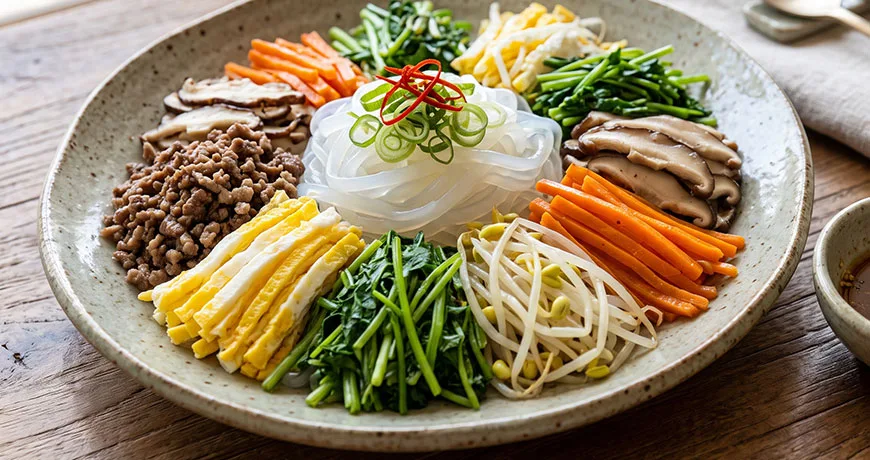
Derived from the phrase tang-tang-pyeong-pyeong (fairness and impartiality) during King Yeongjo’s reign in the Joseon Dynasty, Tangpyeongchae is a historic Korean royal court dish created to symbolize harmony and political balance. Featuring delicate mung bean jelly (cheongpomuk) tossed with colorful vegetables, seasoned beef, shiitake mushrooms, and egg strips, it is a beautifully balanced, light, and refreshing delicacy.
⏱️ Prep: 15 mins | Cook: 15 mins | 🍳 Easy | 🥩 High Protein | 🌾 Gluten-Free
Ingredients (4 servings)
- Main Ingredients: 1/2 block mung bean jelly (cheongpomuk), 100g beef, 2 shiitake mushrooms, 1/4 carrot, 1/4 cucumber, 3 eggs
- Mung Bean Jelly Seasoning: 1/4 tsp salt, 1 tbsp toasted sesame seeds, 1 tbsp sesame oil
- Shiitake Mushroom Seasoning: 1 pinch salt, a dash of black pepper, 1/2 tbsp sesame oil
- Beef Marinade: 3 pinches salt, a dash of black pepper, 1 pinch ginger powder, 1/2 tbsp soy sauce, 1/2 tbsp sugar, 1 tbsp mirin (cooking wine), 1/2 tbsp sesame oil
Allergy Information
- Contains: Beef, Eggs, Soy (Soy sauce), Sesame
Equipment
- Frying Pan, Pot (for blanching), Cutting Board, Knife, Mixing Bowl
Cooking Instructions
- Mung Bean Jelly Prep: Slice the mung bean jelly into thin, bite-sized strips. If stiff or white, blanch briefly in boiling water until clear and translucent, drain, and gently toss with 1/4 tsp salt, 1 tbsp sesame oil, and 1 tbsp sesame seeds.
- Vegetable & Mushroom Prep: Thinly julienne the cucumber and carrot. Slice the shiitake mushrooms thinly and toss with 1 pinch of salt, a dash of black pepper, and 1/2 tbsp sesame oil.
- Marinating & Sautéing Beef: Cut beef into thin strips and marinate with 3 pinches of salt, black pepper, ginger powder, 1/2 tbsp soy sauce, 1/2 tbsp sugar, 1 tbsp mirin, and 1/2 tbsp sesame oil. Sauté the marinated beef and seasoned shiitake mushrooms separately in an oiled pan over medium heat until fully cooked.
- Egg Jidan Prep: Beat the eggs with a pinch of salt and fry into thin egg sheets (jidan). Slice into thin, delicate strips.
- Assembling & Serving: In a large bowl, gently toss the seasoned mung bean jelly with sautéed beef, mushrooms, julienned vegetables, and egg strips until harmoniously combined. Serve on a plate.
💡 Cooking & Pairing Tips
- Restoring Jelly Texture: If mung bean jelly hardens in the refrigerator, blanching it in hot water restores its signature elastic, glassy, and silky texture.
- Symbolic Harmony of Colors: The white jelly, green cucumber, orange carrot, yellow egg, and dark beef/mushrooms were purposefully chosen to represent the major political factions of Joseon Korea coming together in peace.
- Perfect Beverage Pairing: Its light, savory, and clean profile pairs exceptionally well with bekseju (herbal Korean rice wine), clear rice wine (cheongju), or clean traditional soju.
Storage Instructions
- Tangpyeongchae is best enjoyed fresh. Store any leftovers in an airtight container in the refrigerator for up to 1 day; note that mung bean jelly may firm up when chilled and can be brought back to room temperature before serving.
Nutrition Facts (Estimated)
- Total Content : Approx. 400g (4 servings total)
- Calories : 360 kcal total (approx. 90 kcal per 100g / 90 kcal per 1 serving)
– Sodium : 480mg (24%)
– Total Carbohydrate : 18g (5%)
– Sugar : 3g (3%)
– Total Fat : 20g (31%)
– Trans Fat : 0g
– Saturated Fat : 4g (20%)
– Cholesterol : 155mg (52%)
– Protein : 26g (47%)
– Calcium : 50mg (5%)
Editor’s Review
1. A Play of Transparent Silk Touch and Light Textures
The moment the transparently blanched mung bean jelly touches the tip of the tongue, its silky, supple texture gently embraces the palate. Over the fluid elegance of the jelly, coated in the subtle and nutty aroma of sesame oil, the heavy umami of marinated beef and shiitake mushrooms, paired with the crisp freshness of cucumber and carrots, layers a vibrant complexity. It is a sensual elegance blossoming in a harmonious, gentle rhythm of softness, elasticity, and crunch.
2. The Aesthetics of Five Colors Crafted by Delicate Blanching and Knife Work
Tangpyeongchae is the epitome of Korean Royal Court cuisine, demanding meticulous temperature control and precise knife work. Briefly blanching the firmed mung bean jelly in boiling water to restore its clear, glass-like transparency is the core technique to protect its texture. The restrained balance—julienning egg jidan, vegetables, and beef into fine, even strips and tossing them gently so as not to break the fragile jelly—perfectly embodies the aesthetic harmony of the five traditional colors (Obangsaek) and a refined flavor without harsh seasonings.
3. A Table of Serenity and the Wisdom of Harmony Washing Away Strife
This historic royal delicacy embodies the Joseon Dynasty’s spirit of tang-tang-pyeong-pyeong, created under King Yeongjo to dissolve political strife and achieve harmony. Like opposing factions with distinct voices, the cooked beef, fresh vegetables, and vibrant hues converge into a single peaceful flavor atop the impartial canvas of white mung bean jelly. Gently wrapping away sharp conflicts, this harmoniously balanced dish offers us a tranquil, reflective peace across the centuries.