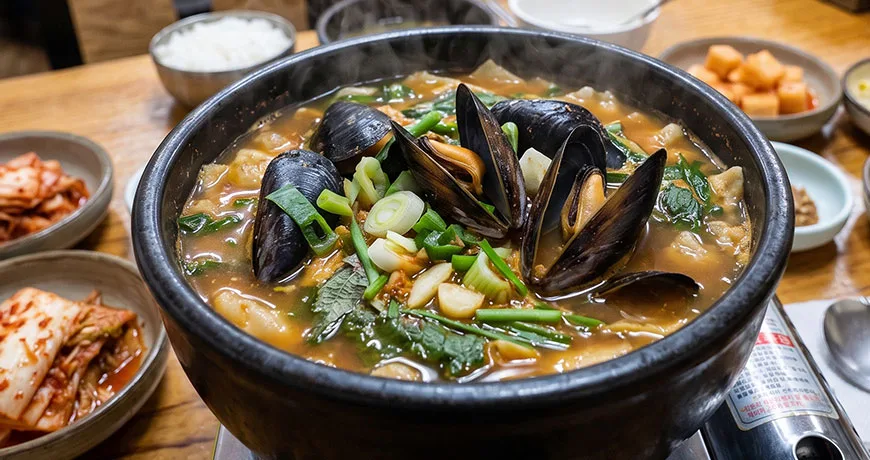
Seop-guk is a deeply comforting, regional restorative stew from the coastal cities of Gangwon-do. It harnesses the explosive ocean umami (succinic acid) of wild sea mussels (“seop” in the local dialect). The culinary brilliance of this dish lies in its carbohydrate-coating technique. By tossing roughly chopped mussels and fresh chives in wheat flour before dropping them into a boiling broth of fermented soybean and chili paste, the starch instantly gelatinizes. This starchy pellicle locks the juices inside the mussels, preventing them from turning rubbery, while simultaneously bleeding just enough starch into the broth to create a thick, velvety viscosity that coats and soothes the stomach.
⏱️ Total: 30 mins | Prep: 15 mins | Cook: 15 mins | 🍳 Difficulty: Moderate (Requires strict control of starch gelatinization) | 🌶️ Profile: Earthy, Spicy, Velvety, and Briny | 🍚 Focus: Starch Gelatinization, Umami Synergy, & Protein Coagulation
Ingredients (3–4 servings)
- Main Ingredient: 300g shelled wild mussels (or standard shelled mussels)
- Vegetables & Protein Binding: 100g Asian chives (buchu), 1 pack enoki mushrooms (or 2 shiitake mushrooms), 1/2 scallion, 1 Cheongyang chili, 2 eggs
- Gelatinization Coating: 3 tbsp wheat flour (or buckwheat flour)
- Emulsion Broth Base: 6 cups anchovy-kelp stock, 2 tbsp gochujang (chili paste), 1.5 tbsp doenjang (soybean paste), 1 tbsp gochugaru (chili flakes), 1 tbsp minced garlic, 1 tbsp soup soy sauce (guk-ganjang), a pinch of black pepper
Allergy Information Contains: Seafood (Mussels), Soy, Wheat (from flour, doenjang, gochujang), Egg
Equipment Large Mixing Bowl, Medium Pot, Cutting Board, Knife, Fine Mesh Strainer
Cooking Instructions
- Mussel Prep & Amino Acid Maximization: Gently rinse the shelled mussels in mildly salted water to physically remove any grit or byssal threads (beards). Shake off excess water. Roughly chop the mussels into 1–2cm pieces. Chopping them increases the surface area, ensuring the succinic and glutamic acids bleed optimally into the broth.
- Vegetable Processing: Cut the chives into 4–5cm lengths. Trim the base off the enoki mushrooms and gently tear them into small clusters. Diagonally slice the scallion and chili.
- Physical Starch Coating: In a large bowl, combine the chopped mussels and chives. Sprinkle the 3 tablespoons of flour over them and toss gently by hand. The residual moisture on the ingredients will hydrate the flour, creating a thin, sticky carbohydrate pellicle on their surfaces.
- Broth Emulsification: Pour the stock into a pot. Use a fine mesh strainer to dissolve the doenjang and gochujang directly into the liquid, ensuring a smooth colloidal base. Add the minced garlic and gochugaru, then bring to a rolling boil over high heat.
- Thermodynamic Gelatinization: Once the broth is boiling fiercely, scatter the flour-coated mussels and chives into the pot in small handfuls. Crucial step: Do not stir immediately. Allow the ingredients to sit untouched for 1–2 minutes. The intense heat will instantly gelatinize the flour, locking it onto the ingredients rather than washing it away into a cloudy mess.
- Protein Ribbons & Finishing: Gently stir the pot. Add the enoki mushrooms, scallion, chili, and soup soy sauce. As the broth noticeably thickens, lightly beat the 2 eggs. Drizzle the beaten eggs in a slow, circular motion over the boiling surface. Turn off the heat immediately and let the eggs coagulate undisturbed for 1 minute to form beautiful, fluffy protein ribbons.
💡 Professional Culinary Tips
- Science of Starch Gelatinization: The defining characteristic of Seop-guk is its velvety texture. Coating wet ingredients in flour prior to boiling serves a dual thermodynamic purpose. First, the rapidly gelatinizing starch forms a protective barrier that stops the mussel proteins from seizing and turning rubbery. Second, the exterior starch dissolves into the broth, thickening it and giving the soup a luxurious, heavy body that is highly prized as a hangover cure.
- Umami Synergy (Succinic & Glutamic Acids): Mussels derive their distinct, deep-sea sweetness from high levels of succinic acid. When this reacts in a boiling environment with the high concentrations of glutamic acid found in the fermented soybean pastes (doenjang and gochujang), it triggers a synergistic umami bomb, exponentially amplifying the savory depth of the stew without requiring meat.
- Thermodynamics of Egg Coagulation: When adding the beaten eggs at the end, stirring the pot immediately will shatter the protein structures before they can set. This results in an unappetizingly murky, gritty broth. By drizzling the egg and allowing the residual heat to gently coagulate the proteins undisturbed, you create soft, continuous ribbons that enhance both the texture and visual appeal of the dish.
Nutrition Facts (Estimated)
Total Content : Approx. 400g (1 serving, including broth)
Calories : 240 kcal
– Sodium : 1,180mg
– Total Carbohydrate : 18.0g
– Sugar : 4.0g
– Total Fat : 7.0g
– Saturated Fat : 1.5g
– Cholesterol : 130.0mg (from eggs and mussels)
– Protein : 22.0g
– Dietary Fiber : 3.5g
*Daily Values are based on a 2,000 calorie diet and standard Korean nutritional reference values
**Nutritional values are calculated based on original ingredients; substitutions may alter specific macronutrients.
The Robust Soul of Coastal Rock-Clinging Mussels Meets Earthy Fermented Paste and Fragrant Chives: A Lyrical Masterpiece of Seopguk and Gangwon Maritime Solace
Seopguk (Spicy Wild Mussel Soup with Soybean Paste) stands as the rustic, profound, and deeply comforting pinnacle of Gangwon-do coastal gastronomy, where thick, wild mussels (seop)—harvested from the wave-battered, craggy rocks of the East Sea—are roughly chopped and simmered alongside fresh garlic chives, mushrooms, and a delicate ribbon of beaten egg in a robust broth seasoned with fermented soybean paste (doenjang) and fiery red chili paste (gochujang). Flourishing across the coastal harbors of Yangyang and Sokcho as an indispensable regional treasure, this iconic soup harnesses the concentrated, ocean-dense sweetness of wild mussels and the earthy depth of aged pastes to deliver an immediate wave of restorative warmth and unvarnished maritime vitality from the very first spoonful.
The moment a piping-hot spoonful of the crimson-earthen broth touches the palate, an immediate wave of deep, savory soybean richness and warming chili heat cascades across the senses, followed by an unmistakable surge of concentrated marine umami. The thick, meaty slices of wild mussel yield to the tooth with an extraordinarily springy, satisfying chew that sets them far apart from cultivated shellfish. This robust bite harmonizes beautifully with the aromatic sweetness of tender garlic chives and the silken, cloud-like swirl of egg, transforming an ordinary bowl of soup into an unforgettable sensory haven.
True gastronomy does not depend on delicate artificial embellishments; it flourishes in the ancestral wisdom of coastal communities who transformed hardy, sea-foraged bounty into an enduring reservoir of physical stamina and emotional solace through traditional fermentation. Savoring an aromatic, bubbling bowl of steaming Seopguk today is an elegant and sacred ritual—clearing away modern exhaustion through a wave of bracing coastal warmth and filling the spirit with unpretentious nourishment, East Sea heritage, and timeless solace.
Editor’s Review
1. An Exhilarating Cadence of Earthy-Spicy Paste Broth Depth, Plump Wild Mussel Resilience, and Silken Egg Harmony
The moment a piping-hot spoonful of Seopguk coats the palate, an immediate burst of rich fermented doenjang depth, piquant gochujang heat, and sweet marine broth awakens the senses with invigorating punch. This robust baseline is swiftly elevated by the remarkably firm, springy chew of the wild mussel meat, the herbal freshness of garlic chives, and the silken slide of poached egg ribbons, orchestrating an endlessly satisfying, multi-layered sensory thrill that makes it the ultimate companion to warm rice.
2. Wild Mussel Taurine-Succinic Acid Umami Synergy, Allyl Sulfide Masking, and Egg Albumin Thermal Buffer Mechanics
Seopguk represents an exacting study in marine shellfish biochemistry and fermented paste synergy. Wild mussels concentrate exceptionally high levels of bioactive taurine, betaine, and natural succinic acid, which fuse with the free glutamates of doenjang to multiply savory umami intensity. Concurrently, allyl sulfides from garlic chives eliminate any trace of seafood gaminess while enhancing metabolic enzyme activity, and the gentle coagulation of egg albumin establishes a protective colloidal buffer across the gastric lining, optimizing nutrient bioavailability and digestive comfort.
3. The Wind-Swept East Coast Port Heritage of Yangyang and Sokcho and the Grounding Sanctuary of Rustic Soup Fellowship
Found welcoming weary fishermen at dawn along the ports of Yangyang and Sokcho as the undisputed herald of coastal resilience and hearty comfort, a modest bowl of spicy wild mussel soup serves as an enduring emotional haven against daily weariness. Revered for generations as an essential comfort staple that restores vitality through shared, soul-warming spoonfuls, enjoying this honest, nutrient-dense delicacy washes away modern stress, granting a timeless sanctuary of stillness, coastal heritage, and grounded culinary happiness.