
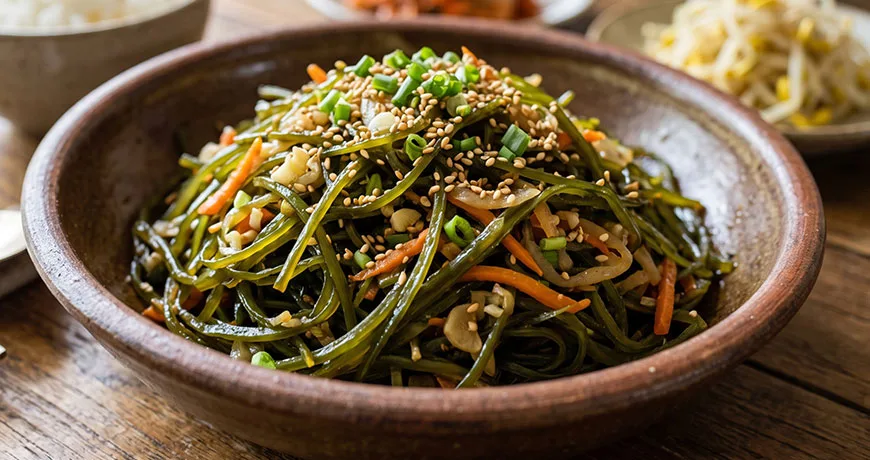
A classic, budget-friendly Korean everyday side dish (mitbanchan) made from the thinly sliced stems of wakame seaweed. The heavily salted stems are thoroughly rinsed and soaked to achieve the perfect seasoning balance, then briefly sautéed with garlic, julienned carrots, and onions. Beloved for its highly addictive, snappy, and chewy texture (kkodeul-kkodeul) along with a deep, savory ocean umami, it is an absolute staple in Korean home dining and traditional lunchboxes (dosirak).
⏱️ Total: 35 mins | Prep: 25 mins (including soaking) | Cook: 10 mins | 🍳 Easy | 🌊 Savory & Chewy | 🍱 Classic Mitbanchan
Ingredients (2-3 servings)
- Main Ingredients: 250g salted seaweed stems (miyeok-julgi), 1/2 yellow onion, 1/3 carrot, 1.5 tbsp cooking oil
- Seasoning & Aromatics: 1 tbsp minced garlic, 1 tbsp cooking wine (cheongju / mirin), 1/2 tsp soy sauce (only if needed after soaking)
- Finishing Touches: 1 tbsp toasted sesame oil, 1 tsp toasted sesame seeds
💡 Substitutes & Notes
- Cooking wine (cheongju) ➔ Dry white wine.
- Gluten-Free ➔ Tamari instead of regular soy sauce.
Allergy Information
- Contains: Soy (if using soy sauce), Wheat (if using soy sauce), Sesame (Fully Vegan & Vegetarian-friendly)
Equipment
- Mixing Bowl, Colander, Frying Pan or Wok, Spatula, Knife, Cutting Board
Cooking Instructions
- Washing & Soaking: Place the heavily salted seaweed stems in a colander and vigorously rub them under cold running water to wash away the thick surface salt. Transfer to a bowl of cold water and let them soak for 15–20 minutes. (Taste a small piece to test—it should taste mildly savory, not overly salty.)
- Draining & Cutting: Drain the seaweed stems thoroughly and squeeze out excess moisture. Since they are very long, cut them into manageable 5–6 cm bite-sized lengths.
- Prepping Vegetables: Slice the onion and julienne the carrot into thin matchsticks to match the shape of the seaweed stems.
- Sautéing Aromatics: Heat the cooking oil in a frying pan over medium-high heat. Add the minced garlic and sauté for 30 seconds until fragrant.
- Stir-Frying the Stems: Add the prepped seaweed stems and pour in the cooking wine (this helps remove any unwanted fishy smell). Stir-fry briskly for 2–3 minutes.
- Adding Vegetables: Add the sliced onions and carrots. Toss everything together for another 2 minutes until the vegetables slightly soften. If the stems lost too much salt during soaking, add a tiny splash of soy sauce here.
- Finishing & Serving: Turn off the heat. Drizzle with toasted sesame oil and sprinkle with sesame seeds. Toss well and let it cool before storing it in an airtight container.
💡 Cooking & Pairing Tips / Health Benefits
- Texture Expectation (Kkodeul-kkodeul): The hallmark of this dish is its snappy, crunchy, and slightly chewy texture. Be careful not to overcook the stems in the pan, as they can lose this signature bounce and turn mushy.
- Mastering the Soaking Time: The success of this dish lies in the soaking. If soaked for too short a time, it will be overwhelmingly salty; if soaked for too long, it loses all its natural ocean flavor and becomes bland. Always taste a small strand at the 15-minute mark!
- Health Benefits: Seaweed stems are exceptionally low in calories but packed with dietary fiber, iodine, and calcium. The rich fiber content expands in the stomach to provide a lasting feeling of fullness, making it a fantastic dish for digestion and weight management.
Nutrition Facts (Estimated)
Total Content : Approx. 100g (1 serving)
Calories : 75 kcal
– Sodium : 450mg (varies by soaking time)
– Total Carbohydrate : 6.0g
– Sugar : 2.5g
– Total Fat : 5.0g
– Saturated Fat : 0.8g
– Cholesterol : 0.0mg
– Protein : 1.5g
– Calcium : 60.0mg
* Daily Values are based on a 2,000 calorie diet and standard Korean nutritional reference values
** Nutritional values are calculated based on the original ingredients, not substitutes.
The Ocean’s Resilient Ligaments: Oceanic Gastronomy Condensed in a Crunchy Chew
Stir-fried Seaweed Stems (Miyeokjulgibokkeum) represents a humble yet brilliant culinary paradox, resurrecting the resilient core of sea mustard—which has endured the ocean’s crashing currents—over a blistering pan. Thinly shredded and suspended in time within high-concentration salt, the seaweed awakens with vibrant, emerald vitality the moment it is submerged in fresh water to shed its heavy salinity. This once tough and unyielding fragment of the sea is transformed through the sharpness of minced garlic and the rich nuttiness of toasted sesame oil into a flawless side dish, boasting both a velvety coating and dynamic elasticity.
As it sizzles in hot oil, the gentle, oceanic aroma rises to captivate the senses long before it touches the tongue. Without relying on expensive seafood or flamboyant techniques, the seaweed stems command the dining table solely through their uniquely addictive, crunchy, and snappy texture that playfully resists the bite.
True gastronomy does not consist of a parade of costly luxuries, but lies in the culinary wisdom of uncovering the intrinsic physical properties of the most modest ingredients and translating them into crisp, delightful pleasure. Clearing away this glossy, green plate today is an affectionate, grounding ritual—swallowing the vivid energy of the ocean to breathe a cheerful, rhythmic vitality back into a weary, modern palate.
Editor’s Review
1. A Cheerful Rhythmic Ocean Melody of Snappy Tension and Toasted Sesame Richness
The moment a tangle of oil-glazed seaweed stems enters the mouth, an extraordinary, snappy resilience playfully pushes back against the teeth, simultaneously stimulating taste and touch. With every crunchy bite, the inherently briny, oceanic juices merge flawlessly with the sharp kick of garlic and the heavy, nutty warmth of toasted sesame oil. This trio forms a perfect triangle of flavor, delivering an endlessly engaging and multi-dimensional sensory thrill from the first bite to the last.
2. Osmotic Desalting Thermodynamics and High-Density Dietary Fiber Mechanics
Miyeokjulgibokkeum is a masterpiece of preparatory food chemistry, utilizing the principles of osmosis to expertly desalt and rehydrate heavily salted kelp. After blanching and desalting, the stems boast an impressive density of soluble dietary fiber—reaching 5.1g per 100g—and alginic acid, which contribute to an overwhelming nutritional profile highly beneficial for digestion. When this dense botanical matrix meets high-heat oil, a delicate emulsion forms on the surface, locking in moisture and ensuring the seaweed retains its bouncy, jelly-like tension perfectly throughout the thermodynamic sautéing process.
3. The Deep Nostalgia of a Tin Lunchbox and the Grounding Solace of the Working-Class Table
A steadfast fixture tucked into the corner of a lovingly packed childhood tin lunchbox or a modest tray at a neighborhood diner, this vibrant green banchan transcends its ingredients to evoke a profound sense of nostalgia. Reliably filling the empty spaces of the dining table at an unburdening cost, chewing through this honest, savory taste of the sea washes away the complexities of modern dining. It grants diners an authentic sanctuary of maternal warmth and deep, grounding solace that soothes the spirit.