
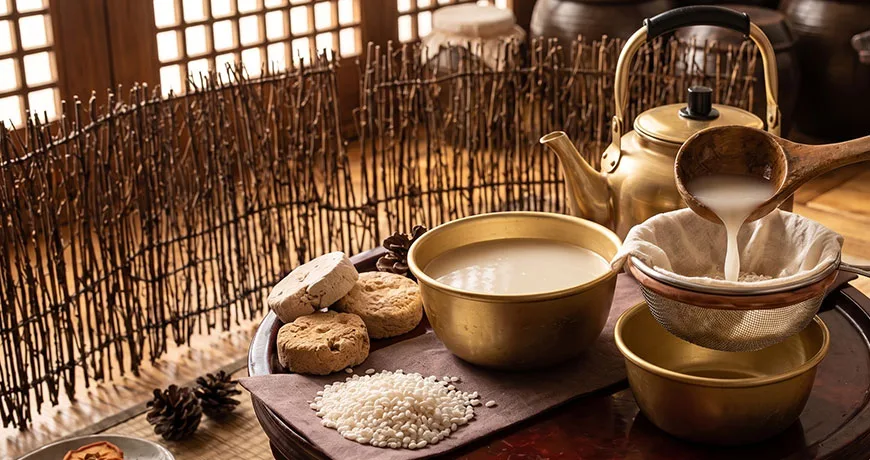
A beloved traditional Korean unfiltered rice wine. Crafted by expertly fermenting hard-steamed rice with water and Nuruk (a traditional Korean fermentation starter), it boasts a beautiful milky appearance, a gentle effervescence, and a wonderfully complex sweet-and-sour flavor profile. Rich in live probiotics, amino acids, and dietary fiber, it acts as a fantastic natural digestive aid and energy booster. Drinking a chilled, refreshing bowl of Makgeolli is the absolute perfect way to wash down rich, savory foods and soothe the fatigue of a long day.
⏱️ Total: 7 days | Prep: 4 hrs | Cook: 1 hr | 🍳 Hard (Temperature Control) | 🌾 Sweet, Tangy & Fizzy | 🍶 Probiotic-Rich Rice Wine
Ingredients (Yields approx. 2-2.5 liters diluted)
- Main Ingredients: 1kg sweet rice (glutinous rice) or regular short-grain white rice, 100g traditional Nuruk (Korean fermentation starter), 1.5 liters water
- Optional: 2–3g dry yeast (Highly recommended for beginners to ensure a stable and successful fermentation)
💡 Substitutes & Notes
- Sweet Rice / Short-grain rice ➔ Do not use long-grain jasmine or basmati rice. Short-grain sushi rice or sweet “sticky” rice works best to release the proper sugars for fermentation.
- Dry Yeast ➔ While traditional brewers rely solely on the wild yeast in Nuruk, adding a tiny pinch of dry baking yeast guarantees an active, bubbly brew.
Allergy Information
- Contains: Wheat (Traditional Nuruk is typically cultivated on cracked wheat). (Fully Vegan & Vegetarian-friendly)
Equipment
- Sterilized Fermentation Vessel (Glass jar, crock, or food-grade plastic container), Steamer, Large Tray or Bamboo Mat (for cooling the rice), Cheesecloth, Fine-mesh Strainer, Wooden Spoon
Cooking Instructions
- Washing & Soaking: Gently wash the rice under cold water until the water runs clear. Soak the rice in fresh cold water for 2–3 hours. Drain it in a colander and let it sit for exactly 30 minutes to completely dry off excess moisture.
- Steaming & Cooling: Steam the soaked rice in a steamer for 40–50 minutes to make Godubap (hard, chewy steamed rice). Spread the hot steamed rice thinly over a large tray or mat and let it cool completely to below 20–25°C (68–77°F).
- Mixing: Once the rice feels cool to the touch, transfer it to a large bowl. Add the 100g of Nuruk and 1.5 liters of water (along with the dry yeast, if using). Using clean hands, gently massage and mix the ingredients together. Be careful not to mash or crush the rice grains!
- Fermenting: Pour the mixture into your sterilized fermentation vessel. Because the fermentation produces natural gases, do not seal it completely. Either leave the lid slightly unscrewed or cover the opening tightly with a cheesecloth. Store the jar in a cool, dark place (20–25°C / 68–77°F) for 5–7 days. (For the first 2–3 days, stir the mixture once or twice a day with a clean wooden spoon to introduce oxygen for the yeast).
- Straining & Diluting: When the rice grains sink to the bottom and the active bubbling slows down, your brew is ready. Squeeze the mixture tightly through a cheesecloth to extract the thick, concentrated wine. This undiluted base (called Wonaek) is quite strong at about 13–15% ABV. Mix it with clean, filtered water to your desired taste and strength (commercially, it is diluted to 6–8% ABV). Store in the fridge and serve icy cold!
💡 Cooking & Pairing Tips / Health Benefits
- Cool the Rice Completely: This is the absolute most critical step! If the steamed rice is even slightly warm when you add the Nuruk, the heat will instantly kill the delicate yeast and bacteria. Your batch will either not ferment at all or turn into harsh vinegar. It must be cooler than your body temperature before mixing.
- Temperature is Everything: If your room is too hot (above 30°C/86°F), lactobacillus will over-multiply, making your wine unpleasantly sour. If it’s too cold (below 15°C/59°F), the yeast will go to sleep and fermentation will stop. Finding a cool, shaded corner in your home is the secret to a perfectly balanced, sweet brew.
- A Probiotic Powerhouse: Because home-brewed Makgeolli is unpasteurized, it contains incredibly high levels of live lactic acid bacteria (probiotics) and organic acids. It actively promotes gut health and acts as an exceptional natural digestive aid after eating heavy, greasy meals like Korean BBQ or savory pancakes.
Nutrition Facts (Estimated)
Total Content : Approx. 250ml (1 serving, diluted to 6-8% ABV)
Calories : 130 kcal
– Sodium : 5mg
– Total Carbohydrate : 25.0g
– Sugar : 3.0g
– Total Fat : 0.5g
– Saturated Fat : 0.0g
– Cholesterol : 0.0mg
– Protein : 2.0g
– Calcium : 10.0mg
*Daily Values are based on a 2,000 calorie diet and standard Korean nutritional reference values
**Nutritional values are calculated based on the original ingredients, not substitutes
The Milky Alchemy of Harvest and Fermentation: A Lyricism of Parallel Fermentation and Peasant Vitality
Makgeolli is the magnificent and primordial zenith of Korean traditional fermentation gastronomy, where whole sun-ripened grains, wild microbial cultures from traditional starter (Nuruk), and pristine water converge in the silent darkness of an earthenware crock to ignite their own thermal alchemy. Behind its humble etymology—meaning “roughly and freshly strained”—lies the astonishing biochemical choreography of Simultaneous Saccharification and Fermentation (SSF). Within a single vessel, fungal amylases systematically dismantle the dense starch matrices of steamed rice into fermentable sugars, while wild yeasts simultaneously breathe them into ethanol and effervescent carbon dioxide.
As the unpolished, milky-white nectar cascades into a wide, rustic bowl, tiny natural micro-bubbles continuously effervesce to the surface, signaling the vibrant pulse of a living probiotic ecosystem. The initial sip introduces an invigorating prickle of natural carbonation and crisp organic acids; yet, as it glides effortlessly down the throat, the gentle, earthy sweetness of rice and the rich, savory depth of fermented amino acids envelope the mouth in a velvety, full-bodied emulsion that clear, distilled spirits can never hope to replicate.
True gastronomy does not dwell in the artifice of industrial filtration; it flourishes in the holistic philosophy of capturing the uncompromised vitality of the harvest to nourish tired, working souls. Raising a battered brass bowl brimming with Makgeolli amidst the rhythm of falling rain is an honest and empowering ritual—instantly slaking physical thirst while replenishing the spirit with living cellular energy and grounded communal warmth.
Editor’s Review
1. An Electric Cadence of Natural Effervescence, Velvety Rice Nectar, and Crisp Lactic Acidity
The moment the rustic bowl touches the lips, a delicate prickle of living yeast carbonation dances across the tongue, instantly awakening the sensory palate. This playful effervescence is seamlessly balanced by the round, comforting sweetness of enzymatic glucose and the bright tang of natural lactic acid. As the unfiltered suspension of micro-grain particles and dormant yeasts glides down the throat, it delivers a silky, unctuous mouthfeel that orchestrates an endlessly refreshing, multi-layered sensory thrill.
2. Simultaneous Saccharification and Fermentation (SSF) Kinetics and Thermal-Controlled Colloidal Mechanics
Makgeolli represents an exacting masterclass in biochemical food engineering. Glucoamylases secreted by Aspergillus and Rhizopus molds in the nuruk continuously hydrolyze insoluble rice starches into glucose, which Saccharomyces cerevisiae instantly metabolizes into ethanol (reaching 13–15% ABV in the mother brew) and carbon dioxide without osmotic shock. Thoroughly cooling the steamed rice (Godubap) to 20–25°C is a critical thermodynamic prerequisite to prevent the thermal denaturing of wild yeasts. Furthermore, maintaining a 20–25°C fermentation window stabilizes the delicate ecological equilibrium between lactic acid bacteria and ethanol-yielding yeasts. The physical straining step retains insoluble fibers, complex dextrins, and active probiotics within the aqueous phase, establishing a stable, non-Newtonian colloidal suspension that defines its signature velvety viscosity.
3. The Nostalgic Clatter of Brass Bowls in the Rain and the Grounding Solace of Agrarian Solidarity
The sensory pairing of crackling savory pancakes (Jeon) and cold Makgeolli served in dented brass bowls while rain patters against the roof is an enduring emotional sanctuary in Korean cultural memory. Celebrated for millennia as Nongju (the farmers’ elixir) to restore spent vitality after grueling field labor, partaking in this honest, unpretentious white nectar washes away the stresses of modern life, granting a timeless sanctuary of collective warmth, restorative sustenance, and agrarian solidarity.
용진집
#모닝와이드 #백종원의3대천왕 #생방송오늘저녁 #생방송투데이 #생생정보통 #수요미식회 #알쓸신잡