
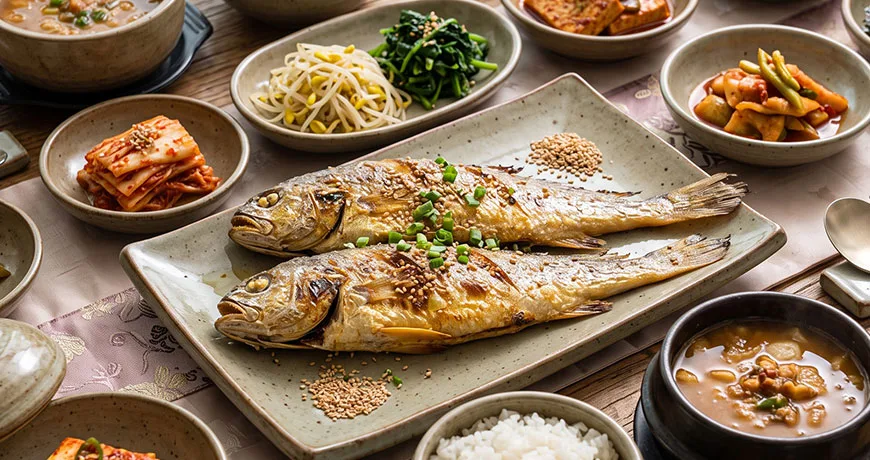
A prized Korean delicacy featuring gulbi—yellow croaker salted and dried in cold sea breezes, with Yeonggwang in Jeollanam-do renowned for producing the absolute finest quality. Generously brushed with fragrant toasted sesame oil and grilled over open flames or pan-fried to a shimmering golden crisp, this luxurious side dish (banchan) is famous across Korea as an iconic “rice thief” (bap-doduk).
⏱️ Prep: 10 mins | Cook: 10 mins | 🍳 Easy | 👑 Premium Delicacy | 🍚 Iconic Rice Thief
Ingredients (2 servings)
- Main Ingredients: 2 salted dried yellow croakers (gulbi, preferably Yeonggwang gulbi), 1 tbsp toasted sesame oil (for brushing), 1 tbsp cooking oil (for pan grilling)
- Pre-soaking Bath (Optional): 2 cups rice-washing water (ssal-ttwwott-mul) or green tea water
- Serving Accompaniments: 1 bowl cold green tea or barley tea with rice (boricha-bap or nokcha-bap), 1 lemon wedge
Allergy Information
- Contains: Fish (Yellow Croaker), Sesame
Equipment
- Frying Pan or Grill Grate (or Air Fryer), Basting Brush, Kitchen Shears, Paper Towels, Wide Spatula
Cooking Instructions
- Soaking & Prepping: Briefly soak the gulbi in starch-rich rice-washing water (ssal-ttwwott-mul) or cold green tea for 10–15 minutes. This softens the skin, removes excess salt, and neutralizes fishy odors. Pat completely dry with paper towels.
- Trimming: Trim off the fins and tail using kitchen shears, and gently scrape off any remaining surface scales with the back of a knife.
- Brushing with Sesame Oil: Generously brush toasted sesame oil over both sides of the gulbi. The sesame oil seals in moisture, prevents sticking, and forms a deep, aromatic golden crust.
- Grilling / Pan-Frying: Heat 1 tbsp cooking oil in a skillet over medium heat (or preheat a wire grill grate). Place the gulbi in the pan skin-side down first and cook for 4–5 minutes until sizzling and golden brown.
- Flipping & Serving: Carefully flip the fish using a wide spatula and cook the other side for another 4–5 minutes until the skin turns crackling crisp and the soft, savory white flesh is cooked through. Serve piping hot.
💡 Cooking & Pairing Tips
- The Secret of Rice-Washing Water (Ssal-ttwwott-mul): Soaking dried fish in starch water before cooking locks in internal moisture while drawing out harsh fishy aromas (birin-mat).
- The Legendary Tea-Rice Pairing: A classic Korean culinary custom is scooping warm white rice into ice-cold green tea or roasted barley tea (boricha) and topping it with a piece of hot, salty gulbi flesh—the cold tea cleanses the palate and highlights the fish’s rich umami.
- Perfect Food & Beverage Pairing: Served as a high-end main side dish (banchan) alongside soybean paste stew (Doenjang-jjigae) and pickled wild greens. Pairs exceptionally well with clear rice wine (Cheongju).
Storage Instructions
- Keep un-cooked dried gulbi wrapped individually in the freezer for up to 3 months. Store leftover cooked fish in an airtight container in the refrigerator for up to 1–2 days. Reheat gently in an air fryer at 170°C for 3–4 minutes or in a dry skillet over medium-low heat.
Nutrition Facts (Estimated)
- Total Content : Approx. 250g (2 servings total)
- Calories : 360 kcal total (approx. 144 kcal per 100g / 180 kcal per 1 serving)
– Sodium : 820mg (41%)
– Total Carbohydrate : 1g (0%)
– Sugar : 0g (0%)
– Total Fat : 16g (30%)
– Trans Fat : 0g
– Saturated Fat : 3g (20%)
– Cholesterol : 140mg (47%)
– Protein : 52g (95%)
– Calcium : 80mg (8%)
Editor’s Review
1. A Sensual Fusion of Briny Umami, Sesame Fragrance, and Flaky Tenderness
The moment the sea-breeze-dried, salt-cured Yeonggwang croaker—brushed lightly with fragrant sesame oil and grilled to golden perfection—touches the palate, a deeply savory, perfectly salted umami unfolds with exquisite luxury. The brilliant contrast between the crisp, savory exterior and the chewy, moist inner flakes delivers an endlessly satisfying and unforgettable gastronomic experience.
2. Culinary Mastery Forged by Sea-Breeze Curing and Sesame Oil Searing Science
Gulbi-gui stands as a masterclass in traditional seafood craft, utilizing precise salting and coastal air-drying to concentrate amino acids and rich umami before applying a delicate sesame oil coat and direct wire-rack searing. Managing thermal intensity to render skin fats while safeguarding tender inner proteins represents fundamental culinary science that achieves peak textural harmony.
3. Heartwarming Solace Found in the Ultimate “Rice Thief” of Traditional Dining
Reigning supreme as Korea’s legendary “rice thief” from royal courts to everyday tables, a neatly grilled piece of Yeonggwang croaker acts as a comforting remedy for daily weariness, filling the spirit with unpretentious warmth. Placing a savory, flaky morsel over a warm spoonful of rice offers a nostalgic ritual of purification that reconnects the heart to the grounding comfort of a traditional meal.