
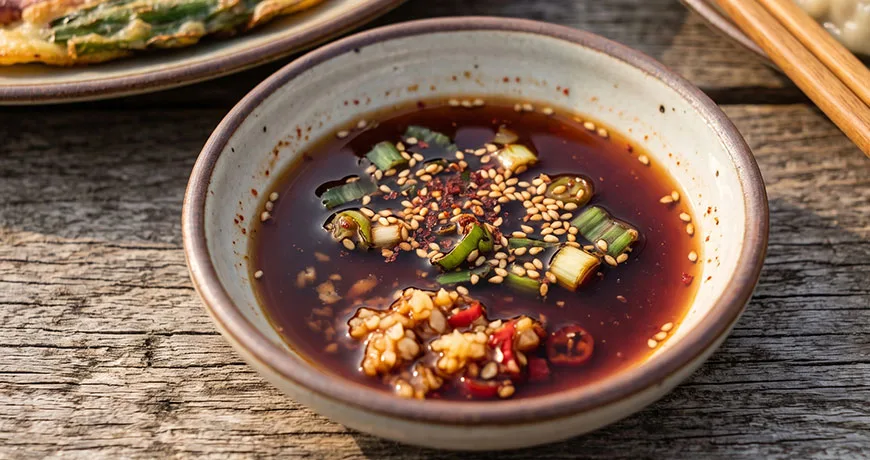
Choganjang is the definitive liquid dipping matrix that pairs the deep, heavy peptide umami of brewed soy sauce with the sharp, bright punch of acetic acid from vinegar, instantly neutralizing the heavy lipid loads of fried or pan-seared foods. The salinity of the soy sauce and the acidity of the vinegar intersect in a golden ratio that awakens the tongue’s taste receptors, while a touch of sweetness buffers the sharp edge into a clean, lingering finish. It is an essential culinary solution that cleanly shears through the residual fat film left behind when eating dumplings, savory pancakes, or deep-fried dishes.
- ⏱️ Total: 5 mins | Prep: 5 mins | Cook & Ferment: None (No-cook simple mixing)
- 🍳 Difficulty: Very Low (Precision measuring and solute agitation)
- 🌶️ Profile: A sharp, refreshing acetic punch contrasting against savory soy umami, offering an immaculate palate-cleansing finish
- 🍚 Focus: Acetic Acid-Salinity Equilibrium, Organic Acid Masking, Unheated Liquid Infusion
- 🍶 Pairing: Pan-fried pork dumplings (Gun-mandu), assorted savory pancakes (Jeon), blanched seafood, and fried finger foods
Physicochemical & Sensory Matrix
- Baseline Salinity: 8.0% ~ 10.0% (Optimized dipping salinity diluted by water and vinegar)
- pH Equilibrium: 3.5 ~ 4.0 (Robust acetic acid organic buffer matrix)
- Viscosity Index: [■□□□□] (Low-viscosity, fully water-soluble liquid fluidity)
- Umami Density (T1R1/T1R3 Synergy): 8.5 / 10 (Flavor-amplifying synergy between soy amino acids and organic acids)
- Shelf Stability: 2~4+ Weeks (Natural antimicrobial and preservative power driven by high acetic concentration)
- Aroma Profile: Sharp Acetic Acid (Vinegar Punch) | Fermented Soy Melanoidins | Subtle Allium/Sesame Notes (Optional)
Ingredients (Yields 1 Small Condiment Dish)
- Base Amino Acid Matrix: 3 tbsp Naturally Brewed Soy Sauce (Yangjo-ganjang)
- Organic Acid Matrix: 2 tbsp Naturally Fermented Vinegar (Brown rice vinegar or apple cider vinegar)
- Sweetener & Buffer Matrix: 1 tbsp Sugar (or Plum Extract / Maesil-cheong), 1 tbsp Purified Water (Optional dilution)
- Aromatic Catalyst: A pinch of finely minced scallions or onions, 1 tsp toasted sesame seeds (Optional)
Allergy Information
- Contains: Soy, Wheat (inherent in soy sauce ingredients)
Equipment Small Condiment Dish (Jongji), Teaspoon
Cooking Instructions
- Precision Liquid Measurement: Accurately measure and pour the brewed soy sauce, naturally fermented vinegar, and purified water into the condiment dish.
- Solute Dissolution & Sweetness Equilibrium: Add the sugar (or plum extract) and agitate thoroughly with a teaspoon. The sugar crystals must dissolve completely to establish a uniform sweetness and osmotic equilibrium across the entire liquid matrix.
- Aromatic Particulate Suspension: Depending on personal preference, gently float finely minced scallions, onions, or toasted sesame seeds on top to add visual texture and delicate allium aromatics.
- Acidity Resting: Allow the sauce to rest at room temperature for 3 to 5 minutes, letting the amino acids of the soy sauce and the acetic acid of the vinegar bind and stabilize physically and chemically.
💡 Professional Culinary Tips
- The Golden Ratio of Acidity and Salinity: The success of Choganjang depends entirely on how smoothly the acidity controls the saltiness. Disrupted ratios result in an aggressively sour or salty shock; maintaining the classic 3:2:1 ratio (Soy Sauce : Vinegar : Sweetener) is the foundational rule for biochemical harmony.
- Natural Preservative Power of Acetic Acid: Acetic acid, the primary component of vinegar, acts as a potent antimicrobial agent. Even without thermal cooking processes, its natural preservation capability suppresses spoilage, allowing the sauce to maintain fresh aromatics for weeks under refrigeration.
🍶 Gastronomic Pairing
- Lipid Membrane Shearing & Palate Reset: Take a bite of a crispy-skinned, juice-bursting pan-fried dumpling or a rich savory pancake, then dip it lightly into this Choganjang. The organic acids of the vinegar immediately shear through the heavy lipid film coating your tongue, resetting your palate and allowing you to experience the very next bite as if it were your first.
Nutrition Facts (Estimated)
Total Content : Approx. 15g (1 tbsp)
Calories : 15 kcal (Fermented amino acids and carbohydrate matrix)
– Sodium : 420mg (Soy-based water-soluble salinity)
– Total Carbohydrate : 1.5g (Natural vegetable sugars and organic acids)
– Sugar : 1.2g
– Total Fat : 0.0g
– Saturated Fat : 0.0g
– Cholesterol : 0.0mg (100% Vegan matrix)
– Protein : 0.8g (Soybean-derived free amino acids)
– Dietary Fiber : 0.0g
*Daily Values are based on a 2,000 calorie diet and standard Korean nutritional reference values.
**Nutritional values are calculated based on original ingredients; substitutions may alter specific macronutrients.
Origins and Food Culture of Vinegar Soy Sauce (Choganjang)
1. Classical Lineage: The Eumsik Dimibang, Gyuhap Chongseo, and Royal Banquet Etiquette
- Recorded in classical Joseon literature primarily under the historic name Chojang (醋醬, literally “vinegar paste/sauce”), the practice of blending brewed soy sauce with fermented vinegar is extensively documented across seminal texts, including Lady Jang Gye-hyang’s 1670 manuscript Eumsik Dimibang, Lady Yi’s 1809 encyclopedia Gyuhap Chongseo, and the late 19th-century compendium Siuijeonso.
- In royal banquet protocols (Jin-yeon Uigwe) and aristocratic noble table settings (bansang), Choganjang occupied an indispensable central position on the dining table, served as the mandatory dip for buckwheat dumplings (memil-mandu), cucumber dumplings (gyu-a-sang), pan-fried fish fillets (saengseon-jeon), boiled sliced meats (pyeonyuk), and raw fish (hoe). It was revered as an aristocratic dipping sauce that refined rich meats without masking delicate natural flavors.
2. The Culinary Chemistry of Acid-Base Buffering and Lipid Emulsification Thermodynamics
- The technical mastery of Choganjang relies upon the thermodynamic buffering capacity created between the basic amino acids and peptides of fermented soy sauce and the carboxylic acids of vinegar.
- The sharp, assertive salinity and barnyard notes of aged soy sauce are comfortably buffered by the hydrogen ions of acetic acid, stabilizing the sauce at an optimal digestive pH of 3.5 to 4.2. When contacting oily, pan-fried foods, this acidic environment lowers lipid surface tension, dispersing oil globules into microscopic emulsions so that the taste buds are not blanketed in grease. The subtle addition of sesame oil or pine nut lipids captures volatile vinegar vapors, rounding out the sharp pungency into an impeccably balanced colloidal condiment.
3. The Sovereign Soul Dip: Harmonizing Savory Pancakes (Jeon), Dumplings, and Yin-Yang Balance
- In Korean food culture, Choganjang reigns as the eternal soul companion to holiday pancake assortments (modeum-jeon), rainy-day street delicacies at bustling markets like Jongno Gwangjang Market (bindaetteok), and celebratory dumpling soups.
- This pairing embodies the ancestral philosophy of Yin-Yang balance in culinary medicine: hot, heavy, oil-rich foods representing Yang (陽) are harmoniously countered and neutralized by the cooling, astringent, and refreshing organic acids of Choganjang representing Yin (陰). Unassuming yet essential, Vinegar Soy Sauce stands as an immortal cultural monument to Korean fermentation subtlety, balanced seasoning art, and everyday dining hospitality.
The Amber Savor of Proteolyzed Soy Sauce Meeting the Piercing Acetic Clarity of Fermented Grain Vinegar: A Refined Portrait of Choganjang
Choganjang (Vinegar Soy Sauce) stands as the sharpest, most agile liquid balancing act on the Korean dining table. Formulated by combining naturally brewed fermented soy sauce (ganjang) with clear, fermented grain or fruit vinegar (sikcho) in an equal or two-to-one ratio—often accented with a sprinkle of toasted sesame seeds, chili flakes, or a delicate pinch of sugar—this dipping broth represents a study in cold liquid assembly. Bypassing heat reductions, it directly integrates two biologically disparate fermentations: the deep, grounding peptide gravity of leguminous umami and the soaring, volatile lift of grain-derived organic acids. As acetic acid disperses into the dark amber soy liquor, it cuts through the heavy sodium edge and rustic meju funk, restructuring the sauce into an exceptionally clean, high-contrast profile. Stationed beside golden, pan-fried pancakes (jeon), crisp mung bean fritters (bindae-tteok), steaming dumplings (mandu), or chilled slices of pressed pork (suyuk), Choganjang is engineered to dissolve heavy frying oils and reset the palate with instantaneous precision.
Tilting a small white porcelain saucer of Choganjang tableside releases an immediate, bracing olfactory charge: the warm, malty perfume of fermented soy is instantly pierced by the stinging, volatile vapor of acetic acid. This crisp fragrance clears the nasal passages, shaking off the heavy aroma of rendered cooking fats. Dipping a golden, jagged corner of a hot pancake into the sauce demonstrates its frictionless fluid dynamics: possessing an ultra-low viscosity similar to water, the sauce wicks instantly into the microscopic crevices of the fried batter through pure capillary action. As your teeth crush the crisp crust, the piercing acidity cuts directly through the lingering oil, triggering a rush of salivation. A split second later, the deep wave of free glutamates from the soy sauce rushes across the palate, rounding out the sour strike with an expansive, savory resonance. Swallowed down, it leaves no cloying greasy film—only an immaculate, refreshed oral cavity ready for the next bite.
The cultural identity of Choganjang is rooted in the physiological dietary wisdom of the Joseon dynasty, where balancing greasy meats and rich batters with digestive acids was an established culinary imperative. Documented across historical compendiums like Eumsik Dimibang and Gyuhap Chongseo, this simple blend proved that high-impact sensory harmony does not demand complex cooking techniques. Uniting the deep baseline of fermented beans with the bright flight of vinegar, a humble saucer of Choganjang remains the most practical, indispensable culinary compass of everyday Korean gastronomy.
Editor’s Review
1. Ultra-Low Viscosity Capillary Action, Immediate Lipid-Film Cleaving, and a Frictionless Aqueous Finish
Choganjang functions as an active rheological counterweight to saturated cooking oils:
- Capillary Dispersion: Operating as a low-viscosity Newtonian fluid with minimal surface tension, the sauce infiltrates the porous cavities of fried batters and dumpling wrappers without requiring mechanical pressure, seasoning the bite evenly from within.
- Lipid Cleaving: The hydrophilic acetic acid solution immediately disrupts the continuous, greasy lipid film formed by frying oils on the oral mucosa, stripping away palate-coating fats.
- Zero-Friction Oral Clearance: Free from thick gums, starches, or particulate fibers, the liquid glides smoothly over oral tissues, clearing the palate cleanly with zero lingering film.
2. Acetic Acid H+ Ion Reception, Sodium Buffering Dynamics, and Accelerated Umami Perception at pH 3.5–4.2
The flavor performance of Choganjang is governed by precise acid-base interactions and sensory neurobiology:
- Proton-Activated Salivation: Acetic acid dissociates into hydrogen ions (H+) that activate OTOP1 proton-selective ion channels on taste cells, stimulating copious salivary flow. This accelerated salivation dissolves hydrophobic fat residues and disperses sapid molecules across the entire tongue.
- Sodium Edge Moderation: Blending vinegar into soy sauce dilutes the native 15–18% salinity down to a moderate 8–10%, while the sourness interacts with amiloride-sensitive sodium channels, softening the harsh mineral prick into a rounded, savory balance.
- Acidic Umami Optimization: Lowering the solution pH into the weak acid range (pH 3.5–4.2) enhances the perceptual contrast of free glutamic acid, producing an intensely defined umami profile without requiring excessive sodium or added sugars.
3. The Precision Culinary Brake Against Palate Fatigue
Choganjang is less a passive seasoning than a physiological reset switch. When the tongue becomes coated in rich animal fats or heavy frying oils, leading to rapid palate fatigue, the sharp acidity and savory backbone of Choganjang strip away the grease, re-establishing flavor clarity. Requiring no heat to prepare, this unpretentious pairing of soy sauce and vinegar remains the most versatile, functionally elegant dipping formula in the Korean culinary repertoire.