
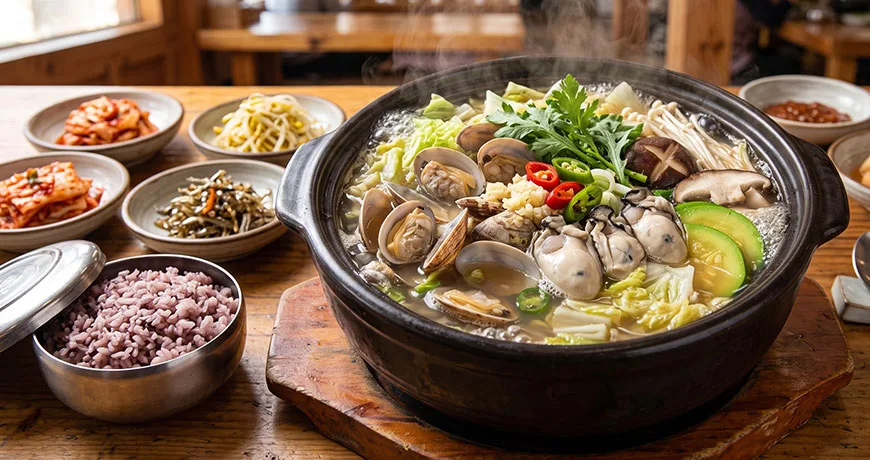
Bajiraksulguk is a hyper-stimulating hangover matrix designed to forcefully metabolize ethanol using the ultra-concentrated taurine and succinic acid of littleneck clams (Bajirak). Unlike crystalline clam consommés, this tavern-style (Pojangmacha) stew intentionally constructs a violent capsaicin-lipid emulsion. By sautéing minced garlic and chili flakes in high-heat lipids, a fiery red base is established before the aqueous solvent is introduced. As the purged clams are dropped into the boiling red emulsion, they hit a critical thermodynamic threshold; their shells pop open, explosively releasing their umami-rich intra-valvular liquor into the spicy broth. To prevent the delicate clam mantles from suffering syneresis (contracting into rubbery pellets), strict thermal termination is required within minutes of the shells opening. Fueled by a massive payload of allicin, capsaicin, and fermented peptides from fish sauce, this stew is engineered to surgically slice through the ethanol coating on the palate.
- ⏱️ Total: 3 hrs 15 mins | Prep: 3 hrs (3% isotonic saline dark purging) | Cook: 15 mins
- 🍳 Difficulty: Medium (Requires absolute mastery of lipid capsaicin extraction and syneresis prevention)
- 🌶️ Profile: Fiery Capsaicin Heat Piercing a Deep, Briny Succinic Acid Broth
- 🍚 Focus: Isotonic Dark Purging, Capsaicin-Lipid Sautéing, & Critical Poaching
Ingredients (3–4 servings)
- Succinic Acid & Taurine Matrix: 1kg Live Littleneck Clams (Bajirak/Baby Clams – MUST be submerged in a 3% isotonic saline solution alongside a steel spoon, covered with black plastic in a dark room for 3+ hours to forcibly purge internal mud and grit)
- Capsaicin-Lipid Binder: 3 tbsp Gochugaru (Chili Flakes), 2 tbsp minced garlic, 2 tbsp cooking oil, 1 tbsp toasted sesame oil (Essential for extracting fat-soluble capsaicin)
- Aqueous Umami Solvent: 1L Anchovy-Kelp Broth or Purified Water
- Aromatic & Reducing Sugar Catalyst: 2 stalks Green Onion (diagonally sliced), 3 Cheongyang green chilies, 1/4 Zucchini (julienned to provide subtle sweetness to round out the capsaicin)
- Ionized Sodium Binder: 1 tbsp Soup Soy Sauce (Guk-ganjang), 1 tbsp Sand Lance Fish Sauce (Kkanari Aekjeot – for immense amino acid synergy), Coarse Sea Salt to taste
Allergy Information Contains: Shellfish (Clam), Soy, Wheat (from Soy Sauce), Fish (Fish Sauce, Anchovy Broth)
Equipment High Thermal Mass Earthenware Pot (Ttukbaegi) or Cast Iron Pan, Mixing Bowl & Black Plastic Bag (for purging), Steel Spoon
Cooking Instructions
- Isotonic Dark Purging: Dissolve 30g of coarse sea salt into 1L of water. Submerge the live clams along with a stainless steel spoon. Cover completely with a black plastic bag. The galvanic corrosion of the metal and the pitch-black environment hyper-stimulate the clams’ respiration, forcing them to violently expel mud. After 3 hours, aggressively scrub the shells against each other under cold running water.
- Capsaicin Lipid Extraction: In a pot, combine the cooking oil and sesame oil. Sauté the minced garlic and scallions over medium heat to release volatile allicin. Lower the heat and add the Gochugaru. Stir continuously so it doesn’t burn. This critical step dissolves the fat-soluble capsaicin pigments into the lipids, creating a vibrant, fiery chili oil base.
- Solvent Fusion: Pour the anchovy broth into the red lipid base and add the julienned zucchini. Turn the heat to high. As it reaches a rolling boil, the lipids and water forcefully emulsify. Stir in the soy sauce and fish sauce to amplify the peptide density.
- Succinic Extraction & Critical Poaching: Once the red broth is boiling violently, drop in the purged clams and sliced chilies. The shells absorb the kinetic heat and suddenly pop open, releasing their highly concentrated succinic acid and taurine liquor directly into the capsaicin solvent.
- Thermodynamic Termination: The absolute moment the clams begin to open, you have a 1-to-2-minute window. Kill the heat immediately. Leaving the flame on will trigger protein syneresis, irreparably ruining the tender clams. Calibrate the final salinity with sea salt and serve bubbling hot in the earthenware pot.
💡 Professional Culinary Tips
- Lipid Solubility of Capsaicin: Dumping dry chili flakes directly into boiling water causes the flakes to bloat and sink, resulting in a muddy, raw-powder flavor. To achieve the razor-sharp, crystalline heat required for a premium hangover stew, the Gochugaru must be sautéed in lipids first. This flawlessly extracts the capsaicin into the oil, preventing powderiness and yielding a brilliant red emulsion.
- Peptide Synergy of Fish Sauce: While clear clam soups rely on purity, the robust, spicy profile of Bajiraksulguk requires an intense umami backbone to support the capsaicin. Introducing a tablespoon of fermented Sand Lance Fish Sauce (Kkanari Aekjeot) injects a massive dose of free amino acids that synergize with the clams’ succinic acid, creating the heavy, lip-smacking body characteristic of authentic tavern fare.
🍶 Gastronomic Pairing
- Biochemical Palate Cleansing: When the plump clams and fiery capsaicin emulsion coat your oral mucosa, pair this intense matrix with an ice-cold shot of premium traditional distilled Soju (40%+ ABV). The highly refined ethanol acts as a chilling surgical scalpel, violently shearing through the thick lipid and capsaicin barrier on your tongue. This flawless chemical intervention instantly resets your pain and taste receptors, maximizing the endorphin rush of the very next bite.
Nutrition Facts (Estimated)
Total Content : Approx. 500g (1 serving, excluding shell weight)
Calories : 180 kcal (Excluding rice)
– Sodium : 1,450mg (Elevated due to Fish Sauce, Soy Sauce, and Sea Salt calibration)
– Total Carbohydrate : 10.0g (Gochugaru polysaccharides and zucchini reducing sugars)
– Sugar : 3.0g
– Total Fat : 8.0g (Extraction lipids from cooking oil and sesame oil)
– Saturated Fat : 1.2g
– Cholesterol : 55.0mg
– Protein : 19.0g (Highly bioavailable taurine and myofibrillar complex)
– Dietary Fiber : 3.0g
*Daily Values are based on a 2,000 calorie diet and standard Korean nutritional reference values.
**Nutritional values are calculated based on original ingredients; substitutions may alter specific macronutrients.
Origins and Food Culture of Baby Clam Soup Accompaniment to Alcoholic Drinks (Bajiraksulguk)
1. Prehistoric Shell Mounds and Classical Treatises (Jasanoebo, Dongui Bogam)
- Named Bajirak from the rhythmic rustling sound (bajirak-bajirak) made by hand-rakes scraping through tidal gravel and sandy mudflats, Manila clams have sustained peninsular coastal communities for millennia, as evidenced by vast Neolithic shell mounds (paechong) unearthed along the southern and western shores (such as Busan Dongsam-dong).
- In his 1814 marine treatise Jasanoebo, scholar Jeong Yak-jeon recorded the clam under the phonetic Hanja names Bajiragi (婆之螺基) or Pacheop (波妾), noting that “its flesh is abundant, sweet, and exceedingly tender; when simmered into soup, it produces a clear savor of unrivaled delicacy.” Furthermore, Heo Jun’s 1613 medical compendium Dongui Bogam praised bivalve broths for their ability to “dispel vexing heat in the chest, quench parching thirst, neutralize alcohol toxicity, and fortify the stomach,” establishing centuries of therapeutic pedigree as a folk medicinal remedy for revelers.
2. The Culinary Science of Osmotic Depuration (Haegam) and Ethanol Codistillation
- The technical foundation of Bajiraksulguk requires meticulous depuration: submerging live clams in dark, ocean-salinity (approx. 3.5%) brine with a metal utensil to stimulate bivalve respiration, prompting them to naturally expel micro-sand grains and silt from their mantle cavities.
- Because the delicate actomyosin protein fibers of clams contract rapidly when overcooked—turning tough and rubbery while losing intracellular moisture—master cooks execute strict thermodynamic timing. A splash of refined rice wine is introduced over high flame; the alcohol vaporizes rapidly, binding and lifting away volatile amine off-notes through azeotropic codistillation. The flame is reduced the moment the shells snap open (approx. 75–80°C), preserving the succulent chew and locking rich glycogen into an unctuous, milky clear broth (Cheongtang).
3. The Cultural Dualism of “Sulguk” and the Heritage of Real-Time Hangover Relief
- In Korean dining, the concept of Sulguk (literally “alcohol soup”) occupies a unique culinary niche: it serves simultaneously as an appetizing, savory accompaniment to alcoholic drinks (anju) and an active counter-agent that promotes soberness during consumption (haejang).
- Foregoing heavy pastes and artificial flavorings in favor of sea salt, garlic, and fresh chilies, Bajiraksulguk became the legendary staple of roadside tent taverns (pojangmacha) and late-night pubs. Cherished by workers and friends gathering over modest cups of soju, it represents the ingenious culinary wisdom of “Concurrent Hangover Relief”—protecting the stomach and detoxifying the liver while revelry is underway—remaining an immortal monument to Korean nocturnal camaraderie, working-class solace, and restorative maritime comfort.
The Crystalline Extraction of Tidal Manila Clam Liquor, the Thermal Vaporization of Refined Rice Wine, and the Incandescent Strike of Cheongyang Chili Broth: A Refined Portrait of Bajiraksulguk
Bajiraksulguk (Baby Clam Soup Accompaniment to Alcoholic Drinks) stands as the dynamic, crystalline, and biologically astonishing summit of Korea’s tavern-born (tangban) gastronomy. Centered upon pristine Manila clams (Ruditapes philippinarum or Bajirak) hand-raked from the intertidal sand-mud flats of the western and southern coastlines, the dish begins with rigorous preparatory discipline. Enclosing concentrated marine minerals and tidal liquor within their variegated calcified shells, the live clams are steeped in dark, cool sea-salt brine for hours to thoroughly purge internal silts and sandy deposits. After vigorously scrubbing the shells clean, the clams are mounded generously inside a heavy iron cauldron or earthenware pot (ttukbaegi) alongside clear spring water and a liberal douse of refined rice wine (cheongju or soju). Layered with thinly sliced fresh garlic and sliced Cheongyang green chilies, the vessel is brought to a rapid, assertive boil over open flames. The moment the internal steam pressure forces the shells open, releasing ivory-hued, succinic-rich clam nectar into the broth, the heat is promptly arrested to prevent myofibrillar toughening. Crowned with chopped scallions and seasoned with a crystalline pinch of solar sea salt or aged artisanal soup soy sauce, this dish represents a masterclass in tavern minimalism. Bypassing heavy bean pastes or fiery chili mashes, Bajiraksulguk harnesses the pure, unmasked organic succinic acids of cold-water bivalves in direct synthesis with evaporating ethanol, delivering a broth that simultaneously summons the next drink while actively cleansing the liver of metabolic fatigue.
Confronting the boiling vessel tableside as diamond-bright vapors curl upward between gaping clam shells and floating emerald chili slices, lifting a deep spoonful of the broth releases an immediate, deeply electrifying olfactory charge: the clean, iodine-fresh perfume of an ocean mudflat mingles seamlessly with the faint sweetness of evaporating cereal wine, the sharp sulfurous warmth of fresh garlic, and the piercing, capsaicin-charged breath of green chilies. Taking the first sip delivers an unadorned revelation across the oral mucosa: devoid of any greasy surface tension, the clarified amino acid broth floods the tongue with silk-like softness, gliding effortlessly down the esophagus to soothe alcohol-inflamed tissues and banish mental fog in an exhilarating wave of what Korean gastronomy reveres as siwon-kalkal-han mat—the sensation of profound, soul-cleansing clarity anchored by a sharp, spicy kick. Plucking the plump clam meat from its calcified shell reveals an extraordinary structural joy: having puffed under convective steam, the ruffled mantle and muscular foot resist tooth pressure with an energetic, springy bounce (taenggeul) before bursting to release concentrated torrents of sweet, briny clam liquor. In delightful contrast, the firm adductor muscle provides a dense, toothsome chew, while the crisp slices of chili supply botanical friction. Pairing each fiery, savory spoonful with a cold sip of traditional spirits, or steeping warm white rice into the reduced clear broth with a bite of aged kimchi, completes an unforgettable ritual of physical rejuvenation, tavern camaraderie, and profound gastronomic catharsis.
The enduring majesty of Bajiraksulguk lies in its working-class heritage—rooted in the ancient tavern (jumak) practice of seonju-hutang (drinking wine first, followed by restorative broth) and reborn under the orange plastic tarps of modern urban street stalls (pojangmacha). In these nocturnal sanctuaries, cooks comforted exhausted laborers by offering a low-cost, lightning-fast cauldron of steaming clams that could sustain an evening of heavy drinking while protecting vulnerable digestive organs. Harmonizing the dual identities of an intoxicating tavern accompaniment and an empirical hangover restorative, a steaming bowl of baby clam wine soup remains an irreplaceable monument of coastal generosity, tavern ingenuity, and brilliant Korean culinary craftsmanship.
Editor’s Review
1. A Dynamic Harmony of Popped Bivalve Elasticity, Adductor Muscle Resilience, Crisp Chili Snap, and Frictionless Consommé Fluidity
The structural architecture inside the vessel delivers an extraordinary, three-tiered choreography between dense molluscan muscle bundles, hydrated allium cell walls, and an ultra-low-viscosity aqueous matrix. Cooked rapidly within its own shell, the Manila clam’s muscular foot and undulating mantle retain their intracellular fluids, delivering an energetic, springy bounce (taenggeul) that pops under mastication with juicy ease. Counterbalancing this, the anterior and posterior adductor muscles supply a dense, fibrous chew that anchors oral resistance. Sliced Cheongyang chilies and fresh scallions preserve high cellular turgor, fracturing between the teeth with an audible, crisp snap (ajak) that diversifies structural friction. Simultaneously, the completely defatted clear broth forms a frictionless lubricating fluid layer across oral membranes, ensuring an impeccably balanced, non-fatiguing mouthfeel from the first steaming sip to the last.
2. Succinic Acid Umami Chemistry, Flash-Boiling Paramyosin Syneresis Mitigation, Ethanol Azeotropic TMA Deodorization, and Taurine-Mediated Hepatic ADH Activation
Bajiraksulguk represents an exacting study in molluscan muscle biochemistry, flavor volatile thermodynamics, and neuroprotective alcohol metabolism. The flavor profile is dominated by high concentrations of organic succinic acid and its sodium salts, which furnish a distinct, deeply resonant, and refreshing savory foundation. This converges with high physiological reserves of sweet free amino acids within the clam flesh—principally glycine, alanine, and betaine—to generate intense, rounded sweetness without refined sugars. Manila clam muscle is heavily reinforced with paramyosin and actomyosin; sustained exposure to rolling boiling (>100°C) triggers hyper-contraction of these protein lattices, causing extensive cellular moisture expulsion (syneresis) that leaves the clam rubbery and shrunken. Bringing the water and rice wine to a covered rolling boil and immediately lowering the flame the moment the hinge ligaments release (the critical 80–85°C window) preserves myofibrillar Water Holding Capacity (WHC), locking in plump tenderness. Thermodynamically, the ethanol from the rice wine boils at 78.3°C; as it vaporizes, it forms an azeotropic mixture with volatile basic amines—principally fishy trimethylamine (TMA)—carrying them off into the air and purifying the aromatic profile. Concurrently, capsaicin from the chilies stimulates oral TRPV1 receptors, triggering salivary flow and peripheral vasodilation to induce mild sweating. Biologically, dense concentrations of bioavailable taurine and methionine in the clam meat accelerate hepatic alcohol dehydrogenase (ADH) and aldehyde dehydrogenase (ALDH) expression, swiftly neutralizing toxic acetaldehyde to establish an immaculate, restorative recovery mechanism.
3. The Pojangmacha Tavern Tradition and the Sovereign Apex of Bivalve Sulguk Gastronomy
By reconciling the conflicting desires of sustained alcohol consumption and rapid physical recuperation within a single steaming pot, Bajiraksulguk stands as the definitive archetype of functional tavern cookery in Korean food history. Evolving from the dockside fires of coastal ports into an indispensable nocturnal staple of modern urban nightlife, this diamond-clear, capsaicin-kissed classic captures the resilient spirit of Korean communal dining, standing as an enduring sanctuary of domestic comfort, tavern camaraderie, and brilliant culinary artistry.