
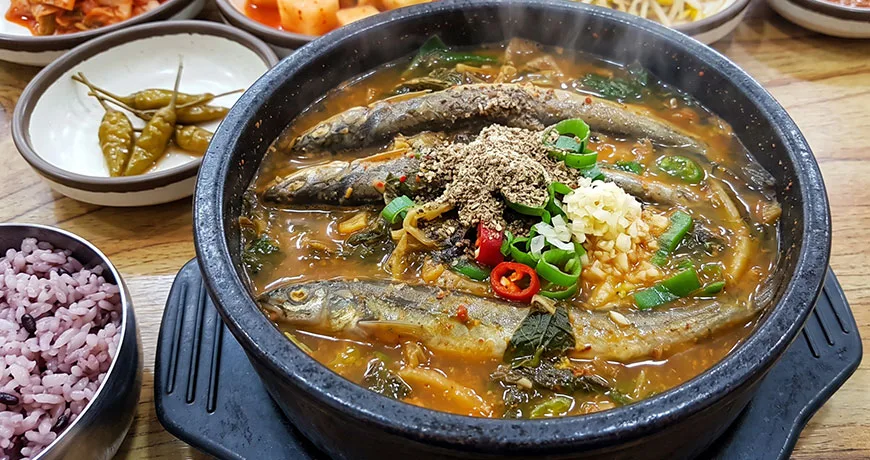
Tongchueotang is a brutal, high-thermodynamic recovery soup engineered to extract the intact calcium, proteins, and viscera of freshwater mud loaches by boiling them entirely whole, completely bypassing mechanical grinding. The purity of the broth is dictated by a ruthless pre-treatment: bombarding live loaches with coarse salt triggers an extreme osmotic shock, forcing them to thrash and violently purge their defensive mucin slime layer and internal mud (which contains geosmin). Submerged in a boiling hypertonic solvent, the loaches undergo prolonged thermal hydrolysis, a thermodynamic convection process that slowly softens their fine skeletal structure until the bones are tender enough to chew effortlessly. The hypertonic fermented soybean peptides (Doenjang) integrate into the dense cellulose matrix of dried radish greens (Siraegi), acting as a massive sponge for the heavy broth. In the final moments, the addition of Sancho (Korean Sichuan pepper) powder introduces volatile sanshool compounds that physically tingle and stimulate the TRPA1 receptors on the tongue, chemically paralyzing the palate just enough to perfectly mask the residual muddy, freshwater off-notes.
⏱️ Total: 2 hrs 30 mins | Prep: 1 hr (Osmotic purging & mucin stripping) | Cook: 1 hr 30 mins | 🍳 Difficulty: Extreme (Requires live freshwater fish purging and whole bone thermal softening) | 🌶️ Profile: Deeply Earthy, Savory, and Electrically Tingling (Sanshool) | 🍚 Focus: Osmotic Shock Purging, Whole Bone Thermal Hydrolysis, & TRPA1 Receptor Stimulation | 🍶 Pairing: Tart, highly carbonated unpasteurized Saeng-Makgeolli
Ingredients (3–4 servings)
- Freshwater Protein & Calcium Matrix: 500g Live Mud Loaches (Misgurnus anguillicaudatus – for purging: 1/2 cup coarse salt, a lid, and coarse pumpkin leaves or a plastic bag for friction)
- Cellulose & Lignin Matrix: 300g Rehydrated Dried Radish Greens (Siraegi), 200g Napa Cabbage outer leaves (Eolgari-baechu)
- Hypertonic Fermented Solvent: 1.5L Anchovy-Kelp Broth or Rice Water, 3 tbsp Doenjang (Korean soybean paste), 1 tbsp Gochujang (chili paste)
- Aromatic & Chemical Masking Catalyst: 1 tsp Sancho or Chopi powder (Korean Sichuan pepper), 3 tbsp Hulled Perilla Seed Powder (Deulkkae-garu), 2 tbsp minced garlic, 1 tbsp minced ginger, 2 stalks Green Onion (diagonally sliced), 1 handful Asian Chives (Buchu), 2 Cheongyang green chilies
Allergy Information Contains: Freshwater Fish (Loach), Soy, Wheat (from Doenjang, Gochujang)
Equipment Deep pot with a heavy lid (for purging), High Thermal Mass Cauldron or Heavy-bottomed Pot, Cutting Board, Knife
Cooking Instructions
- Osmotic Shock & Geosmin Purging: Place the live loaches into a deep pot. Pour the coarse salt over them and immediately clamp the lid down tight. The catastrophic osmotic shock causes the loaches to thrash violently, forcing them to excrete their protective mucin (slime) and internal mud. After 15 minutes, once they have expired, vigorously scrub the loaches using coarse pumpkin leaves or handfuls of salt to physically strip away the remaining coagulated mucin layer. Rinse thoroughly under cold water.
- Initial Thermal Coagulation: Place the cleaned whole loaches, broth, ginger, and 1 tbsp of Doenjang into the cauldron and bring to a rapid boil. The water-soluble blood and impurities will thermally coagulate into dark foam. Meticulously skim this scum away to establish a clean, non-fishy baseline.
- Cellulose Matrix Integration: Chop the Siraegi and cabbage into bite-sized pieces. Vigorously knead them with the remaining Doenjang, Gochujang, and minced garlic. This physical kneading forces the hypertonic seasoning deep into the tough cellular lignin structures of the greens.
- Whole Bone Thermal Hydrolysis: Add the seasoned greens into the boiling loach pot. Cover and simmer over medium heat for at least 1 hour. This prolonged thermodynamic convection is absolutely critical to thermally hydrolyze and break down the calcium matrix of the loach’s spine, softening it so the entire fish can be chewed and swallowed without catching in the throat.
- Emulsion & TRPA1 Stimulation: In the final 10 minutes, stir in the green onions, chilies, and perilla seed powder to exponentially increase the rheological viscosity of the broth. Just before serving, crown with fresh chives and a dusting of Sancho powder, deploying its sanshool compounds to aggressively mask any lingering freshwater aromas.
💡 Professional Culinary Tips
- The Physics of Mucin Depletion: The slippery mucin on a loach’s skin is a biochemical trap that locks in geosmin (the compound responsible for the smell of mud). Purging them with osmotic salt shock and manually scrubbing the slime off with abrasive friction is not optional. Failing this grueling, analog process will contaminate the entire broth with a foul, fishy viscosity, completely destroying the dish.
- Thermodynamic Threshold of Bone Softening: Unlike Namwon-style Chueotang where the fish are boiled and pulverized in a blender, Tongchueotang demands the fish be eaten whole. If you fail to subject the loaches to 100°C kinetic heat for at least 60 continuous minutes, their rigid vertebrae will not undergo thermal hydrolysis. The bones will remain dangerously sharp, causing a critical textural failure when chewing.
- TRPA1 Paralysis via Sanshool Compounds: Sancho (Chopi) powder is not merely a flavor enhancer. It contains hydroxy-alpha-sanshool, a potent chemical that physically binds to the TRPA1 receptors on the tongue, causing a localized numbing/tingling sensation. This biological anesthetic is a calculated culinary filter, temporarily paralyzing the palate so the brain cannot detect the heavy, dank geosmin typical of freshwater ecosystems.
🍶 Gastronomic Pairing
- Biochemical Palate Cleansing: When the heavy, earthy viscera of the whole loaches and the electric tingling of the Sancho powder explosively dominate your mouth, pair this intense dish with a chilled bowl of unpasteurized Saeng-Makgeolli. The sharp lactic acid generated by active yeast and the biting carbonation fiercely scrub the heavy mud-notes and perilla lipids from your tongue. This flawlessly resets your palate and brilliantly highlights the deep, savory umami of the softened radish greens.
Nutrition Facts (Estimated)
Total Content : Approx. 750g (1 serving)
Calories : 410 kcal (Excluding rice)
– Sodium : 1,350mg (Variable depending on Doenjang and Gochujang)
– Total Carbohydrate : 35.0g (Polysaccharides from radish greens)
– Sugar : 4.0g
– Total Fat : 14.0g (Unsaturated lipids from perilla seeds and loach)
– Saturated Fat : 2.5g
– Cholesterol : 115.0mg
– Protein : 38.0g (High-density whole bone calcium and chondroitin-bound proteins)
– Dietary Fiber : 16.0g (Ultra-high density cellulose)
*Daily Values are based on a 2,000 calorie diet and standard Korean nutritional reference values.
**Nutritional values are calculated based on original ingredients; substitutions may alter specific macronutrients.
Origins and Food Culture of Whole Loach Soup (Tongchueotang)
1. Autumn Paddy Field Foraging (Cheonlyeop) and Classical Medical Lineage
- Rooted in the ancient agrarian tradition of draining rice paddies (dogu-chigi) around the autumn equinox (Chubun) and White Dew (Baengno), when farmers gathered the plump, mud-burrowing loaches fattened for winter hibernation in communal foraging outings (cheonlyeop).
- Reflecting its cultural identity, the Hanja character for loach (Chu / 鰍) literally combines “fish” (魚) and “autumn” (秋). Praised in Heo Jun’s 1613 Dongui Bogam as “warm in nature, sweet in taste, and non-toxic, effectively nourishing the internal organs and arresting chronic diarrhea,” and lauded in the Bencao Gangmu for its ability to replenish vital yang energy and restore youthful vigor, loach has long stood as Korea’s premier wild seasonal tonic.
2. The Culinary Science of Seoul-Style “Chutang” and Whole-Fish Integrity
- Distinct from the pureed mud-porridge consistency of southern Jeolla-style Chueotang or the chili paste-and-dough flake (sujebi) profile of Gangwon Wonju-style, historic Seoul/Gyeonggi-style Chutang preserves the loaches entirely whole.
- Rooted in the urban tastes of Hanyang merchants and scholar-nobles, this variation features an aromatic beef brisket and marrow bone stock cooked with whole loaches, deep-fried tofu (yubu), fresh bean curd, and mushrooms. The culinary secret lies in purging the live fish with salt or rough pumpkin leaves and executing precise hydrothermal simmering: cooking the loaches long enough for the bones to soften into chewable morsels while keeping the exterior skin and meat intact without dissolving into mush.
3. The Ritual of “Chubok” (Autumn Rejuvenation) and Modern Culinary Heritage
- Serving as the autumn counterpart to summer’s three dog days (Sambok), the tradition of Chubok called for consuming whole loach soup to fortify the body against the upcoming winter freeze. The loach’s dynamic ability to burrow through dense, freezing mud made it an enduring folk metaphor for resilient masculinity and unyielding vitality.
- Immortally preserved through historic mid-20th-century Seoul dining bastions like Yonggeumok (established in 1932 in Mugyo-dong), which catered to generations of national poets, political leaders, and journalists, Tongchueotang remains a revered living monument to Korean whole-food dining and working-class gastro-resilience.
The Primal Vitality of Subterranean River Loaches and the Resonant Depth of Bovine Broth: A Refined Portrait of Tongchueotang
Tongchueotang (Seoul-Style Whole Loach Soup) stands as the unapologetically bold, biologically intact, and deeply invigorating summit of Korea’s traditional freshwater fish (tangban) gastronomy. In late autumn, as rice paddies dry out and river loaches (mud pond fish—chueo or Misgurnus anguillicaudatus) fatten themselves to burrow into deep mudflats for winter hibernation, they are collected and rigorously rubbed with coarse sea salt and pumpkin leaves to strip their slippery surface mucin. In stark contrast to the southern variants (Namdo-style) where the fish is boiled down, pureed, and passed through a fine mesh sieve to eliminate visual cues, Tongchueotang preserves the fish in its unadorned, whole anatomy—head, visceral mass, and calcified skeleton. Submerged into a foundational beef stock brewed from brisket, marrow bones, and cow intestines, the soup is enriched with aged chili paste, rustic soybean paste (doenjang), fresh bean curd cubes, zucchini, mushrooms, and fried tofu before being brought to a rolling simmer inside an earthenware vessel (ttukbaegi). By refusing the homogenizing impulse of modern food processing, this dish celebrates whole-organism nourishment, delivering the full spectrum of marine-riverine minerals, gelatin, and visceral savor into a majestic bowl of restorative vitality.
Confronting the bubbling crimson surface as the whole, graceful silhouettes of the loaches emerge alongside golden tofu cubes and green scallions releases an immediate, electrifying sensory charge: the bright, citrusy, and numbing perfume of freshly ground Korean pepper (chopi) mingles with the rich, bready savor of aged doenjang, the hearty warmth of slow-cooked beef broth, and the faint, sweet scent of riverbanks. Taking the first sip coats the palate in a velvety, full-bodied broth that washes down the throat, infusing an exhausted digestive system with deep warmth. Lifting an entire loach to the mouth and biting into it reveals an extraordinary textural revelation: the delicate, poached flesh dissolves instantly across the tongue like warm cream, while the slender spinal column and fin rays—softened by gentle hydrothermal cooking—yield with a pleasant, microscopic crunch (odok) without sharp bone hazard. The complex, slightly bitter savor of the natural visceral organs harmonizes with the broth’s fiery capsicum heat, while silken tofu provides a soothing cushion, yielding an unforgettable, fatigue-banishing ritual of complete nutritional and sensory rejuvenation.
The enduring majesty of Tongchueotang lies in its dual heritage—originating in the post-harvest communal ritual of cheonlyeop (river wading and fish-catching feasts in rural irrigation trenches) and evolving into the iconic urban Chutang of Joseon-era Seoul. In taverns along the Cheonggyecheon stream and surrounding city gates, aristocratic scholars and gritty manual laborers sat side-by-side to consume the restorative power of whole riverine life. A steaming cauldron of whole loach soup remains an irreplaceable monument of agrarian resourcefulness, whole-food nutritional reverence, and dazzling Korean culinary craftsmanship.
Editor’s Review
1. A Dynamic Harmony of Silken Loach Myotome Tenderness, Softened Micro-Bone Crunch, and Cushioning Bean Curd Density
The structural architecture inside the vessel delivers an extraordinary, tactile choreography between whole vertebrate anatomy, softened skeletal tissues, and plant-based curd gels. Gentle boiling dissolves the delicate inter-muscular collagen sheets of the loach, allowing the tender flesh to separate effortlessly along individual myotome flakes without stringy resistance. Concurrently, the central vertebral column and delicate ribs, tenderized through steady hydrothermal extraction, offer an engaging micro-crunch that fractures cleanly under tooth pressure without sharp resistance. Silken tofu cubes and porous fried tofu puffs act as soft, fluid-filled cushions that contrast with the fish, while sliced squash and Welsh onions provide crisp structural friction, ensuring an impeccably balanced, non-fatiguing mouthfeel from the first bite to the last.
2. Epidermal Mucin Glycoprotein Rheology, Skeletal Mineral Solvation, Visceral Autolytic Amino Acids, and Sanshool-Geosmin De-Odorization Mechanics
Tongchueotang represents an exacting study in freshwater fish histology, skeletal demineralization physics, and botanical deodorization chemistry. The slippery protective epidermal coating of the loach is rich in high-molecular-weight mucin glycoproteins and chondroitin sulfate complexes; during cooking, these compounds hydrate and disperse into the broth, elevating its dynamic viscosity and forming a protective, demulcent film that coats the gastric mucosa. Prolonged simmering over controlled convective heat softens the calcium phosphate lattice of the whole fish skeleton, promoting the extraction of trace bioavailable minerals and bone marrow collagen into the liquid. Free amino acids released through post-mortem visceral autolysis (principally aspartic acid and glutamic acid) converge with muscle-derived inosine monophosphate (IMP) and the rich glutamates of the beef stock and fermented soybean paste, triggering a massive, multi-tiered umami response across oral T1R1/T1R3 heterodimers. Furthermore, freshwater muddy volatiles—principally geosmin and 2-methylisoborneol (2-MIB)—are mechanically scrubbed away during initial salt abrasion, while residual odors are chemically masked by the volatile monoterpenes (limonene, citronellal) and hydroxy-alpha-sanshool in chopi (Korean peppercorn), which activate oral TRPV1 and TRPA1 receptors to stimulate the palate and eliminate fishy aftertastes.
3. The Seoul Metropolitan Chutang Heritage, Whole-Body Ingestion (Ilche-Eumsik), and the Zenith of Korean Riverine Gastronomy
Distinguished from the pureed, sieved loach soups of the southern provinces, the whole-fish tradition of Seoul-style Chutang stands as a monument to metropolitan gastronomic confidence. Embodying the ancient East Asian philosophical principle of Ilche-Eumsik (一體飮食—consuming an organism in its entirety to absorb its total, indivisible vital energy), this unmasked culinary masterpiece elevates humble mud-dwelling fish into an elite restorative tonic, representing an enduring sanctuary of ecological balance, seasonal wisdom, and brilliant Korean culinary artistry.