
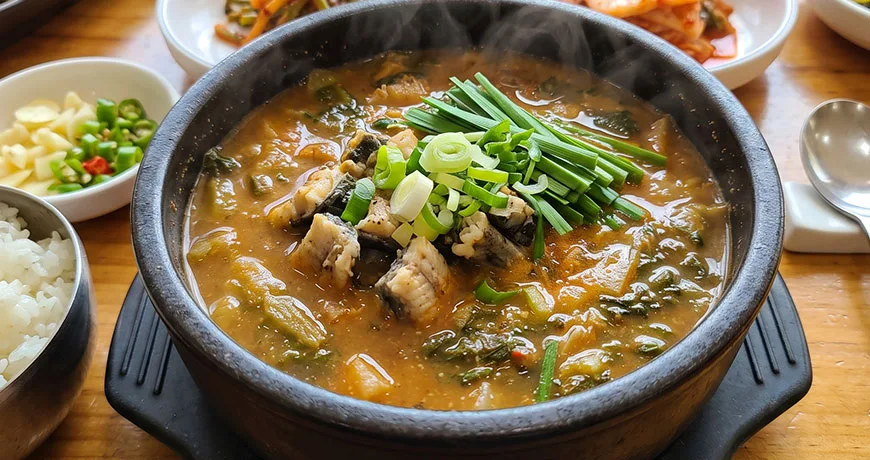
Jangeotang is a hyper-viscous, extreme stamina-recovery colloidal soup engineered by thermally breaking down the thick mucin layer and dense muscular tissues of highly fatty eels, followed by brutal mechanical maceration. As the boiling convective energy renders the eel’s overwhelming unsaturated fatty acids (EPA/DHA) into the broth, highly fibrous Siraegi (dried radish greens) and Perilla seed powder are introduced. These act as powerful emulsifiers, violently binding the separating lipids and aqueous broth into a thick, heavy colloidal suspension. This dense animal-lipid matrix is integrated with the fermented amino acids of Doenjang. Upon serving, the addition of Chopi (Korean prickly ash) detonates sanshool compounds that physically numb the tongue’s tactile receptors, flawlessly neutralizing any trace of the eel’s muddy, freshwater aromatics. In times of severe physical exhaustion, this soup acts as an optimized, liquid-state nutritional payload delivered instantly to the brain and muscles without overloading the digestive tract.
- ⏱️ Total: 2 hrs 30 mins | Prep: 30 mins | Cook: 2 hrs
- 🍳 Difficulty: High (Requires precise mechanical maceration and lipid emulsification)
- 🌶️ Profile: Earthy, Intensely Nutty, and Numbing/Tingling
- 🍚 Focus: Mechanical Maceration, Emulsion Stabilization, & Alkaloid Masking
- 🍶 Pairing: Acidic, chilled Bokbunja (Black Raspberry Wine) or refined Cheongju
Ingredients (3–4 servings)
- Protein & Lipid Matrix: 1kg Cleaned Sea Eel or Freshwater Eel (gutted, surface slime washed)
- Cellulose Matrix: 400g Boiled Siraegi (Dried Radish Greens) or Ugeoji (excess water squeezed, chopped)
- Emulsion Stabilizer & Binder: 5 tbsp Hulled Perilla Seed Powder (Deulkkae-garu)
- Fermented Deodorizer (Seasoning): 3 tbsp Doenjang, 1 tbsp Gochujang, 3 tbsp minced garlic, 1 tbsp minced ginger, 2 tbsp Soup Soy Sauce (Guk-ganjang), 2 tbsp cooking wine (Mirim)
- Aqueous Solvent: 3L Purified Water
- Aromatic & Alkaloid Finish: 2 stalks Green Onion, 3 Cheongyang green chilies, 1 handful Garlic Chives (Buchu), Chopi/Sancho powder (to taste)
Allergy Information
- Contains: Fish (Eel), Soy, Wheat (from Doenjang, Gochujang, and soy sauce)
Equipment
- Large Stockpot, Blender or Immersion Hand Blender, Mixing Bowl, Fine Mesh Strainer (Optional)
Cooking Instructions
- Thermal Hydrolysis & Extraction: Blanch the cleaned eels in boiling water with a splash of cooking wine and ginger for 10 minutes to coagulate surface mucin and impurities. Rinse thoroughly. Place the eels in a large pot with 3L of purified water. Boil over medium heat for at least 1.5 hours until the physical structure of the fish completely disintegrates.
- Mechanical Maceration & Emulsion: Using a blender or immersion blender, violently pulverize the fully cooked eels, bones and all, directly into the broth. (Pass through a strainer if a smoother texture is required). The marrow lipids and muscle proteins are micro-shattered, forging a heavy, opaque milky colloidal base.
- Cellulose Binding: Vigorously knead the chopped Siraegi with Doenjang, Gochujang, soy sauce, garlic, and ginger. This mechanical friction forces the hypertonic seasoning into the plant’s cellular matrix. Introduce this seasoned cellulose into the pulverized eel broth and simmer over medium-low heat for 30 minutes.
- Lipid Stabilization & Alkaloid Finish: Once the greens are tender, introduce the perilla seed powder to maximize viscosity and stabilize the lipid emulsion. Add chopped green onions, chilies, and garlic chives, boiling for one final minute. Right before consuming, the diner must introduce Chopi powder, utilizing its paresthesia-inducing compounds to strike and control the sensory receptors.
💡 Professional Culinary Tips
- Lipid Emulsification & Perilla Powder: The massive volume of animal lipids (oil) from the eel inherently wants to separate from the water. The introduced perilla seed powder is not merely a flavor enhancer; its microscopic plant proteins and dietary fibers act as a structural emulsifier. It chemically binds the eel fat with the aqueous broth, creating that flawless, lip-sticking viscosity.
- Sensory Control via Sanshool: The earthy, muddy aromatics (geosmin) inherent in eels cannot be fully masked by heat or garlic alone. The sanshool compounds in Chopi powder do not just cover the smell; they trigger the 50Hz vibration receptors on the tongue, causing a physical numbing and tingling sensation (paresthesia). This chemical strike completely blocks off-flavors and exponentially detonates the appetite.
🍶 Gastronomic Pairing
- Biochemical Palate Cleansing: When the ultra-dense emulsion of eel lipids and perilla powder tightly coats your palate, and the tingling Chopi dominates your senses, pair this with a chilled glass of Bokbunja (traditional Black Raspberry Wine). The intense organic acids and tannins of the black raspberries act as a surgical solvent, slicing right through the heavy lipid matrix, while its tart, fruity aromatics provide a striking contrast to the heavy, earthy soup.
Nutrition Facts (Estimated)
Total Content : Approx. 800g (1 serving)
Calories : 536 kcal
– Sodium : 3096.0mg
– Total Carbohydrate : 29.4g
– Sugar : 21.2g
– Total Fat : 31.2g
– Saturated Fat : 5.0g
– Cholesterol : 270.0mg
– Protein : 34.5g
– Dietary Fiber : 8.8g
*Daily Values are based on a 2,000 calorie diet and standard Korean nutritional reference values.
**Nutritional values are calculated based on original ingredients; substitutions may alter specific macronutrients.
Origins and Food Culture of Eel Soup (Jangeotang)
1. Southern Port Heritage and Classical Marine Lineage in the Jasanoebo
- Rooted in the rich maritime communities of the southern Korean coastline—most notably Yeosu, Tongyeong, and Goheung—where fishermen harnessed daily catches of conger eel (Bung-jangeo) and pike eel (Hamo) to nourish their bodies against turbulent sea winds.
- Historically documented in Jeong Yak-jeon’s 1814 marine treatise Jasanoebo under the Hanja name Hae-man-ryeo (海鰻鱺), where it was lauded as “sweet, rich, exceptionally nourishing, and deeply restorative for physical debility.” Similarly, Heo Jun’s 1613 Dongui Bogam praises eel (Man-ryeo-eo) as a supreme medicinal food that replenishes visceral energy, clears damp-heat, and dispels chronic exhaustion, confirming centuries of therapeutic coastal dining.
2. Cauldron Bone Emulsification and the Dual Lineages: “Tong” (Whole) vs. “Gari” (Pureed)
- The cornerstone of authentic flavor lies in prolonged cauldron extraction: roasting and simmering nutrient-dense eel heads and backbone frames over high fires to generate a stable, milky colloidal lipid emulsion (yuhwa) that delivers deep savory body without artificial enhancers.
- The culinary tradition developed into two distinct regional techniques: the “Gari” style (common in inland and western Jeolla homes), where boiled eel meat is pureed and strained through a fine sieve into an ultra-smooth, porridge-like consistency similar to southern Chueotang; and the famed “Tong-jangeotang” of Yeosu, where thick, bone-in steaks of succulent conger eel are simmered directly with radish greens to deliver a hearty, chewable texture.
3. The Icon of Summer “Bokdal-im” and Southern Marine Soul Food
- Revered alongside Samgyetang and Mineotang as one of the ultimate Bokdal-im foods consumed during the scorching dog days of midsummer (Sambok) to counter dehydration, profuse sweating, and seasonal loss of appetite.
- The eel’s extraordinary physical tenacity in swimming upstream against fierce ocean currents made it an enduring cultural metaphor for unyielding life energy and masculine vigor. Anchoring celebrated destinations like the Yeosu Bongsan-dong Eel Alley, Jangeotang remains an enduring cultural monument to Korean maritime gastronomy, dedicated to comforting tired workers and invigorating the human spirit.
The Torrential Lipid Vitality of Coastal Eels, the Earthy Emulsion of Roasted Perilla, and the Resonant Depth of Fermented Soy: A Refined Portrait of Jangeotang
Jangeotang (Simmered Eel and Perilla Seed Soup) stands as the deeply nourishing, lipid-rich, and biologically opulent summit of Korea’s marine restorative (tangban) gastronomy. Wild or farmed eels—ranging from the sea-dwelling conger (Conger myriaster) and daggertooth pike conger (Muraenesox cinereus) harvested from the churning tidal waters of Yeosu, Goheung, and Tongyeong, to freshwater river eels (Anguilla japonica)—are gathered during their peak fat-storing cycles. Whole carcasses, encompassing collagenous heads, mineral-dense spines, and fillets, are simmered over sustained heat in roaring cauldrons until the structural tissues collapse into a milky, nutrient-dense fish bone stock. The poached eel meat is either carefully flaked into tender fillets or passed through a fine mesh sieve to eliminate needle-like intermuscular bones. Seasoned deeply with aged artisanal soybean paste (doenjang), red chili flakes, crushed garlic, and fresh ginger, the broth is fortified with blanched cabbage greens (ugeoji) or radish tops, mung bean sprouts, scallions, and generous handfuls of finely milled toasted perilla seed powder (deulkkaegaru). Transcending the sharp clarity of everyday fish stews and the simple char of grilled eel, this dish binds copious marine lipids and bioavailable proteins into a creamy, plant-buffered colloidal suspension, wrapping the body in an unbroken wave of restorative warmth.
Confronting the boiling earthenware pot (ttukbaegi) as golden-brown volcanic bubbles burst across its surface releases an immediate, deeply comforting olfactory charge: the toasted nuttiness of milled perilla seeds mingles seamlessly with the rich, bready savor of aged doenjang, the sweet warmth of simmered alliums, and the zesty, citrus-pine lift of freshly crushed chopi (Korean peppercorn). Taking the first sip coats the palate in a velvety, lip-clinging emulsion of natural fish gelatin and unsaturated oils; the unctuous stock glides effortlessly down the esophagus, delivering deep, restorative warmth to an exhausted digestive tract. Sinking your teeth into the flaked eel meat reveals an extraordinary structural tenderness: having relaxed along its muscular myotomes, the fish dissolves across the tongue like warm cream, releasing a clean, concentrated savor. The braised cabbage greens, having drunk deeply of the savory broth, yield with a tender, succulent chew that balances the richness with sweet vegetable hydration. Seasoned at the table with a pinch of wild pepper and accompanied by warm rice and crisp radish kimchi, this meal resolves into an unforgettable, fatigue-banishing ritual of complete physical rejuvenation.
The enduring majesty of Jangeotang lies in its coastal lineage—celebrated in Jeong Yak-jeon’s 19th-century marine treatise Jasan Eobo, which praised the daggertooth pike conger for its exquisite flavor and singular capacity to revive depleted human energy (qi). Developed in the bustling fishing harbors of the southern archipelago, where dockside cooks transformed bony, fat-heavy eels into an accessible, stomach-soothing feast for weary mariners, a bubbling bowl of eel soup remains an irreplaceable monument of coastal resilience, whole-carcass resourcefulness, and brilliant Korean culinary craftsmanship.
Editor’s Review
1. A Dynamic Harmony of Silken Eel Myotome Dissolution, Spongy Cabbage Fiber Give, and Perilla-Lipid Colloidal Fluidity
The structural architecture inside the vessel delivers an extraordinary interplay between delicate aquatic muscle tissue, tender plant cell walls, and a high-viscosity fluid suspension. Sustained hydrothermal cooking breaks down the collagenous septa between muscle myotomes, allowing the eel flesh to separate effortlessly along its natural grain with cloud-like softness. This is cushioned by the slow-braised ugeoji, whose relaxed fiber matrix absorbs the broth like an organic sponge, releasing sweet vegetal moisture with every bite. Simultaneously, the microscopic particles of toasted perilla seed powder and emulsified marine lipids form a continuous lubricating boundary layer across oral tissues and steeped rice grains, ensuring an impeccably balanced, non-fatiguing mouthfeel from the first steaming spoonful to the last.
2. Polyunsaturated Fatty Acid (EPA/DHA/Oleic Acid) O/W Micro-Emulsification, Nucleotide IMP-Glutamate Synergy, TMA Deodorization Kinetics, and Retinol Thermal Stability
Jangeotang represents an exacting study in marine lipid physical chemistry, colloidal interfacial mechanics, and aromatic volatility control. The eel’s body composition consists of 15–20% lipids, heavily dominated by unsaturated fatty acids such as oleic acid, EPA, and DHA. Vigorous convective boiling of the bones and skin breaks these neutral lipids into sub-micron droplets, while soluble gelatin peptides and plant mucilage from the milled perilla seeds act as amphiphilic stabilizers, creating a durable oil-in-water (O/W) micro-emulsion that eliminates greasy surface separation and yields a velvety, opaque body. Muscle-derived inosine monophosphate (IMP) converges with the free glutamates of the aged fermented soybean paste (doenjang), triggering an exponential activation of oral T1R1/T1R3 umami receptors. Crucially, volatile fish amines (trimethylamine, TMA) and lipid oxidation products (hexanal) are chemically captured and neutralized by the gingerols and shogaols of fresh ginger, allicin from garlic, and the volatile monoterpenes (limonene) and hydroxy-alpha-sanshool of chopi, which stimulate oral TRPA1/TRPV1 channels to banish any muddy or oily off-notes. Furthermore, high concentrations of lipid-soluble retinol (Vitamin A) and tocopherols (Vitamin E) concentrated within the eel tissue are chemically protected against thermal oxidation by natural phenolic antioxidants in the perilla seeds, maximizing gastrointestinal bioavailability.
3. The Southern Rias Harbor Lineage and the Living Summit of Korean Marine Restorative Gastronomy
By resolving the structural challenges of dense intramyocellular lipids and complex skeletal bones through prolonged hydrothermal extraction, bone sieving, and perilla-doenjang emulsification, Jangeotang exemplifies the pinnacle of Korean whole-fish cookery. Evolving from a pragmatic harbor restorative that fortified coastal fishermen against wind and sea into a nationally revered wellness dish, this unadorned classic stands as an enduring sanctuary of domestic comfort, nutritional ingenuity, and brilliant Korean culinary craftsmanship.