
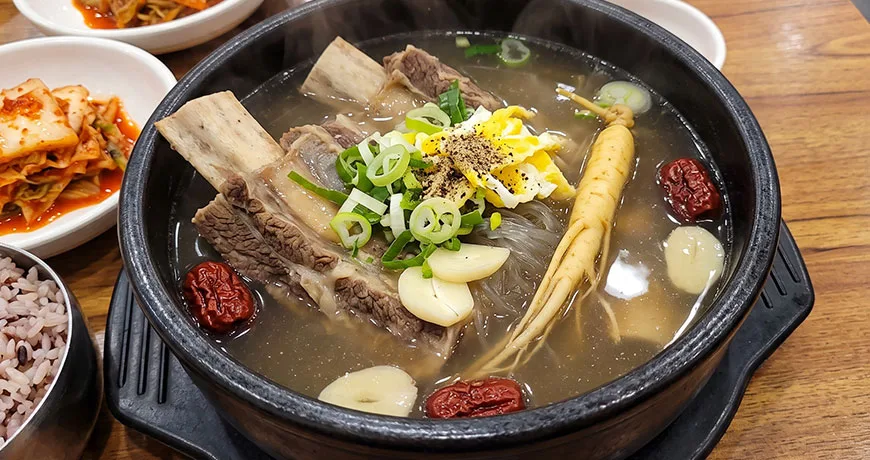
YeongyanghanuGalbitang is a high-end biochemical matrix engineered by subjecting the dense connective tissues of premium Korean beef (Hanwoo) ribs to prolonged thermal hydrolysis, transforming rigid collagen into yielding gelatin, and integrating it with the potent active compounds of medicinal botanicals. As the unique, low-melting-point lipids (oleic acid) of Hanwoo render into the clear aqueous solvent under thermodynamic heat, ginsenosides (saponins) extracted from fresh ginseng initiate a micro-emulsification with the heavy animal fats. This biochemical reaction perfectly masks any gamey aromatics with a deep, earthy botanical resonance while exponentially elevating the broth’s rheological viscosity. Extracted via precise thermal control at 90–95°C—meticulously skimming away coagulated proteins and insoluble lipids to prevent cloudy emulsification—this transparent, golden consommé merges with the reducing sugars of jujubes to create a flawless thermodynamic energy source designed to instantly elevate core body temperatures during harsh winters.
- ⏱️ Total: 3 hrs 30 mins | Prep: 1 hr (Osmotic blood purging) | Cook: 2 hrs 30 mins
- 🍳 Difficulty: High (Requires strict thermal control to prevent broth emulsification and ensure collagen denaturation)
- 🌶️ Profile: Deeply Rich, Earthy (Ginseng Aromatics), and Clean Savory Umami
- 🍚 Focus: Thermal Hydrolysis, Saponin Extraction, & Lipid Clarification
- 🍶 Pairing: Chilled, highly refined traditional Cheongju (Rice Wine) or aged distilled Soju
Ingredients (3–4 servings)
- Collagen & Lipid Matrix: 1kg Hanwoo Beef Short Ribs for soup (submerged in cold water for 1 hour to purge blood proteins via osmotic pressure)
- Saponin & Active Compound Catalyst: 2 roots Fresh Ginseng (Susam – crowns removed, scrubbed clean), 5 Dried Jujubes (Dates), 5 Peeled Chestnuts, 10 Ginkgo Nuts
- Aqueous Solvent & Clarifier: 3.5L Purified Water, 200g Daikon Radish (left whole), 1 whole Onion, 10 cloves Garlic, 2 Green parts of Scallion, 1 tsp Whole Black Peppercorns
- Ionized Sodium Binder: 2 tbsp Soup Soy Sauce (Guk-ganjang), Sea Salt to taste (used for final salinity to preserve broth clarity)
- Aromatic & Allyl Finish: 1 stalk Scallion (finely chopped), 1 Egg (separated and pan-fried for Hwangbaek Jidan garnish)
Allergy Information Contains: Beef, Soy, Wheat (from Soy Sauce), Egg (garnish)
Equipment Massive High Thermal Mass Cauldron or Stainless Steel Stockpot, Fine Skimmer, Cutting Board, Knife
Cooking Instructions
- Thermal Coagulation & Blanching: Pour boiling water over the osmotically purged Hanwoo ribs until fully submerged and boil aggressively for 10 minutes. The water-soluble myoglobin and impurities trapped in the bone marrow will thermally coagulate, erupting as dark foam. Discard this liquid entirely and physically scrub the coagulated proteins off the bone cuts under running cold water.
- Thermal Hydrolysis & Initial Clarification: Place the cleaned ribs into a large pot with 3.5L of purified water, the whole radish, onion, garlic, scallion greens, and peppercorns. Heat over high flame. The moment it reaches a boil, reduce the heat to medium-low (90–95°C). A violent rolling boil will forcefully emulsify the rendered lipids into the water, resulting in a murky broth. Maintain a gentle simmer for 1 hour and 30 minutes, relentlessly skimming off the surfacing fats with a fine mesh to extract a crystalline, golden consommé.
- Saponin Integration & Reducing Sugars: Once the connective tissues begin to yield, remove and discard all floating aromatic vegetables (except the radish). Into this clarified broth, introduce the fresh ginseng, jujubes, chestnuts, and ginkgo nuts. Simmer for an additional 1 hour. The ginsenosides dynamically bind with the heavy Hanwoo lipids, effectively masking any lingering beef aromas with their signature earthy, bitter-sweet resonance.
- Critical Softening & Salinity Adjustment: When the collagen fascia on the ribs has fully denatured into gelatin, allowing the meat to gently separate from the bone, remove the radish and slice it into squares. Season the broth precisely with soup soy sauce and sea salt to calibrate the sodium ion concentration.
- Allyl Finish & Plating: Serve the hot ribs, ginseng, jujubes, and radish in a pre-heated Ttukbaegi (earthenware bowl) or large bowl, pouring the pristine golden broth over them. Garnish with the chopped scallions to release volatile allyl sulfides and crown with the thermally coagulated egg ribbons (Jidan).
💡 Professional Culinary Tips
- Thermodynamics of Hanwoo Lipids: Hanwoo beef possesses an overwhelmingly high oleic acid content compared to standard beef, resulting in a significantly lower lipid melting point. While this creates an explosive umami mouthfeel, it can easily make the soup excessively greasy. Continuous lipid clarification (skimming) throughout the simmer is absolutely mandatory, not optional.
- Natural Emulsification via Saponins: Saponins, the active compounds in ginseng, share an etymological root with “soap” because they act as highly effective natural surfactants. When they interact with the heavy animal fats of the Hanwoo, they prevent the fat from coating the mouth in a greasy film, instead synthesizing a smooth, silky rheological texture.
- Thermal Control for Consommé Clarity: Simmering this soup with a heavy lid closed traps convective energy, causing the water and fat to violently mix into a cloudy suspension. To achieve the signature transparent, golden hue of Galbitang, you must leave the lid off or slightly ajar, maintaining a delicate 90–95°C kinetic environment.
🍶 Gastronomic Pairing
- Biochemical Palate Cleansing: When the concentrated Hanwoo lipids, gelatin, and the earthy bitterness of the ginseng profoundly saturate your oral mucosa, pair this dish with a chilled glass of traditional Cheongju or high-proof aged distilled Soju. The highly refined ethanol molecules act as a precise surgical solvent, cleanly slicing through the complex lipid and botanical barrier on your tongue. This flawlessly resets your palate, geometrically amplifying the crystalline, savory beef umami of the very next spoonful.
Nutrition Facts (Estimated)
Total Content : Approx. 750g (1 serving, excluding bone weight)
Calories : 520 kcal (Excluding rice)
– Sodium : 1,250mg (Variable depending on soy sauce and salt usage)
– Total Carbohydrate : 18.0g (Polysaccharides and reducing sugars from botanicals)
– Sugar : 6.0g
– Total Fat : 28.0g (High-density oleic acid lipids native to Hanwoo)
– Saturated Fat : 11.0g
– Cholesterol : 95.0mg
– Protein : 46.0g (Dense with highly bioavailable collagen peptides)
– Dietary Fiber : 3.5g
*Daily Values are based on a 2,000 calorie diet and standard Korean nutritional reference values.
**Nutritional values are calculated based on original ingredients; substitutions may alter specific macronutrients.
Origins and Food Culture of Nutritious Korean Beef Rib Soup (YeongyanghanuGalbitang)
1. Historical Lineage: Goryeo “Garibeom,” Joseon Court “Uhyeoptang,” and Wedding Banquets
- Tracing its culinary roots to the ancient native Korean word Gari (the archaic term for beef rib), documented in late Goryeo Dynasty records and Joseon royal court protocols (Uigwe) as Garibeom (加里汎) or Uhyeoptang (牛脇湯)—an elite banquet soup served exclusively to royalty and noble scholar (yangban) families.
- Because cattle were the nation’s primary agricultural engine, beef ribs were among the most coveted delicacies in the kingdom. From the late 19th century into modern times, Galbitang evolved into the indispensable centerpiece of Korean wedding banquets (honrye-yeon), where hosts served steaming bowls of beef rib soup to convey profound gratitude, respect, and celebratory hospitality to honored guests.
2. The Culinary Science of Desanguination and Cold-Defatted Clear Consommé (Cheongtang)
- Unlike milky, bone-emulsified broths such as Seolleongtang or Dwaejigukbap that require vigorous rolling boils, authentic Galbitang adheres to the refined aesthetic of Cheongtang (crystal-clear consommé).
- Achieving this requires an arduous cleaning protocol: soaking the raw bone-in ribs in flowing cold water for hours to leach out deep-seated heme iron, followed by a rapid parboil (blanching) to eliminate coagulated blood. The ribs are then simmered gently over medium-low heat with aromatics, skimming foam continuously, and the broth is chilled so that every trace of solidified white beef tallow can be lifted away, yielding a pure, golden broth free of greasy residue.
3. The “Yeongyang” (Nutritious) Medicinal Evolution and the Pride of Hanwoo
- The evolution from standard rib soup to “Yeongyang” (nutritious/restorative) Galbitang occurred through the deliberate addition of classical therapeutic botanicals—fresh ginseng, dried jujubes, milkvetch root, and angelica—seamlessly integrating Korea’s ancient Yaksik-dongwon (“food is medicine”) philosophy into modern celebratory gastronomy.
- In an era of widespread commercial imported beef, choosing exclusively native Korean beef (Hanwoo) represents the pinnacle of gastronomic prestige, filial devotion when treating aging parents, and genuine culinary pride, remaining an enduring monument to Korean therapeutic heritage and noble banquet hospitality.
The Aristocratic Extraction of Indigenous Bovine Rib Marrow, the Pure Clarity of Golden Consommé, and the Restorative Alchemy of Korean Ginseng: A Refined Portrait of YeongyanghanuGalbitang
YeongyanghanuGalbitang (Nutritious Korean Beef Rib Soup) stands as the majestic, crystalline, and biologically opulent summit of Korea’s noble medicinal (tangban) gastronomy. Centered exclusively upon the highly prized short ribs—short cut, chuck, and flanken cuts—of purebred indigenous Korean Hanwoo cattle (Bos taurus coreanae), celebrated globally for their genetic marbling and elevated oleic acid content, the bones are steeped in cold spring water for hours to leach deep-tissue hemoglobin. Subjected to a preliminary flash-blanch with alliums and rice wine to strip away surface coagulants, the ribs are gently simmered in pure water over a low, watchful convective flame alongside medicinal roots including fresh six-year-old Korean ginseng (Panax ginseng), milkvetch root (hwanggi), and angelica root (danggui). Layered with sweet dried jujubes, peeled chestnuts, ginkgo nuts, tender mushrooms, and translucent sweet potato glass noodles (dangmyeon), the soup is ladled into a heavy earthenware pot or gleaming bronzeware (bangjja yugi) bowl and seasoned transparently with artisanal soup soy sauce and solar sea salt. Firmly rejecting the masking crutch of heavy spices or fiery chili pastes, this dish captures the unmasked marrow essence and bioavailable peptides of sovereign native beef, harmonizing terrestrial proteins and botanical adaptogens in absolute thermodynamic equilibrium.
Confronting the steaming bowl as pure, amber-tinted steam curls upward to reveal massive bone-in beef ribs anchored beside a whole ginseng root, lifting a deep spoonful of the broth releases an immediate, deeply calming olfactory charge: the rich, sweet perfume of slow-extracted Hanwoo beef marrow mingles seamlessly with the bittersweet, earthy bloom of ginseng saponins, the comforting aroma of braised jujubes and chestnuts, and the crisp, sulfurous brightness of fresh scallions. The first sip delivers an unadorned revelation across the tongue: the clarified broth, laden with dissolved bone collagen and muscle amino acids, glides over the palate with zero greasy heaviness, washing down the throat to infuse an exhausted body with profound, restorative warmth. Grasping a rib reveals meat whose intramuscular collagen has completely melted into liquid silk; the beef pulls away from the bone with effortless tenderness, discharging concentrated torrents of rich, oleic-laden beef juices. The succulent chew of rehydrated jujubes and sweet chestnuts provides comforting textural breaks, while the slippery elasticity of broth-soaked glass noodles enriches the mouthfeel. Enjoyed alongside warm rice and crisp cubes of fermented radish kimchi (kkakdugi), every mouthful becomes an unforgettable ritual of deep metabolic renewal and quiet gastronomic transcendence.
The enduring majesty of YeongyanghanuGalbitang lies in its historical lineage—descended from the elite Joseon court and noble banquet tradition known as Garitang (加里湯). In an agrarian society where draft cattle were sacred agricultural pillars and slaughter was strictly regulated, consuming rich bovine ribs was a luxury reserved exclusively for royal feasts, matrimonial unions, and milestone celebrations. By uniting the ancestral prestige of sovereign native beef with the restorative principles of Korean food therapy (yaksikdongwon), a steaming cauldron of nutritious Hanwoo rib soup remains an irreplaceable monument of agricultural reverence, maternal indulgence, and dazzling Korean culinary craftsmanship.
Editor’s Review
1. A Dynamic Harmony of Fall-Off-The-Bone Rib Tenderness, Slippery Glass Noodle Elasticity, Soft Medicinal Fruit Yield, and Frictionless Broth Fluidity
The structural architecture inside the vessel delivers an extraordinary, high-register choreography between mammalian muscle tissue, hydrated starch hydrogels, soft botanical reserves, and an ultra-low-viscosity aqueous matrix. Sustained gentle hydrothermal cooking completely dissolves the dense collagenous sheaths encasing the rib bones, allowing the succulent Hanwoo beef to separate along natural muscle grain with cloud-like ease and minimal tooth resistance. This delicate chew is dynamically counterbalanced by the slippery, viscoelastic snap of sweet potato glass noodles, which drink in the savory broth. Braised jujubes and tender chestnuts yield with a soft, pillowy chew that releases sweet vegetal moisture, while the defatted, crystal-clear consommé forms a frictionless lubricating fluid layer across oral tissues, ensuring an impeccably balanced, non-fatiguing mouthfeel from the first steaming sip to the last.
2. Type I Collagen Hydrothermal Gelatinization, Hanwoo Oleic Acid Flavor Volatiles, IMP-Glutamate-GMP Triple Nucleotide Synergy, and Ginsenoside-Mediated O/W Emulsification
YeongyanghanuGalbitang represents an exacting study in connective tissue biophysics, flavor volatile chemistry, and nucleotide umami receptor kinetics. Insoluble Type I collagen, heavily concentrated within the rib periosteum, tendons, and intramuscular perimysium, undergoes thermal denaturation between 85°C and 90°C, cleaving its tight triple-helix hydrogen bonds into water-soluble gelatin polypeptides that provide a silky oral viscosity. Korean Hanwoo beef is uniquely rich in oleic acid (monounsaturated fatty acid), which imparts a significantly lower fat-melting point and yields elevated concentrations of desirable volatile aromatics (lactones and aldehydes) compared to non-indigenous cattle breeds. Muscle-derived inosine monophosphate (IMP) converges with the free glutamates of simmered jujubes, onions, and scallions, alongside guanosine monophosphate (GMP) leached from mushrooms, triggering an exponential triple synergy across human oral T1R1/T1R3 umami heterodimers. Furthermore, ginsenosides (steroidal saponins) extracted from the fresh ginseng root possess an amphiphilic molecular geometry, acting as natural surfactants that disperse residual lipid droplets into a stable, micro-scale oil-in-water (O/W) emulsion; this eliminates surface grease slicking while substantially elevating gastrointestinal nutrient bioavailability. Meanwhile, organosulfur volatiles (allyl sulfides) from scallions and garlic chemically capture and mask trace lipid oxidation byproducts, maintaining a pristine, pure aromatic profile.
3. The Joseon Garitang Court Heritage, Yaksikdongwon Alchemy, and the Sovereign Summit of Clear Korean Beef Gastronomy
Carrying forward the distinguished lineage of Joseon banquet cookery, YeongyanghanuGalbitang exemplifies the ultimate sophistication of Korean clear beef broths. By refusing to mask the meat behind heavy pastes or spices, and relying instead on the unadorned symbiosis between indigenous beef marrow and classic herbal adaptogens, this radiant centerpiece captures the apex of aristocratic restraint. Translating imperial celebratory prestige into an enduring, restorative tonic, this unmasked masterpiece stands as an enduring sanctuary of domestic comfort, terroir integrity, and brilliant Korean culinary artistry.