
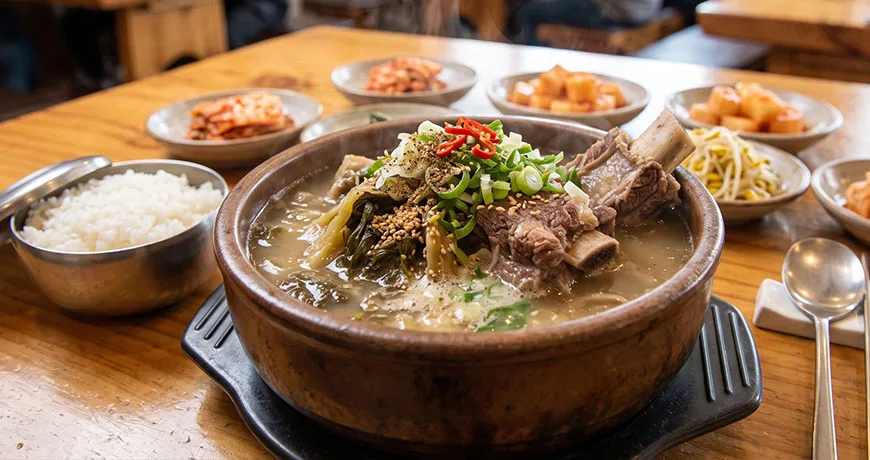
Sagolugeojigalbitang is a robust biochemical matrix that fuses a massive colloidal emulsion of bovine bone marrow lipids with the highly porous, hydrated cellulose structure of dried outer cabbage leaves (Ugeoji) and the dense collagen of beef short ribs. Unlike clear beef consommé (Galbitang), this dish relies on continuous, violent thermodynamic convection (rolling boil) to force the marrow lipids and water into a stable, milky-white macro-emulsion. This heavy animal solvent is chemically neutralized by the fermented peptides of traditional soybean paste (Doenjang), perfectly masking any oxidized lipid off-notes. The dried, rehydrated cabbage acts as a microscopic culinary sponge; as its rigid cellular walls break down under heat, it absorbs the rich marrow emulsion and the inosinate from the ribs. Simultaneously, the rib collagen undergoes thermal hydrolysis into sticky gelatin, yielding an overwhelmingly rich, viscous, and deeply earthy restorative stew.
- ⏱️ Total: 14 hrs (Including marrow extraction) | Prep: 12 hrs (Bone soaking & primary emulsion extraction) | Cook: 2 hrs (Collagen hydrolysis & cellulose degradation)
- 🍳 Difficulty: High (Requires stable macro-emulsification via kinetic heat and precise cellulose hydration)
- 🌶️ Profile: Profoundly Savory, Earthy, and Viscous Creamy Umami
- 🍚 Focus: Marrow Emulsification, Cellulose Matrix Hydration, & Peptide Masking
- 🍶 Pairing: Ice-cold raw rice fermented Dongdongju
Ingredients (3–4 servings)
- Marrow Lipid & Emulsion Matrix: 1kg Hanwoo Beef Marrow Bones (Sagol – fully purged of blood and boiled aggressively for 12+ hours to extract 2L of milky-white bone broth emulsion)
- Collagen & Protein Matrix: 600g Beef Short Ribs (soaked in cold water for 1 hour to purge blood proteins osmotically)
- Cellulose Sponge Matrix: 300g Boiled Ugeoji (Dried outer leaves of Napa cabbage – torn lengthwise to maximize surface area)
- Fermented Peptide & Umami Binder: 2 tbsp Traditional Soybean Paste (Doenjang), 1 tbsp Soup Soy Sauce, 2 tbsp minced garlic, 1.5 tbsp Gochugaru (Chili Flakes – for slight color and masking)
- Aromatic & Allyl Catalyst: 2 stalks Green Onion (diagonally sliced), 2 Cheongyang green chilies
Allergy Information Contains: Beef, Soy, Wheat (from Doenjang, Soy Sauce)
Equipment Massive High Thermal Mass Cauldron, Mixing Bowl, Ttukbaegi (earthenware bowl), Cutting Board, Knife
Cooking Instructions
- Osmotic Purging & Blanching: Flash-boil the osmotically purged short ribs in aggressive heat for 10 minutes. The residual water-soluble myoglobin will thermally coagulate on the surface. Discard the water and vigorously scrub the ribs under cold running water.
- Cellulose Peptide Coating: Place the hydrated Ugeoji in a mixing bowl and add the Doenjang, soy sauce, garlic, and chili flakes. Knead violently by hand. This mechanical pressure forces the fermented peptides deep into the porous cellulose structure of the cabbage.
- Marrow Emulsion & Collagen Hydrolysis: Combine the milky Sagol marrow emulsion (2L) and the cleaned ribs in a large pot. Unlike the gentle simmer of a clear consommé, apply high heat and close the lid to generate a violent rolling boil. This aggressive kinetic convection is strictly required to maintain the lipid emulsion. Boil for 1 hour to thermodynamically degrade the rib collagen into yielding gelatin.
- Matrix Fusion & Breakdown: Once the ribs are tender, introduce the seasoned Ugeoji into the emulsion. Lower to medium heat and simmer for 40 minutes. The rigid cellulose cell walls will biochemically collapse, acting as a sponge that absorbs the heavy marrow lipids.
- Allyl Finish: Transfer the matrix to a Ttukbaegi. While boiling vigorously, garnish with green onions and chilies to release a final burst of volatile allyl sulfides before serving.
💡 Professional Culinary Tips
- Thermodynamics of Consommé vs. Emulsion: Standard Galbitang requires a gentle 90°C simmer to prevent fat and water from mixing, resulting in a clear consommé. Sagolugeojitang demands the exact opposite. A violent, 100°C+ rolling boil forces the rendered bone marrow lipids to physically smash into the water molecules, creating a stable, milky-white macro-emulsion. Lowering the heat prematurely will cause phase separation, resulting in a greasy, unappetizing layer of oil on top.
- Porous Sponge Kinetics of Cellulose: Using fresh cabbage instead of Ugeoji (dried cabbage) ruins the engineering of the dish. The dehydration process fundamentally alters the plant’s cellular structure, turning it into a porous micro-matrix. When rehydrated and boiled, this structure acts as an unparalleled natural sponge, specifically designed to soak up massive amounts of heavy marrow emulsion.
- Chemical Masking via Peptides: Prolonged boiling of bone marrow can produce oxidized lipid off-notes (a slight gamey smell). The heavy application of traditional Doenjang is a chemical necessity; its rich fermented peptides bind to these oxidized molecules, completely neutralizing them and replacing them with a deep, earthy umami profile.
🍶 Gastronomic Pairing
- Biochemical Palate Cleansing: When the ultra-dense colloidal bone marrow emulsion and the gelatin-soaked cabbage heavily coat your oral mucosa, pair this dish with ice-cold raw rice fermented Dongdongju. The unpasteurized, natural lactic acid and the lively carbonation generated in the bottle act as a heavy-duty palate cleanser. It smoothly washes away the dense animal lipid barrier on your tongue, providing a brilliant textural and acidic contrast to the rich stew.
Nutrition Facts (Estimated)
Total Content : Approx. 750g (1 serving, excluding bone weight)
Calories : 540 kcal (Excluding rice)
– Sodium : 1,450mg (Variable depending on Doenjang and soy sauce)
– Total Carbohydrate : 16.0g (Driven by cabbage polysaccharides)
– Sugar : 3.0g
– Total Fat : 34.0g (High-density marrow lipids and rib fat)
– Saturated Fat : 15.0g
– Cholesterol : 105.0mg
– Protein : 45.0g (High bioavailability myofibrils and collagen peptides)
– Dietary Fiber : 8.5g (Dense plant cellulose from Ugeoji)
*Daily Values are based on a 2,000 calorie diet and standard Korean nutritional reference values.
**Nutritional values are calculated based on original ingredients; substitutions may alter specific macronutrients.
Origins and Food Culture of Korean Cabbage and Beef Bone Short Rib Soup (Sagolugeojigalbitang)
1. Gimjang Cabbage Frugality and Cattle Market Taverns
- Rooted in the frugal wisdom of traditional Korean agrarian society during the late-autumn Gimjang (kimchi-making) season, where the tough outer green leaves (ugeoji) stripped from napa cabbage heads were blanched and hung to dry under the eaves as an indispensable winter storehouse of fiber and vitamins.
- While prime beef ribs were historically luxury delicacies reserved for royal banquets and ancestral rites, tavern keepers near regional cattle markets and slaughterhouses gathered discarded ox leg bones (sagol) and rib trimmings (maguri); boiling these marrow cuts overnight with humble dried cabbage greens and aged doenjang created an accessible, deeply restorative tavern soup (jangteo-gukbap) for traveling merchants and day laborers.
2. The Culinary Science of Marrow Emulsification and Fermented Pre-Seasoning
- Unlike clear-broth rib soups (Cheongtang), this preparation relies on prolonged hydrothermal extraction of ox leg bones over sustained rolling heat to break down marrow lipids and collagen into an opaque, milky emulsion (sagol yuksu).
- The authentic secret lies in pre-seasoning the boiled greens (ugeoji mitgan): massaging the squeezed cabbage with aged soybean paste (doenjang), minced garlic, and toasted sesame oil before simmering. The active enzymes and organic acids within the fermented paste tenderize the tough plant cellulose fibers while ensuring the deep savory flavor permeates the core of the greens, creating complete culinary harmony with the rich marrow stock.
3. The Legacy of Seoul’s Dawn Hangover Alleys and Universal Soul Comfort
- Deeply anchored in the history of Seoul’s historic dawn hangover alleys—most notably Cheongjin-dong, Mugyo-dong, and Mapo—where gigantic cauldrons bubbled through the night to nourish market vendors, sanitation crews, and weary urban laborers greeting the break of day.
- Combining the prestigious bone-marrow sustenance of cattle with the grounding humility of sun-cured autumn greens, Sagolugeojigalbitang stands as an enduring cultural monument to Korean gastro-resilience, maternal slow-food comfort, and therapeutic peninsular dining.
The Torrential Extraction of Bovine Leg Bone Marrow, the Silk-Melted Tenderness of Braised Short Ribs, and the Earthy Respite of Winter Cabbage Greens: A Refined Portrait of Sagolugeojigalbitang
Sagolugeojigalbitang (Ox Bone, Winter Cabbage, and Beef Short Rib Soup) stands as the deeply restorative, unctuously rich, and biologically harmonious summit of Korea’s composite bovine (tangban) gastronomy. Heavy bovine leg bones (sagol) and pelvic bones—renowned for their dense mineral matrices and rich marrow cavitations—are steeped in cold spring water for hours to thoroughly leach residual hemoglobin. Submerged in a roaring iron cauldron, the bones undergo sustained hydrothermal boiling across tens of hours until the collagen, calcium, and marrow lipids break down into an opaque, milk-white stock. Layered into this ivory foundation are choice beef short ribs—short cut and chuck ribs celebrated for their dense intramuscular connective tissue—which are pre-blanched with alliums to strip away coagulated surface impurities. The pot is then fortified with a generous mound of ugeoji (sun-dried or blanched outer Napa cabbage greens), gently bruised and hand-seasoned with aged artisanal soybean paste (doenjang), crushed garlic, red chili flakes, and toasted sesame oil. Transcending the crystalline clarity of standard meat broths, this dish anchors the celebratory luxury of beef ribs onto a velvety marrow emulsion, harmonizing aristocratic elegance with countryside thrift in absolute thermodynamic equilibrium.
Confronting the boiling earthenware pot (ttukbaegi) as golden-crimson bubbles burst through clouds of fragrant white steam, lifting a colossal bone-in rib alongside a mass of slow-braised greens releases an immediate, deeply comforting sensory charge: the rich, buttery perfume of slow-extracted bovine marrow mingles seamlessly with the deep, bready savor of fermented doenjang, the sweet warmth of simmered alliums, and the zesty lift of toasted sesame. Taking the first sip delivers a luxurious revelation across the palate: the velvety broth, dense with dissolved gelatin and suspended marrow lipids, glides over oral membranes with zero greasy separation, washing down the esophagus to infuse an exhausted body with deep, restorative heat. Grasping the rib reveals meat whose intramuscular collagen has completely melted into liquid silk; the beef pulls away from the bone with effortless tenderness, discharging concentrated torrents of sweet, oleic-laden juices. The braised cabbage greens, having drunk deeply of the milky bone broth, yield with a tender, succulent chew that cushions the soup’s richness with sweet vegetable hydration. Steeping a bowl of warm white rice into the bubbling broth and capping each spoonful with a crisp cube of aged radish kimchi (kkakdugi) completes an unforgettable ritual of deep metabolic renewal and profound gastronomic catharsis.
The enduring majesty of Sagolugeojigalbitang lies in its historical synthesis—uniting the elite, celebratory indulgence of bovine short ribs with the democratic sustenance of long-simmered ox bone broth (seolleongtang) and humble outer cabbage leaves that would otherwise be discarded during the autumn kimchi-making season (gimjang). Born at the cultural crossroads where courtly banquet splendor met the bubbling cauldrons of rural five-day markets, a steaming bowl of ox bone, cabbage, and rib soup remains an irreplaceable monument of sustainable whole-carcass utilization, maternal generosity, and brilliant Korean culinary craftsmanship.
Editor’s Review
1. A Dynamic Harmony of Fall-Off-The-Bone Rib Tenderness, Spongy Cabbage Fiber Give, and Colloidal Broth Lubrication
The structural architecture inside the vessel delivers an extraordinary, tactile choreography between dense mammalian muscle bundles, hydrated vegetable cell walls, and a high-viscosity colloidal emulsion. Sustained convective cooking dissolves the tough collagenous sheaths encasing the rib bones, allowing the succulent beef fibers to pull away with delicate, tooth-yielding tenderness. This rich density is cushioned by the slow-braised ugeoji, whose relaxed fibrous matrix absorbs the broth like an organic sponge, releasing sweet vegetable moisture with every chew. Concurrently, the dissolved bone gelatin and emulsified marrow lipids form a continuous, velvety fluid layer over oral tissues and steeped rice grains, ensuring an impeccably balanced, non-fatiguing mouthfeel from the first steaming spoonful to the last.
2. Cancellous Bone Lipid O/W Micro-Emulsification, Rib Type I Collagen Gelatinization, IMP-Glutamate Nucleotide Synergy, and Dietary Fiber Lipid Adsorption Kinetics
Sagolugeojigalbitang represents an exacting study in skeletal histochemistry, lipid colloid mechanics, and nucleotide flavor dynamics. Neutral lipids (triglycerides) leached from the cancellous bone tissue and marrow cavities are subjected to the violent shear forces of the rolling boil, breaking them into sub-micron droplets. Soluble gelatin fragments leached from bone collagen and plant pectins leached from the cabbage act as natural amphiphilic stabilizers, encapsulating the lipid droplets into a stable oil-in-water (O/W) micro-emulsion that scatters incident light to produce an opaque, milky turbidity without greasy surface pooling. Insoluble Type I collagen, heavily concentrated within the rib periosteum and tendons, undergoes thermal denaturation between 85°C and 95°C, cleaving its tight triple-helix hydrogen bonds into water-soluble gelatin polypeptides that soften the meat. Muscle-derived inosine monophosphate (IMP) from the short ribs converges with the abundant free glutamates of the fermented soybean paste (doenjang) and simmered cabbage, triggering an exponential synergy across human oral T1R1/T1R3 umami heterodimers. Furthermore, the insoluble cellulose and hemicellulose fiber networks of the ugeoji physically adsorb excess lipid micelles, moderating digestive transit and preventing gastric heaviness, while scallion allicin volatiles chemically bind trace aldehydes (such as hexanal) to secure a pristine, pure aromatic profile.
3. Aristocratic Rib Heritage, Marketplace Cauldron Alchemy, and the Sovereign Summit of Composite Korean Tangban
By synthesizing the prestige of celebratory banquet ribs with the democratic nourishment of ox leg bone broths and resourceful agricultural thrift, Sagolugeojigalbitang exemplifies the pinnacle of Korean culinary integration. Harmonizing rich mammalian proteins with earth-grown brassica greens through the ancient microbial alchemy of fermented soybean paste, this iconic classic stands as an enduring sanctuary of domestic comfort, ecological intelligence, and brilliant Korean culinary artistry.