
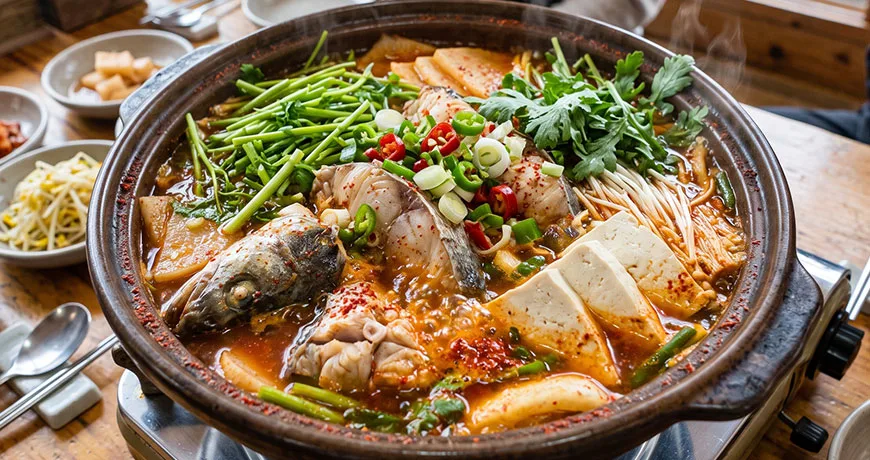
Maeuntang is a hybrid high-end stew that purges the aggressive capsaicin overload of modern recipes, instead reviving the traditional, sophisticated aromatics of Sancho (Sanshool) rooted in Joseon-era culinary literature through modern molecular food science. Bypassing the heavy, starchy emulsion of commercial chili paste (Gochujang), this formulation builds its baseline umami from daikon reducing sugars, a touch of traditional Doenjang, and soup soy sauce, allowing the natural inosinate of the fish to shine. The fish head and bones undergo prolonged thermal hydrolysis to build a viscous gelatin body, while the tender white fillets are introduced later and flash-poached at a critical 70–80°C threshold to prevent toughness and structural crumbling. In the final moments, the introduction of volatile sanshool compounds from Sancho powder stimulates the TRPA1 sensory receptors on the tongue, cleanly masking any lingering marine off-notes, while crown daisy and Minari provide potassium ions to balance the electrolyte load.
⏱️ Total: 50 mins | Prep: 20 mins | Cook: 30 mins | 🍳 Difficulty: High (Requires Sancho aromatic control and white fish thermal coagulation management) | 🌶️ Profile: Deeply Savory, Tingly-Tasting (Sanshool), and Briny | 🍚 Focus: Bone Thermal Hydrolysis, Sanshool Masking, & White Fish Flash-Poaching | 🍶 Themed Pairing: Refined traditional distilled Soju
Ingredients (3–4 servings)
- White Fish Protein Matrix: 1 whole fresh White Fish (Rockfish or Cod – scales, viscera, and gills removed, chopped into thick steaks)
- Collagen & Inosinate Matrix: Fish Head and Skeletal Bones (for rich stock extraction)
- Pectin & Reducing Sugar Matrix: 200g Daikon Radish (sliced into squares), 1/2 Onion (julienned)
- Aqueous Umami Solvent: 1.2L Anchovy-Kelp Broth or Rice Water
- Fermented Amino Acid Binder: 1 tbsp Doenjang, 1.5 tbsp Soup Soy Sauce, 1.5 tbsp Gochugaru (for color and mild baseline heat), 2 tbsp minced garlic, 0.5 tsp minced ginger
- Sanshool & Aromatic Catalyst: 1 tsp fresh Sancho (or Chopi) powder, 1 stalk Green Onion, 2 Cheongyang green chilies, 1 handful Water Dropwort (Minari), 1 handful Crown Daisy
Allergy Information Contains: Fish, Soy, Wheat (from Doenjang, Soy Sauce)
Equipment Wide High Thermal Mass Pot, Sieve, Cutting Board, Knife, Skimmer
Cooking Instructions
- Solvent & Pectin Hydrolysis: Place the cold kelp broth and square-cut radish into a wide pot and heat over high flame. Starting from cold allows the rigid pectin cellular walls of the radish to gradually undergo thermal hydrolysis, smoothly leaching cooling reducing sugars into the solvent.
- Fermented Binder & Bone Extraction: Once boiling, dissolve the Doenjang, soy sauce, and a touch of Gochugaru into the liquid. Drop in the skeletal fish bones and head first. As the bone collagen undergoes thermal hydrolysis to establish rheological body, meticulously skim away the surfacing protein scum to eradicate off-notes.
- Critical Thermal Coagulation of White Flesh: When the broth has achieved profound depth, introduce the thick white fish steak pieces. Simmer over medium heat for precisely 10 minutes, cooking the protein into an optimal viscoelastic state without drying it out.
- Sanshool & Allyl Finish: Just before cutting the heat, heap the green onions, chilies, Minari, and Crown Daisy over the top, and evenly dust 1 tsp of Sancho powder across the surface. The volatile sanshool compounds ride the steam to cleanly mask any marine aromas via TRPA1 receptor stimulation.
- In-situ Fusion: Serve the bubbling pot directly at the table, harmonizing the electric tingly punch of the Sancho with the savory depth of the fish.
💡 Professional Culinary Tips
- TRPA1 Stimulation via Sanshool: Unlike the lingering burn of capsaicin, hydroxy-alpha-sanshool in Sancho acts on the TRPA1 receptors to deliver a swift, tingly numbness that cuts straight through heavy fish lipids, reflecting the sophisticated masking techniques of historic Korean gastronomy.
- Omitting Gochujang for IMP Clarity: Heavy starch from Gochujang clouds the broth and mutes the delicate inosinate flavor of the fish. Relying on Doenjang and soy sauce for the umami baseline preserves the absolute purity of the bone-extracted collagen stock.
- 70–80°C Critical Thermal Control: Extracting a deep stock from the bones first and flash-poaching the delicate white fillets later is the unyielding law of preventing rubbery, overcooked fish flesh.
🍶 Gastronomic Pairing
- Biochemical Palate Cleansing: When the tingly sanshool finish and rich fish lipids coat your oral mucosa, pair this dish with a glass of crisp, refined traditional distilled Soju. The clean ethanol molecules completely reset your taste receptors, geometrically amplifying the inosinate umami of your next spoonful.
Nutrition Facts (Estimated)
Total Content : Approx. 600g (1 serving)
Calories : 270 kcal (Excluding rice)
– Sodium : 1,200mg (Variable based on soy sauce and Doenjang usage)
– Total Carbohydrate : 11.0g
– Sugar : 3.0g
– Total Fat : 4.5g (Natural unsaturated fish fats)
– Saturated Fat : 0.8g
– Cholesterol : 60.0mg
– Protein : 36.0g (High bioavailability fish protein and gelatin)
– Dietary Fiber : 4.5g
*Daily Values are based on a 2,000 calorie diet and standard Korean nutritional reference values.
**Nutritional values are calculated based on original ingredients; substitutions may alter specific macronutrients.
Origins and Food Culture of Spicy Fish Stew (Maeuntang)
1. Historical Roots: Joseon “Jochi” and the River Foraging (Cheonlyeop) Tradition
- Tracing its culinary lineage to the historic Jochi (seasoned, concentrated stews) of the Joseon Dynasty royal court and noble scholar (yangban) estates, where fresh catches were simmered with red chili paste, soybean paste, and seasonal vegetables.
- In agrarian folk culture, the dish evolved through the popular summertime ritual of Cheonlyeop (river foraging): village neighbors gathered along riverbanks to net freshwater fish (catfish, loach, mandarin fish) and set up iron cauldrons over open stones, tossing in local squash, wild chilies, and homemade paste to create a restorative communal feast. Concurrently, coastal fish market taverns developed the ocean-fish variation by boiling mixed catches and bony fish into fiery, restorative cauldrons for harbor laborers.
2. The Raw Fish (Hoe) Renaissance and the Art of “Seodeori” Upcycling
- With the rapid modernization of South Korea during the 1970s and 1980s, coastal seafood centers (such as Noryangjin in Seoul and Jagalchi in Busan) popularized dining on fresh raw fish fillets (hoe / sashimi), giving rise to the indispensable culinary concept of Seodeori-tang.
- Rather than discarding the heads, collar bones, backbone frames, and tail trimmings (seodeori) remaining after filleting, tavern cooks simmered these bone-rich cuts over high heat; recognizing that fish bones and collagenous cheek muscles concentrate the highest density of savory inosinic acids and gelatin, this upcycled stew became the non-negotiable grand finale of every Korean raw-fish banquet, cleansing the palate of raw fat.
3. The Tabletop Burner Culture and the Hand-Torn Dough Flake (Sujebi) Ritual
- The advent of portable butane burners (burusta) shifted Maeuntang from a static bowl served from the kitchen into an interactive, theatrical tabletop centerpiece where diners control the simmer rate and garnish cooking times.
- The quintessential dining custom of dropping hand-torn wheat flour dough flakes (sujebi) directly into the bubbling broth near the end of the meal thickens the soup with gentle starch, providing a chewy, comforting texture that embodies Korea’s heartwarming culture of communal table sharing and satisfying carbohydrate-rich closure.
The Torrential Extraction of Fish Skeletal Marrow, the Incandescent Piquancy of Fermented Chili Broth, and the Verdant Aromatic Lift of Water Parsley: A Refined Portrait of Maeuntang
Maeuntang (Spicy Fish Stew) stands as the colossal, unapologetically vibrant, and biologically restorative summit of Korea’s marine and freshwater (tangban) gastronomy. Utilizing freshly caught coastal fish—such as black rockfish, sea bass, red seabream, and cod—or fierce riverine species like catfish and mandarin fish, whole carcasses featuring collagenous fish heads, mineral-dense spines, and succulent fillets are mounded high in a shallow casserole or heavy earthenware pot. Anchored upon a refreshing bed of sliced winter radish and soybean sprouts, the stew is submerged in a foundational anchovy-kelp stock dissolved with an assertive seasoning paste of sun-dried red chili powder (gochugaru), red chili paste (gochujang), a touch of aged soybean paste (doenjang), minced garlic, and ginger. Brought to an aggressive tableside boil and crowned at the rolling climax with wild water parsley (minari), aromatic crown daisy (ssukgat), scallions, and Cheongyang chilies, this dish transcends the delicate restraint of clear fish soups (jiri). It harnesses the fiery kinetics of capsaicin to master fish volatiles and unlock an exponential wave of deep marine umami.
Confronting the wide pot boiling furiously as crimson oil bubbles froth around snowy fillets of fish releases an immediate, electrifying sensory charge: the spicy, roasted heat of chili and alliums mingles seamlessly with the primal, buttery perfume of simmering fish bones and the brisk, pine-fresh fragrance of wild water parsley and crown daisy. Lifting a deep metal spoon for the first sip delivers an exhilarating revelation across the tongue: the rich broth, fortified with dissolved fish collagen and the natural sweetness of braised radish, coats the palate with zero greasy heaviness. It courses down the throat to unlock instant, soothing warmth, triggering revitalizing perspiration across the body. Gently flaking the fish meat with a spoon yields tender, ivory morsels that collapse effortlessly across the palate, discharging pure, fat-free marine sweetness. The broth-soaked radish yields with a melting, tooth-yielding chew, while the crisp snap of wild herbs and the chewy elasticity of hand-pulled wheat dough flakes (sujebi) provide delightful structural contrast, transforming the meal into an unforgettable ritual of metabolic restoration and profound gastronomic catharsis.
The enduring brilliance of Maeuntang lies in its dual heritage—originating along windswept coastal docks where fishermen combined discarded fish frames and bycatch in communal iron pots, as well as rural riverbanks where village anglers gathered for cheonlyeop (riverside fishing picnics) to boil their mixed catch with wild greens and chili paste. Seamlessly integrated into contemporary dining culture as the celebratory grand finale (seodaritang) following raw sliced fish (hoe) banquets, a bubbling cauldron of spicy fish stew remains an irreplaceable monument of zero-waste aquatic stewardship, maternal comfort, and brilliant Korean culinary craftsmanship.
Editor’s Review
1. A Dynamic Harmony of Silken Fish Myotome Flaking, Melting Radish Sponginess, Crisp Herb Snap, and Chewy Sujebi Dough
The structural architecture inside the vessel delivers an extraordinary, tactile choreography between delicate aquatic muscle flakes, hydrated root matrices, crisp botanical fibers, and gelatinized wheat starches. Gentle convective simmering relaxes the delicate connective sheets between fish myotomes, allowing the white flesh to part into tender flakes that dissolve smoothly across the palate. This softness is anchored by the thickly sliced radish, which absorbs the savory stock like an organic sponge and yields with a succulent, juicy give. Wild water parsley and crown daisy maintain rigid cellular turgor amid the boiling currents, introducing a brisk, auditory snap. Meanwhile, the hand-pulled sujebi dough flakes provide a buoyant, viscoelastic chew (elasticity) that enriches the mouthfeel, ensuring an impeccably balanced, non-fatiguing sensory experience from the first steaming sip to the last.
2. Fish Bone Collagen Hydrothermal Gelatinization, Nucleotide IMP-Glutamate Synergism, Trimethylamine (TMA) Sequestration Mechanics, and Capsaicin TRPV1 Thermoregulation
Maeuntang represents an exacting study in teleost fish histology, aromatic volatility control, and sensory neurochemistry. Insoluble Type I collagen, densely concentrated within the fish head cartilage, skin, and spinal column, undergoes thermal denaturation during sustained boiling above 85도C, cleaving its triple-helix peptide bonds into water-soluble gelatin that elevates the broth’s dynamic viscosity. Inosine monophosphate (IMP) extracted from the simmered fish muscle converges with the natural succinic acid of the radish and the rich free glutamic acid (Glutamate) leached from fermented doenjang and gochujang, triggering an exponential synergy across human oral T1R1/T1R3 umami heterodimers. Crucially, volatile basic nitrogen compounds responsible for fishiness—principally trimethylamine (TMA) and piperidine—are physically adsorbed by the colloidal soybean proteins of doenjang and rapidly vaporized along with cooking alcohol vapors. Simultaneously, active gingerols from fresh ginger, allicin from garlic, and volatile monoterpenes (limonene, terpinolene) from water parsley and crown daisy chemically mask residual off-notes. Furthermore, lipophilic capsaicin from the red pepper powder excites oral TRPV1 receptors, promoting peripheral vasodilation, gentle sweating, and gastrointestinal secretion to achieve a comprehensive, restorative hangover recovery mechanism.
3. The Maritime Dockside Lineage, Riverine Cheonlyeop Heritage, and the Climax of Tableside Post-Sashimi Gastronomy
Transforming skeletal remnants and humble catches into an iconic centerpiece through the bold alchemy of chili and fermented soy, Maeuntang represents the ultimate expression of Korean whole-fish utilization. Evolving from a rustic fisherman’s restorative into the definitive conclusion of the modern raw-fish feast, this bubbling tableside classic allows flavors to continuously deepen as bone minerals and vegetable essences leach into the boiling stock, standing as an enduring sanctuary of domestic comfort, ecological intelligence, and brilliant Korean culinary artistry.