
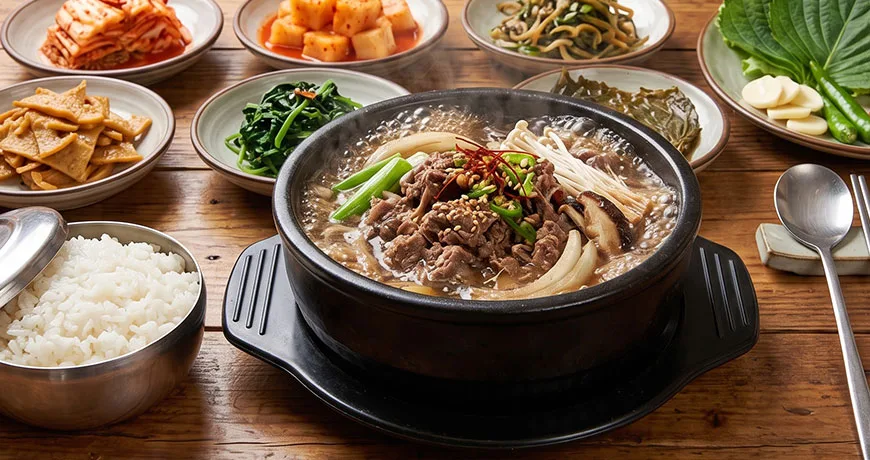
Ttukbaegibulgogi is a biochemical wet-cooking masterclass where thin matrices of mammalian myofibrils are pre-degraded by plant-derived proteolytic enzymes (proteases from Asian pear) and subsequently merged with an aqueous solvent within the violent kinetic convection of a high-thermal-mass earthenware pot (Ttukbaegi). Unlike dry-grilled Bulgogi, which relies on the Maillard reaction, this dish operates on osmotic diffusion; the amino acids and reducing sugars driven into the meat cells by the hypertonic soy marinade bleed back into the boiling kelp broth, exponentially amplifying the solvent’s umami concentration. Into this heavy amino-acid solvent, sweet potato starch noodles are introduced, absorbing the thermal energy to undergo rapid amylopectin gelatinization, producing a highly elastic chew. The extreme thermal mass of the Ttukbaegi maintains the thermodynamic threshold near boiling long after leaving the stove, continually emulsifying the rendered beef lipids and driving flavor extraction at the table.
- ⏱️ Total: 45 mins | Prep: 30 mins (Proteolytic tenderization & osmotic marination) | Cook: 15 mins
- 🍳 Difficulty: Medium (Requires precise control of proteolytic enzyme action and starch gelatinization)
- 🌶️ Profile: Deeply Sweet & Savory Umami with a Rich Lipid Finish
- 🍚 Focus: Proteolysis (Enzymatic Tenderization), Osmotic Diffusion, & Amylopectin Gelatinization
- 🍶 Pairing: Chilled, dry traditional Takju (Makgeolli) or dry refined Cheongju
Ingredients (2 servings)
- Proteolytic Protein Matrix: 300g Hanwoo Beef for Bulgogi (Ribeye or Chuck, sliced to 1.5mm thickness – gently patted dry to remove surface blood)
- Osmotic & Tenderizing Marinade: 3.5 tbsp Soy Sauce, 3 tbsp Grated Asian Pear (crucial for protease enzymes), 2 tbsp Grated Onion, 1 tbsp Sugar, 1 tbsp Minced Garlic, 1 tbsp Sesame Oil (for lipid coating), Black Pepper to taste
- Starch Gelatinization Matrix: 50g Glass Noodles (100% Sweet Potato Starch – hydrated in cold water for 30+ minutes)
- Aqueous Glutamate Solvent: 400ml Anchovy-Kelp Broth
- Textural & Allyl Catalyst: 1/2 pack Enoki Mushrooms, 1 Shiitake Mushroom (sliced), 1 stalk Green Onion (diagonally sliced)
Allergy Information Contains: Beef, Soy, Wheat (from Soy Sauce)
Equipment High Thermal Mass Earthenware Pot (Ttukbaegi) or Cast Iron Pot, Mixing Bowl, Whisk
Cooking Instructions
- Biochemical Tenderization & Osmosis: Place the thinly sliced beef in a mixing bowl and pour in the marinade of grated pear, onion, soy sauce, sugar, garlic, and sesame oil. Massage gently and let rest for 20–30 minutes. The pear’s proteolytic enzymes will cleave the rigid muscle fibers, while osmotic pressure forces the savory amino acids deep into the cellular structure.
- Solvent Heating & Starch Gelatinization: Pour the kelp broth into the Ttukbaegi and apply high heat. Once boiling, introduce the hydrated glass noodles and shiitake mushroom. The kinetic energy attacks the sweet potato amylopectin, initiating gelatinization and transforming the stiff noodles into a translucent, viscoelastic gel.
- Critical Thermal Coagulation: As the noodles turn translucent, introduce the marinated beef along with its juices into the boiling broth. Quickly untangle the meat to ensure even cooking. Because the 1.5mm slices undergo immediate thermal coagulation in the 100°C solvent, precise timing is essential to prevent the denatured proteins from becoming tough and rubbery.
- Cellular Breakdown & Allyl Finish: Once the beef loses its raw red color and clear animal lipids rise to the surface, crown the stew heavily with the enoki mushrooms and green onions.
- Thermodynamic Serving: Remove the pot from the heat just before the enoki mushrooms collapse. The massive thermal capacity of the earthenware will sustain a rolling boil at the table, utilizing radiant heat to perfectly finalize the protein coagulation and extract the volatile allyl compounds from the scallions.
💡 Professional Culinary Tips
- Protease Kinetics of Asian Pear: Unlike the artificial sweetness of commercial marinades, the grated pear acts as a critical molecular tool for physical tenderization. However, if marinated for over 2 hours, the enzymes will over-cleave the myofibrils, causing the meat to structurally disintegrate into mush upon boiling. Strict time control (approx. 30 minutes) is imperative.
- Gelatinization and Viscosity Control: Dropping dry glass noodles directly into boiling broth will cause their surface starch to dissolve, polluting the clear consommé into a muddy, glue-like paste. Thoroughly hydrating them in cold water for 30 minutes stabilizes the starch granules, ensuring clean gelatinization without compromising the broth’s transparency.
- The Thermodynamic Blind Spot of Ttukbaegi: An earthenware pot continues cooking long after the flame is off due to retained heat. If the beef is 100% fully cooked on the stove, it will severely overcook and toughen at the table. The thermodynamic calculation requires removing the pot from the stove when the meat is 85% done, allowing the residual heat to perfectly finish the dish during service.
🍶 Gastronomic Pairing
- Biochemical Palate Cleansing: When the sweet, dense amino-acid solvent, the rich rendered beef lipids, and the slick gelatinized starch thickly coat your oral mucosa, pair this dish with a chilled, dry traditional Takju (Makgeolli) completely free of artificial sweeteners. The abundant organic lactic acid and fine particulate suspension of the rice wine act as a mild abrasive and chemical solvent. It flawlessly scrubs away the heavy, sweet-savory coating on your tongue, providing a brilliant structural contrast to the rich meat matrix and resetting your palate for the next bite.
Nutrition Facts (Estimated)
Total Content : Approx. 500g (1 serving)
Calories : 410 kcal (Excluding rice)
– Sodium : 1,250mg (Attributed to the soy sauce marinade)
– Total Carbohydrate : 35.0g (Reducing sugars from pear/onion and starch polysaccharides from noodles)
– Sugar : 14.0g
– Total Fat : 16.0g (High-density lipids native to beef and sesame oil)
– Saturated Fat : 5.5g
– Cholesterol : 65.0mg
– Protein : 32.0g (Highly bioavailable myofibrillar protein)
– Dietary Fiber : 3.5g
*Daily Values are based on a 2,000 calorie diet and standard Korean nutritional reference values.
**Nutritional values are calculated based on original ingredients; substitutions may alter specific macronutrients.
Origins and Food Culture of Hot Pot Bulgogi (Ttukbaegibulgogi)
1. Lineage: From Ancient Goguryeo “Maekjeok” and Royal “Neobiani” to Broth Bulgogi
- Rooted in the ancient peninsular heritage of Maekjeok (貊炙)—skewered, marinated meat grilled over open flames by the people of Goguryeo—which evolved during the Goryeo Dynasty into Seolyamyeok (雪夜覓) and later into the Joseon royal court’s marinated sliced beef known as Neobiani.
- By the late Joseon era, this grilling tradition merged with the communal hot pot culture (Jeongol). Utilizing domed brass braziers with concave outer rings to capture descending meat juices and botanical broths, cooks created Bulgogi Jeongol (bulgogi hot pot), the direct structural ancestor of today’s broth-rich bulgogi stew.
2. The Culinary Science of Fruit Protease and Earthenware Thermodynamics
- Because thinly shaved beef fibers contract rapidly under high heat and risk becoming tough, traditional cooks utilized the natural enzymatic tenderization of grated Korean pear and onion; the native proteases break down tough protein bonds during marination, ensuring the meat remains tender even when simmered.
- Transferring the preparation into porous earthenware pottery (ttukbaegi) represents a masterclass in culinary thermodynamics: the thick clay walls absorb heat and emit far-infrared radiation, cooking the delicate beef uniformly while retaining radiant heat well above 70°C throughout the meal, thereby preventing rendered bovine fats from cooling into an unpalatable white grease.
3. The Single-Diner (“Honbap”) Adaptation and the Modern Workplace Lunch Heritage
- Historically, Bulgogi Jeongol was an exclusively communal banquet dish requiring two or more diners to gather around a central tabletop stove to celebrate festive occasions.
- During the rapid urbanization and industrial boom of the 1980s and 1990s in Seoul, bustling restaurant districts adapted the recipe for individual diners by cooking single-portion servings inside personal earthenware bowls directly on kitchen ranges. This innovation allowed lone diners, office workers, and students to enjoy the luxury of beef bulgogi quickly and affordably, cementing “Ttukbul” as modern Korea’s ultimate comfort-food lunch staple.
The Silk-Melted Tenderness of Feather-Thin Beef Ribbons, the Caramelized Savor of Artisanal Soy Nectar, and the Restorative Bubble of Earthenware Heat: A Refined Portrait of Ttukbaegibulgogi
Ttukbaegibulgogi (Hot Pot Bulgogi) stands as the comforting, accessible, and biologically ingenious summit of Korea’s individual-serving composite (tangban) gastronomy. Centered upon select cuts of beef chuck, round, top blade, or brisket sliced into paper-thin ribbons, the meat is marinated in an artisanal infusion of aged brewed soy sauce, fresh Korean pear juice, grated onion, minced garlic, toasted sesame oil, and raw sugar to achieve deep enzymatic tenderization. Layered inside a dark, porous earthenware pot (ttukbaegi) over a foundation of hydrated sweet potato glass noodles (dangmyeon), the marinated beef is crowned with enoki mushrooms, shiitake caps, thinly sliced sweet onions, carrots, and scallions. Immersed in a shallow bath of light kelp-anchovy or brisket broth and brought to a violent, fragrant boil over open flames, this dish bridges the dry-heat searing of traditional grilled bulgogi with the communal grandeur of royal hot pot casseroles (jeongol). Reimagined within a single-portion clay vessel, it extracts rich amino acids, natural fruit sugars, and roasted alliums into a deeply savory, aromatic broth that unites meat, starch, and vegetables in absolute thermodynamic equilibrium.
Confronting the boiling earthenware pot as ivory-caramel bubbles froth around glossy beef ribbons releases an immediate, deeply comforting olfactory charge: the toasted, sweet savor of gently caramelized soy sauce mingles seamlessly with the rich, buttery perfume of simmering beef juices, the nutty warmth of toasted sesame oil, and the sweet, sulfurous fragrance of softened scallions and onions. Taking the first sip delivers an unadorned revelation across the oral mucosa: the clarified broth, enriched with muscle-derived free amino acids and the natural fructose of pureed pear, glides over the palate with zero greasy cloying, balancing savory, sweet, and umami registers in effortless harmony. The paper-thin beef ribbons require virtually no chewing effort; tenderized by fruit enzymes, the meat parts along delicate grain lines like warm silk, discharging sweet, concentrated juices. In delightful contrast, the slippery glass noodles deliver an unctuous, viscoelastic snap that drinks in the seasoned broth, while enoki mushrooms introduce a brisk, auditory crunch. Ladling the savory beef, noodles, and broth over a bowl of warm white rice alongside a crisp bite of fermented cabbage kimchi transforms the meal into an unforgettable ritual of domestic solace, communal nostalgia, and profound gastronomic catharsis.
The enduring brilliance of Ttukbaegibulgogi lies in its historical adaptability—descended from the ancient Goguryeo marinated meat skewers (maekjeok), the aristocratic Joseon court delicacy neobiani, and the celebratory, communal brass-pan bulgogi feasts of the 1960s and 1970s. During the rapid urban industrialization of the late 20th century, forward-thinking Seoul restaurateurs modularized this grand communal centerpiece into a single-portion, fast-casual earthenware format tailored for bustling office workers. By transforming a celebratory luxury into an accessible everyday restorative that delivers complete nutritional balance in a single steaming vessel, Ttukbaegibulgogi remains an irreplaceable monument of culinary democratization, maternal generosity, and brilliant Korean gastronomic craftsmanship.
Editor’s Review
1. A Dynamic Harmony of Zero-Resistance Beef Tenderness, Viscoelastic Glass Noodle Snap, Crunchy Fungal Chitin, and Melting Onion Give
The structural architecture inside the vessel delivers an extraordinary, multi-tiered choreography between ultra-thin mammalian muscle fibers, hydrated starch hydrogels, resilient fungal cell walls, and softened vegetable turgor. Sliced to an exacting thickness of 1.0 to 1.5 millimeters, the beef ribbons avoid heat-induced muscle toughening, parting effortlessly across the tongue with a silky, velvety mouthfeel. Framing this delicate protein, the sweet potato glass noodles absorb the hot broth like organic sponges, supplying a buoyant, viscoelastic chew (elasticity) that enriches oral friction. The enoki and shiitake mushrooms provide an energetic, auditory snap that diversifies the soft chew, while the braised sweet onions collapse into tender cushions that release sweet vegetal moisture, ensuring an impeccably balanced, non-fatiguing sensory experience from the first steaming spoonful to the last.
2. Fruit Protease-Induced Actomyosin Cleavage, Aqueous Maillard Caramelization Thermodynamics, Sweet Potato Starch Gelatinization Rheology, and Triple Nucleotide Umami Synergism (IMP-Glutamate-GMP)
Ttukbaegibulgogi represents an exacting study in enzymatically accelerated meat tenderization, aqueous-phase Maillard thermodynamics, and flavor nucleotide kinetics. Pre-marinating thin beef slices in grated Korean pear and onion introduces endogenous plant proteases and mild organic acids that partially hydrolyze structural peptide bonds in myofibrillar actomyosin and perimysial collagen, dramatically suppressing muscle toughness prior to cooking. Within the boiling aqueous environment of the earthenware vessel (90-100°C), reducing sugars from the fruit juices and onions interact with peptides from the naturally brewed soy sauce, undergoing aqueous Maillard reactions and mild caramelization to synthesize rich volatile aromatics (furans and alkylpyrazines). Concurrently, sweet potato starch noodles undergo thermal gelatinization between 65°C and 75°C; the swelling of branched amylopectin polymers creates a slippery, elastic gel network while moderately elevating the dynamic viscosity of the surrounding broth. Broth savor is driven by a profound three-way biochemical synergy: muscle-derived inosine monophosphate (IMP) from the beef converges with the free glutamates of the soy sauce and onions, alongside guanosine monophosphate (GMP) leached from shiitake mushrooms, triggering an exponential activation across human oral T1R1/T1R3 umami heterodimers. Furthermore, the porous clay matrix of the earthenware bowl provides high thermal inertia and low thermal conductivity, maintaining gentle convective currents tableside that prevent surface lipid separation and starch retrogradation throughout the dining experience.
3. Courtly Neobiani Lineage, Fast-Casual Urban Modular Innovation, and the Sovereign Apex of Composite Korean Comfort Food
By translating the grand, interactive etiquette of communal banquet bulgogi into a self-contained, single-serving earthenware bowl, Ttukbaegibulgogi exemplifies the pinnacle of urban culinary adaptation in modern Korea. Uniting high-grade animal protein, complex carbohydrates, and wholesome dietary fibers in complete thermodynamic and nutritional balance, this unpretentious, bubbling classic stands as an enduring sanctuary of restorative sustenance, commercial ingenuity, and brilliant Korean culinary artistry.