
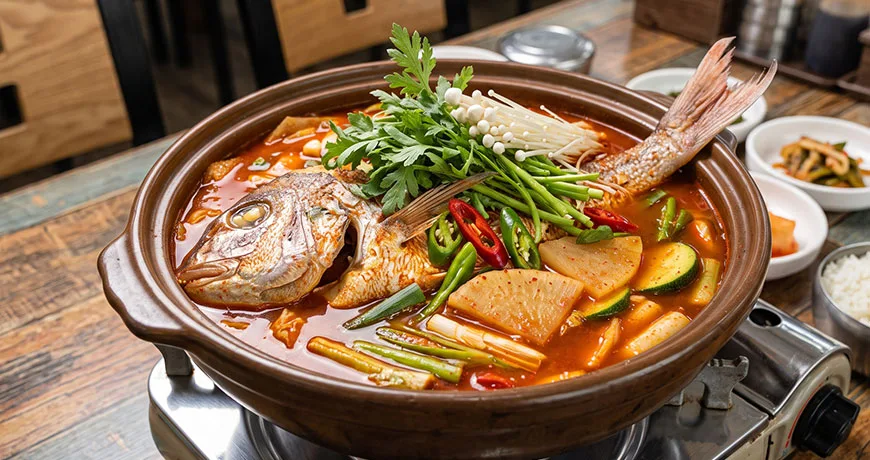
Domimaeuntang is a high-end marine matrix engineered to extract the massive concentrations of inosinate (IMP) and collagen housed within the imposing cranium and skeletal structure of the Red Sea Bream (Domi). Through precise thermal hydrolysis, these elements are transformed into a profoundly rich, yet crystalline consommé. The myofibrils of the sea bream feature firmer connective tissue than standard white fish, allowing the fillets to undergo thermal coagulation into a bouncy, viscoelastic texture without easily disintegrating. The critical engineering of this dish lies in strictly omitting starchy chili paste (Gochujang) to preserve the transparent, regal umami of the sea bream. Instead, the broth relies entirely on a clear capsaicin emulsion formed by chili flakes and soy sauce. The reducing sugars from the breaking pectin walls of daikon radish naturally buffer the sharp spice, while a final heavy canopy of water dropwort and crown daisy volatile terpenes elegantly masks any residual marine lipids, resulting in an olfactory catharsis.
- ⏱️ Total: 50 mins | Prep: 20 mins (Scale removal, cranial blood purging) | Cook: 30 mins
- 🍳 Difficulty: High (Requires thermal extraction of massive bone structure and critical poaching of fillets)
- 🌶️ Profile: Regal Marine Umami, Refined Capsaicin Heat, and Crisp Terpene Aromatics
- 🍚 Focus: Cranial Thermal Hydrolysis, Clear Capsaicin Emulsion, & Myofibrillar Poaching
- 🍶 Pairing: Ice-cold Somaek (Soju + Beer bomb) engineered with a highly carbonated light lager (Terra)
Ingredients (3–4 servings)
- High-Density Protein & Cranial Matrix: 1 whole Fresh Red Sea Bream (참돔, approx. 1kg+ – scales and gills removed, massive head split in half, body portioned into thick steaks with all spinal blood purged)
- Pectin & Reducing Sugar Matrix: 200g Daikon Radish (sliced into squares), 1/3 Zucchini (sliced into half-moons)
- Aqueous Umami Solvent: 1.3L Kelp-Anchovy Broth or Rice Water
- Hypertonic Clear Capsaicin Binder: 3.5 tbsp Gochugaru (Chili Flakes), 2 tbsp Soup Soy Sauce, 1.5 tbsp minced garlic, 0.5 tsp minced ginger, 0.5 tbsp Doenjang (for chemical lipid masking), Coarse Sea Salt to taste
- Aromatic & Terpene Catalyst: 1 handful Crown Daisy (Ssukat), 1 handful Water Dropwort (Minari), 1 stalk Green Onion (diagonally sliced), 2 Cheongyang green chilies
Allergy Information Contains: Fish (Sea Bream), Soy, Wheat (from Soy Sauce, Doenjang)
Equipment Wide High Thermal Mass Pot, Fine Skimmer, Fish Scaler, Cutting Board, Knife
Cooking Instructions
- Initial Cranial Coagulation: Flash-blanch only the split head and skeletal bone sections in boiling water for 1 minute. This thermally coagulates the surface myoglobin and impurities. Rinse thoroughly under cold water. This physical purging is the absolute prerequisite for a crystal-clear broth.
- Cranial Hydrolysis: In a wide pot, combine the broth, square-cut radish, and the prepped sea bream head. The soul of this broth originates from the cranium. Bring to a boil, then reduce to medium heat, simmering for 15 minutes to forcefully extract the deep inosinate (IMP) and collagen into the solvent.
- Capsaicin Emulsion: Once the cranium yields its profound umami, dissolve the chili flakes, soy sauce, garlic, ginger, and a touch of Doenjang into the liquid to establish a clear, hypertonic capsaicin matrix. Relentlessly skim away any surfacing foam.
- Critical Thermal Coagulation: Introduce the thick sea bream fillets and zucchini into the fully constructed broth. Poach uncovered over medium heat for strictly 10–12 minutes. This controls the thermal coagulation, ensuring the delicate protein structures tighten into a bouncy, elastic state without breaking apart.
- Terpene Coating: Once the protein turns an opaque, firm white, heap the green onions, chilies, Ssukat, and Minari over the top right before turning off the heat. The radiant heat triggers the release of volatile terpenes and allyl compounds, providing a crisp, forest-fresh finish that beautifully masks the heavy marine lipids.
💡 Professional Culinary Tips
- Biochemical Value of the Cranium: The traditional proverb highlighting the superiority of fish heads is absolute molecular fact. The massive cranium of the sea bream houses highly concentrated lipids around the eyes, hypertrophied cheek muscles, and massive reserves of water-soluble inosinate (IMP) within the cranial cavity. Boiling only the fillets will never achieve the immense, sweet body characteristic of authentic Domimaeuntang.
- Philosophy of Gochujang Omission: While cheap or muddy freshwater fish require the heavy starch of Gochujang for masking, premium sea bream demands clarity. The viscous texture of chili paste irreparably clouds the crystalline sweetness and umami of the fish. Utilizing only chili flakes maximizes both the optical transparency and the flavor resolution of the broth.
- Staggered Protein Introduction: Boiling the dense cranial collagen for an extended period first, while introducing the delicate myofibrillar fillets at the very end for a rapid flash-poach, is the unyielding law of high-end marine thermodynamics.
🍶 Gastronomic Pairing
- Biochemical Palate Cleansing: When the dense sub-dermal lipids, bouncy collagen, and crystalline spicy broth fully saturate your oral mucosa, pair this regal stew with a perfectly engineered, ice-cold Somaek (Soju and Beer bomb). Utilizing a highly carbonated, crisp light lager like Terra is optimal; its aggressive effervescence combined with the refined ethanol of Soju acts as a surgical scalpel. This fluid dynamically slices through the heavy marine lipids and capsaicin coating your tongue, instantly resetting your taste receptors and geometrically amplifying the inosinate umami of the very next spoonful.
Nutrition Facts (Estimated)
Total Content : Approx. 700g (1 serving, excluding bone weight)
Calories : 310 kcal (Excluding rice)
– Sodium : 1,300mg
– Total Carbohydrate : 12.0g (Reducing sugars from radish and zucchini)
– Sugar : 4.0g
– Total Fat : 6.0g (High-quality Omega-3 lipids native to cranial and dermal tissues)
– Saturated Fat : 1.5g
– Cholesterol : 90.0mg
– Protein : 46.0g (Ultra-dense myofibrillar protein and collagen peptides)
– Dietary Fiber : 4.5g
*Daily Values are based on a 2,000 calorie diet and standard Korean nutritional reference values.
**Nutritional values are calculated based on original ingredients; substitutions may alter specific macronutrients.
Origins and Food Culture of Spicy Sea Bream Stew (Domimaeuntang)
1. Joseon Royal Court Banquets and the “King of Fishes” in Classical Compendiums
- Adorned with brilliant crimson scales and iridescent turquoise spots, the red sea bream (chamdom) was traditionally celebrated as the “King of Hundred Fishes” (Baek-eo-ui Wang), symbolizing longevity, prosperity, and aristocratic dignity. It was an indispensable centerpiece for Joseon royal birthday banquets (tansin sura) and noble family milestones like 60th birthday feasts (hwangap).
- Documented in Jeong Yak-jeon’s 1814 marine treatise Jasanoebo under the Hanja name Domi (陶尾) or Jin-eo (眞魚, “the true fish”), it was praised because “its flesh is exceedingly white, firm, and clean, producing an incomparable delicacy when simmered into broth.” Similarly, Heo Jun’s 1613 Dongui Bogam recorded that it “is balanced in nature, sweet in flavor, nourishing vital energy and fortifying stomach function,” confirming centuries of prestigious medicinal lineage.
2. The Culinary Maxim of “Eodu-ilmi” (Fish Head Flavor) and Thermal Extraction
- The celebrated Korean gastronomic proverb “Eodu-ilmi (魚頭一味)”—proclaiming that a fish’s head yields the most exquisite flavor—owes its origin primarily to the sea bream, whose cranial bones, cheek muscles (bbolsal), and jaw cartilage concentrate the highest density of savory ribonucleotides and structural collagen.
- Authentic kitchens practice a delicate scalding technique (yubiki): splashing boiling water over the cleaned head and bone frame prior to stewing to instantly wash away residual blood and loose scales, ensuring an impeccably clear broth without fishy off-notes. Simmering radish first to extract sweet botanical juices before introducing the fish over controlled heat locks in internal moisture and draws deep bone essence into the broth.
3. Auspicious Banquet Hospitality and the Grand Finale of Raw-Fish Feasts
- Historically serving as the ultimate expression of noble hospitality, sea bream stew directly inherits the prestige of Domimyeon (Seunggjiaktang), an elaborate royal hot pot dish celebrated in palace records.
- In contemporary dining culture, following a lavish banquet of sliced raw sea bream (chamdom hoe), preparing a bubbling cauldron of Domimaeuntang using the reserved head and bone frame (seodeori) serves as the mandatory, crowning finale. Cleansing the palate of rich oils and warming the core, it remains an enduring cultural monument to Korean maritime gastronomy, celebratory warmth, and noble restorative dining.
The Regal Flakes of Wild Red Seabream, the Lip-Clinging Extraction of Cranial Cartilage Marrow, and the Incandescent Dynamic of Fermented Chili Broth: A Refined Portrait of Domimaeuntang
Domimaeuntang (Spicy Red Seabream Stew) stands as the aristocratic, biologically opulent, and majestically restorative summit of Korea’s marine white-fleshed (tangban) gastronomy. Centered upon the celebrated red seabream (Pagrus major or Chamdom)—revered across centuries of Korean culinary history as the undisputed sovereign king of white fish—the dish utilizes whole carcasses: the colossal, mineral-dense head, heavy spinal columns, and thick, pink-skinned fillets of snowy white meat. Anchored upon a refreshing bedrock of thinly sliced winter radish and crisp soybean sprouts to build a clean vegetable foundation, the stew is bathed in a foundational dried kelp and anchovy stock dissolved with an assertive seasoning paste of sun-dried red chili powder (gochugaru), a touch of aged soybean paste (doenjang), red chili paste (gochujang), aged soup soy sauce, crushed garlic, and ginger. Brought to an aggressive, rolling tableside boil and crowned at the rolling climax with wild water parsley (minari), aromatic crown daisy (ssukgat), and scallions, this creation easily eclipses the fragile crumble of lesser white-fleshed fish stews. It transports an elite perciform predator’s firm, muscular sheets and dense cranial connective tissues into the fiery kinetics of capsaicin, achieving absolute thermodynamic equilibrium between lip-clinging bone nectar and soul-reviving spice.
Confronting the boiling vessel tableside as terracotta-colored bubbles froth vigorously around the magnificent seabream head releases an immediate, deeply comforting sensory charge: the rich, buttery perfume of slow-simmered fish bones and melted marrow mingles seamlessly with the deep savor of fermented soybean paste and the brisk, pine-fresh fragrance of wild crown daisy and water parsley. Taking the first sip delivers a luxurious revelation across the oral mucosa: the rich broth, fortified with natural asparagine from the sprouts, sweet succinic acids from the braised radish, and copious gelatin leached from the fish skull, coats the palate with zero greasy heaviness. It courses down the throat to unlock instant, soothing warmth, triggering revitalizing perspiration that swiftly banishes bodily fatigue. Parting the seabream’s flesh with a spoon yields dense, snowy flakes that retain their muscular integrity under boiling currents, fracturing cleanly against the palate to release concentrated streams of clean, uncorrupted marine sweetness. The prized cheek meat (bbolsal) and gelatinous eye socket tissues provide an unctuously rich, viscoelastic chew dense with bioavailable collagen. The translucent radish yields with a melting, juicy chew, while the crisp snap of wild herbs provides refreshing botanical friction, transforming the meal into an unforgettable ritual of metabolic restoration, physical renewal, and profound gastronomic catharsis.
The enduring majesty of Domimaeuntang lies in its historical pedigree—descended from elite Joseon Dynasty court banquets, where red seabream was immortalized in legendary centerpieces like Seunggiaktang (勝妓樂湯—literally “a dish so sublime its pleasure surpasses the music and dance of court courtesans”) and the royal brass hot pot Domimyeon. Evolving from an imperial celebratory delicacy into the undisputed crowning finale of modern raw fish feasts (seodaritang), a steaming cauldron of spicy seabream stew remains an irreplaceable monument of zero-waste marine stewardship, aristocratic indulgence, and brilliant Korean culinary craftsmanship.
Editor’s Review
1. A Dynamic Harmony of Firm Seabream Myotome Flaking, Viscoelastic Cranial Gelatin, Melting Radish Sponginess, and Herbaceous Crunch
The structural architecture inside the vessel delivers an extraordinary, high-contrast choreography between dense marine perciform muscle fibers, heat-denatured cranial cartilage tissues, and crisp vegetable cell walls. Because red seabream possesses tight connective sheaths between its myotomes, the firm white meat resists hydrothermal flaking, parting under tooth pressure with an energetic, springy bounce (taenggeul) before dissolving into succulent flakes. Concurrently, the extensive connective tissues of the seabream head and cheek muscles melt into an unctuous, viscoelastic chew that provides luxurious oral lubrication. Cushioning this richness, the thickly sliced radish—having absorbed the savory stock like an organic sponge—yields with a tender bite, framed by the brisk, auditory snap of briefly wilted water parsley and crown daisy, ensuring an impeccably balanced, non-fatiguing mouthfeel from the first steaming sip to the last.
2. Cranial Type I Collagen Hydrothermal Gelatinization, Perciform Actomyosin Water Holding Capacity (WHC) Retention, IMP-Glutamate Nucleotide Synergy, and Capsaicin TRPV1 Thermoregulation
Domimaeuntang represents an exacting study in teleost cranial osteology, myofibrillar thermodynamics, and flavor volatile extraction. Insoluble Type I collagen, densely woven within the seabream’s cranial bones, opercular plates, and fin bases, undergoes thermal denaturation during sustained simmering above 85-90도C, cleaving its tight triple-helix hydrogen bonds into water-soluble gelatin polypeptides that elevate the broth’s dynamic viscosity. Concurrently, the seabream’s myofibrillar actomyosin network exhibits remarkable structural stability, retaining cellular moisture (high Water Holding Capacity) without undergoing excessive syneresis under moderate convective heat (85-90도C). Broth savor is driven by a powerful biochemical synergy: muscle-derived inosine monophosphate (IMP) converges with natural succinic acid from the braised radish and free glutamic acid (Glutamate) leached from fermented doenjang, triggering an exponential synergy across human oral T1R1/T1R3 umami heterodimers. Crucially, volatile basic nitrogen compounds—principally trimethylamine (TMA)—are physically adsorbed by the colloidal soybean proteins of doenjang and rapidly vaporized along with cooking alcohol vapors. Simultaneously, active gingerols from ginger, allicin from garlic, and volatile monoterpenes (limonene, terpinolene) from water parsley chemically mask trace lipid off-notes. Furthermore, lipophilic capsaicin from the red pepper powder excites oral TRPV1 receptors, promoting peripheral vasodilation, gentle sweating, and digestive secretion to complete a comprehensive, restorative metabolic recovery mechanism.
3. The Joseon Seunggiaktang Court Lineage and the Sovereign Peak of Elite Marine Fish Gastronomy
Prized in Joseon court lore above all other maritime treasures for its longevity and auspicious beauty, the red seabream occupies the highest echelon of Korean fish cookery. Transcending the austere minimalism of clear soups by marrying rich, marrow-infused bone collagen with the bold clarity of fermented red pepper and soybean paste, Domimaeuntang stands as the ultimate expression of Korean fish cookery—an enduring sanctuary of courtly refinement, structural harmony, and brilliant culinary artistry.