
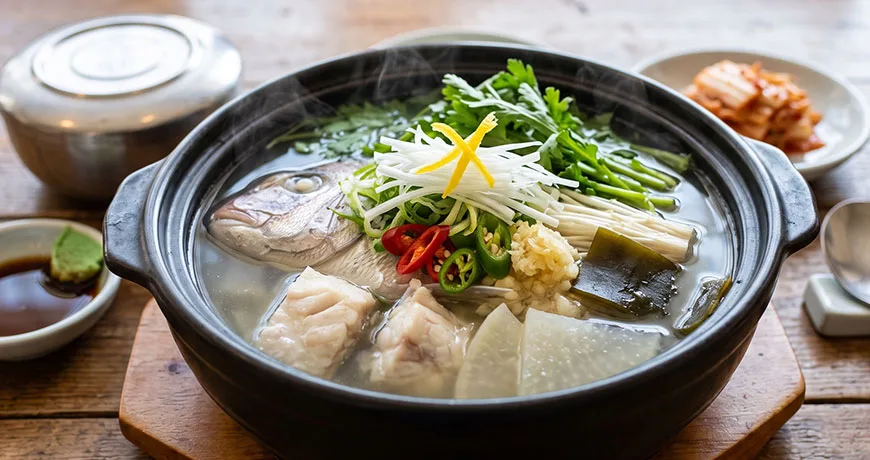
Domimalgeuntang is the pinnacle of minimalist seafood consommés, engineered to extract the profound inosinate (IMP) and dense collagen trapped within the massive cranium and thick dermis of the Red Sea Bream (Tai/Domi)—the undisputed “King of White Fish.” Unlike softer species, sea bream possesses a robust skeletal structure and thick skin that absolutely requires the “Shimofuri” (frosting) technique: pouring boiling water over the raw fish to instantaneously coagulate the surface proteins. This thermal shock strips away volatile trimethylamine (fishy odor) from the mucin layer, shrinks the skin to lock in intra-cellular moisture, and allows for the physical removal of microscopic residual scales. The bone extraction is then conducted in a tranquil, sub-boiling thermodynamic environment (90–95°C) to prevent the lipids from emulsifying, ensuring the broth remains as clear as white wine. By completely prohibiting minced garlic and soy sauce, and relying solely on sea salt, sliced garlic, and kelp glutamate, this matrix maximizes the elegant, sweet marine minerality inherent to premium sea bream.
- ⏱️ Total: 45 mins | Prep: 20 mins (Shimofuri thermal coagulation & physical scaling) | Cook: 25 mins
- 🍳 Difficulty: Extreme (Requires mastery of the Shimofuri technique and critical convection control for broth clarity)
- 🌶️ Profile: Crystalline Clear, Elegantly Sweet, and Profoundly Deep Marine Umami
- 🍚 Focus: Shimofuri Coagulation, Cranial Thermal Hydrolysis, & Critical Myofibril Poaching
- 🍶 Pairing: Chilled, highly refined Premium Daiginjo Sake or a mineral-driven Meursault White Wine
Ingredients (3–4 servings)
- High-Density Collagen & Cranial Matrix: 1 whole Fresh Red Sea Bream (Domi – approx. 1.2kg+, gutted, gills removed. Cranium split in half, thick fillets separated from the spine)
- Pectin & Reducing Sugar Matrix: 150g Daikon Radish (sliced into squares), 2 white leaves of Napa Cabbage, 1 Fresh Shiitake Mushroom (Guanylate source)
- Aqueous Umami Solvent: 1.5L Kelp Broth or Purified Water
- Aromatic & Terpene Catalyst: 1 handful Water Dropwort (Minari), 1 white stalk of Green Onion (diagonally sliced), 1 Cheongyang green chili
- Ionized Sodium Binder: Coarse Sea Salt to taste (Soy sauce strictly prohibited), 3 cloves Garlic (sliced, absolutely NOT minced), 3 tbsp Premium Rice Wine (Cheongju)
Allergy Information Contains: Fish (Sea Bream)
Equipment Wide High Thermal Mass Pot, Fine Skimmer, Strainer (for Shimofuri), Mixing Bowl with Ice Water, Tweezers
Cooking Instructions
- Shimofuri Thermal Coagulation & Physical Purging: Place the prepped cranium, bones, and fillets in a strainer. Pour 100°C boiling water directly over them. The skin and surface proteins will instantly turn white and forcefully contract. Immediately plunge the fish into a bowl of ice water to halt the cooking process. Using your fingers and tweezers, meticulously scrape away any loose scales, coagulated blood clots, and slimy mucin. (A crystalline broth is physically impossible without this step.)
- Cranial Hydrolysis: In a wide pot, combine the kelp broth, radish, rice wine, and the purged cranium and bones. Heat over medium. Once approaching a boil, strictly control the kinetic heat to maintain a tranquil 90–95°C simmer. Allowing a violent rolling boil will hydrodynamically emulsify the bone lipids and ruin the clarity. Extract the IMP for 15 minutes.
- Critical Myofibril Poaching: Once the broth develops a deep umami profile and the radish turns translucent, introduce the cabbage, shiitake mushroom, sliced garlic, and the sea bream fillets. Lower the heat to maintain a calm 85°C poaching environment. Gently cook for 5–7 minutes so the dense white myofibrils firm up with a bouncy, hydrated texture without suffering syneresis.
- Lipid Clarification & Salinity: Relentlessly use a fine mesh skimmer to remove any micro-protein foam rising to the surface. Calibrate the final sodium ion concentration strictly with coarse sea salt.
- Terpene Coating & Finish: Once the fillets are fully opaque and turgid, place the scallions, chili, and a generous heap of Minari on top right before turning off the heat. The radiant heat will release the volatile botanical terpenes, providing a crisp, aromatic seal over the marine broth.
💡 Professional Culinary Tips
- The Physicochemistry of Shimofuri: The thick skin of the sea bream holds strong connective tissues and a layer of mucin prone to oxidation. The “Shimofuri” (boiling water blanch) instantaneously gelatinizes the outer collagen, creating a biological “capsule.” This prevents the internal amino acids from bleeding out uncontrollably during the simmer and structurally reinforces the flaky flesh so it holds together beautifully in the bowl.
- Control of Convection and Garlic: The broth of Domimalgeuntang must possess the optical clarity of white wine. Minced garlic acts as an abrasive pollutant, clouding the solvent with micro-particles, while its aggressive allicin destroys the bream’s elegant floral notes. Furthermore, a 100°C rolling boil forces the calcium and lipids from the bones into a milky suspension (Paitan style), completely ruining the intended crystalline consommé (Chintan style).
- Molecular Value of the Cranium: The true umami and gelatinous luxury of a sea bream are concentrated in the heavy jaw muscles (Kama) and the dense lipid deposits behind the eyes. A soup made exclusively from fillets is molecularly flat. Splitting the massive cranium and extracting its marrow and collagen is the non-negotiable core of this high-end recipe.
🍶 Gastronomic Pairing
- Biochemical Palate Cleansing: When the bouncy, gelatinous skin of the sea bream and the crystalline, sweet inosinate broth elegantly coat your oral mucosa, pair this masterwork with a highly refined Premium Daiginjo Sake or a structured, mineral-driven Meursault (White Burgundy). The polished ethanol and sharp tartaric acid act as a surgical scalpel, cleanly slicing through the delicate lipid barrier on your tongue, completely resetting your palate and geometrically amplifying the sophisticated marine umami of the very next spoonful.
Nutrition Facts (Estimated)
Total Content : Approx. 700g (1 serving, excluding bone weight)
Calories : 190 kcal (Excluding rice, ultra-low calorie)
– Sodium : 1,150mg (Dependent entirely on final sea salt calibration)
– Total Carbohydrate : 8.0g (Reducing sugars from radish and cabbage polysaccharides)
– Sugar : 3.0g
– Total Fat : 3.5g (High-quality unsaturated lipids concentrated beneath the skin)
– Saturated Fat : 0.8g
– Cholesterol : 65.0mg
– Protein : 32.0g (Highly bioavailable hydrated myofibrillar protein and collagen peptides)
– Dietary Fiber : 3.0g
*Daily Values are based on a 2,000 calorie diet and standard Korean nutritional reference values.
**Nutritional values are calculated based on original ingredients; substitutions may alter specific macronutrients.
1. Joseon Royal Court Heritage and the “King of Fishes” in Classical Treatises
- Boasting brilliant crimson scales adorned with iridescent turquoise spots and celebrated for its long lifespan, the red sea bream (chamdom) was historically revered as the “King of Hundred Fishes” (Baek-eo-ui Wang), symbolizing longevity, good fortune, and aristocratic dignity. It served as the supreme ceremonial fish presented at Joseon royal birthday banquets (tansin sura) and noble family milestones.
- Documented in Jeong Yak-jeon’s 1814 marine biology compendium Jasanoebo under the name Jin-eo (眞魚, literally “the true fish”) or Domi (陶尾), it was lauded because “its flesh is exceedingly white, firm, and clean; when simmered into soup, it yields a crystal-clear broth of unrivaled delicacy.” Similarly, Heo Jun’s 1613 Dongui Bogam praised its ability to harmonize the stomach and replenish vital energy, confirming centuries of prestigious lineage as an elite restorative tonic.
2. The Culinary Maxim of “Eodu-ilmi” and the Blanching (Yubiki) Pre-treatment Technique
- The celebrated Korean gastronomic proverb “Eodu-ilmi (魚頭一味)”—proclaiming that a fish’s head yields the most exquisite flavor—owes its origin primarily to the sea bream, whose cranial bones, cheek muscles (bbolsal), and jaw cartilage concentrate the highest density of savory ribonucleotides and structural collagen.
- To preserve crystalline clarity and eliminate fishy off-notes, master kitchens employ a delicate pre-treatment scalding technique (yubiki): splashing boiling water over the dressed head and bone frame to instantly coagulate residual blood and rinse away loose scales. Simmering sweet radish first to extract crisp vegetable essences before gently poaching the sea bream over controlled heat locks internal moisture within the flesh while releasing rich bone essence into a sparkling clear broth (Cheongtang).
3. Aristocratic Hospitality and the Sovereign Benchmark of “White Hangover Relief”
- Directly inheriting the regal elegance of Domimyeon (Seunggjiaktang)—the elaborate brass hot pot dish of the Joseon palace—Domimalgeuntang transitioned in modern dining into the mandatory, crowning finale of high-end raw-fish (hoe) courses.
- By foregoing heavy chili pastes in favor of solar sea salt, clear soup soy sauce, fresh water dropwort, and a splash of vinegar, Domimalgeuntang celebrates the unmasked, pristine purity of the sea. Revered for gently pacifying the stomach and restoring tired liver function, it remains an immortal monument to Korean maritime gastronomy, aristocratic hospitality, and the therapeutic art of “White Hangover Relief” (baeksaek haejang).
The Noble Resilience of Apex Red Sea Bream Myotomes, the Lip-Clinging Extraction of Cranial Type I Collagen Gelatin, and the Crystalline Purity of Marine Consommé: A Refined Portrait of Domimalgeuntang
Domimalgeuntang (Clear Sea Bream Soup, celebrated colloquially as Domijiri) stands as the aristocratic, crystalline, and biologically immaculate summit of Korea’s high-tier marine clear-broth (cheongtang) gastronomy. Centered upon the red sea bream (Pagrus major or Chamdom)—revered across millennia as the “King of a Hundred Fish” and an enduring emblem of longevity and auspicious fortune—the dish begins with surgical butchery. Sporting vivid carmine scales speckled with luminescent azure dots, the fish is descaled, eviscerated with care to avoid rupturing the bitter bile sac, and sectioned into thick bone-in steaks alongside its colossal, marrow-dense head (eodu). The pieces undergo an initial rolling water scald (blanching) to instantly purge coagulated surface albumins, epidermal biofilms, and vascular residues. Anchored upon a refreshing bedrock of thinly sliced winter radish and crisp soybean sprouts inside an earthenware cauldron (ttukbaegi) or wide casserole, the vessel is flooded with a pristine kelp infusion alongside minced garlic and refined rice wine. Brought to a rapid boil, the heat is promptly dialed back to maintain a gentle convective simmer (85–90°C), while skimmers methodically lift away surface froth and excess lipid droplets to preserve immaculate transparency. Crowned at the final moment with tender tofu, emerald ribbons of wild water parsley (minari), aromatic crown daisy (ssukgat), enoki mushrooms, and scallions, the soup is seasoned transparently with aged artisanal soup soy sauce or solar sea salt. Rejecting fiery red pepper pastes and heavy fermented bean mashes, Domimalgeuntang extracts the pure, unmasked amino acids and bone minerals of this noble sparid fish through sheer thermodynamic minimalism, delivering an austere masterclass that purifies the palate and soothes fatigued organs with radiant warmth.
Confronting the boiling earthenware vessel tableside as diamond-bright steam ascends between vivid green ribbons of water parsley and translucent broth, lifting a deep spoonful of the broth releases an immediate, deeply calming sensory charge: the brisk, iodine-clean perfume of deep-sea reefs mingles seamlessly with the honeyed vegetable sweetness of simmered winter radish and the crisp, pine-fresh aroma of wild water parsley. Taking the first sip delivers an unadorned revelation across the oral mucosa: devoid of any greasy surface tension, the clarified amino acid broth floods the tongue with silk-like softness, gliding effortlessly down the esophagus to soothe alcohol-inflamed tissues and awaken dormant perspiration in an exhilarating wave of what Korean gastronomy reveres as siwonhan mat—the sensation of profound, soul-cleansing lightness. Sinking your teeth into the poached sea bream reveals an extraordinary structural joy: forged in rapid ocean currents, the firm white muscle parts along dense myotomal boundaries into toothsome, succulent flakes that resist mastication with an energetic, springy bounce (taenggeul) before releasing concentrated streams of noble, crystalline fish nectar. In luxurious contrast, the simmered cheek meat, lips, and collagenous eye sockets of the sea bream head supply an unctuous, viscoelastic chew (jjondeuk) dense with gelatin. Translucent radish yields with a succulent, juicy bite, while the brisk snap of water parsley cleanses lingering rich notes. Finishing with a few drops of tableside vinegar and steeping warm white rice into the diamond-bright broth alongside a crisp cube of aged white kimchi transforms the meal into an unforgettable ritual of physical rejuvenation, aristocratic solace, and quiet gastronomic transcendence.
The enduring majesty of Domimalgeuntang lies in its courtly lineage—recorded across Joseon royal banquet protocols (Uigwe) as the centerpiece of grand state celebrations (Domimyeon and Domitang) and cherished by coastal fishermen along the windswept wharves of Yeosu, Tongyeong, and Geomundo, who tossed freshly harvested sea bream straight into bubbling dockside cauldrons of clear seawater and winter radish. Bypassing heavy condiments to let the cold ocean’s untamed vitality shine through disciplined thermal poaching, a steaming cauldron of clear sea bream soup remains an irreplaceable monument of zero-waste marine stewardship, seasonal reverence, and brilliant Korean culinary craftsmanship.
Editor’s Review
1. A Dynamic Harmony of Dense Muscle Flaking, Viscoelastic Cranial Gelatin, Crisp Botanical Turgor, and Frictionless Consommé Fluidity
The structural architecture inside the vessel delivers an extraordinary, high-contrast choreography between dense teleost myofibrillar bundles, heat-denatured dermal connective tissue, hydrated root matrices, and an ultra-low-viscosity aqueous matrix. Because red sea bream inhabits high-energy reef zones, its white muscle fibers possess high fascicular density; even under convective hydrothermal cooking, the meat resists structural disintegration, separating under mastication into colossal, succulent flakes that discharge trapped moisture with a lively, toothsome bounce. Dynamic richness is supplied by the cheek meat, opercular connective sheets, and dermal layers of the sea bream head, which hydrolyze into an unctuous, viscoelastic gelatin sheath that clings to the lips with rich oral lubrication. Cushioning these textures, the braised winter radish yields with a melting bite, framed by the brisk, auditory snap of briefly wilted water parsley and soybean sprouts, ensuring an impeccably balanced, non-fatiguing mouthfeel from the first steaming sip to the last.
2. Actomyosin Syneresis Mitigation via Gentle Simmering (85–90°C), Cranial Type I Collagen Gelatinization, IMP-Glutamate Nucleotide Synergy, and Acetic Acid TMA Salification Kinetics
Domimalgeuntang represents an exacting study in sparid fish muscle biochemistry, connective tissue thermodynamics, and volatile amine mitigation. Red sea bream muscle is characterized by high protein density and low intramuscular fat; exposing the fillets to aggressive rolling boiling (>100°C) triggers rapid, irreversible contraction of myofibrillar actomyosin, causing extensive cellular moisture expulsion (syneresis) that leaves the fish dry and chalky. Constructing the vegetable stock first and poaching the sea bream within a gentle convective window (85–90°C) preserves myofibrillar Water Holding Capacity (WHC), locking in cellular juices. Insoluble Type I collagen, densely woven within the heavy cranial bones, jaw hinge, fin bases, and thick skin, hydrolyzes into water-soluble gelatin polypeptides, endowing the clear broth with a subtle, lip-clinging dynamic viscosity. Broth savor is driven by an exponential biochemical synergy: muscle-derived 5′-inosine monophosphate (5′-IMP) converges with natural free glutamates from the kelp and winter radish, alongside asparagine from the sprouts, triggering intense activation across human oral T1R1/T1R3 umami heterodimers. Pre-cook blanching mechanically removes surface oxidized lipids and peripheral coagulants, while cooking alcohol vapors carry away volatile off-notes. Crucially, the tableside addition of acetic acid (vinegar) lowers the broth’s pH, protonating volatile free amines—principally trimethylamine (TMA)—into non-volatile ammonium acetate salts, thereby eliminating residual fishy off-notes while exciting salivary flow to heighten the clarity of the underlying marine umami.
3. Joseon Royal Banquet Heritage, Southern Archipelago Terroir, and the Sovereign Apex of Marine Clear Gastronomy
Revered throughout the Joseon Dynasty as an auspicious symbol of health, prosperity, and courtly dignity, red sea bream stands as the quintessential icon of aristocratic fish cookery in Korean history. Uniting the cold-water power of southern reef-dwelling sparids with the immaculate clarity of winter root vegetables and disciplined thermal science, Domimalgeuntang represents the absolute triumph of minimalist extraction. Standing as an enduring sanctuary of environmental authenticity, ancestral reverence, and brilliant Korean culinary artistry, this radiant, diamond-bright classic captures the cold ocean’s untamed vitality in its purest, most noble form.