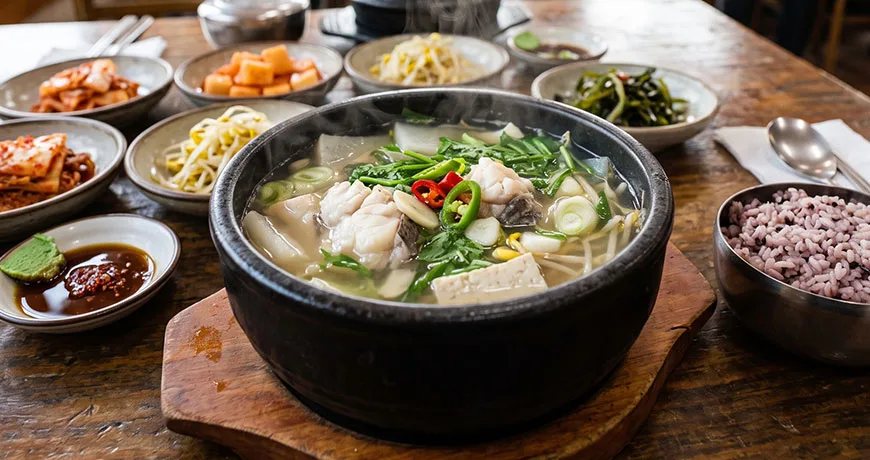
Daegumalgeuntang is a hyper-minimalist marine matrix engineered to extract the massive concentrations of glutamate and inosinate (IMP) trapped within the imposing cranium and skeletal structure of the Cod, an apex cold-water predator. Through precise thermal hydrolysis in a tranquil 95°C convection environment, the deep umami of the bones is rendered into a crystalline, transparent consommé (Jiri). Because the white myofibrils of the cod contain minimal connective tissue, subjecting them to a 100°C rolling boil will hydrodynamically disintegrate the flesh into mush. Therefore, strict dual-phase cooking is required: extracting the deep broth from the cranium first, then introducing the delicate fresh fillets and milt (Shirako) at the very end to critically poach them in a calm 85°C solvent. Omitting chili paste, soy sauce, and minced garlic completely preserves the pristine optical clarity and delicate sweetness of the fish, while a heavy canopy of water dropwort (Minari) terpenes elegantly masks any residual marine trimethylamine.
- ⏱️ Total: 40 mins | Prep: 15 mins (Cranial blood purging & physical abrasion) | Cook: 25 mins
- 🍳 Difficulty: High (Requires critical convection control for consommé clarity and protection of delicate myofibrils)
- 🌶️ Profile: Crystalline Clear, Profoundly Deep Marine Umami with a Crisp Terpene Finish
- 🍚 Focus: Cranial Thermal Hydrolysis, Critical Myofibril Poaching, & Terpene Masking
- 🍶 Pairing: Chilled, mineral-driven Traditional Cheongju or hot savory Hire-zake
Ingredients (3–4 servings)
- High-Density Protein & Cranial Matrix: 1 whole Fresh Cod (Daegu, never frozen, approx. 1.5kg – scales removed, massive head split in half, spinal bloodlines meticulously purged), 150g Fresh Cod Milt (Shirako/Iri)
- Pectin & Aspartic Acid Matrix: 200g Daikon Radish (sliced into squares), 100g Soybean Sprouts (heads and tails removed for pure aspartic acid extraction)
- Aqueous Umami Solvent: 1.5L Kelp Broth or Purified Water
- Aromatic & Terpene Catalyst: 1 large handful Water Dropwort (Minari), 1 white stalk of Green Onion (diagonally sliced), 1 Cheongyang green chili
- Ionized Sodium Binder: Coarse Sea Salt to taste (Soy sauce is omitted to preserve optical clarity), 3 cloves Garlic (sliced, absolutely NOT minced)
Allergy Information Contains: Fish (Cod)
Equipment Wide High Thermal Mass Pot, Fine Skimmer, Heavy Cutting Board, Knife
Cooking Instructions
- Initial Coagulation & Purging: Flash-blanch only the split cod head and heavy skeletal bone sections in vigorously boiling water for 1 minute. The surface myoglobin and impurities will thermally coagulate. Remove and scrub the blood clots from the bone cavities under cold running water. This physical purging is the absolute prerequisite for a crystal-clear broth.
- Cranial Hydrolysis: In a wide pot, combine the kelp broth, square-cut radish, soybean sprouts, and the prepped cod cranium/bones. Bring to a boil, then reduce the heat to medium (90–95°C) and simmer for 15 minutes. This thermal energy forcefully extracts the deep inosinate (IMP) and collagen from the skull into the solvent.
- Hydrated Myofibril Coagulation: Once the cranium yields its profound umami, introduce the thick fresh cod fillets and sliced garlic. Strictly lower the heat to maintain a calm 85°C poaching environment. Allowing the water to reach a rolling boil will hydrodynamically destroy the delicate flesh. Poach gently for 5–7 minutes until the proteins coagulate into a bouncy, flaky state.
- Shirako Gelation: 2 minutes before the end of cooking, slide the delicate milt (Shirako) into the broth. The soft milt requires gentle, low-temperature gelation to retain its creamy, lipid-rich core without becoming rubbery.
- Terpene Coating & Finish: Once the cod flesh turns an opaque, firm white, precisely calibrate the salinity with sea salt. Right before turning off the heat, heap the green onions, chili, and a massive amount of Minari over the top. The radiant heat triggers the release of volatile terpenes, laying a crisp, forest-fresh coating over the marine broth.
💡 Professional Culinary Tips
- Biochemical Value of the Cranium: The massive head of the cod (making up nearly a third of its body mass) houses immense quantities of hypertrophied jaw muscle, sub-dermal lipids, and highly concentrated water-soluble inosinate within the cranial cavity. A broth made solely from cod fillets is molecularly vacant. Pre-extracting the cranium via thermal hydrolysis is the non-negotiable core of this dish.
- Garlic Slicing Logic: The soul of Daegu Jiri is its crystalline, untainted clarity. Using minced garlic releases microscopic particles that irreversibly cloud the solvent, and the resulting aggressive allicin explosion completely destroys the delicate, sweet minerality of the cod. Using whole, thinly sliced garlic carefully leaches water-soluble aromatics without compromising optical or flavor purity.
- Hydrodynamic Protection of Myofibrils: Because the cod’s muscle fibers lack dense connective tissue, they melt in the mouth but are highly susceptible to the violent kinetic friction of boiling water. Extracting a deep stock from the bones first, then carefully poaching the fillets in a calm 85°C solvent at the very end, is the absolute law for preserving structural integrity and achieving the perfect flaky texture.
🍶 Gastronomic Pairing
- Biochemical Palate Cleansing: When the hyper-clean, crystalline umami broth, the incredibly tender white fish, and the creamy milt saturate your palate, pair this minimalist masterpiece with a highly refined, chilled Traditional Cheongju, or a savory, hot Hire-zake (sake infused with a roasted pufferfish fin). The refined ethanol and tartaric acid act as a chemical astringent, cleanly resetting your taste receptors and geometrically amplifying the pure inosinate of the very next spoonful.
Nutrition Facts (Estimated)
Total Content : Approx. 700g (1 serving, excluding bone weight)
Calories : 180 kcal (Excluding rice, ultra-low calorie)
– Sodium : 1,250mg (Dependent on final sea salt calibration)
– Total Carbohydrate : 6.0g (Reducing sugars from radish and sprouts)
– Sugar : 2.5g
– Total Fat : 1.5g (Extreme lean protein with creamy lipids native to milt)
– Saturated Fat : 0.3g
– Cholesterol : 85.0mg
– Protein : 35.0g (Highly bioavailable hydrated myofibrillar protein and IMP complex)
– Dietary Fiber : 3.5g
*Daily Values are based on a 2,000 calorie diet and standard Korean nutritional reference values.
**Nutritional values are calculated based on original ingredients; substitutions may alter specific macronutrients.
Origins and Food Culture of Codfish Soup (Daegumalgeuntang)
1. Joseon Royal Tributes, Geoje Jinhae Bay Fisheries, and the Dongui Bogam
- Named Daegu (大口, literally “large mouth”) owing to its cavernous mouth and voracious appetite, Pacific cod is a cold-water migratory species that has sustained peninsular populations for centuries. The sheltered coastal waters of Jinhae Bay, flanking Geoje Island and Gadeok Island in South Gyeongsang Province, historically served as the peninsula’s premier winter spawning grounds.
- The 15th-century geographical surveys Sejong Sillok Jiriji and Sinjeung Dongguk Yeoji Seungnam consistently document dried cod (Geon-daegu) and fresh cod as the foremost royal tribute items of Geoje County. Furthermore, Heo Jun’s 1613 medical compendium Dongui Bogam recorded cod as Daegu-eo (大口魚), praising it because “its nature is balanced, its flavor savory-salty, and it possesses no poison; it tonifies vital qi (益氣), harmonizes the stomach, and cures cholera-like sudden gastrointestinal distress,” establishing its prestigious therapeutic pedigree across royal and common tables alike.
2. The Culinary Science of Water Retention (WHC) and Flash-Simmering with Cod Liver
- While freezing cod damages cellular membranes and causes moisture leakage during thawing—resulting in dry, stringy meat—freshly landed winter cod preserves its native intracellular Water Holding Capacity (WHC), delivering an extraordinarily succulent, melt-in-the-mouth flakiness.
- Master kitchens practice precise thermodynamic timing: simmering sweet Korean radish and bean sprouts first to extract a crisp vegetable base before gently sliding in the bone-in cod steaks over rapid heat to seal the meat without allowing it to disintegrate. Furthermore, incorporating the delicate cod liver (ae) and milt (iri) into the simmering stock coaxes natural omega-3 lipids to emulsify gently into the broth, imparting a rich, velvety depth to the otherwise crystal-clear soup.
3. Geoje Oepo Port Festival and the Southern “White Hangover Relief” Heritage
- Every winter, Oepo Port in Geoje—the primary distribution hub for wild Pacific cod—hosts the annual Geoje Codfish Festival, celebrating centuries-old maritime customs where fishermen boiled freshly hauled catches in giant dockside cauldrons to ward off freezing offshore gales.
- While absorbing the minimalist clarity of early 20th-century clear pot techniques (chiri), Korean cooks replaced heavy seasonings with solar sea salt, soup soy sauce, fresh water dropwort, and vinegar. Anchoring bustling culinary hubs such as Busan’s Haeundae Daegutang alleys, Daegumalgeuntang evolved into the undisputed nationwide benchmark of “White Hangover Relief” (baeksaek haejang), revered for its pristine, unmasked restorative power.
The Majestic Flaking of Winter Pacific Cod Muscle, the Velvety Dissolution of Ocean Milt, and the Crystalline Purity of Marine Consommé: A Refined Portrait of Daegumalgeuntang
Daegumalgeuntang (Clear Pacific Cod Soup, celebrated colloquially as Daegujiri) stands as the pristine, comforting, and biologically magnificent summit of Korea’s winter marine clear-broth (cheongtang) gastronomy. Centered upon apex Pacific cod (Gadus macrocephalus or Chamdaegu) returning during the dead of winter to spawn within the protected coastal fjords of Jinhae Bay and Geoje Island, the carcass undergoes immaculate butchery. Generous steaks of snowy white meat, mineral-dense cranial bones, and prized soft textures—including the convoluted milt sacks (iri), rich liver (ae), and gelatinous stomach—are arrayed within a heavy casserole or earthenware vessel. Anchored upon a refreshing bed of thinly sliced winter radish and crisp soybean sprouts to establish an unblemished vegetable foundation, the vessel is bathed in a delicate kelp infusion alongside crushed garlic and refined rice wine. Brought to a controlled, rapid simmer over convective heat while constantly skimming coagulated surface albumins, the pot is finished with tender tofu, emerald ribbons of wild water parsley (minari), and scallions before being seasoned transparently with artisanal soup soy sauce, fermented salted shrimp (saeujeot), and solar salt. Rejecting fiery red pepper pastes and heavy soybean seasonings, this dish extracts the pure, unmasked amino acids and bone minerals of an ultra-lean gadoid fish (possessing less than 1% fat) through sheer thermodynamic minimalism, delivering an austere masterclass that purifies the palate and soothes the internal organs with radiant warmth.
Confronting the bubbling vessel tableside as diamond-bright steam ascends between emerald ribbons of water parsley and translucent broth, lifting a deep spoonful releases an immediate, deeply calming sensory charge: the brisk, iodine-clean perfume of deep-sea minerals mingles seamlessly with the honeyed vegetable sweetness of simmered winter radish and the crisp, pine-fresh aroma of wild water parsley. Taking the first sip delivers an unadorned revelation across the oral mucosa: devoid of any greasy surface tension, the crystalline amino acid broth floods the tongue with silk-like softness, gliding effortlessly down the esophagus to soothe alcohol-inflamed tissues and awaken dormant perspiration in an exhilarating wave of what Korean gastronomy reveres as siwonhan mat—the sensation of profound, soul-cleansing lightness. Sinking your teeth into the poached cod meat reveals an extraordinary structural joy: free of fine intramuscular bones, the dense white muscle parts along its massive myotomal boundaries into large, succulent flakes that melt across the tongue with sweet, uncorrupted marine protein. In luxurious contrast, the simmered cod milt collapses like warm cream, flooding the palate with velvety lipid richness, while the poached cod skin supplies an unctuous, viscoelastic chew (jjondeuk) dense with collagen. Translucent radish yields with a succulent, juicy bite, while the brisk snap of water parsley cleanses lingering notes. Finishing with a few drops of tableside vinegar and steeping warm white rice into the diamond-bright broth alongside a crisp cube of aged radish kimchi transforms the meal into an unforgettable ritual of physical rejuvenation, winter solace, and quiet gastronomic transcendence.
The enduring majesty of Daegumalgeuntang lies in its historical and coastal pedigree—recorded in Joseon royal tribute registries as one of the court’s most celebrated delicacies and savored by coastal fishermen along the windswept wharves of Geoje’s Oepo Harbor, who tossed whole winter catches straight into bubbling cauldrons of clear brine. Bypassing heavy condiments to let the cold ocean’s untamed vitality shine through disciplined thermal poaching, a steaming cauldron of clear codfish soup remains an irreplaceable monument of zero-waste marine stewardship, seasonal reverence, and brilliant Korean culinary craftsmanship.
Editor’s Review
1. A Dynamic Harmony of Expansive Muscle Flaking, Velvety Milt Viscoelasticity, Crisp Botanical Turgor, and Frictionless Consommé Fluidity
The structural architecture inside the vessel delivers an extraordinary, high-contrast choreography between massive teleost myofibrillar bundles, lipid-dense reproductive organs, hydrated root matrices, and an ultra-low-viscosity aqueous matrix. Because Pacific cod possesses delicate myocommata connecting large muscle segments, the firm white meat separates under gentle tooth pressure into colossal, succulent flakes that discharge trapped moisture without fibrous stringiness. Dynamic richness is supplied by the simmered cod milt, which dissolves across oral tissues with a velvety, cream-like mouthfeel, complemented by the chew of the collagen-rich cod skin and cheek meat. Cushioning these textures, the braised winter radish yields with a melting bite, framed by the brisk, auditory snap of briefly wilted water parsley and soybean sprouts, ensuring an impeccably balanced, non-fatiguing mouthfeel from the first steaming sip to the last.
2. Actomyosin Syneresis Mitigation via Low-Temperature Poaching (80-85°C), Cranial Type I Collagen Hydrothermal Gelatinization, IMP-Glutamate Nucleotide Synergy, and Acetic Acid TMA Salification Kinetics
Daegumalgeuntang represents an exacting study in gadoid muscle biochemistry, connective tissue thermodynamics, and volatile amine mitigation. Pacific cod muscle consists of more than 90% white muscle fibers with an exceptionally low lipid profile (consistently under 1%) and high baseline moisture. Subjecting the delicate fillets to aggressive rolling boiling (>100°C) triggers rapid, irreversible contraction of myofibrillar actomyosin, causing extensive cellular moisture expulsion (syneresis) that leaves the meat chalky and dry. Preparing the vegetable stock first and poaching the cod within a gentle convective window (80-85°C) preserves myofibrillar Water Holding Capacity (WHC), locking in cellular juices. Insoluble Type I collagen, densely woven within the massive cranial bones, operculum, and vertebrae, hydrolyzes into water-soluble gelatin polypeptides, endowing the clear broth with a subtle, lip-clinging dynamic viscosity. Broth savor is driven by an exponential biochemical synergy: muscle-derived 5′-inosine monophosphate (5′-IMP) converges with natural free glutamates from the kelp and winter radish, alongside asparagine from the sprouts and fermented peptides from salted shrimp, triggering intense activation across human oral T1R1/T1R3 umami heterodimers. Trace volatile basic nitrogen compounds—principally trimethylamine (TMA)—are partially carried away with cooking alcohol vapors and chemically masked by radish isothiocyanates and water parsley monoterpenes. Crucially, the tableside addition of acetic acid (vinegar) lowers the broth’s pH, protonating volatile free amines into non-volatile ammonium acetate salts, thereby eliminating residual fishy off-notes while exciting salivary flow to heighten the clarity of the underlying marine umami.
3. The Jinhae Bay-Geoje Terroir, Royal Tribute Lineage, and the Sovereign Apex of Winter Marine Clear Gastronomy
Rooted in the winter migrations of wild Pacific cod into the sheltered fjords of the southern coast, Daegumalgeuntang represents the absolute zenith of white-fleshed fish cookery in Korean food history. Evolving from courtly banquets and windswept wharfside sustenance into an indispensable winter restorative that revitalizes the modern palate, this radiant, diamond-bright classic captures the cold ocean’s untamed vitality, standing as an enduring sanctuary of environmental authenticity, seasonal discipline, and brilliant Korean culinary artistry.