
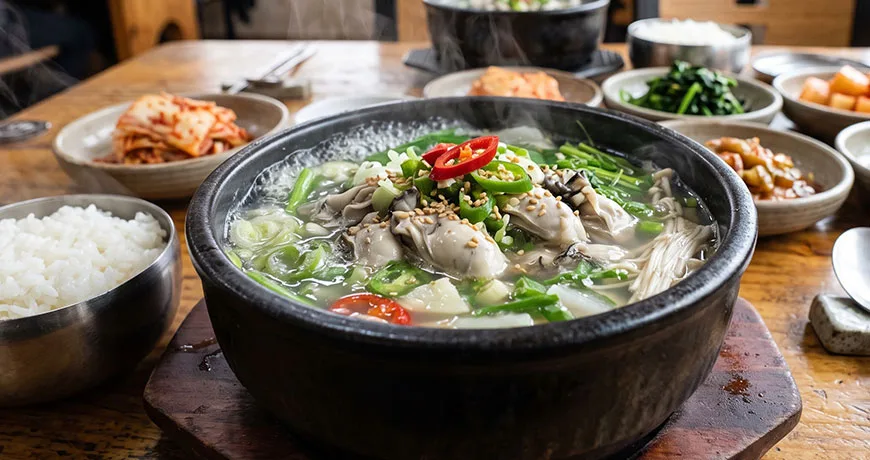
Gultang is an extreme minimalist marine matrix engineered to precisely diffuse the concentrated glycogen and taurine trapped within the delicate semi-permeable membranes of fresh oysters. Because oyster tissue is exquisitely fragile, subjecting it to a 100°C rolling boil triggers severe thermal syneresis—the protein matrix violently contracts, squeezing out its intra-cellular fluids and transforming the oyster into a shriveled, rubbery mass. To prevent this, the clear solvent base (enriched with radish reducing sugars and kelp glutamate) must be fully constructed first. Only then is the heat reduced, allowing the oysters to be gently poached in a tranquil 80–85°C bath. This strict thermodynamic control preserves optimal cellular turgor pressure, leaving the oysters plump and milky. Finished with sharp capsaicin from Cheongyang chilies and volatile allyl compounds from chives to cut through the heavy marine zinc and minerality, this soup delivers the pristine, untainted texture of raw oysters in a profoundly savory, warm broth.
- ⏱️ Total: 25 mins | Prep: 10 mins (Isotonic saline washing) | Cook: 15 mins
- 🍳 Difficulty: Medium-High (Requires strict temperature control to prevent oyster protein syneresis)
- 🌶️ Profile: Crystalline Marine Umami, Brisk Terpene Heat, and Deep Glycogen Sweetness
- 🍚 Focus: Isotonic Purging, Glycogen Extraction, & Critical Thermal Poaching
- 🍶 Pairing: Chablis (Unoaked Chardonnay) or Crisp Traditional Cheongju (to match high zinc content)
Ingredients (2 servings)
- Glycogen & Taurine Matrix: 300g Fresh Raw Oysters (MUST be gently washed in a 3% isotonic saline solution to remove shell fragments and mucin. Never wash in freshwater)
- Pectin & Reducing Sugar Matrix: 150g Daikon Radish (sliced into squares)
- Aqueous Umami Solvent: 800ml Anchovy-Kelp Broth or Purified Water
- Aromatic & Terpene Catalyst: 1 handful Asian Chives (Buchu – cut to 4cm), 1/2 stalk Green Onion (diagonally sliced), 1 Cheongyang green chili, 1/2 Red chili
- Ionized Sodium Binder: 1 tbsp Salted Shrimp (Saeujeot – provides fermented peptides to synergize with oyster umami), 2 cloves Garlic (sliced, absolutely NOT minced)
Allergy Information Contains: Shellfish (Oysters), Crustacean (Salted Shrimp)
Equipment High Thermal Mass Cast Iron Pot or Earthenware, Mixing Bowl, Fine Skimmer, Cutting Board, Knife
Cooking Instructions
- Isotonic Saline Washing: Dissolve 1 tbsp of coarse sea salt into 1L of cold water to create a 3% isotonic solution matching seawater. Gently agitate the oysters in this bath to detach shell fragments and excess mucin. Washing oysters in hypotonic freshwater causes rapid osmotic shock; the cells swell and burst, hemorrhaging their precious glycogen.
- Solvent Base Construction: Place the broth and square-cut radish in a pot and apply high kinetic heat. Once boiling, dissolve the salted shrimp to establish the baseline fermented peptide and sodium ion concentration. Boil until the radish turns translucent and its pectin walls collapse.
- Critical Thermal Poaching: Once the radish yields, strictly reduce the heat to medium-low (maintain 80–85°C). Wait for the violent rolling boil to completely subside, then introduce the washed oysters and sliced garlic. Never boil the oysters. Gently poach them in the tranquil solvent for approximately 3 minutes, just until their edges gently curl.
- Terpene Coating: As the oysters coagulate into a plump, milky-white state, scatter the chives, green onions, and chilies over the surface right before cutting the heat.
- Residual Heat Fusion: Turn off the heat immediately. Allow the radiant heat of the pot to extract the volatile plant terpenes into the broth without overcooking the delicate bivalves. Serve immediately.
💡 Professional Culinary Tips
- Physicochemistry of Protein Syneresis: Throwing oysters into a 100°C boiling broth forces the protein matrix to contract violently. This action (syneresis) literally wrings the oyster out like a wet sponge, expelling its flavorful amino acids and moisture, leaving behind a tough, unappetizing pellet. The absolute core of Gultang is poaching the bivalves, never boiling them.
- Garlic Slicing Logic: Minced garlic releases overwhelming concentrations of allicin that will utterly obliterate the delicate, milky minerality of the oysters. By using whole garlic slices, you control the extraction rate, allowing a subtle, elegant hint of allyl sulfides to perfume the broth without dominating it.
- Biochemical Synergy of Salted Shrimp: Seasoning with Saeujeot (salted shrimp) rather than plain salt is a masterstroke in flavor engineering. The free amino acids generated by the shrimp’s proteolytic fermentation collide with the taurine and inosinate of the oyster, triggering an exponential umami synergy on the palate.
🍶 Gastronomic Pairing
- Biochemical Palate Cleansing: When the plump, glycogen-rich oysters and their heavy zinc minerality coat your oral mucosa, pair this crystalline matrix with a bone-dry, highly mineral Chablis (unoaked Chardonnay from a cool climate) or a refined traditional Cheongju. The sharp tartaric acid and distinct minerality of the wine act as a precision scalpel, cleanly slicing through the faint brine of the bivalves, geometrically magnifying the deep sweetness of the oyster in your next spoonful.
Nutrition Facts (Estimated)
Total Content : Approx. 500g (1 serving)
Calories : 160 kcal (Excluding rice, ultra-low calorie)
– Sodium : 1,250mg (Variable depending on salted shrimp usage)
– Total Carbohydrate : 11.0g (Biological glycogen from oysters and radish polysaccharides)
– Sugar : 3.0g
– Total Fat : 3.5g (Natural unsaturated marine lipids)
– Saturated Fat : 0.8g
– Cholesterol : 75.0mg
– Protein : 18.0g (Highly bioavailable taurine and essential amino acid complex)
– Dietary Fiber : 3.0g
*Daily Values are based on a 2,000 calorie diet and standard Korean nutritional reference values.
**Nutritional values are calculated based on original ingredients; substitutions may alter specific macronutrients.
Origins and Food Culture of Oyster Soup (Gultang)
1. Historical Lineage: Neolithic Shell Mounds, Dongui Bogam, and Jasanoebo
- Oyster consumption along the Korean peninsula dates back thousands of years, as evidenced by massive accumulations of fossilized oyster shells unearthed in Neolithic shell mounds (paechong) across the southern and western coastlines.
- Documented in Heo Jun’s 1613 Dongui Bogam under the classical Hanja name Moryeo (牡蠣), oysters were praised as “balanced in nature, savory-sweet, and non-toxic… refining the complexion, brightening the skin, and serving as the most precious, tonifying medicine of the sea.” Similarly, Jeong Yak-jeon’s 1814 marine treatise Jasanoebo lauded them because “their taste is exceedingly sweet and tender; when simmered into soup or fermented into jeotgal, they produce an incomparable delicacy,” confirming centuries of prestigious therapeutic heritage.
2. The Culinary Science of Flash Poaching and Milky Consommé (Cheongtang)
- Because prolonged thermal exposure causes the delicate actomyosin proteins of oyster meat to denature and contract rapidly—expelling moisture and turning the flesh rubbery—authentic kitchens practice strict thermodynamic control.
- Master cooks simmer the radish, kelp, and aromatics thoroughly first to build a fragrant vegetable stock; the raw shucked oysters are introduced only during the final one to two minutes of active boiling. This delicate flash-poaching technique traps the natural sweet juices inside the plump mantle while releasing just enough glycogen and water-soluble minerals into the surrounding broth to yield a velvety, opalescent clear soup.
3. Southern Oyster Shacks (Gul-mak) and the “White Hangover Relief” Heritage
- Deeply rooted in the maritime culture of South Gyeongsang Province (Tongyeong and Geoje) and the rocky tidal flats of South Chungcheong Province (Seosan and Boryeong), where oyster shuckers working along wind-whipped winter shores tossed freshly harvested bivalves into boiling cauldrons to ward off freezing coastal gales.
- Foregoing heavy red pepper pastes and artificial flavorings in favor of sea salt and light soy sauce, Gultang highlights the pure, unmasked essence of the sea. Evolving from a humble harbor sustenance into an indispensable nationwide breakfast staple, it remains an immortal cultural monument to Korean maritime gastronomy, seasonal wellness, and the restorative purity of “White Hangover Relief.”
The Milky Glycogen Reserves of Winter Oysters, the Crystalline Sweetness of Braised Winter Radish, and the Ethereal Clarity of Marine Consommé: A Refined Portrait of Gultang
Gultang (Clear Korean Oyster Soup) stands as the pristine, comforting, and biologically opulent summit of Korea’s winter marine clear-broth (cheongtang) gastronomy. Centered upon freshly harvested Pacific oysters (Crassostrea gigas or Chamgul) collected during the sub-zero depths of winter from the pristine hanging culture ropes and tidal flats of the southern archipelago—principally Tongyeong, Geoje, and Yeosu—the dish begins with delicate preparatory discipline. Shucked oysters are gently agitated in a mild sea-salt brine or pureed radish bath to lift away trapped silts and excess surface mucus while fully retaining their precious intracellular liquor and native marine salinity. Layered within a heavy earthenware pot (ttukbaegi) or wide casserole over a generous foundation of thinly sliced winter radish and de-tailed soybean sprouts to establish an immaculate vegetable base, the vessel is bathed in a delicate sheet-kelp infusion alongside minced garlic and sliced Cheongyang green chilies. Once the radish turns translucent under a rapid boil, the plump raw oysters and thick slabs of tender tofu are introduced, allowing the heat to gently set the oyster mantles without expelling moisture. Crowned at the final moment with wild water parsley (minari) and scallions, and seasoned transparently with fermented salted shrimp (saeujeot) and solar salt, this dish strictly rejects fiery pastes or heavy soybean mashes. It extracts the raw, unmasked glycogen, bioavailable zinc, and organic succinic acids of cold-water bivalves through absolute thermodynamic minimalism, delivering an austere masterclass that purifies the palate and soothes the internal organs with radiant warmth.
Confronting the boiling earthenware pot as crystalline steam curls upward to reveal ivory-white oysters and bright ribbons of water parsley, lifting a deep spoonful of the broth releases an immediate, deeply calming olfactory charge: the brisk, iodine-clean perfume of a winter sea breeze mingles seamlessly with the honeyed vegetable sweetness of simmered radish and the crisp, sulfurous brightness of fresh scallions. Taking the first sip delivers an unadorned revelation across the oral mucosa: devoid of any greasy surface tension, the clarified amino acid broth floods the tongue with silk-like softness, gliding effortlessly down the esophagus to soothe fatigued tissues and awaken dormant perspiration in an exhilarating wave of what Korean gastronomy reveres as siwonhan mat—the sensation of profound, soul-cleansing lightness. Gently biting into a poached oyster reveals an extraordinary textural contrast: having set under convective heat, the ruffled mantle fringe offers a lively, springy bounce (taenggeul) that gives way to the core visceral mass, which dissolves across the tongue like warm sea cream to discharge concentrated streams of sweet, briny oyster nectar. The translucent radish yields with a succulent, juicy bite, while tender tofu supplies a soft cushion and fresh water parsley provides crisp botanical friction. Steeping a bowl of warm white rice into the diamond-bright broth and capping each spoonful with a crisp cube of aged radish kimchi (kkakdugi) completes an unforgettable ritual of physical rejuvenation, winter comfort, and quiet gastronomic transcendence.
The enduring majesty of Gultang lies in its historical lineage—celebrated in Heo Jun’s 17th-century medical compendium Dongui Bogam, where oyster meat (Moryeo-yuk) is codified as a sweet, non-toxic restorative capable of replenishing vital fluids, purifying the blood, and dispelling alcohol toxicity. Originating along windswept southern fishing coves where coastal villagers tossed freshly shucked oysters directly into bubbling iron pots of radish and sea brine to combat biting ocean winds, this dish has evolved into the quintessential winter comfort tonic across the peninsula. Uniting whole bivalve vitality with the crystalline clarity of native root vegetables, a steaming pot of clear oyster soup remains an irreplaceable monument of zero-waste marine stewardship, seasonal reverence, and brilliant Korean culinary craftsmanship.
Editor’s Review
1. A Dynamic Harmony of Elastic Mantle Resilience, Melting Visceral Velvet, Pillowy Tofu Cushion, and Crisp Botanical Turgor
The structural architecture inside the vessel delivers an extraordinary, multi-layered choreography between the dual tissue morphology of marine bivalves, hydrated plant cell walls, an amorphous soy protein hydrogel, and an ultra-low-viscosity aqueous matrix. Searing convective heat quickly sets the oyster’s ruffled mantle fringe into an energetic, springy bounce that provides pleasant masticatory resistance. Concurrently, the central visceral mass—rich in glycogen and intracellular moisture—liquefies across the palate like warm butter under body temperature, achieving a luxurious, velvet mouthfeel without fibrous stringiness. Sliced winter radish absorbs the savory stock like an organic sponge, yielding with a tender, juicy bite, while cubes of soft tofu provide a pillowy textural cushion. Flash-wilted wild water parsley introduces a brisk, auditory snap that supplies structural friction, ensuring an impeccably balanced, non-fatiguing mouthfeel from the first steaming spoonful to the last.
2. Winter Glycogen Hydrothermal Extraction, Low-Temperature Poaching Kinetics (80-85°C) for Syneresis Suppression, Succinic Acid-Glutamate-Peptide Umami Synergy, and Radish Isothiocyanate Deodorization
Gultang represents an exacting study in bivalve histology, organic acid flavor chemistry, and volatile sulfur management. Ahead of their spring spawning cycle, winter oysters accumulate massive physiological reserves of glycogen within their tissues; during gentle simmering, this polysaccharide undergoes mild hydrothermal cleavage into sweet oligosaccharides and glucose, imparting an unadorned, natural sweetness to the broth. Oysters’ delicate actomyosin and collagen proteins are acutely sensitive to heat; exposure to aggressive rolling boils (>100°C) triggers violent myofibrillar contraction, causing massive moisture expulsion (syneresis) that shrinks the oyster to less than half its volume and leaves it unpleasantly rubbery. Constructing the simmering vegetable base first and staging the oysters into an 80-85°C poaching window for under three minutes preserves myofibrillar Water Holding Capacity (WHC), locking in internal juices and ensuring plump cellular turgor. Broth savor is governed by a profound multi-pathway synergy: the oyster’s native succinic acid converges with the free glutamates of the kelp and winter radish, alongside the rich water-soluble peptides and glycine leached from fermented salted shrimp (saeujeot), triggering an exponential activation across human oral T1R1/T1R3 umami heterodimers. Trace volatile sulfur off-notes—principally marine dimethyl sulfide (DMS)—are chemically captured and masked by isothiocyanates leached from the winter radish and allyl sulfides from scallions and garlic. Furthermore, bioavailable zinc ions (Zn2+) and dense endogenous taurine accelerate hepatic alcohol dehydrogenase (ADH) expression, completing an immaculate, restorative metabolic recovery mechanism.
3. Southern Archipelago Terroir and the Sovereign Summit of Winter Marine Clear Gastronomy
Harnessing the pristine biological peak of winter oysters without the heavy camouflage of red peppers or fermented bean pastes, Gultang represents the ultimate triumph of culinary subtraction in Korean seafood cookery. Evolving from a humble fisherman’s dockside sustenance into an indispensable winter restorative that cleanses the modern urban palate, this radiant, diamond-bright classic captures the cold ocean’s untamed vitality, standing as an enduring sanctuary of environmental authenticity, seasonal discipline, and brilliant culinary artistry.