
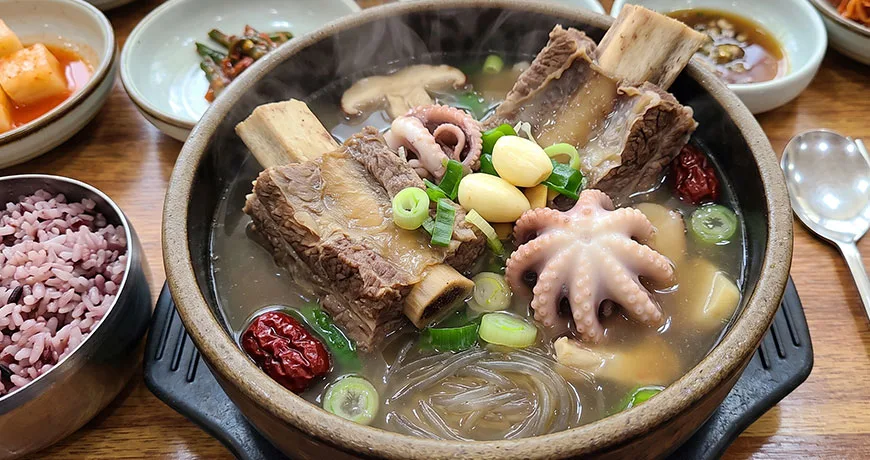
Gallaktang is a supreme “Surf and Turf” biochemical consommé that fuses the heavy, lipid-rich matrix of mammalian short ribs—broken down into yielding gelatin through aggressive thermodynamic kinetic energy—with the hyper-delicate, radial muscle fibers of fresh cephalopods (octopus). The engineering of this dish demands an extreme asymmetric staggered cooking timeline. The rigid mammalian collagen requires a minimum of 90 minutes of continuous thermal hydrolysis to denature, while the boneless octopus will undergo violent protein syneresis (squeezing out its internal moisture and turning to rubber) if boiled for more than 3 minutes. The mastery of Gallaktang lies in bringing these two wildly different biological matrices into a flawless 2-minute intersection at the very end of the cooking process. As the mammalian inosinate (IMP) merges with the cephalopod’s taurine and glutamate in a crystalline solvent clarified of heavy lipids, it creates an exponentially magnified umami explosion on the palate.
- ⏱️ Total: 3 hrs | Prep: 1 hr (Osmotic blood purging & cephalopod mucin abrasion) | Cook: 2 hrs
- 🍳 Difficulty: Extreme (Requires mastery of dual-thermodynamic timelines: mammalian collagen vs. cephalopod syneresis)
- 🌶️ Profile: Profoundly Deep Meat Umami with a Crisp, Briny Cephalopod Finish
- 🍚 Focus: Dual-Phase Thermal Hydrolysis, Cephalopod Flash-Poaching, & IMP-Taurine Synergy
- 🍶 Pairing: Chilled, highly refined traditional distilled Soju (40%+ ABV)
Ingredients (3–4 servings)
- Mammalian Collagen Matrix: 1kg Hanwoo Beef Short Ribs for soup (submerged in cold water for 1 hour to osmotically purge blood proteins and myoglobin)
- Cephalopod Radial Muscle Matrix: 2 whole Fresh Live Octopus (Nakji – intensely scrubbed with wheat flour and coarse salt to mechanically tear away the surface mucin and suction-cup grit, viscera and eyes/beak excised)
- Aqueous Solvent & Pectin Matrix: 3.5L Purified Water, 200g Daikon Radish (sliced into large chunks), 1 piece Dried Kelp
- Odor Adsorption Catalyst: 10 cloves Garlic, 1 whole Onion, 2 white stalks of Green Onion, 1 tsp Whole Black Peppercorns
- Ionized Sodium Binder: 1.5 tbsp Soup Soy Sauce (Guk-ganjang), Coarse Sea Salt to taste (used for final calibration to preserve optical clarity)
- Aromatic & Allyl Finish: 1 green stalk of Green Onion (finely chopped), Small handful of Enoki mushrooms
Allergy Information Contains: Beef, Cephalopod (Octopus), Soy, Wheat (from Soy Sauce, flour scrub residue)
Equipment Massive High Thermal Mass Cauldron or Stockpot, Shallow Serving Pot (Jeongol pan), Mixing Bowl, Fine Skimmer, Kitchen Shears
Cooking Instructions
- Mammalian Coagulation & Blanching: Flash-boil the osmotically purged beef ribs in aggressively rolling water for 10 minutes. The myoglobin trapped inside the bone marrow will thermally coagulate into dark foam. Discard the water entirely and rigorously scrub the coagulated proteins off the bones under cold running water.
- Cephalopod Mechanical Abrasion: In a mixing bowl, violently knead the fresh octopus with 2 tbsp of wheat flour and 1 tbsp of coarse salt, as if washing heavy laundry. The hydrated gluten dynamically binds to the slimy surface mucin (which houses fishy off-odors) and the grit inside the suction cups, physically ripping them away. Rinse thoroughly under cold water until crystal clear.
- Collagen Hydrolysis: Place the cleaned ribs, radish, onion, garlic, scallion whites, peppercorns, and 3.5L of water into a large pot. Bring to a high boil. Remove the kelp immediately. Reduce the heat to medium-low (90–95°C) and simmer gently for 1 hour and 30 minutes. Relentlessly skim the surfacing animal lipids to refine a pristine, golden consommé.
- Critical Gelatinization & Salinity: Once the tough fascia surrounding the ribs denatures into sticky gelatin, causing the meat to yield gently from the bone, discard all aromatic aromatics. Slice the radish into smaller squares. Calibrate the sodium ion concentration precisely with soup soy sauce and sea salt. Transfer the boiling broth and ribs to a shallow serving pot (or Ttukbaegi).
- Critical Cephalopod Poaching: Once the serving pot reaches a violent 100°C rolling boil, introduce the prepped whole octopus, enoki mushrooms, and chopped scallions. The radial muscles of the cephalopod will instantly begin thermal coagulation. Strictly after 1 minute 30 seconds to 2 minutes, turn off the heat. Use shears to cut the octopus and serve immediately before syneresis turns it into rubber.
💡 Professional Culinary Tips
- Extreme Thermodynamic Asymmetry: The collagen holding mammalian ribs together is remarkably dense, requiring massive heat capacity (1.5+ hours at 100°C) to break down into edible gelatin. In stark contrast, boneless cephalopod myofibrils will violently contract (syneresis) if boiled past 3 minutes, expelling all cellular moisture and becoming unchewable. Controlling this staggering temporal imbalance—bringing 90 minutes of beef hydrolysis into a collision course with a 90-second octopus flash-poach—is the supreme molecular engineering of Gallaktang.
- Biochemical Synergy of IMP and Taurine: The heavy, resonant inosinate (IMP) extracted from terrestrial beef collides with the massive taurine and glutamate payload of the marine octopus within the aqueous solvent. This biochemical intersection triggers an exponential umami synergy, forcefully striking the tongue’s taste receptors.
- Hydrodynamics of Cephalopod Mucin: The transparent slime coating an octopus degrades rapidly and holds volatile, fishy off-notes. Scrubbing it with dry wheat flour leverages hydrodynamics: the flour absorbs the slime’s moisture, forming a sticky gluten paste that mechanically adheres to the impurities deep inside the microscopic suction cups, pulling them out far more effectively than salt alone.
🍶 Gastronomic Pairing
- Biochemical Palate Cleansing: When the heavy mammalian lipids of the ribs and the hyper-elastic radial fibers of the octopus simultaneously strike your oral mucosa, pair this masterpiece with an ice-cold shot of premium traditional distilled Soju (40%+ ABV). The highly refined, high-concentration ethanol acts as a surgical scalpel, sharply slicing through the dense collagen and lipid barrier on your tongue. This flawless chemical intervention completely resets your palate, geometrically amplifying the sweet, pristine taurine flavors of the cephalopod in the very next bite.
Nutrition Facts (Estimated)
Total Content : Approx. 800g (1 serving, excluding bone weight)
Calories : 480 kcal (Excluding rice)
– Sodium : 1,350mg (Dependent on final sea salt calibration)
– Total Carbohydrate : 12.0g (Reducing sugars from radish and kelp polysaccharides)
– Sugar : 3.5g
– Total Fat : 24.0g (Dominated by low-melting-point oleic acid from beef ribs)
– Saturated Fat : 10.0g
– Cholesterol : 185.0mg (Elevated due to ultra-dense cephalopod proteins and taurine complexes)
– Protein : 52.0g (Mammalian collagen peptides and marine myofibrils)
– Dietary Fiber : 2.5g
*Daily Values are based on a 2,000 calorie diet and standard Korean nutritional reference values.
**Nutritional values are calculated based on original ingredients; substitutions may alter specific macronutrients.
Origins and Food Culture of Short Rib and Octopus Soup (Gallaktang)
1. The Synergy of Yeongam Dokcheon Cattle Market and Tidal Mudflats
- Originating in Dokcheon-ri, Haksan-myeon, Yeongam-gun, Jeollanam-do, where one of the Honam region’s premier traditional five-day cattle markets (Dokcheon Usijang) historically converged with the rich tidal mudflat fisheries of the adjacent Yeongsan River basin.
- During the mid-to-late 20th century, tavern cooks catering to cattle merchants, butchers, and farmers combined the hearty, bone-simmered beef rib soups (Galbitang) of the livestock market with freshly dug, living mudflat octopuses (nakji) brought in by local coastal gatherers, creating a groundbreaking regional fusion that came to be celebrated across Korea as Gallaktang.
2. The Classical Lore of Jasanoebo and the Legend of the Fallen Ox
- In his landmark 1814 marine biology compendium Jasanoebo, scholar Jeong Yak-jeon immortalized the therapeutic vigor of the mudflat octopus, recording: “Its flesh is white, sweet, and peaceful in nature… If you feed three or four mud octopuses to an ox that has collapsed from exhaustion, the beast will immediately regain tremendous strength and spring back to its feet.”
- The culinary narrative of Gallaktang captures this ancient folklore: boiling the revitalized ox alongside the miraculous marine cephalopod that possessed the power to restore it. To preserve the delicate texture of the octopus, authentic master kitchens execute strict thermodynamic timing: simmering the beef ribs until fully tender, and introducing the whole fresh octopus only in the final moments of rolling heat to ensure the flesh remains tender, sweet, and packed with intact taurine.
3. The Yeongsan River Estuary Dam and the Heritage of Dokcheon Gallaktang Street
- Following the completion of the massive Yeongsan River Estuary Dam in 1981, local tidal mudflats were converted into agricultural land, altering the immediate aquatic ecology. Nevertheless, Dokcheon’s restaurant matriarchs preserved the heritage by sourcing pristine live octopuses from neighboring coastal flats in Shinan, Muan, and Haenam.
- Foregoing heavy chili pastes in favor of solar sea salt and light soy sauce to highlight the unmasked, crystalline purity of the broth, Gallaktang remains anchored along the famed “Dokcheon Gallaktang Food Street.” It stands as an enduring cultural monument to Southwestern Korean gastronomy, generous feast-day hospitality, and the timeless philosophy of Yuk-hae Hap-il (uniting the best of land and sea).
The Aristocratic Extraction of Terrestrial Bovine Rib Marrow, the Plump Viscoelasticity of Tidal Mudflat Octopus, and the Radiant Equilibrium of Land and Sea: A Refined Portrait of Gallaktang
Gallaktang (Short Rib and Octopus Soup) stands as the majestic, crystalline, and biologically astonishing summit of Korea’s land-and-sea composite (tangban) gastronomy. Harmonizing choice beef short ribs—short cut and chuck ribs celebrated for their dense intramuscular connective tissue—with pristine small octopus (Octopus minor or Nakji) hand-harvested from the intertidal mudflats of the southwestern coast, the preparation begins with rigorous preparatory discipline. The beef ribs undergo prolonged steeping in running cold spring water to thoroughly leach deep-bone hemoglobin and residual myoglobin. Subjected to an initial rolling blanch in boiling water infused with whole garlic, ginger, scallions, and refined rice wine to purge coagulated surface albumins, the ribs are gently transferred to an iron cauldron filled with fresh spring water alongside sweet winter radish, onions, and allium roots. Simmered across hours of patient convective cooking, the skeletal connective tissues slowly relax as deep bone marrow liquefies into the stock, which is then chilled to strip away solidified surface tallow, yielding a crystal-clear, golden consommé (cheongtang). Reassembled inside a heavy earthenware pot (ttukbaegi) or glistening bronzeware bowl (bangjja yugi), the simmering rib broth is brought to a rolling boil tableside. At this precise climax, fresh live octopus—scoured with coarse sea salt to purge surface mud and mucilage—is plunged whole into the bubbling cauldron, gently poached just until its curling tentacles tighten into plum-hued arcs. Crowned with fresh scallions, sweet jujubes, and cracked black pepper, and seasoned transparently with artisanal soup soy sauce and solar sea salt, this dish completely eschews fiery pastes and heavy soybean mashes. It unites the deep amino acid essence of terrestrial mammalian bone with the brisk, taurine-rich sweetness of an intertidal cephalopod in absolute thermodynamic equilibrium.
Confronting the boiling vessel as crystalline steam ascends to reveal towering bone-in beef ribs anchored beside the tender, coiled tentacles of poached octopus, lifting a deep spoonful of the broth releases an immediate, deeply calming olfactory charge: the rich, sweet perfume of slow-extracted bovine marrow mingles seamlessly with the brisk, iodine-clean minerality of tidal mudflat cephalopods and the crisp, sulfurous brightness of fresh scallions. Taking the first sip delivers an unadorned revelation across the oral mucosa: devoid of any greasy surface tension, the clarified amino acid broth floods the tongue with silk-like softness, gliding effortlessly down the esophagus to soothe fatigued tissues and awaken dormant perspiration in an exhilarating wave of what Korean gastronomy reveres as siwonhan mat—the sensation of profound, soul-cleansing lightness. Grasping a beef rib reveals meat whose intramuscular collagen has completely melted into liquid silk; the beef pulls away from the bone with effortless tenderness, discharging concentrated torrents of rich, oleic-laden juices. In lively textural contrast, the gently poached octopus tentacles yield with an energetic, springy bounce (taenggeul) under tooth pressure, bursting with sweet intracellular nectar and natural taurine. The broth-soaked radish yields with a succulent, juicy chew, while the rich, creamy head of the octopus (nakji meori) provides luxurious depth. Steeping a bowl of warm white rice into the amber consommé and topping each spoonful with a crisp cube of aged Jeolla-style radish kimchi (kkakdugi) completes an unforgettable ritual of metabolic renewal, structural indulgence, and profound gastronomic catharsis.
The enduring majesty of Gallaktang lies in its distinctive terroir—born in the historic crossroads village of Dokcheon in Yeongam County, Jeollanam-do, where the fertile inland pastures of Yeongam Hanwoo cattle converged with the vast, nutrient-rich intertidal mudflats of the Yeongsan River estuary. Rooted in the ancient folkloric wisdom that “even an exhausted draft ox collapsed in the furrow will leap to its feet if fed three mudflat octopuses,” this dish poetically unites the restorative agent (the octopus) with the revived beast (the ox) within a single earthenware cauldron. Transforming a regional agrarian tonic into an iconic centerpiece of restorative luxury, a steaming bowl of short rib and octopus soup remains an irreplaceable monument of sustainable whole-animal utilization, geographic synthesis, and brilliant Korean culinary craftsmanship.
Editor’s Review
1. A Dynamic Harmony of Fall-Off-The-Bone Rib Tenderness, Viscoelastic Cephalopod Snap, Succulent Radish Sponginess, and Frictionless Consommé Fluidity
The structural architecture inside the vessel delivers an extraordinary, high-contrast choreography between dense mammalian skeletal muscle fibers, an invertebrate muscular hydrostat, hydrated root matrices, and an ultra-low-viscosity aqueous matrix. Sustained hydrothermal cooking completely dissolves the tough collagenous sheaths encasing the rib bones, allowing the succulent beef fibers to separate along natural grains with cloud-like ease and minimal tooth resistance. This yielding softness is dynamically counterbalanced by the flash-poached octopus tentacles, whose densely organized muscle layers resist tooth pressure with an energetic, springy bounce before parting cleanly. Cushioning these contrasting proteins, the thickly sliced radish—having absorbed the savory stock like an organic sponge—yields with a tender, juicy bite, while the completely defatted clear consommé glides across oral tissues with zero friction, ensuring an impeccably balanced, non-fatiguing mouthfeel from the first steaming sip to the last.
2. Rib Type I Collagen Hydrothermal Gelatinization, Cephalopod Paramyosin Denaturation Kinetics (Flash-Poaching at 80-85°C), IMP-Taurine-Betaine-Glutamate Umami Synergism, and Tallow Defatting Rheology
Gallaktang represents an exacting study in cross-phylum protein thermodynamics, invertebrate muscle histology, and flavor nucleotide kinetics. Insoluble Type I collagen, heavily concentrated within the rib periosteum and perimysium, undergoes thermal denaturation between 85°C and 90°C during prolonged simmering, cleaving its tight triple-helix hydrogen bonds into water-soluble gelatin polypeptides that provide a silky oral viscosity. Conversely, octopus muscle contains no dense collagen sheets; it is a muscular hydrostat dominated by helically woven actomyosin and paramyosin fibers. Subjecting the octopus to sustained boiling alongside the beef would trigger violent myofibrillar hyper-contraction, causing massive moisture expulsion (syneresis) and leaving the meat tough and rubbery. Introducing the cleaned octopus into the hot broth (80-85°C) for less than two minutes (flash-poaching) prevents paramyosin cross-linking, locking in intracellular moisture and preserving its tender, bouncy Water Holding Capacity (WHC). Broth savor is driven by a profound cross-kingdom biochemical synergy: muscle-derived inosine monophosphate (5′-IMP) from the beef ribs converges with the natural free glutamic acid (Glutamate) of the simmered radish, alongside high physiological concentrations of free amino acids leached from the octopus—principally taurine, betaine, and glycine—triggering an exponential activation across human oral T1R1/T1R3 umami heterodimers. Furthermore, post-cook refrigeration solidifies surface tallow for mechanical removal (defatting), securing low dynamic viscosity, while active allyl sulfides from scallions chemically bind trace lipid aldehydes, yielding an immaculate, pure aromatic profile.
3. The Yeongam Dokcheon Terroir, Mudflat-Pasture Convergence, and the Sovereign Apex of Composite Korean Restorative Gastronomy
Synthesizing the terrestrial power of indigenous beef short ribs with the coastal vitality of tidal mudflat octopuses, Gallaktang represents the absolute zenith of hybrid restorative cookery in Korean gastronomic history. Evolving from an empirical folk restorative into an exquisite masterpiece of whole-carcass craftsmanship, this radiant, golden cauldron captures the profound ecological symbiosis of the southwestern peninsula, standing as an enduring sanctuary of domestic comfort, geographic authenticity, and brilliant Korean culinary artistry.