
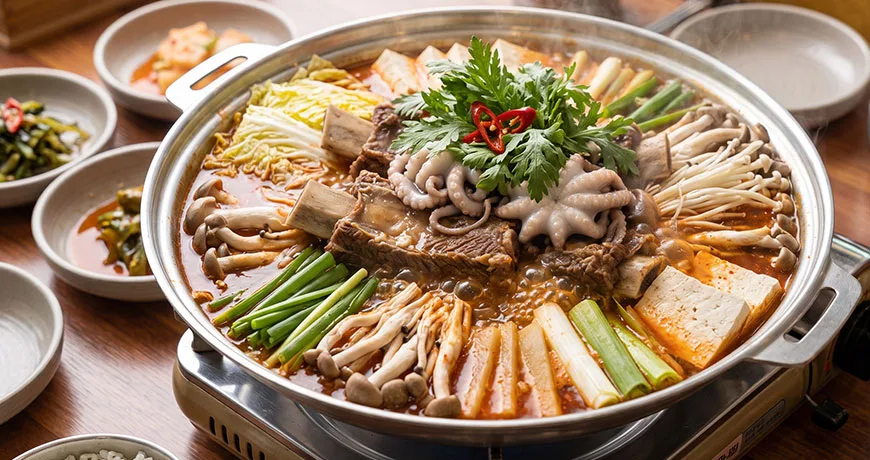
Gallakjeongol is a grand gastronomic epic where the rich, heavy grounding of beef short ribs meets the dynamic, vital energy of mudflat octopus within a single boiling vessel. This extraordinary hot pot masterfully balances the deep, savory umami of ribs that have been slow-braised until they slip effortlessly from the bone, with the crisp, oceanic refreshment of raw octopus briefly poached at the very last moment. Managing the extreme temporal demands of these two proteins—one requiring hours, the other mere seconds—makes this dish the absolute pinnacle of Korean surf-and-turf, delivering an explosive synergy of land and sea.
- ⏱️ Total Time: 2.5 Hours | Prep: 30 Mins (Blood purging and octopus cleansing) | Cook: 2 Hours (Slow-braising ribs) + 5 Mins (Table-side octopus poaching)
- 🍳 Difficulty: High (Requires masterful timing to balance extreme cooking differentials and precise broth clarification)
- 🌶️ Profile: A profound, rich beef consommé that is instantly electrified by the brisk, refreshing, and clean umami of the ocean
- 🍚 Core Process: Blood Purging, Dual Broth Extraction, Table-side Flash Poaching
- 🍶 Pairing: A smooth barley soju (distilled spirit), freshly tossed spicy geotjeori (unfermented kimchi), nutritious stone-pot rice with ginkgo nuts and chestnuts
Physicochemical & Sensory Matrix
- Baseline Salinity: 1.2% ~ 1.5% (A golden ratio designed to maximize umami while remaining perfectly drinkable as a broth)
- Thermal Dynamics: A dramatic contrast between ribs tenderized for 2 hours at 95°C and raw octopus flash-cooked for exactly 40 seconds at 90°C right at the table
- Textural Harmony: The luxurious, cotton-candy-like melting of the beef fat juxtaposed against the rhythmic, bouncy resistance of the octopus tentacles
- Umami Density: 9.9 / 10 (An unparalleled explosion of flavor created by the synergy of beef inosinate and the abundant taurine and glutamate of the octopus)
- Aroma Profile: Deep Roasted Beef Fat | Clean Marine Iodine | Earthy Mushroom & Bright Herbaceous Minari
Ingredients (Yields 1 Large Hot Pot, Serves 3-4)
- Earth Matrix: 600g Premium Beef Short Ribs (Galbi), cut for braising with good marbling
- Ocean Matrix: 2 Whole Fresh or Live Small Octopuses (Nakji)
- Broth & Vegetable Matrix: 200g Korean Radish, 2 Scallions, 5 Cloves Garlic, 1 Onion, 1 Sheet Dried Kelp (10x10cm), 2 tbsp Traditional Soup Soy Sauce (Guk-ganjang), Coarse Sea Salt
- Aromatic Catalyst: 2 Shiitake Mushrooms, 1 Bunch Enoki Mushrooms, 100g Water Dropwort (Minari), 1 Cheongyang Green Chili, 1 Red Chili
Allergy Information
- Contains: Beef, Mollusc (Octopus), Soy, Wheat (inherent in soup soy sauce)
Equipment Large Stainless Steel Pot, Shallow Cast Iron or Brass Hot Pot (Jeongol-nabe) for the table, Fine Cheesecloth, Mixing Bowl, Portable Tabletop Stove
Cooking Instructions
- Purification of the Ribs: Submerge the beef short ribs in cold water for at least 1 hour to draw out the blood. Transfer them to a pot of vigorously boiling water for 5 minutes. This vital pre-blanching purges surface impurities and bone fragments, laying the foundation for a mirror-clear broth. Discard the water and rinse the ribs.
- Simmering the Earth’s Broth: In a clean pot, combine the blanched ribs, radish, onion, 1 scallion, and garlic. Cover with ample water and simmer over medium heat for at least 1.5 hours. When the beef easily yields to a fork and gently separates from the bone, remove the meat and radish. Strain the broth through a fine cheesecloth, meticulously skimming off the fat. Season this pristine beef consommé with soup soy sauce and salt.
- Cleansing the Octopus: Instead of using coarse salt, generously sprinkle all-purpose flour over the raw octopus and massage gently. The fine flour particles expertly bind to the mud and slippery mucin within the suction cups, lifting them away without tearing the fragile skin. Rinse thoroughly, remove the viscera, eyes, and beak, and leave the octopus whole.
- Assembling the Hot Pot: Slice the reserved boiled radish thickly and lay it at the base of your shallow tabletop hot pot. Arrange the deeply tenderized short ribs on top. Surrounding the beef, artfully arrange the shiitake, enoki mushrooms, water dropwort, and diagonally sliced scallions and chilies. Pour the clear, hot beef broth over the arrangement.
- The Fleeting Poach at the Table: Place the hot pot on a portable stove in the center of the dining table and turn on the heat. Once the broth reaches a rolling boil and the herbaceous aromas of the vegetables bloom, plunge the whole, cleansed octopus directly into the boiling liquid. Watch closely—the moment the tentacles curl tightly and blush a vibrant purplish-red (roughly 40 seconds to 1 minute), immediately reduce the heat. Use scissors to quickly snip the octopus into bite-sized pieces and serve alongside the meltingly tender ribs.
💡 Professional Culinary Tips
- 1. Time-Differential Protein Control: The mastery of Gallakjeongol lies in manipulating time. Beef collagen requires a minimum of 90 minutes of sustained heat to gelatinize into a melt-in-your-mouth texture. Conversely, octopus loses its moisture and turns rubbery if cooked past 60 seconds. Simmering the ribs in the kitchen and flash-poaching the octopus at the dining table is the essential dynamic that ensures both proteins achieve absolute textual perfection.
- 2. The Science of Flour Cleansing: Scrubbing octopus with coarse sea salt can tear the skin and extract too much cellular moisture, compromising its tender snap. Flour acts as a gentle abrasive and highly effective absorbent, drawing out mud and slime seamlessly while keeping the delicate flesh perfectly intact.
- 3. The Symbiosis of the Broth: The broth undergoes a breathtaking transformation during the meal. It begins as a rich, savory beef consommé, but the very second the raw octopus is plunged into the boiling liquid, it releases a wave of taurine and marine minerals. This instantaneous infusion cuts through the heaviness of the beef fat, elevating the soup into an incredibly refreshing, complex, and profound surf-and-turf elixir.
🍶 Gastronomic Pairing
- A Clear Toast to Land and Sea: A hot pot that navigates the heavy richness of beef fat and the brisk clarity of the ocean demands a beverage that can bridge both worlds. A premium, distilled barley soju (Bori Soju)—featuring a subtle malty sweetness and a remarkably clean finish—is the perfect companion. As the rich galbi coats your palate and the bouncy octopus provides rhythmic texture, a chilled sip of soju washes the senses clean, guiding you effortlessly into the next luxurious bite. Add a side of freshly tossed, spicy geotjeori (unfermented kimchi) to provide a brilliant, fiery contrast to the deep, savory broth.
Nutrition Facts (Estimated)
Total Content : Approx. 300g (1 Serving, including meat, seafood, and broth)
Calories : 450 kcal (Sustaining energy from the ribs and lean marine protein)
– Sodium : 850mg (A balanced salinity that supports the deep umami of the broth)
– Total Carbohydrate : 12.0g
– Sugar : 3.0g
– Total Fat : 22.0g (Rich, flavorful saturated and unsaturated fats from the beef)
– Saturated Fat : 9.0g
– Cholesterol : 150mg (A combination of crustacean sterols and beef)
– Protein : 45.0g (An ultra-dense matrix of terrestrial and marine proteins)
– Dietary Fiber : 3.5g (Derived from an abundance of mushrooms and herbs)
*Daily Values are based on a 2,000 calorie diet and standard Korean nutritional reference values.
**Nutritional values are calculated based on original ingredients; substitutions may alter specific macronutrients.
Origins and Food Culture of Short Rib and Octopus Hot Pot (Gallakjeongol)
1. The Geographical Intersection of Yeongam’s Dokcheon Cattle Market and Tidal Mudflats
- The historical origin of Gallakjeongol traces back to Galnaktang (individual short rib and octopus soup), created in the late 1970s in the village of Dokcheon (Dokcheon Nakji Alley) in Yeongam County, Jeollanam-do. Historically, Dokcheon was home to one of southwestern Korea’s largest cattle trading posts (Dokcheon Cattle Market), ensuring a constant supply of fresh native beef short ribs and marrow bones.
- Simultaneously, before the construction of the Yeongsan River Estuary Dam in 1981, Dokcheon served as a thriving coastal inlet where fishermen gathered and traded freshly dug wild mudflat octopuses (sebal-nakji) from the nutrient-rich flats of Muan, Mangun, and Yeongam. Local tavern cooks ingeniously combined the rich, hot beef rib soups of the cattle market with live octopuses straight from the mudflats. Over the decades, this rustic restorative soup blossomed into the elaborate, vegetable-strewn communal hot pot known today as Gallakjeongol.
2. Folklore from the Jasan Eobo (1814) and the Holistic Wisdom of “Dual Qi-Blood Fortification”
- The cultural prestige of octopus as a health food was documented in the landmark 1814 marine biology compendium Jasan Eobo, penned by Joseon scholar Jeong Yak-jeon during his exile on Heuksan Island. He observed of the octopus (nakji / 章魚): “Its flavor is sweet and its nature is balanced. If five or six octopuses are fed to a lean, exhausted cow that has collapsed from labor, the beast will immediately regain its footing and strength.”
- Ancestral cooks recognized that combining the restorative animal that revived spent draft oxen with the beef ribs of cattle themselves created an optimal harmony of Dual Qi-Blood Fortification (氣血雙補)—where beef strengthens the physical Yang-qi of the terrestrial realm and octopus replenishes the Yin-blood and vital fluids of the maritime sphere. It stands as an enduring gastronomic monument honoring agrarian labor and coastal tidal ecology.
3. Evolution into a Celebratory Tabletop Communal Feast
- While Galnaktang was traditionally savored as an individual quick restorative soup served in stone earthenware bowls (ttukbaegi), Gallakjeongol elevated the preparation into a vibrant tabletop centerpiece designed for family gatherings, business banquets, and honored guests.
- The communal brass or cast-iron pan accommodates Napa cabbage, enoki, wild shiitake, and glass noodles, which drink in the rich juices as diners share the feast. Following the retrieval of the succulent ribs and tender octopus, tradition dictates adding handmade wheat noodles (kalguksu) or stir-frying seasoned rice with chopped water parsley and roasted seaweed into the concentrated reduction. Blending regional terroir with dynamic dining customs, Gallakjeongol represents a triumph of Korean regional gastronomy, seasonal vitality, and celebratory hospitality.
The Primal, Marbled Richness of Pasture-Fed Beef Short Ribs Colliding with the Resilient, Mineral-Laden Ocean Snap of Tidal Octopus Inside a Shallow Brass Basin: A Refined Portrait of Traditional Gallakjeongol
Gallakjeongol (Braised Beef Short Rib and Long-Arm Octopus Hot Pot) stands as an exhilarating, structurally magnificent summit within Korea’s communal hot pot gastronomy. Merging two legendary emblems of restorative vigor—thick beef short ribs (galbi) slow-simmered until tender enough to slip effortlessly from the bone, and live mud octopus (nakji) harvested from the tidal mudflats of the southwestern coast—this banquet dish is assembled tableside in a wide, shallow vessel alongside radishes, Napa cabbage, water dropwort (minari), crown daisy, and wild mushrooms bathed in a clear, golden bone broth. Originating around the coastal hubs of Yeongam and Mokpo in Jeollanam-do, this preparation bridges fertile inland pastures and dynamic tidal ecosystems. As celebrated in early nineteenth-century fisheries treatises, octopus was prized as an invigorating medicine capable of reviving exhausted cattle. Ancestral cooks transformed this philosophical affinity into an edible reality: the cloying richness of saturated bovine marrow fats is balanced by the cool, oceanic salinity of cephalopod juices, while the delicate fluid of fresh octopus gains rounded body from the gelatinized broths of slowly simmered ribs.
Removing the lid from the bubbling vessel tableside releases a swirling column of steam that fuses pasture and ocean into a singular olfactory bouquet. The sweet, malty fat profile of simmered beef bones is pierced by the clean, dewy ozone of newly poached octopus, brightened by the volatile pinene notes of wild dropwort and pungent alliums. Snapping off a tender, purplish octopus tentacle with tongs and testing it between the teeth reveals an immediate tactile reward: a buoyant, springy resistance that fractures with an audible, succulent crunch without a hint of rubbery chew. Following with a tender morsel of rib meat, the beef yields like velvet, discharging savory juices trapped within the unraveled collagen matrix. Ladling the broth into a porcelain bowl and taking a deep sip unlocks a profound harmony: the comforting depth of beef consommé meets the clean, maritime finish of an octopus bouillon, flooding the palate with warmth while carrying a rejuvenating charge through the body.
The cultural identity of Gallakjeongol lies in the confident mastery that orchestrated two wildly contrasting protein worlds through open-flame convection and vegetal buffering. By tempering dense land fats with crisp marine sweetness, this communal hot pot remains a vibrant centerpiece of the Korean table, turning everyday restorative eating into a luxurious celebration of regional abundance.
Editor’s Review
1. Bimodal Protein Thermodynamics: Bovine Collagen Gelatinization vs. Cephalopod Myofibrillar Contraction Kinetics
Gallakjeongol reconciles the opposing thermodynamic requirements of bovine connective tissue and cephalopod musculature within a single simmering vessel:
- Thermal Solubilization of Type-I Collagen: The intercostal muscles and periosteum of beef ribs are bound by a rigid triple-helix collagen matrix. Extended pre-simmering at 80–85°C destabilizes inter-chain hydrogen bonds, converting insoluble collagen into water-soluble gelatin. This neutralizes mechanical toughness, yielding a tender structure that releases cleanly from bone surfaces.
- Cephalopod Paramyosin Shear Control: Octopus tentacles are powered by obliquely striated muscle fibers framed by thick paramyosin cores and dense collagen sheets. Prolonged exposure to temperatures exceeding 65°C drives rapid actomyosin denaturation, cellular moisture expulsion, and irreversible toughening. By introducing live octopus into the rolling boil (95–100°C) tableside for a brief interval, surface proteins coagulate while core moisture is trapped, securing an elastic, succulent fracture (hydraulic snap) under tooth shear.
2. Tri-Component Umami Hyper-Synergy and Gelatin-Mediated Amphiphilic Emulsification
The layered body and clean finish of Gallakjeongol stem from nucleotide-amino acid receptor potentiation and colloidal surface physics:
- Tri-Partite Umami Network (IMP-Glutamate-Osmolytes): Free 5′-inosine monophosphate (5′-IMP) extracted from beef muscle combines with free L-glutamate from radishes, onions, and fermented soy broth, alongside free amino osmolytes (taurine, betaine, glycine, alanine) leached from octopus tissues. This complex binds allosterically to oral T1R1/T1R3 taste receptors, magnifying perceived savor far beyond solitary seasonings.
- Amphiphilic Lipid Emulsification via Gelatin: Rendered bovine tallow normally coalesces into an unctuous, hydrophobic oil slick that numbs taste perception. Water-soluble gelatin molecules derived from the ribs act as natural amphiphilic hydrocolloids, orienting hydrophilic and lipophilic residues to disperse molten beef lipids into stable micro-droplets. This imparts a velvety, mouth-coating viscosity without greasy heaviness.
3. Volatile Deodorization Kinetics and Open-Vessel Convective Mass Transfer
The aromatic clarity of the broth is governed by continuous thermal evaporation and botanical terpene masking:
- Azeotropic Volatilization of Off-Odors: Simmering the hot pot in an open, wide basin maximizes the surface-area-to-volume ratio, allowing fishy trimethylamine (TMA) from cephalopods and volatile carbonyls from rendered beef tallow to co-evaporate with rising water vapor.
- Terpenoid-Organosulfur Masking: Volatile sulfur compounds (allyl sulfides) from leeks and garlic, paired with monoterpenes (alpha-pinene, myrcene) from crown daisy and water dropwort, trap residual animal odors, leaving the broth fragrant, aromatic, and invigorating.