
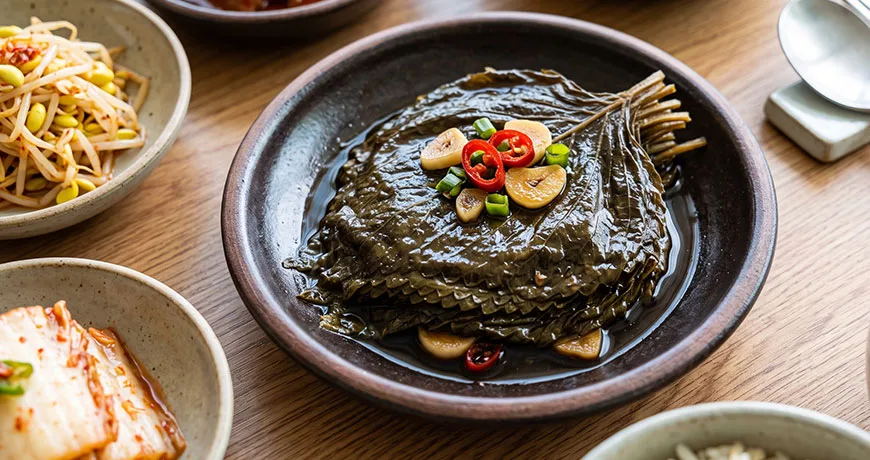
Kongnipjangajji is a masterclass in Korean fermentation, transforming tough, inedible autumn soybean leaves into an incredibly tender, umami-packed preserve. The intensely lignified cellulosic structure of the yellow bean leaves is broken down through a rigorous anaerobic lactic acid fermentation process, followed by thermal softening. Once purified and stripped of its harsh textures and odors, the leaf matrix is layered with a highly concentrated paste made from pure anchovy extract, brewed soy sauce, and Gochugaru. Through the power of osmotic pressure, the marine inosinate and plant-based glutamates penetrate deep into the softened fibers. The result is a profoundly earthy, funky, and intensely savory masterpiece that serves as the ultimate companion to simple steamed rice.
- ⏱️ Total: 15–20 Days | Prep: 10–15 Days (10% brine anaerobic lactic curing) | Cook & Ferment: 5 Days (Thermal softening, moisture extraction, and osmotic aging)
- 🍳 Difficulty: Very High (Requires vigilant microbial control during the extended brine curing and precise texture management)
- 🌶️ Profile: A deeply earthy, fermented funk enveloped in an explosive, spicy, marine-driven umami
- 🍚 Focus: Anaerobic Lactic Fermentation, Thermal Cellulose Softening, Extreme Moisture Expulsion, Multi-layer Osmotic Infusion
- 🍶 Pairing: Steaming hot white rice, roasted barley tea soaked rice, fatty grilled pork belly (K-BBQ)
Physicochemical & Sensory Matrix
- Baseline Salinity: 7.5% ~ 9.0% (High-salinity matrix engineered to penetrate dense fibers and ensure long-term preservation)
- pH Equilibrium: 4.2 ~ 4.6 (Lactic acid buffer generated during the initial brine curing)
- Textural Crunch Index: [■■□□□] (Tough fibers are completely degraded into a soft, tender, yet cohesive bite)
- Umami Density (T1R1/T1R3 Synergy): 9.4 / 10 (Maximum flavor amplification between plant peptides and marine amino acids)
- Shelf Stability: 6+ Months (Highly stable at room temperature or refrigerated due to complete moisture expulsion and heavy salinity)
- Aroma Profile: Lactic Fermentation Funk | Earthy Roasted Soy | Pungent Allicin & Capsaicin
Ingredients (Yields 1 Medium Airtight Container)
- Primary Plant Matrix: 500g Autumn Yellow Soybean Leaves (Danpung-kongnip). Must be intact, mature, and pesticide-free.
- Primary Curing Matrix: 3L Purified Water, 300g Coarse Sea Salt (Creating a 10% brine solution)
- Pickling Paste: 1.5 Cups Pure Anchovy Extract (Myeolchi-aekjeot), 0.5 Cup Brewed Soy Sauce, 2 tbsp Traditional Soybean Paste (Doenjang), 1 Cup Plum Extract (Maesil-cheong), 2 Cups Coarse Red Chili Flakes (Gochugaru), 1 Cup Rich Kelp-Anchovy Broth
- Aromatic Catalyst: 3 tbsp Finely Minced Garlic, 1 tsp Finely Minced Ginger, 3 tbsp Toasted Sesame Seeds
Allergy Information
- Contains: Soy, Wheat (inherent in soy sauce/doenjang), Fish (Anchovy extract)
Equipment Breathable Earthenware Crock (Onggi) or Large Container with a Pressing Stone, Large Stainless Steel Boiling Pot, Cheesecloth, Sanitary Gloves
Cooking Instructions
- 10% Brine Lactic Curing: Wash the yellow bean leaves and tie them into neat bundles of 10-20 leaves using culinary string. Stack them inside the crock. Dissolve the sea salt in the water to create a 10% brine and pour it over the leaves. Weigh them down with a heavy stone to completely block oxygen exposure. Let sit in a cool, shaded area for 10 to 15 days to undergo anaerobic lactic fermentation, softening the rigid structure.
- Thermal Softening & Deodorization: Remove the cured leaves and boil them in a large pot of water for 30 to 40 minutes. This thermal shock permanently collapses the remaining cellulosic structure. Transfer the boiled leaves to a large basin of cold water and soak for at least 12 hours, changing the water frequently to extract the pungent fermentation odors, bitterness, and excess salt.
- Extreme Moisture Expulsion: Take the soaked leaves and aggressively squeeze them with both hands to expel absolutely every drop of free water. If residual moisture remains in the cellular network, the seasoning paste will slide off, and the leaves will spoil during aging.
- High-Concentration Paste Synthesis: In a mixing bowl, combine the anchovy extract, soy sauce, Doenjang, broth, plum extract, chili flakes, garlic, and ginger. Whisk thoroughly and let the matrix rest for 10 minutes, allowing the dry chili flakes to hydrate and thicken the paste into a highly viscous mud.
- Multi-layer Osmotic Infusion: Lay down 2 to 3 squeezed bean leaves flat and spread a generous layer of the thick paste over them. Stack another 2-3 leaves and repeat. Pack the layered leaves tightly into an airtight container and refrigerate for at least 5 days. The osmotic pressure forces the marine and plant amino acids deep into the microscopic pores of the softened leaves, locking in the umami.
💡 Professional Culinary Tips
- 1. Biochemistry of Cellulose Degradation via Lactic Fermentation: Autumn yellow bean leaves are heavily fortified with lignin and cellulose, making them physically impossible to eat raw. The prolonged 10% brine submersion activates lactic acid bacteria, which biochemically sever these rigid fiber chains. The subsequent boiling process finalizes the degradation, creating a highly porous, sponge-like cellular matrix perfectly primed to absorb the seasoning.
- 2. Marine & Plant Peptide Synergy: The deliberate combination of fermented soybean paste (Doenjang) and pure anchovy extract in the paste is a masterstroke in flavor science. When the glutamic acid from the fermented soy collides with the inosinate (IMP) from the marine extract, the resulting umami signal perceived by the tongue’s taste receptors is exponentially amplified compared to using either ingredient alone.
- 3. Extreme Moisture Expulsion & Sealing Mechanics: Aggressively squeezing out every drop of free water from the boiled leaves is a critical defense mechanism against rogue alcoholic or spoilage fermentation during aging. This dehydrated, highly porous leaf matrix acts as a molecular sponge, tightly holding the dense seasoning paste to preserve structural and aromatic integrity over long storage periods.
🍶 Gastronomic Pairing
- Extreme Carbohydrate Envelopment: Take a single, heavily seasoned leaf and wrap it tightly around a spoonful of steaming, freshly cooked white rice. The tender yet slightly chewy fibrous texture melts against the hydration of the rice. The deeply funky, hyper-savory anchovy matrix forcefully elevates the simple, sweet starches of the grain, creating a devastatingly addictive culinary loop.
Nutrition Facts (Estimated)
Total Content : Approx. 20g (10 leaves)
Calories : 30 kcal (High-fiber plant matrix and complex paste sugars)
– Sodium : 580mg (High salinity derived from brine curing and fish extract)
– Total Carbohydrate : 4.5g (Complex polysaccharides from chili flakes and plum extract)
– Sugar : 1.8g
– Total Fat : 0.4g
– Saturated Fat : 0.0g
– Cholesterol : 1.0mg (Trace amounts from anchovy extract)
– Protein : 1.5g (Bean leaf structural proteins and marine amino acids)
– Dietary Fiber : 2.5g (Insoluble dietary fibers from the cured leaves)
*Daily Values are based on a 2,000 calorie diet and standard Korean nutritional reference values.
**Nutritional values are calculated based on original ingredients; substitutions may alter specific macronutrients.
Origins and Food Culture of Pickled Bean Leaf (Kongnipjangajji)
1. Ancient Agricultural Lineage: Wild Soybean Origins, Agrarian Treatises, and “Duyeopji”
- As the Korean peninsula and neighboring Manchuria represent the indigenous evolutionary cradle of wild and cultivated soybeans (Glycine max), peninsular ancestors pioneered holistic plant utilization, consuming whole bean seeds, sprouts (kongnamul), and leaves since antiquity.
- Classical agrarian treatises, including Seo Yu-gu’s early 19th-century encyclopedia Imwon Gyeongjeji (Jeongjo-ji) and Yu Jung-im’s Jeungbo Sallim Gyeongje (1766), documented techniques for preparing Duyeopji (豆葉漬)—harvesting pruned soybean leaves to blanch for fresh table wraps (ssam) or curing them in fermented pastes and brines to secure vital green provisions across frozen winter months without disrupting autumn bean harvests.
2. The Culinary Science of Brine Curing and Vascular Venation Softening Thermodynamics
- The technical mastery of authentic Kongnipjangajji lies in mitigating tough vascular leaf ribs through anaerobic saline fermentation.
- Soybean leaves feature microscopic trichomes (surface hairs) and elevated structural lignin content along their veins, rendering unfermented leaves rough on the palate. Ancestors resolved this by tying leaves into neat bundles and submerging them in a 10% sea salt brine beneath pressing stones for days or weeks. This anaerobic maceration leaches out bitter tannins while softening cell-wall pectin linkages. Consequently, when coated with thick seasoned sauces, the leaves absorb savory seasonings without tearing, achieving an impeccably tender, toothsome bite.
3. Regional Soul Heritage in Yeongnam and Jeju: “Green” vs. “Autumn Foliage” Variations
- While appreciated in various southern provinces, Kongnipjangajji represents the undisputed regional soul food of the Yeongnam region (Gyeongsangbuk-do and Gyeongsangnam-do, including Daegu, Gyeongju, and Busan) as well as Jeju Island.
- Regional food culture celebrates two distinct seasonal iterations: Pureun-kongnip (tender green leaves gathered in midsummer, pickled lightly in anchovy water and doenjang) and Danpung-kongnip (golden, frost-kissed autumn leaves harvested just before bean threshing, brine-cured and coated in rich red-pepper seasoning for winter storage). Transforming humble agricultural foliage into a celebrated culinary staple reflects the sustainable, zero-waste gastronomy of Korean rural heritage, standing as an immortal cultural monument to ancestral culinary wisdom and slow-food integrity.
On the eve of autumn frosts, the coarse, leathery bean leaves rustling behind dry legume pods were never intended for the refined dining table; they were agrarian castoffs destined for compost. Kongnipjangajji (Pickled Bean Leaves) is the fierce, ingenious triumph of southern Korean rural gastronomy—a masterclass in subduing intractable plant cellulose and tough leaf veins through saline curing, rich anchovy fish sauce, or rustic soybean paste, transforming tough field waste into an addictive table staple.
While tender green leaves harvested in early summer are occasionally cured lightly in soy sauce or doenjang, the pinnacle of Kongnipjangajji belongs to the fibrous, golden autumn leaves (danpung kongnip) gathered after the harvest. To break down their tough vascular networks, the stacked leaves are pressed beneath flat river stones in a mild brine for weeks or even months of anaerobic fermentation. This lactic pickling strips away raw botanical astringency and wild plant tannins, introducing an earthy, aged funk. After being thoroughly rinsed and steamed to purge bitter volatiles, the softened bundles are coated in a thick, savory paste of well-aged anchovy fish sauce (myeolchi-aekjeot), sun-dried chili flakes, minced garlic, ginger, and rice syrup. Packed tightly into earthenware crocks, the seasoned leaves mature into a bold, deeply aromatic reserve.
Peeling away a delicate layer of three or four seasoned leaves with chopsticks and wrapping them tightly around a steaming mouthful of white rice releases an immediate, primal aromatic bloom: the savory maritime funk of aged fish sauce merges with the smoky warmth of sun-dried chili and the deep, autumnal forest floor scent of fermented foliage. Biting down introduces an authoritative textural sensation. Unlike tender perilla leaves that surrender instantly under tooth pressure, pickled bean leaves push back with an elastic, fibrous chew rooted in their resilient leaf venation. As the teeth shear through the laminated layers, the concentrated savory sauce trapped between the sheets floods the palate, binding effortlessly with the sweet, gelatinized starch of the hot rice. The deep salinity of the fish sauce, the sharp prick of garlic and chili, and the rustic, nutty bitterness of the leaf harmonize into a compelling, deeply satisfying balance that banishes table fatigue.
The cultural identity of Kongnipjangajji lies in the resilient survival science of agrarian communities across Gyeongsang Province and Jeju Island, where no botanical byproduct was ever wasted. By deploying lactic fermentation and osmotic curing to tame tough cellulose into an amino-rich culinary asset, a crock of seasoned bean leaves stands as an unvarnished monument to agrarian thrift, microbial mastery, and the deep, soul-stirring soul of the Korean hearth.
Editor’s Review
1. High-Tensile Leaf Venation Resistance, Interlaminar Capillary Entrapment, and Mastication Dynamics
Kongnipjangajji delivers a firm, mechanical bite unmatched by common garden greens:
- Cellulose and Lignin Venation Tensility: Mature autumn bean leaves possess dense vascular networks heavily reinforced with cellulose and lignin. The lactic brining and parboiling treatments soften this framework without collapsing it, resulting in a distinct, springy chew that resists easy mastication.
- Interlaminar Capillary Trapping: The rough cuticle and microscopic surface trichomes hold the viscous anchovy-chili paste through capillary adhesion. Consumed in thin, overlapping leaf stacks, this laminated structure releases concentrated bursts of savory marinade gradually with each bite.
- Prolonged Masticatory Salivation: The physical resistance of the leaf skeleton demands extended chewing, stimulating copious salivary flow that thoroughly hydrates the starches of accompanying rice and facilitates rapid flavor dispersion across oral taste buds.
2. Lactic De-Tannification Kinetics, Pectin Depolymerization, Marine Peptide Infiltration, and Aw Stabilization
The transformation of tough bean foliage is governed by controlled anaerobic fermentation and osmotic mass transfer:
- Lactic Fermentation and Softening: Submerging the leaves in mild brine (2–3% salinity) promotes the growth of halophilic Lactobacillus species. Microbial organic acids and endogenous enzymes hydrolyze bitter polyphenols and astringent soluble tannins while partially cleaving cell-wall pectins, tenderizing the fibrous tissue without inducing structural mushiness.
- Osmotic Peptide Infiltration: The finishing paste, dominated by aged anchovy fish sauce, introduces an immense pool of free glutamates, aspartic acids, and small marine peptides. Driven by high osmotic gradients, these umami-rich solutes diffuse deep into the dehydrated intercellular voids of the leaf, fixing a profound savory backbone within the plant tissue.
- Multi-Barrier Preservation System: High ambient salinity combined with dissolved syrups depresses water activity (Aw) to roughly 0.82, while allicin from raw garlic and capsaicin from chili flakes supply secondary antimicrobial barriers, ensuring prolonged shelf stability without industrial preservatives.
3. Agrarian Upcycling and Southern Terroir
Bypassing the volatile essential oils of perilla leaves or the sweet allium brightness of wild mountain garlic, Kongnipjangajji celebrates the honest, heavy gravity of aged sea salt, cured fish, and autumn foliage. Converting desiccated, post-harvest leaves into a bioavailable source of minerals, dietary fiber, and concentrated umami, it remains an enduring benchmark of ecological resourcefulness and rustic brilliance in Korean culinary science.