
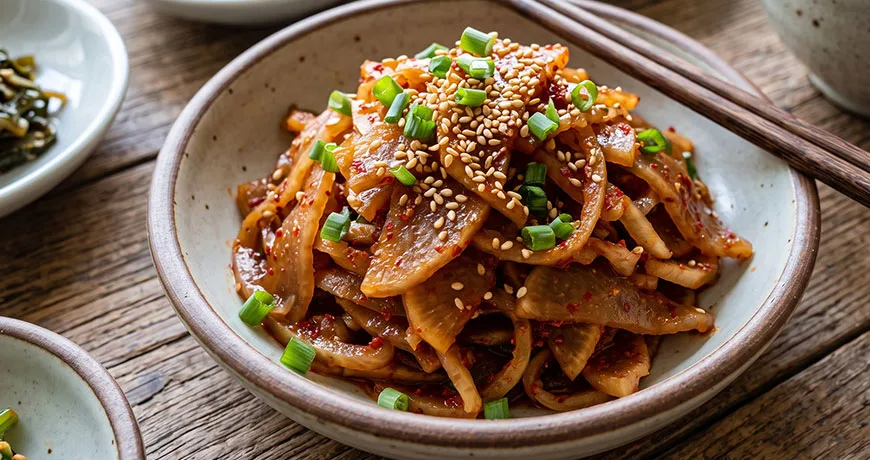
Mujangajji is an exercise in the profound aesthetics of emptying and refilling. As the chill of late autumn sets in, the Korean radish (Mu)—plump, dense, and bursting with clear, sweet hydration—is subjected to a gentle but relentless osmotic cure. By resting under the heavy pressure of coarse sea salt and rice syrup, the root willingly surrenders its excess moisture, shrinking into a dense, translucent, amber-hued jewel. Replacing that lost water with a slow-simmered, time-honored soy broth is the chef’s meticulous way of refining sharp saltiness into a deeply elegant, rounded sweetness. Yielding a resounding, juicy crunch with every bite, this preserve gracefully cuts through heavy fats and stands as a formidable pillar of the traditional Korean dining table.
- ⏱️ Total Time: 5–7 Days | Prep: 24 Hours (Osmotic dehydration via salt and syrup) | Cook & Ferment: Initial warm infusion, followed by a secondary boil and cold aging on day 3
- 🍳 Difficulty: Medium (Requires accurate judgment of moisture extraction and temperature control during secondary boiling)
- 🌶️ Profile: A deep, percussive crunch that bursts with the radish’s natural sweetness, enveloped in a rich, savory soy umami
- 🍚 Core Process: Osmotic Dehydration, Slow-simmering Broth, Lukewarm Infusion, Secondary Simmering
- 🍶 Pairing: Cold pressed pork slices (Pyeonyuk), clear beef brisket soup (Gomtang), warm abalone porridge
Physicochemical & Sensory Matrix
- Baseline Salinity: 5.5% ~ 6.5% (A steadfast, penetrating saltiness that deeply seasons the dense, dehydrated root)
- pH Equilibrium: 4.5 ~ 4.8 (A subtle acidic layer introduced by plum extract that elevates the natural sugars)
- Textural Crunch Index: [■■■■□] (A deeply satisfying, juicy, and resonant crunch, distinct from the rigid snap of sun-dried radishes)
- Umami Density: 8.0 / 10 (A lingering depth forged by the root’s natural sweetness meeting the fermented amino acids of brewed soy)
- Shelf Stability: Peaks after 5 days; maintains its phenomenal texture and amber glow for over 6 months refrigerated
- Aroma Profile: Refreshing Sweet Radish | Earthy Shiitake & Brewed Soy | Delicate Fruity Plum
Ingredients (Yields 1 Medium Airtight Glass Container)
- Primary Plant Matrix: 1kg Premium, dense Autumn Korean Radish (Mu), unpeeled and free of hollow cores
- Dehydration Matrix: 0.5 Cup Coarse Sea Salt, 1 Cup Rice Syrup (Jocheong) or Unrefined Sugar
- Aromatic Broth Matrix: 2 Cups Brewed Soy Sauce, 1.5 Cups Purified Water, 0.5 Cup Plum Extract (Maesil-cheong), 0.5 Cup Cooking Wine
- Aromatic Catalyst: 1 Sheet Dried Kelp (10x10cm), 2 Dried Shiitake Mushrooms, 2 Dried Red Chilies, 5 Cloves Garlic
Allergy Information
- Contains: Soy, Wheat (inherent in brewed soy sauce)
Equipment Large Mixing Bowl, Heavy Pressing Stone (or a water-filled bowl), Stainless Steel Saucepan, Heat-resistant Glass Airtight Container, Soft Cotton Cloth
Cooking Instructions
- Preparing for Dehydration: Wash the radish thoroughly, leaving the skin entirely intact. The skin acts as a structural boundary that ensures the radish remains firm and crunchy throughout the long aging process. Cut the radish lengthwise into thick, substantial batons (quarters or sixths, depending on size).
- Osmotic Dehydration: Place the radish batons in a large bowl, scattering the sea salt and rice syrup evenly over them. Toss well. Place a heavy weight on top and let it rest peacefully at room temperature for 24 hours. The intense osmotic gradient created by the salt and dense syrup will firmly but gracefully draw out massive amounts of water, rendering the batons pliable and significantly reduced in size.
- Moisture Expulsion: After 24 hours, discard the vast pool of extracted liquid entirely. Wipe the surface of the shriveled radish pieces with a clean cloth to remove residual moisture, and pack them neatly into the glass container.
- Simmering & Infusion: In a saucepan, combine the water, soy sauce, cooking wine, kelp, shiitake, red chilies, and garlic. Bring to a gentle simmer. Once the earthy aromas bloom, remove the kelp, turn off the heat, and stir in the plum extract. Allow the broth to cool until it retains only a comforting lukewarm warmth (approx. 60°C), then pour it generously over the radish batons.
- Secondary Simmering & Aging: Refrigerate the container for 3 days. Despite the initial dehydration, the radish will release more water into the broth. Carefully drain only the liquid into a pot and bring it to a boil to evaporate this excess moisture. Let this re-boiled broth cool completely to room temperature before pouring it back over the radish. This essential purification process secures the preserve’s long-term stability and deep amber brilliance.
💡 Professional Culinary Tips
- 1. Preserving the Skin and Bold Cuts: Peeling the radish or slicing it too thinly will speed up dehydration but ruin the culinary experience. The preserve will lose its signature resilient tension. Retaining the tough outer skin and cutting the root into bold, thick batons guarantees that the cellular structure withstands months of soaking, rewarding the diner with a luxurious, resounding crunch.
- 2. The Science of Syrup Osmosis: Curing a large root with salt alone for 24 hours invites an aggressive, unpalatable influx of sodium. Introducing rice syrup—a heavy, large-molecule polysaccharide—creates a powerful osmotic engine that aggressively pulls water out of the cells while blocking excess salt from penetrating too deeply. This technique condenses the root’s natural sweetness and establishes the perfect textural foundation.
- 3. Preservation Dynamics via Secondary Simmering: Even after rigorous curing, a thick radish harbors deep internal moisture that slowly seeps out, diluting the brine. Re-boiling this thinned broth on the third day and pouring it back completely cold is a non-negotiable step in the high-end Chanbang (pantry). It prevents microbial spoilage and physically drives the complex soy aromas straight into the heart of the vegetable.
🍶 Gastronomic Pairing
- Mastering Fats with a Resounding Crunch: Remove a well-aged baton of Mujangajji and slice it into elegant, bite-sized pieces. Present it alongside beautifully pressed, cold pork slices (Pyeonyuk) or a steaming, deeply savory bowl of clear beef brisket soup (Gomtang). As the rich, heavy proteins and fats envelop the palate, the deep, percussive crunch and the bright, sweet soy finish of the radish effortlessly sweep the palate clean, renewing the appetite for the next exquisite bite.
Nutrition Facts (Estimated)
Total Content : Approx. 30g
Calories : 25 kcal (Concentrated root sugars and complex syrup polysaccharides)
– Sodium : 480mg (Stabilized long-term aging salinity achieved via intensive dehydration)
– Total Carbohydrate : 5.8g
– Sugar : 3.5g
– Total Fat : 0.0g
– Saturated Fat : 0.0g
– Cholesterol : 0.0mg
– Protein : 0.4g
– Dietary Fiber : 1.8g
*Daily Values are based on a 2,000 calorie diet and standard Korean nutritional reference values.
**Nutritional values are calculated based on original ingredients; substitutions may alter specific macronutrients.
Origins and Food Culture of Pickled Radish (Mujangajji)
1. Historical Lineage: “Nabokjang” (羅蔔醬) in Classical Joseon Treatises
- Korean cultivation of radish dates back over a millennium. In the 13th-century Goryeo text Dongguk Isanggukjip, scholar Yi Gyu-bo famously penned in his poem Gapo Yuk-yeong (“Six Songs of the Vegetable Garden”) that radishes preserved in soybean paste serve as the ultimate summer sustenance.
- Early Joseon culinary compendiums, including the pioneering Suunjabbang (c. 1540), Yu Jung-im’s Jeungbo Sallim Gyeongje (1766), and Seo Yu-gu’s early 19th-century encyclopedia Imwon Gyeongjeji, codified detailed recipes for Nabokjang (羅蔔醬)—curing the classical Chinese radish (nabok 羅蔔) in soy sauce, fermented bean paste, or chili mash. Embedding halved or whole salted radishes into earthenware jars secured a year-round reserve of crisp greens that bridged the gap between seasonal harvests.
2. The Food Processing Science of Solid-Paste Curing and Cellular Compaction
- The craftsmanship of authentic Mujangajji lies in purging massive internal moisture without compromising the crispness of the cellular framework.
- Traditional households avoided plunging raw, watery radishes directly into paste vats. Instead, they employed a pre-salting step beneath heavy pressing stones or air-dried the wedges on woven wicker trays until the outer surface withered slightly. This semi-dehydrated state prevented the curing pastes from becoming diluted and souring. Packed tightly into breathable earthenware vessels (onggi), the anaerobic, hypertonic environment fostered the slow migration of savory amino acids into the root core while preserving an unyielding, dense chew.
3. Aristocratic Lineage Pantries (Jongga) and the Universal Counterpoint to Rich Gukbap
- Mujangajji was an indispensable household asset in noble lineage estates (jongga), providing nourishment through long winters and early-spring famines.
- Finely julienned and wrung dry in cotton cloth, the cured radish was seasoned with fragrant toasted sesame oil, garlic, and scallions to create Mujangajji-muchim, gracing both scholars’ morning tables and banqueting trays. With the commercial expansion of rich beef bone soups (seolleongtang and gomtang) in late-Joseon urban markets, Mujangajji joined radish kimchi (kkakdugi) as an essential accompaniment, dissolving greasy residues and enlivening traditional dining.
Submerging the Heavy Flesh of Frost-Ripened Autumn Radishes into the Deep Osmotic Abyss of Brewed Soy, Displacing Fragile Moisture with Dense Fermented Amino Acids to Forge an Enduring, Acoustic Crunch: A Refined Portrait of Traditional Mujangajji
Mujangajji (Pickled Korean White Radish in Aged Soy Sauce) stands as an enduring monument to structural preservation within Korea’s heritage of root vegetable gastronomy. Centered on dense, sugar-laden Korean white radishes (mu) harvested immediately after the first late-autumn frosts when cell walls are thickest, this venerable preserve is crafted by salting whole or halved roots, then submerging them beneath a deep sea of boiled-and-cooled dark soy sauce under the compressive weight of heavy granite stones. Fresh radishes are composed of over 90% water, rendering them acutely vulnerable to internal pithiness or enzymatic decay during winter storage. Ancestral cooks overcame this structural frailty through ruthless osmotic discipline. As the hypertonic soy liquor slowly traverses the radish flesh from cortex to core, intracellular free water is coaxed outward, replaced molecule by molecule by rich soy peptides and dark melanoidin pigments. Over months of undisturbed cellar maturation, the pale white flesh transforms into a translucent, dark mahogany jewel, its once-fragile tissues compacted into an elastic, resilient matrix.
Pulling an aged baton of Mujangajji from the depths of an earthenware crock and resting it on the cutting board reveals its remarkable structural change: the knife meets a firm, leather-like resistance, and slicing through exposes glistening, amber-stained facets. Cut into thin crescents or slender batons and arranged in a ceramic dish, the translucent mahogany flesh catches the light like polished gemstone. Approaching the nose, the pungent, eye-watering sulfur sting of raw radish is entirely absent; in its place rises a comforting, aristocratic perfume of dark malt, aged fermented soybean paste, and a warm, caramelized root sweetness. Clamping down with the molars yields a striking sensory revelation: completely removed from the watery crunch of raw radishes or the limp yield of commercial yellow pickles, an authoritative, deep odok-ajak resonates through the jawbone. The compressed, dense cell walls shear cleanly under tooth pressure, releasing trapped pockets of savory soy umami and concentrated radish sweetness across the tongue. The savory mineral salinity is immediately rounded off by the radish’s intrinsic vegetal sugars, triggering copious salivation. Whether rinsed, squeezed dry, and tossed with toasted sesame oil and chili flakes, or eaten plainly draped over a steaming spoonful of rice porridge (juk), it anchors the table with elemental simplicity.
The cultural identity of Mujangajji lies in the domestic foresight that refused to settle for fleeting seasonal freshness, using hypertonic dehydration to build a wholly new physical texture and unmatched shelf life. By trading ephemeral moisture for the eternal savor of aged soy, this modest dish of pickled radish remains an indispensable pillar of the Korean winter hearth, quietly steadying the rhythm of every meal it accompanies.
Editor’s Review
1. Osmotic Parenchymal Compaction and High-Density Brittle Shear Fracture
Mujangajji exhibits a dense, non-fibrous masticatory resilience achieved through non-thermal water evacuation:
- Vacuolar Evacuation and Intercellular Void Collapse: The large vacuoles of radish parenchymal cells store extensive volumes of free water. Under prolonged hypertonic soy submersion and mechanical stone compression, steep osmotic gradients draw this water out. The cell walls contract, flattening the intercellular capillary spaces into tightly laminated sheets.
- Preservation of the Cellulose Framework: Because thermal processing is bypassed, the native cellulose microfibrils and middle-lamella pectins avoid heat-induced solubilization. When bitten, this dense, dehydrated cellular lattice pushes back against dental pressure before shearing abruptly along lamellar planes, producing an audible, high-frequency acoustic fracture (odok-ajak).
2. Solute Diffusion Kinetics, Isothiocyanate Attenuation, and Aw Suppression
The deep amber translucence and rounded savor of Mujangajji are governed by steady molecular exchange and moisture stabilization:
- Enzymatic Pungency Inactivation: The tear-inducing heat of raw radish stems from 4-methylthio-3-butenyl isothiocyanate (MTBITC), generated when cellular injury allows myrosinase to cleave glucosinolate precursors. High salinity and gentle organic acidity denature endogenous myrosinase, while volatile isothiocyanates diffuse harmlessly into the exterior brine, leaving only concentrated natural saccharides behind.
- Capillary Infiltration of Melanoidins and Peptides: Over months of curing, free glutamic acid, small oligopeptides, and brown melanoidin polymers from brewed soy sauce diffuse through the vascular rays toward the core. This uniform molecular infusion turns the ivory flesh into a translucent amber-brown matrix packed with savory depth.
- Water Activity (Aw) Depression: High sodium chloride concentrations combined with dissolved sugars drop the system water activity (Aw) below 0.80. This creates an impenetrable microbiological hurdle that halts the proliferation of molds, bacteria, and yeasts during ambient cellar storage.
3. Residual Diastatic Activity and Lipid Cleansing Gastro-Physiology
Mujangajji functions as an active digestive ally alongside both starches and rich proteins:
- Amylolytic Starch Support: Prepared cold, the radish preserves trace levels of endogenous diastase (amylase). When paired with calorie-dense white rice or starch porridges, it supports the breakdown of complex carbohydrates, easing gastric emptying.
- Interfacial Saturated Fat Clearance: When accompanying rich grilled meats, the low-pH marinade and sodium ions lower the surface tension of hydrophobic lipid films (lard, tallow) adhering to the oral mucosa. Emulsifying and washing away greasy films, it resets lingual taste buds to complete sensory clarity.