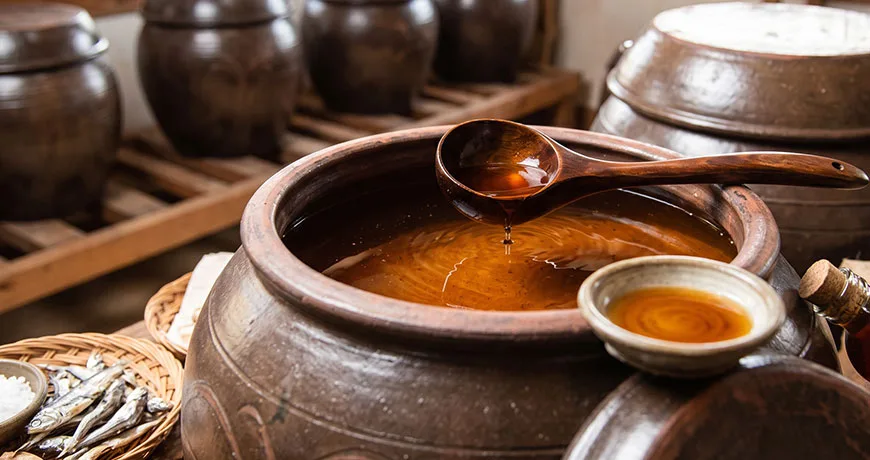
Eoganjang is a profound liquid amino acid matrix derived purely from marine proteins. Unlike standard soy sauce, which ferments plant-based soybeans, Eoganjang utilizes the biochemical process of autolysis. By relying on the powerful endogenous enzymes found in the viscera (guts) of fresh fish, the fish flesh and bones are naturally hydrolyzed in an extreme high-salinity environment. Following a dormant aging process of 1 to 3 years, the sharp, pungent trimethylamine (fishy) odors dissipate, leaving behind a hyper-concentrated, halophilic liquid exploding with inosinate (IMP) and glutamic acid. Just a few drops act as a culinary masterkey, unlocking unparalleled depth in clear broths.
- ⏱️ Total: 1–3 Years | Prep: 1 Day (Washing and salting the catch) | Cook & Ferment: 1–3 Years (Ambient long-term autolytic fermentation)
- 🍳 Difficulty: High (Requires stringent salinity control and meticulous micro-filtration to prevent spoilage over years of aging)
- 🌶️ Profile: An explosive marine umami with a deep, heavy salinity that mellows into a clean, slightly sweet oceanic finish
- 🍚 Focus: Autolysis, Halophilic Protein Hydrolysis, Long-Term Aging, Micro-filtration & Clarification
- 🍶 Pairing: Seaweed soup (Miyeokguk), clear radish soup, and acting as the core umami seasoning for blanched vegetable sides (Namul)
Physicochemical & Sensory Matrix
- Baseline Salinity: 22.0% ~ 25.0% (Extreme osmotic barrier required for long-term preservation and controlled autolysis)
- pH Equilibrium: 5.5 ~ 6.0 (Mildly acidic buffer maintained by free amino acid breakdown)
- Viscosity Index: [■□□□□] (Thin, fully water-soluble liquid post micro-filtration)
- Umami Density (T1R1/T1R3 Synergy): 9.9 / 10 (Maximum synergy between marine-derived glutamic acid and inosinate)
- Aging Horizon: 12 ~ 36 Months (Ambient natural solid-to-liquid degradation)
- Aroma Profile: Controlled Trimethylamine (Oceanic Notes) | Amino Acid Fermentation Funk | Clean Savory Depth
Ingredients (Yields 1 Large Traditional Crock)
- Marine Protein & Enzyme Matrix: 10kg Ultra-fresh whole Anchovies or Sand Lance (Must remain entirely intact; intestines and bones are biochemically essential)
- Osmotic Preservative Matrix: 2.5kg ~ 3kg Coarse Solar Sea Salt aged for 3+ years (Targeting 25–30% of total fish weight)
Allergy Information
- Contains: Fish
Equipment Large Microporous Earthenware Crock (Onggi), Heavy Pressing Stone, Fine Cheesecloth or Traditional Hanji Paper (for micro-filtration), Large Basin
Cooking Instructions
- Marine Matrix Preparation: Gently rinse the freshly caught fish in brine matching seawater salinity to remove impurities, then drain completely. Avoid rigorous washing with fresh water, as it ruptures osmotic balance and invites rogue spoilage bacteria.
- High-Salinity Blending: Place the drained fish in a massive basin and pour in 70% of the prepared sea salt. Toss very gently by hand to coat the fish without crushing the flesh.
- Crock Sealing & Osmotic Barrier: Layer the salted fish tightly into a sanitized earthenware crock. Pour the remaining 30% of the sea salt over the top, forming a thick, impenetrable salt cap (osmotic seal) that blocks all air exposure.
- Long-term Autolytic Fermentation: Place a heavy stone on top to keep the solids submerged. Cover and store in a cool, shaded, well-ventilated area for a minimum of 1 year. The endogenous proteases in the viscera will slowly digest the flesh and bone, liquefying the matrix completely.
- Micro-filtration & Clarification: After 1 to 3 years, once the solids have collapsed into a dark, clear, reddish-brown liquid, line a strainer with multiple layers of fine cheesecloth or Hanji paper. Allow gravity to pull the liquid through slowly (do not press or squeeze). The resulting clarified Eoganjang can be flash-boiled for thermal stabilization or used raw.
💡 Professional Culinary Tips
- Biochemical Necessity of Visceral Enzymes: Removing the guts from the fish prior to fermentation is a catastrophic error. The proteases (like trypsin) inside the viscera are the biochemical engines that drive autolysis, hydrolyzing complex marine proteins into bioavailable amino acids.
- Importance of Aged Sea Salt: Because the matrix operates at an extreme 25% salinity, the salt quality dictates the final flavor. Using raw sea salt containing bittern (magnesium chloride) will inject a harsh, metallic bitterness into the Eoganjang, causing a critical fermentation defect.
- Nitrogenous Shift via Aging: At 1 year, Eoganjang still retains a sharp fishy odor (TMA). However, pushing the aging horizon to 3 years or beyond allows these volatile compounds to degrade, recombining into deep, sweet, and nutty aromas that rival the finest premium soy sauces.
🍶 Gastronomic Pairing
- The Masterkey for Clear Broths: Eoganjang imparts devastating umami depth without muddying the visual clarity of a soup. Drop 1 to 2 tablespoons into a simmering pot of premium Hanwoo beef seaweed soup (Miyeokguk) or winter radish soup instead of standard salt. It instantly grounds the molecular structure of the broth, pulling a profound, oceanic umami across the palate.
Nutrition Facts (Estimated)
Total Content : Approx. 15g (1 tbsp)
Calories : 10 kcal (Hyper-saline water-soluble amino acid matrix)
– Sodium : 1,250mg (Extreme salinity halophilic fermentation liquid)
– Total Carbohydrate : 0.5g (Trace residual polysaccharides)
– Sugar : 0.0g
– Total Fat : 0.0g (Lipids are degraded and filtered out during long-term aging)
– Saturated Fat : 0.0g
– Cholesterol : 0.0mg
– Protein : 2.0g (100% fully hydrolyzed liquid free amino acids)
– Dietary Fiber : 0.0g
*Daily Values are based on a 2,000 calorie diet and standard Korean nutritional reference values.
**Nutritional values are calculated based on original ingredients; substitutions may alter specific macronutrients.
Origins and Food Culture of Fish Soy Sauce (Eoganjang)
1. Ancient Foundations: The Lineage of “Eojang” (魚醬) and Classical Joseon Agrarian Treatises
- Paralleling the ancient Greco-Roman tradition of Garum and the fish sauce cultures of maritime Southeast Asia, Korea’s fish sauce heritage dates back millennia to ancient coastal fishing communities who cured surplus seasonal catches in sea salt to produce fermented fish pastes (eojang) and preserved delicacies (eusikhae).
- By the late Joseon Dynasty, Yu Jung-im’s 1766 agrarian compendium Jeungbo Sallim Gyeongje and Lady Yi’s 1809 culinary encyclopedia Gyuhap Chongseo documented precise methods for brewing Eojang (魚醬)—curing anchovies, croakers, or gizzard shads in salt and straining the clear liquid to replace grain-based soy sauce in high-class banquets. In coastal and insular regions where arable land for soybean cultivation was scarce, fish soy sauce reigned as the primary savory lifeblood of domestic kitchens.
2. The Culinary Science of Endogenous Autolysis and Multi-Year Onggi Aging Thermodynamics
- The technical mastery of authentic Eoganjang relies on harnessing endogenous visceral proteases for autolysis alongside halophilic microbial ecology over multi-year aging cycles. While everyday kimchi fish extracts (aekjeot) are typically cured for merely 6 to 12 months—retaining a pungent fish odor and heavy turbidity—true artisanal Eoganjang matures undisturbed inside breathable earthenware crocks (onggi) for two to five years.
- Oxygen circulating through the micro-porous earthenware walls facilitates aerobic microbial degradation, completely hydrolyzing fish muscle tissues into soluble free amino acids while volatilizing raw trimethylamines into sweet, nutty aromatic esters. The clarified liquid is subsequently simmered over gentle heat to precipitate residual proteins, creating an immaculate, transparent amber liquid seasoning that never spoils at room temperature.
3. The Maritime Heritage of Jeju Island and the Global Triumph of K-Fish Sauce
- The premier cultural homeland of Korean Fish Soy Sauce is volcanic Jeju Island. Historically constrained by rocky, porous basalt soil that made extensive soybean farming difficult, Jeju’s diving women (haenyeo) and fishermen cured fresh hauls of mackerel, horse mackerel, and anchovies in large earthenware vats along stone walls, aging them across several years to yield a clear, all-purpose seasoning for everyday soups and greens.
- Today, Jeju Eoganjang has earned international acclaim among global master chefs as an additive-free, clean-tasting artisanal liquid umami that bridges maritime traditions with modern gastronomy. Preserving ancient ecological knowledge and slow-food integrity, Traditional Fish Soy Sauce remains an immortal cultural monument to Korean coastal heritage, patience, and fermentation mastery.
The Amber-Dark Maritime Elixir of Endogenous Proteolytic Autolysis, the Coastal Reclamation of Missing Legume Fields, and the Synergistic Harmony of Marine Amino Acids: A Refined Portrait of Traditional Korean Eoganjang
Eoganjang (Traditional Korean Fish Soy Sauce) stands as the profound, liquid convergence of ocean biology and patient earthenware fermentation. Diverging from standard soy sauce (ganjang) brewed from agricultural legumes, this maritime condiment is crafted by layering pristine coastal catches—predominantly nutrient-dense anchovies, horse mackerel, or juvenile pelagic species—with coarse solar sea salt within breathing terracotta crocks (onggi), subjecting the mixture to slow, unhurried aging across one to three years. Flourishing historically across the volcanic shores of Jeju Island and the southern rias coasts, where basalt terrain made extensive soybean and rice farming difficult, Eoganjang was born out of ecological necessity. The process harnesses the natural digestive enzymes residing inside the fish’s viscera to systematically digest its own myofibrillar muscle tissue through enzymatic autolysis. High salinity (20–25%) suppresses putrefactive microbes, allowing clean autolytic breakdown to proceed beneath seasonal sunlight and sea breezes. As muscle proteins liquefy into small peptides and free amino acids, floating surface fish oils are scrupulously skimmed off (defatting), and the clear liquor is aged—often alongside traditional soybean meju blocks to cross-pollinate maritime and terrestrial savor. The outcome is a brilliant, clear mahogany broth that completely bypasses the raw, aggressive pungency of short-cured dipping fish sauces (aekjeot), capturing instead a rounded, versatile, and deeply focused liquid umami.
Tilting a small porcelain dish of aged Eoganjang reveals an immediate, remarkably clean olfactory profile: the rancid, fishy volatility of raw seafood is entirely absent, replaced by a subtle, savory bouquet of toasted malt, ocean minerals, and the warm, dried-fruit notes of prolonged melanoidin browning. Resting a tiny drop upon the tongue demonstrates its frictionless rheology. The ultra-low viscosity fluid spreads instantly across oral tissues, its initial saline prick dissolving immediately into an immense, velvety wave of marine-derived free amino acids. Deeper and more expansive than pure soy-derived seasoning, its peptide architecture coats the oral cavity with luxurious weight, finishing with a lingering, naturally sweet resonance without greasy or muddy undertones. Introduced into a gently simmering pot of clear sea-mustard soup (miyeokguk) or beef-and-radish soup, a single teaspoon establishes an authoritative savory backbone without altering the broth’s pristine translucence—operating as an invisible, diplomatic conductor that unifies disparate ingredients into a seamless whole.
The cultural identity of Eoganjang is rooted in the maritime resourcefulness of coastal and island communities that adapted to geological constraints by turning the sea into their primary protein pantry. Documented in late-Joseon compendiums such as Jeungbo Sallim Gyeongje and Gyuhap Chongseo under aristocratic preparations of Eoyukjang (meat-and-fish soy sauce), this time-honored liquid reflects an uncompromising mastery of ambient enzymatic digestion. Transforming modest pelagic catches into a multifaceted, shelf-stable seasoning, a bottle of aged Eoganjang remains an enduring benchmark of ecological adaptation, microbial patience, and brilliant Korean culinary craftsmanship.
Editor’s Review
1. Ultra-Low Viscosity Fluidity, Frictionless Capillary Penetration, and a Pure, Non-Fatiguing Lingering Finish
Eoganjang showcases a refined textural paradigm that stands apart from viscous glazes or particulate-heavy pastes:
- Capillary Infiltration: As a fully liquefied, thoroughly filtered aqueous solution with surface tension similar to water, Eoganjang exhibits exceptional capillary movement. It penetrates the porous boundaries of cooked meats, marine algae, and blanched vegetables without mechanical resistance, distributing salinity and umami evenly throughout cellular matrices.
- Frictionless Oral Flow: Completely devoid of insoluble starches, coarse fibers, or suspended solids, the liquid glides across the tongue without imparting chalkiness or abrasive resistance.
- Persistent Hydration Film: The high concentration of small-chain peptides and mineral salts establishes a thin, hydrating coating across the mucosal lining, sustaining active salivation and extending the perception of savory depth long after swallowing.
2. Endogenous Protease Autolysis, Glutamate-IMP Synergism, Defatting Oxidation Control, and Volatile Amine Neutralization
Eoganjang represents a precise study in marine enzyme kinetics, nucleotide flavor chemistry, and lipid stability:
- Endogenous Autolytic Cleavage: During the early stages of fermentation, native serine and acid proteases (pepsin, trypsin, cathepsins) residing within the fish viscera drive the systematic cleavage of actomyosin and collagen into short-chain oligopeptides and free amino acids. This enzymatic process remains active within high-saline conditions, fully liquefying solid fish tissue over 12 to 36 months.
- Glutamate-IMP Umami Synergism: While conventional soy sauce relies predominantly on plant-derived free glutamic acid, Eoganjang contains both free glutamates and high concentrations of inosine 5′-monophosphate (IMP), generated via the post-mortem degradation of fish adenosine triphosphate (ATP). The simultaneous binding of glutamate and IMP to oral T1R1/T1R3 umami receptors amplifies savory perception exponentially compared to single-source umami seasonings.
- Defatting and Lipid Rancidity Mitigation: To eliminate the development of volatile lipid oxidation byproducts (such as hexanal and 2,4-decadienal), surface fish oils that separate during fermentation are systematically skimmed off. Concurrently, long-term Maillard reaction products (melanoidins) and mild organic acids physically adsorb and chemically neutralize volatile trimethylamine (TMA), converting fishy sharpness into a savory, toasted aroma profile.
- Water Activity (Aw) Suppression: A sustained salinity level exceeding 20% lowers water activity (Aw) below 0.75, establishing an impenetrable osmotic barrier against spoilage organisms while allowing halophilic flavor maturation to proceed unhindered.
3. The Maritime Terroir of Jeju and the Sovereign Umami Amplifier of Soups
Unlike Southeast Asian fish sauces (nam pla, nuoc mam), which frequently lean into pungent, unmasked fish aromatics to dominate stir-fries and fresh salads, traditional Korean Eoganjang underwent centuries of refinement alongside soy sauce traditions, resulting in an aristocratic, rounded seasoning designed to blend into broths. Capable of reinforcing the structural depth of clear consommés without muddying their visual clarity or overwhelming subtle seasonal vegetables, Eoganjang remains the most intellectually elegant, functionally versatile maritime amplifier in Korean soup gastronomy.