
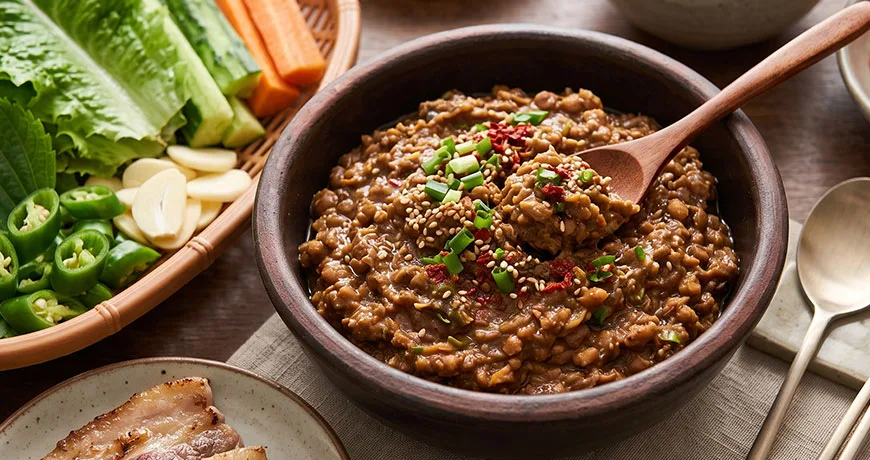
Ssamjang is the definitive hybrid dipping sauce that completes the Korean BBQ (K-BBQ) and Ssam (wrap) experience. It utilizes the heavy, deep peptide umami of fully fermented Doenjang as its foundation, interweaving it with the sweet, spicy tension of Gochujang. This base is then spiked with the sharp, volatile aromatics of fresh alliums (garlic, scallions, onions) and enriched with a crunch matrix of crushed nuts and toasted sesame oil. Requiring zero heat, it is synthesized purely through mechanical blending. The result is a powerful culinary matrix designed specifically to cut through intense animal fats and mask the raw, grassy notes of fresh wrapping leaves.
- ⏱️ Total: 10 mins | Prep: 10 mins (Mincing and blending) | Cook & Ferment: None (24-hour refrigerated resting recommended for stabilization)
- 🍳 Difficulty: Low (No-cook process; relies on precise ratio balancing and textural control)
- 🌶️ Profile: A perfect equilibrium of deep savory earthiness, sweet heat, pungent fresh garlic, and rich nutty crunch
- 🍚 Focus: Heterogeneous Paste Integration, Allium Flavor Extraction, Nut Moisture Absorption, Lipid Emulsion Coating
- 🍶 Pairing: Grilled pork belly (Samgyeopsal), crisp lettuce and perilla leaves, and raw garlic slices
Physicochemical & Sensory Matrix
- Baseline Salinity: 8.0% ~ 10.0% (Optimized dipping salinity diluted by fresh vegetables and syrups)
- pH Equilibrium: 5.3 ~ 5.6 (Pleasant mild acidity buffered by Gochujang and plum extract)
- Viscosity Index: [■■■■□] (Dense, highly viscoelastic paste that clings perfectly to leaves without dripping)
- Umami Density (T1R1/T1R3 Synergy): 9.6 / 10 (Soybean amino acids maximizing the natural sweetness of garlic and onions)
- Aging Horizon: 24 Hours (Refrigerated resting for flavor integration)
- Aroma Profile: Sharp Allicin Punch | Toasted Nut & Sesame Oil Richness | Fermented Soybean Pyrazines
Ingredients (Yields 1 Medium Airtight Container)
- Primary Paste Matrix: 200g Traditional Doenjang (Soybean Paste), 100g Traditional Gochujang (Chili Paste) – adhering to the 2:1 Golden Ratio
- Aromatic & Vegetable Matrix: 2 tbsp Finely Minced Garlic, 3 tbsp Finely Minced Scallion (white parts preferred), 3 tbsp Finely Minced Onion
- Texture & Moisture Control Matrix: 3 tbsp Finely Crushed Mixed Nuts (Walnuts, Peanuts, Pine Nuts), 1 tbsp Ground Toasted Sesame Seeds
- Sweetener & Lipid Matrix: 2–3 tbsp Plum Extract (Maesil-cheong) or Honey/Jochung, 2 tbsp Toasted Sesame Oil
Allergy Information
- Contains: Soy, Wheat (within Gochujang), Peanuts and Tree Nuts (depending on nut mix used)
Equipment Large Mixing Bowl, Silicone Spatula, Airtight Glass Container
Cooking Instructions
- Allium Preparation: Using a sharp knife, meticulously mince the scallions, onion, and garlic. (Do not use a blender or food processor, as completely rupturing the cell walls will release excessive water and highly bitter, astringent compounds.)
- Nut Matrix Crushing: Place the nuts into a mortar and pestle or chop them coarsely with a knife to ensure a distinct, crunchy texture remains.
- Base Paste Integration: In the mixing bowl, combine the Doenjang and Gochujang in a 2:1 ratio. Mash and fold them together with a spatula until a smooth, uniform base matrix is formed.
- Aromatic & Sweetener Blending: Add the minced vegetables, plum extract, and crushed nuts into the base paste. Fold vigorously to ensure all ingredients are completely integrated.
- Lipid Emulsion & Stabilization: Once the paste has absorbed the slight moisture released by the vegetables, add the sesame oil and toasted sesame seeds. Fold gently to create a protective lipid emulsion over the paste. Transfer to an airtight container and rest in the refrigerator for 24 hours to allow the complex flavors to marry perfectly.
💡 Professional Culinary Tips
- The 2:1 Golden Ratio & Buffering: The secret to Ssamjang is a flawless tug-of-war between salty, bitter, sweet, and spicy. By adhering to a 2:1 ratio of Doenjang (which provides the heavy savory and salty base) to Gochujang (which provides sweet and spicy top notes), you prevent the aggressive chili flavor from overpowering the deep, fermented umami profile.
- Moisture Control via Nut Matrix: As fresh onions and scallions sit in the salty paste, osmosis draws out their internal water, which can quickly turn Ssamjang into a watery mess. The inclusion of crushed nuts and ground sesame seeds acts as a biochemical sponge, absorbing this excess moisture to maintain a firm, spreadable viscosity while simultaneously adding structural crunch.
- Lipid Encapsulation Process: Introducing the sesame oil only at the very final stage is a calculated chemical decision. The lipids form a microscopic coating around the paste and the exposed cuts of the minced vegetables. This encapsulated barrier prevents highly volatile aromatics (like allicin in garlic) from oxidizing into the air and turning unpleasantly pungent during storage.
🍶 Gastronomic Pairing
- The Masterkey of K-BBQ: Take a sizzling piece of pork belly, heavily browned via the Maillard reaction on a grill, and place it upon a bed of fresh lettuce and perilla leaves. Smear a generous dollop of this Ssamjang over the meat. The sharp punch of the alliums instantly slices through the heavy animal fats, while the nutty, savory paste merges with the meat’s juices to create a symphonic explosion of Korean flavor.
Nutrition Facts (Estimated)
Total Content : Approx. 20g (1 tbsp)
Calories : 45 kcal (Fermented soy protein and plant-based lipid matrix)
– Sodium : 410mg (Blended Doenjang/Gochujang optimal dipping salinity)
– Total Carbohydrate : 4.5g (Vegetable polysaccharides and Gochujang starches)
– Sugar : 2.5g (Natural allium sugars and plum extract)
– Total Fat : 2.2g (High-quality unsaturated fatty acids from nuts and sesame oil)
– Saturated Fat : 0.3g
– Cholesterol : 0.0mg (100% Vegan matrix)
– Protein : 2.0g (Soybean proteins and nut-derived free amino acids)
– Dietary Fiber : 1.2g (Nut and fresh vegetable dietary fibers)
*Daily Values are based on a 2,000 calorie diet and standard Korean nutritional reference values.
**Nutritional values are calculated based on original ingredients; substitutions may alter specific macronutrients.
Origins and Food Culture of Red Chili and Soybean Paste (Ssamjang)
1. Historical Lineage: The Ancient “Ssam” Tradition, Dongguksesigi, and the Heritage of “Bokssam”
- Wrapping cooked rice and savory condiments inside fresh leafy greens (ssam) is an indigenous Korean culinary tradition dating back to the Three Kingdoms era. During the Goryeo Dynasty, when peninsular women were sent as court ladies to the Yuan Dynasty in China, Chinese historical accounts noted them planting lettuce in imperial palace courtyards to prepare Goryeo Ssambap, shedding tears of nostalgia for their homeland.
- In Hong Seok-mo’s 1849 seasonal folklore treatise Dongguksesigi, eating leafy parcels on the first full moon of the lunar year (Jeongwol Daeboreum) was documented as Bokssam (福쌈, “wrapping good fortune into food”) to pray for agricultural abundance. While historical ancestors initially seasoned these vegetable parcels with plain doenjang or vinegar chili paste, the introduction and adaptation of red chili peppers in late Joseon laid the groundwork for combining doenjang, gochujang, and aromatics into a unified composite seasoning sauce known today as Ssamjang.
2. The Culinary Science of Dual Fermentation Buffering and Sesame Lipid Emulsification
- The technical mastery of Ssamjang lies in the physicochemical fusion of two distinct fermentation profiles: the savory, protein-dense hydrolysis of soybean paste (doenjang) and the sweet, carbohydrate-saccharified heat of red chili paste (gochujang).
- Doenjang’s sharp salinity and rustic barnyard notes are softened by the maltose and fructose inherent in gochujang, while gochujang’s sharp capsaicin heat is comfortably buffered by doenjang’s peptides and lipids. The addition of toasted sesame oil acts as a natural emulsifying bridge between hydrophilic fermented pastes and hydrophobic animal fats, ensuring that when spooned over freshly seared meats, the sauce clings tenaciously to the caramelized surface rather than beading off, creating an optimal colloidal glaze.
3. The 1983 Commercial Green-Tub Revolution and the Global Triumph of K-BBQ Ssam Culture
- While households historically hand-blended small bowls of ssamjang for daily meals, modern food science revolutionized this practice in 1983 when Samwon Foods (now Haechandle) developed and commercially released the iconic “Four-Seasons Ssamjang” in its ubiquitous rectangular green plastic tub.
- Coinciding with the nationwide surge of tabletop pork belly (samgyeopsal) restaurants during South Korea’s rapid urbanization in the 1980s and 1990s, Ssamjang became the irreplaceable centerpiece of Korean meat gastronomy. Today, as an indispensable ambassador of global K-BBQ, Ssamjang introduces international diners to the communal, interactive ritual of wrapping food by hand—an enduring cultural monument to Korean hospitality, holistic wellness, and convivial dining.
The Rustic Soybean Curds of Aged Doenjang, the Glossy Vermilion Heat of Fermented Chili Paste, the Sharp Pungency of Raw Alliums, and the Rich Emulsion of Toasted Sesame Oil: A Refined Portrait of Ssamjang
Ssamjang (Seasoned Soybean and Chili Paste) stands as the dynamic, intensely communicative, and indispensable diplomatic bridge of the Korean communal grill. Born from the union of Korea’s primary fermented pillars—earthy, umami-dense soybean paste (doenjang) and glossy, sweet-spicy chili paste (gochujang)—this seasoned condiment is enlivened by minced raw garlic, chopped scallions, toasted sesame seeds, a drizzle of grain syrup, and a generous thread of pure toasted sesame oil. Doenjang provides an immovable bassline of aged microbial savor, while gochujang injects a bright melody of fermented grain maltose and vibrant capsaicin heat. Folded together without cooking, the sharp, sulfurous bite of freshly crushed alliums is softened by the unctuous lipid film of sesame oil, rounding off raw edges and mitigating excessive salinity. Operating at the direct crossroads where grilled meats, crisp mountain greens, and warm rice intersect, Ssamjang functions not as a passive dip, but as an active culinary mediator designed to harmonize contrasting temperatures, textures, and flavors within a single bite.
Approaching a tabletop grill laden with sizzling ribbons of pork belly, resting an overlapping pair of fresh red-leaf lettuce and wild perilla leaves on the palm, and adding a generous dollop of Ssamjang with chopsticks releases an immediate, electrifying aromatic burst. The nutty warmth of toasted sesame oil mingles with the sharp perfume of crushed garlic and the deep funk of fermented legumes. Folding the leaves into a tight parcel with warm rice and a sliver of raw pepper, then placing the whole bundle into the mouth, triggers an immediate textural awakening: the cool, watery snap of cellular plant leaves shatters first, followed by the rich gush of hot pork fat, seamlessly enveloped by the velvety weight of the paste. The coarse soybean solids yield between the teeth to release earthy amino acids, while the sweet chili heat cuts through animal grease. The bitter tannins and wild astringency of the forest greens are neutralized by the paste’s sugars and oils, transforming disparate sensory inputs into an integrated, deeply satisfying rhythm that refreshes the palate and banishes fatigue.
The cultural genius of Ssamjang lies in the modernization of Korea’s ancient ssam (leaf-wrapping) tradition, which evolved alongside the explosion of urban tabletop barbecue culture in the late 20th century. By erasing the boundaries between separate dipping pastes and synthesizing them into a single, vibrant paste, a humble bowl of Ssamjang remains the ultimate peacemaker of the Korean table—quietly negotiating the divide between bitter woodland foliage, rich animal lipids, and wholesome grain.
Editor’s Review
1. A Four-Tiered Heterogeneous Dispersion: Coarse Cotyledon Mash, Viscoelastic Chili Polymers, Crisp Allium Turgor, and Brittle Whole Seeds
Ssamjang avoids the uniform monotony of strained emulsion sauces by maintaining a structured, multi-phase colloidal suspension:
- The Structural Base: Coarsely crushed soybean fragments (cotyledons) from doenjang contribute physical body and particulate graininess, suspended within the cohesive, viscoelastic starch-maltose matrix of gochujang.
- Cellular Turgor Rupture: Suspended fragments of raw minced garlic and scallions resist initial mastication before bursting under tooth pressure, releasing crisp vegetal cellular fluids and localized bursts of sharpness.
- Particulate Crunch and Fluid Lubrication: Toasted sesame seeds shatter under dental friction to provide micro-crunch, while free polyunsaturated lipids from sesame oil coat oral tissues, ensuring smooth oral transit without cloying pastiness.
2. Lipid Emulsification of Hydrophobic Volatiles, Glutamate-IMP Umami Synergism, and Unheated Aw Stabilization
Ssamjang represents an elegant exercise in room-temperature colloidal chemistry and sensory physics:
- Lipid Buffering of Pungent Compounds: The active compounds in raw garlic (allicin) and chili (capsaicin) are hydrophobic. The unsaturated triglycerides in sesame oil, aided by natural soy lecithins, encapsulate these fiery molecules within micro-droplets. This buffers their immediate contact with mucosal TRPV1 and TRPA1 pain receptors, converting an abrasive sting into a rich, rounded warmth.
- Synergistic Flavor Amplification: The dense concentration of free glutamic acid residing in aged doenjang forms an exponential umami bond with the inosine monophosphate (IMP) abundant in seared meats, amplifying savory perception far beyond what either ingredient could achieve independently.
- Ambient Shelf Stability without Heat: Combining the baseline 10–12% salinity of aged pastes with the osmotic pull of added grain syrups lowers the water activity (Aw) to roughly 0.75–0.80. This suppresses bacterial proliferation in unheated states, while natural organic acids buffer the pH around 5.0, securing lasting biological stability.
3. The Culinary Linker Between Saturated Animal Lipids and Botanical Greens
Rather than acting as a self-contained dish, Ssamjang functions as a specialized culinary linker. Its salt, sugar, and lipid components coat the palate to suppress the bitter polyphenols and astringent tannins found in raw leaf wraps (lettuce, crown daisy, perilla). Simultaneously, its sharp allicin volatiles and emulsifying soy proteins break through heavy coats of rendered animal fat, preventing sensory palate fatigue. This multi-functional balance makes Ssamjang the indispensable mechanical engine behind Korean wrap gastronomy.