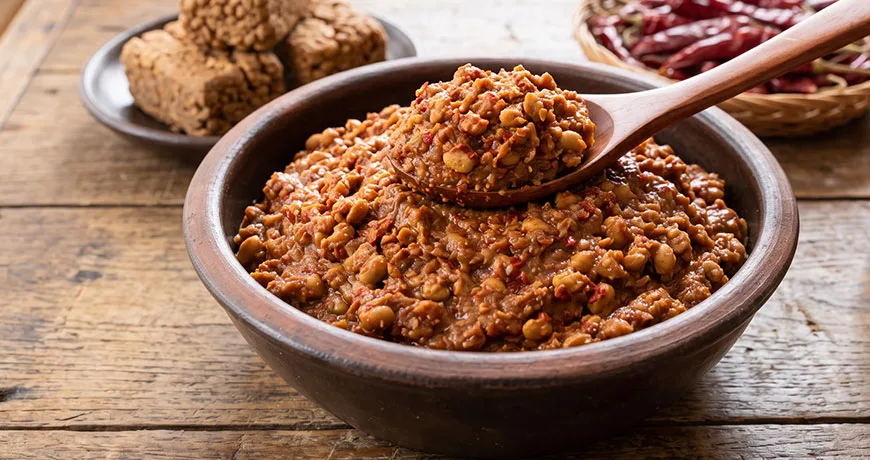
Makjang is a uniquely fast-maturing Korean fermented paste. Unlike traditional Doenjang, which requires months or years of hanging Meju, Makjang blends finely pulverized Meju powder, grain flour (such as barley rice flour), red chili powder, and brine, achieving rich umami and spicy depth in just 1 to 2 weeks. By finely grinding the Meju and simultaneously driving grain saccharification and Bacillus proteolysis, it yields an explosive payload of free amino acids and Maillard/melanoidin reactions almost immediately. Controlling the salinity and leveraging capsaicin as an antimicrobial barrier are the foundational pillars of this accelerated solid-state fermentation process.
- ⏱️ Total: 10–14 Days | Prep: 1 Day (Weighing and grain hydration) | Cook & Ferment: 10–14 Days (Accelerated ambient aging)
- 🍳 Difficulty: Medium (Requires vigilant moisture and salinity balance control during rapid maturation)
- 🌶️ Profile: Brightly spicy and pungent with fresh chili notes, harmonized with savory Meju umami and heavy soybean body
- 🍚 Focus: Fine Meju Pulverization, Grain Saccharification, Capsaicin Preservative Integration, Accelerated Proteolysis
- 🍶 Pairing: Fresh pork belly (Samgyeopsal) ssamjang application and crisp green pepper/cucumber vegetable sticks
Physicochemical & Sensory Matrix
- Baseline Salinity: 10.0% ~ 12.0% (Optimized osmotic and preservation balance for rapid maturation)
- pH Equilibrium: 5.5 ~ 5.8 (Mildly acidic to neutral buffer optimized for enzymatic activity)
- Viscosity Index: [■■■□□] (Smooth, heavy paste / optimized Ssamjang fluidity)
- Umami Density (T1R1/T1R3 Synergy): 9.4 / 10 (Complex synergy between Meju proteases and grain saccharification breakdown)
- Aging Horizon: 10 ~ 14 Days (Ambient accelerated solid-state fermentation)
- Aroma Profile: Capsaicin Spice Notes | Fermented Soybean Pyrazines | Subtle Rustic Meju Funk
Ingredients (Yields 1 Medium Crock or Airtight Container)
- Protein & Enzyme Matrix: 500g Traditional Meju Powder (Finely ground)
- Saccharification Matrix: 300g Barley Rice Flour (Provides mellow sweetness and microbial nutrient substrates)
- Antimicrobial & Spice Catalyst: 250g Sun-dried Red Chili Powder (Taeyangcho), 50g Chili Seed Powder (Color vibrancy and capsaicin-driven pathogen suppression)
- Osmotic Solvent Matrix: 1.5L Purified Water (boiled and cooled), 200g Coarse Sea Salt (Targeting a 10–12% salinity environment)
Allergy Information
- Contains: Soy, Barley (Cereals)
Equipment Sanitized Glass Airtight Container or Earthenware Crock, Large Mixing Bowl, Whisk or Heavy Spatula
Cooking Instructions
- Brine Preparation: Completely dissolve coarse sea salt into boiled and cooled purified water to create the brine matrix.
- Dry Matrix Blending: In a massive basin, thoroughly whisk together the fine Meju powder, barley rice flour, red chili powder, and chili seed powder until completely homogeneous.
- Hydration & Viscosity Setting: Gradually pour the prepared brine into the dry matrix, working it continuously with a spatula to eliminate lumps. Adjust the moisture until the paste achieves the smooth, pliable consistency characteristic of optimal Ssamjang.
- Compacting & Accelerated Fermentation: Firmly pack the Makjang paste into a sanitized container, pressing down forcefully with your fists to eliminate any pockets of trapped air. Smooth the top surface and apply a tight protective barrier (such as a light layer of salt or cling wrap) to minimize atmospheric exposure.
- Stabilization: Age at ambient room temperature in a shaded, well-ventilated area for 10 to 14 days. During this window, grain saccharification and protein breakdown synergize to develop peak flavor complexity. Transfer to refrigeration for long-term storage thereafter.
💡 Professional Culinary Tips
- The Magic of Grain Saccharification: The incorporation of barley rice flour is critical; as starches convert into simple sugars during short-term fermentation, they gracefully mask any inherent soybean bitterness while imparting a smooth, glossy sweetness to the paste.
- Moisture Management and Pathogen Defense: Because Makjang operates at a lower salinity and higher moisture content than traditional Doenjang (10–12% salinity), ensuring uniform brine distribution during initial mixing and blocking surface air exposure are absolute laws to prevent spoilage during rapid aging.
🍶 Gastronomic Pairing
- Raw Dip Harmony: Makjang shines brightest not in cooked stews, but when served raw alongside freshly boiled pork belly (Suyuk) or smeared thickly onto crisp green peppers and cucumber sticks. The bright, sharp spice of the fresh chili powder combined with the mellow umami of the broken-down Meju effortlessly cuts through rich animal fats and refreshes clean vegetable notes.
Nutrition Facts (Estimated)
Total Content : Approx. 20g (1 tbsp)
Calories : 35 kcal (High-protein soybean and complex carbohydrate matrix)
– Sodium : 480mg (Optimized salinity for accelerated fermentation)
– Total Carbohydrate : 4.5g (Grain saccharification products and soy polysaccharides)
– Sugar : 0.6g (Enzymatically cleaved natural reducing sugars)
– Total Fat : 1.0g
– Saturated Fat : 0.2g
– Cholesterol : 0.0mg (100% Vegan matrix)
– Protein : 2.8g (Rapidly hydrolyzed free amino acids and peptides)
– Dietary Fiber : 1.8g (Derived from chili skins and seed coats)
*Daily Values are based on a 2,000 calorie diet and standard Korean nutritional reference values.
**Nutritional values are calculated based on original ingredients; substitutions may alter specific macronutrients.
Origins and Food Culture of Fermented Soybean Paste with Red Chili Powder (Makjang)
1. Historical Lineage: Mountain Regional Heritage and the Evolution of Accelerated “Sokseong-jang”
- Makjang developed primarily across the mountainous inland provinces of Gangwon Province and northern Gyeongsang Province (such as Andong, Yeongju, and Bonghwa), where harsh winters and rugged terrain made lengthy aging processes impractical.
- The etymology of Makjang reflects its rustic character: either derived from mak (“roughly” or “hastily prepared”) due to its simplified manufacturing process, or from mak-jang (“the final batch”) made when aged reserves ran thin. Documented across late Joseon agrarian texts, these rapid regional pastes ensured year-round access to essential proteins and probiotics.
2. The Biochemical Kinetics of Grain-Flour Blending and Rapid Bacillus Fermentation
- The technical mastery of Makjang relies upon incorporating starchy cereal flours—such as barley, wheat, or corn meal—directly into the powdered meju mash to serve as an accessible carbon and nutrient source for microorganisms.
- Unlike conventional meju bricks that require liquid separation, Makjang’s balanced moisture and cereal matrix allow Bacillus and yeast cultures to proliferate rapidly within weeks at ambient spring or autumn temperatures. The incorporation of sun-dried red chili powder provides natural antimicrobial defense against spoilage organisms while establishing the paste’s iconic ruby-red hue and spicy aromatic profile.
3. The Sovereign Companion of Vegetable Wraps (Ssamjang) and Mountain Domestic Culture
- Traditionally paired with fresh garden greens, wild mountain herbs, and steamed cabbage leaves, Makjang earned its reputation as the ultimate companion for rural vegetable wraps (ssam).
- Requiring no elaborate curing rituals, it became a beloved staple of household domestic kitchens. Today, celebrated as a triumph of rustic slow food and regional fermentation heritage, Makjang remains an immortal monument to Korean agricultural ingenuity and heartfelt comfort dining.
The Coarsely Ground Meju, Sun-Dried Chili Powder, and Sweet Boiled Barley Milled into a Fast-Aged Red Rustic Paste: A Refined Portrait of Makjang
Makjang (Quick-Fermented Soybean and Chili Paste) stands as the rustic, efficient, and texturally distinct summit of mountain and regional Korean fermentation. Diverging from traditional doenjang, which requires months or years of cellar aging after drawing off liquid soy sauce, Makjang is formulated by pulverizing dried meju blocks into a coarse meal, then blending it immediately with coarse red chili powder, salt, and steamed adjunct grains such as barley, soybeans, or cornmeal. Allowing for rapid fermentation within days or a few weeks, the paste earned its name from the colloquial adverb mak—meaning hastily or roughly mixed. Unlike the refined, long-aged soybean pastes of the central lowlands, Makjang retains every fragment of the soybean’s fibrous hull and nutritious cotyledon, yielding a heavy, substantial body when simmered into stews. Infused with chili powder, it delivers a muted, earthy crimson hue and a sharp, warming depth that bypasses long waiting periods.
Scooping a spoonful of bubbling stew tableside reveals an immediate aromatic identity: the toasted, nutty perfume of freshly milled meju meal mingling with the sharp, smoky aroma of sun-dried chili powder and the comforting, rustic scent of toasted barley. Taking a sip delivers an unadorned structural revelation: despite bypassing extended aging, the rapid enzymatic breakdown of grain starches and legume proteins generates an intense, concentrated wave of amino-acid umami that coats the palate with rich density. The coarsely crushed meju fragments and chili seed fibers provide a satisfying, tactile graininess that contrasts the smooth background broth, while a gentle wave of capsaicin warmth follows closely behind, cleanly cutting through the heavy legume lipids. Dipping crisp raw green peppers or garden roots directly into the thick, pungent paste delivers an unmasked expression of rural comfort—an honest, unpretentious anchor that brings vitality to everyday table settings.
The true essence of Makjang lies in the resourceful survival engineering of mountainous farming communities where long storage waiting times were an unaffordable luxury. By crushing mature meju and binding it with chili and whole grains to accelerate microbial activity, rural cooks converted a potential bottleneck into a vibrant culinary asset. Fusing the boundaries of paste and spice, a pot of Makjang remains an enduring monument of pragmatic ingenuity and rustic Korean culinary craftsmanship.
Editor’s Review
1. A High-Contrast Texture of Coarse Meju Particulates, Starch Gel Viscosity, and Chili Fiber Friction
Unlike smooth, homogenous soy pastes, Makjang displays a heterogeneous multi-phase physical structure where coarsely fractured meju fragments and insoluble red chili fibers remain fully suspended within the broth. When scooped, the paste exhibits heavy plastic resistance due to interlocking solid granules; when simmered, the micro-milled meju and steamed barley starches hydrate into a dense, viscous emulsion. On the palate, the distinct particulate graininess provides active masticatory feedback, while the slow release of grain sweetness and chili warmth ensures an engaging, non-fatiguing mouthfeel from the first spoonful to the last.
2. Accelerated Enzymatic Proteolysis, Capsaicin-Lipid Emulsification, and Grain Starch Saccharification Dynamics
The flavor and physical behavior of Makjang are governed by rapid, accelerated biochemical reactions:
- Accelerated Proteolytic Breakdown: Because the dried meju is pulverized into a fine meal and mixed directly with salt, chili, and cooked grains, microbial enzymes gain immediate access to the solid substrates, hydrolyzing soybean globulins into short-chain peptides and free glutamates within days or weeks.
- Capsaicin-Lipid Emulsification: Lipophilic capsaicinoids from the chili powder bind naturally with the residual plant lipids released from the crushed legumes and barley, forming a stable micro-emulsion that softens the sharp needle-like burn of raw chili into a rounded, enveloping warmth.
- Starch Gelatinization and Sweetness: The inclusion of steamed barley or corn flour introduces starches that undergo thermal gelatinization during boiling, thickening the broth while releasing subtle, residual sweetness that balances the sharp mineral salinity.
3. The Pragmatic Mountain Fermentation Engineering of Accelerated Aging
Challenging the dogma that fine fermentation demands prolonged waiting periods, Makjang stands as a masterwork of pragmatic food engineering. By bypassing traditional liquid separation steps and harnessing accelerated solid-state microbial action, mountainous communities transformed basic field ingredients into an intense, highly functional paste—embodying the ultimate practical resilience, ingenuity, and wisdom of the traditional Korean hearth.