
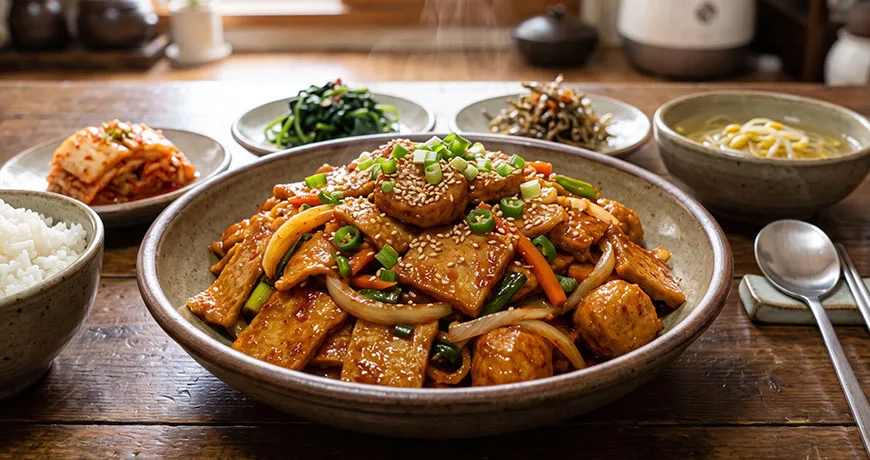
A masterclass in textural preservation and thermal fat management. Unlike basic sautéing, achieving a resilient, springy mouthfeel in fish cakes requires a preliminary blanching step to remove surface oils and enhance marinade permeability. Rapid stir-frying over medium heat caramelizes the soy-sweetener blend via controlled Maillard reactions, creating a glossy, deeply savory glaze without compromising the structural integrity of the protein matrix.
⏱️ Total: 15 mins | Prep: 5 mins | Cook: 10 mins | 🍳 Difficulty: Easy | 🌶️ Profile: Savory, Balanced Sweetness | 🍚 Focus: Protein-Vegetable Balance
Ingredients (2 servings)
- Main Ingredients: 4 sheets fish cake (approx. 200g), 1/2 onion, 1/2 scallion, 1 Cheongyang chili (optional)
- Seasoning Sauce: 2 tbsp soy sauce, 1 tbsp mirin (or clear rice wine), 1.5 tbsp oligosaccharide (or 1 tbsp agave syrup), 0.5 tbsp minced garlic, 1 tbsp sesame oil, a pinch of sesame seeds
Allergy Information Contains: Fish, Soy, Wheat (from soy sauce), Seafood derivatives
Equipment Cutting Board, Knife, Boiling Water Pot (for blanching), Skillet, Spatula
Cooking Instructions
- Ingredient Preparation: Cut the fish cakes into bite-sized square or strip shapes, slice the onion uniformly, and diagonally cut the scallion and chili.
- Thermal Blanching (Oil Management): Place the cut fish cakes in a strainer and pour boiling water evenly over them. This eliminates surface oxidized oils and enhances marinade absorption.
- Formulating the Sauce: In a bowl, combine the soy sauce, mirin, oligosaccharide (or agave syrup), and minced garlic.
- Aromatic Sauté: Lightly oil a skillet over medium heat and sauté the onion until translucent to draw out natural sweetness.
- Glazing and Searing: Add the blanched fish cakes and the sauce into the skillet. Stir-fry rapidly over medium heat until the sauce evenly coats the fish cakes and the moisture evaporates into a glossy finish.
- Residual Heat Finishing: Turn off the heat completely. Fold in the scallion, chili, sesame oil, and sesame seeds, relying on the residual thermal energy to preserve aromatic volatiles.
💡 Professional Culinary Tips
- Blanching Mechanism for Texture: Rinsing fish cakes with hot water strips away surface fats that would otherwise block osmotic absorption. This crucial pre-treatment ensures a bouncy, firm texture rather than a soggy, oil-heavy finish.
- Thermal Control of Caramelization: Combining oligosaccharides and soy sauce allows for controlled Maillard browning under medium heat. Managing this thermodynamic curve ensures a rich, glossy umami coat without burning the sugars.
- Volatile Retention: Scallions and sesame oil contain delicate aromatic compounds that degrade under prolonged high heat. Introducing them post-combustion leverages residual heat to protect their pungent and nutty profiles.
Nutrition Facts (Estimated)
Total Content : Approx. 120g (1 service)
Calories : 210 kcal.
– Sodium : 650mg
– Total Carbohydrate : 16.0g
– Sugar : 8.0g
– Total Fat : 9.0g
– Saturated Fat : 1.5g
– Cholesterol : 25.0mg
– Protein : 14.0g
– Calcium : 40mg
*Daily Values are based on a 2,000 calorie diet and standard Korean nutritional reference values
**Nutritional values are calculated based on original ingredients; substitutions may alter specific macronutrients.
The Origins and Culture of Eomukbokkeum (Stir-Fried Fish Cakes)
1. Roots in Colonial-Era Fish Cakes and Post-War Evolution
- Eomuk-bokkeum (stir-fried fish cakes) traces its roots to the fish cake culture introduced to the Korean Peninsula, which gradually localized to fit Korean culinary preferences. Following the Korean War, fish cake manufacturing flourished particularly around Busan, making it an accessible, affordable staple for everyday households.
2. The Mastery of Sweet-and-Salty Harmony and Chewy Textures
- The defining charm of Eomuk-bokkeum is its addictive sweet-and-salty flavor profile, achieved by stir-frying sliced fish cakes with soy sauce, sugar (or corn syrup), minced garlic, and sesame oil.
- It is often tossed with onions, carrots, and green onions—or spiced up with chili flakes and hot peppers for a fiery kick. Adding a splash of water or broth during cooking ensures a wonderfully moist, chewy texture.
3. An Undisputed Classic of Everyday Korean Tables and Lunchboxes
- Though humble in appearance, it is an essential fixture of everyday Korean dining tables (banchan) and a nostalgic symbol of classic school lunchboxes.
- Easy to prepare yet endlessly comforting, it remains one of the most beloved and familiar household side dishes in Korean culinary culture.
The Oceanic Elasticity and Savory Glaze: An Everlasting Classic of Everyday Table Gastronomy
Eomuk Bokkeum (Stir-fried Fish Cakes) stands as the most approachable and brilliant lyricism of everyday Korean home-cooking gastronomy, where chewy, protein-rich fish cakes crafted from minced marine catch meet sweet onions over a sizzling skillet, embraced by a rich savory soy glaze. Eschewing heavy spices, the ancestral wisdom of allowing soy sauce and sesame aromatics to permeate the dense, springy matrix of thinly sliced fish cakes achieves the ultimate expression of democratic comfort food.
As the fish cakes and onions dance across the hot pan, the billowing aroma of caramelized soy sauce commands the surrounding air, gently awakening the appetite. The delightful springiness of the fish cake yields to the bite, releasing its savory essence alongside the meltingly sweet juices of translucent onions to coat every grain of warm white rice in luscious moisture.
True gastronomy does not dwell exclusively in elite banquets; it flourishes in the dedication to elevating everyday ingredients to satisfy the weary soul’s hunger with profound warmth. Savoring a glossy, piping-hot morsel of stir-fried fish cakes over rice today is an honest and comforting ritual—putting down the burdens of a complex world and filling the spirit with unpretentious, grounding joy.
Editor’s Review
1. A Sensual Harmony of Sweet-and-Savory Soy Glaze, Springy Fish Cake Texture, and Sweet Onion Crispness
The moment a gloss-drenched slice of fish cake touches the palate, an immediate wave of savory depth and rounded sweetness awakens the taste buds. This is swiftly followed by the resilient, satisfying chew of the surimi protein matrix and the gentle tenderness of caramelized onions, while a final whisper of toasted sesame oil envelops the mouth in velvety warmth to orchestrate an endlessly comforting culinary experience.
2. Surimi Protein Gel-Network Thermodynamics, Maillard Browning Kinetics, and Quercetin Extraction Mechanics
Eomuk Bokkeum represents an exacting study in culinary physics and protein chemistry. The high-temperature searing induces rapid Maillard reactions between the soy amino acids and reducing sugars, forming a savory, amber glaze that coats the fish cake’s structured 3D gel network. Concurrently, the bioactive quercetin and organosulfur compounds from the onions neutralize any marine notes while promoting metabolic circulation, establishing an optimal nutritional matrix that is both highly digestible and deeply satisfying.
3. The Silver Platters of Local Diners and the Grounding Sanctuary of Everyday Home Comforts
Found gracing the silver side-dish platters of neighborhood diners across the nation and comforting family dinner tables for generations, a modest plate of stir-fried fish cakes serves as an enduring emotional haven against daily weariness. Savoring this honest, reliable staple washes away modern stress, granting a timeless sanctuary of stillness, maternal care, and grounded culinary happiness.