
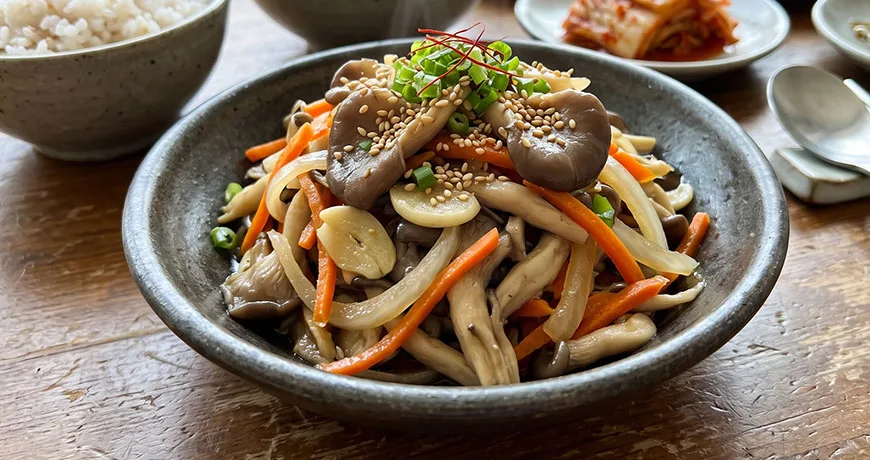
A wholesome, nutrient-dense Korean staple side dish (banchan) featuring tender oyster mushrooms (neutari-beoseot). The mushrooms are briefly blanched and gently squeezed to lock in their delightfully springy, chewy (jjolgit) texture, then stir-fried over high heat with julienned carrots, onions, and garlic in a savory sesame-soy glaze. Naturally low in calories yet rich in dietary fiber and essential minerals, it is a healthy, savory everyday favorite for the entire family.
⏱️ Total: 20 mins | Prep: 10 mins (trimming & blanching) | Cook: 10 mins | 🍳 Easy | 🍄 Low-Calorie & High-Fiber | 🥢 Chewy Banchan
Ingredients (2-3 servings)
- Main Ingredients: 250–300g fresh oyster mushrooms (neutari-beoseot), 1/2 yellow onion (thinly sliced), 1/3 carrot (julienned), 1/2 green bell pepper or mild green chili (julienned, optional), 1/2 tsp coarse salt (for blanching water), 1.5 tbsp cooking oil
- Seasoning & Aromatics: 1 tbsp Korean soup soy sauce (guk-ganjang or light soy sauce), 1/2 tsp fine sea salt (or 1/2 tbsp oyster sauce for extra umami), 1 tsp minced garlic, 2 tbsp chopped green onion, 1/4 tsp freshly ground black pepper
- Finishing Touches: 1 tbsp toasted sesame oil, 1 tsp toasted sesame seeds
Allergy Information
- Contains: Soy (Soy sauce), Wheat (Soy sauce), Sesame (Optional oyster sauce contains Molluscan Shellfish / Oyster)
Equipment
- Stockpot (for blanching), Colander, Frying Pan or Wok, Kitchen Tongs, Spatula, Cutting Board
Cooking Instructions
- Trimming & Shredding Mushrooms: Slice off the tough bottom base of the oyster mushroom clusters. Gently tear the clusters with your hands into bite-sized, individual single-stem strands.
- Flash Blanching & Squeezing: Bring a pot of water with 1/2 tsp of coarse salt to a rolling boil. Submerge the shredded mushrooms for just 30–40 seconds. Quickly drain in a colander, rinse briefly under cold running water, and gently squeeze out excess moisture with your hands (do not over-squeeze—leave a slight springiness).
- Prepping Vegetables: Thinly slice the onion, julienne the carrot into matchstick strips, and finely chop the scallions.
- Sautéing Aromatics & Vegetables: Heat 1.5 tbsp cooking oil in a frying pan or wok over medium heat. Add the minced garlic and sliced onions, stir-frying for 1–2 minutes until aromatic and translucent. Add the julienned carrots and cook for another minute.
- High-Heat Mushroom Stir-Frying: Add the blanched, squeezed oyster mushrooms into the pan. Increase the heat to medium-high. Add the soup soy sauce (or salt), black pepper, and stir-fry briskly for 2–3 minutes so the savory seasonings coat every strand and any residual moisture evaporates.
- Finishing & Serving: Toss in the chopped green onions (and bell peppers) during the final 30 seconds of cooking. Turn off the heat, drizzle with toasted sesame oil, and sprinkle toasted sesame seeds. Toss well and serve warm or at room temperature.
💡 Cooking & Pairing Tips / Health Benefits
- Low-Calorie & High-Fiber Powerhouse (Health Benefits): Oyster mushrooms are naturally low in calories and fats while being rich in dietary fiber, beta-glucans, B-vitamins (such as niacin and pantothenic acid), and minerals. They help support digestive health, lipid control, and immune wellness without adding calorie burdens.
- The Blanch-and-Squeeze Secret (Jjolgit Texture): Oyster mushrooms contain a high water content. Blanching them briefly before stir-frying collapses the porous spongy structure and prevents them from turning soggy in the pan, ensuring a pleasantly firm and chewy texture that resembles tender meat.
- Nutrient Synergy with Carrots (Food Pairing): Pairing mushrooms with oil-sautéed carrots enhances the bioavailability of fat-soluble beta-carotene (Vitamin A precursor) while imparting natural sweetness and vibrant visual contrast.
- Perfect Food & Beverage Pairing: An essential side dish on any Korean dinner table. Pairs seamlessly with warm white rice, hearty soybean paste stew (Doenjang-jjigae), grilled fish, and bulgogi. Also makes a fantastic topping for classic Bibimbap.
Nutrition Facts (Estimated)
- Total Content : Approx. 100g (1 serving)
- Calories : 87 kcal
– Sodium : 453mg
– Total Carbohydrate : 7.7g
– Sugar : 3.2g
– Total Fat : 4.7g
– Saturated Fat : 0.5g
– Cholesterol : 1.2mg
– Protein : 3.6g
– Calcium : 34.0mg
– Dietary Fiber : 4.4g
(Daily Values are based on a 2,000 calorie diet and standard Korean nutritional reference values)
The Aesthetics of Chewy Vitality Embodying the Breath of the Earth
This oyster mushroom stir-fry is a small culinary miracle born from the memory of the soil and the warmth of the sun. The elastic, deeply resilient texture of hand-torn mushrooms awakens a primal sensory delight, as if one is chewing on the very pulsating vitality of the forest itself. Its subtle, earthy aroma—a clean, unpretentious depth that rich meats cannot replicate—harmonizes beautifully with the vibrant sweetness of julienned carrots and translucent onions, transforming the palate into a vivid canvas of nature.
The process of briefly blanching the mushrooms to extract excess water and maximize their firm, meaty structure, followed by a rapid, high-heat sauté with an array of vegetables, is an art form in moisture control. Upon the blazing pan, the forest aromas trapped within the fungi bloom explosively through the emulsion of oil, allowing the savory seasonings to deeply saturate every fiber. This brilliant culinary technique—shedding heavy calories while elevating the tactile joy of chewing—maps a multi-dimensional topography of flavor across the mouth.
True gastronomy lies in nourishing the body and mind with clean energy, without the burden of heavy indulgence. Oyster mushroom stir-fry is the essence of Korean dining, drawing out the perfect contrast of textures and wholesome vitality from the most everyday, modest ingredients. Clearing away this light, delightful plate today is a tender, restorative healing ritual offered by the forest to bodies and souls exhausted by the clamor of modern life.
Editor’s Review
1. A Breathtaking Symphonic Fusion of Meaty Fungi, Crisp Vegetables, and Savory Glaze
The moment the intensely resilient, meat-like chew of hand-torn oyster mushrooms crosses paths with the bright, crisp crunch of julienned carrots and onions, a brilliant burst of natural vegetable sweetness and deep earthy umami floods the senses. Wrapped in a shimmering glaze of subtle garlic notes and nutty sesame oil, the dynamic interplay of contrasting textures and deep flavors delivers an endlessly satisfying and dynamically transcendent culinary experience.
2. Culinary Mastery Forged by Precise Moisture-Extraction Blanching and High-Heat Sautéing Dynamics
Neutari-beoseot-bokkeum stands as a masterclass in traditional Korean vegetable craft, utilizing a rapid blanching and meticulous squeezing stage to force out water and build a dense, elastic tension within the spongy fungi before executing a flash-sauté over high heat alongside ingredients of varying moisture contents. Managing thermal intensity to safeguard the distinct structural integrity of each vegetable while deeply saturating every fold with balanced seasonings represents fundamental culinary science that achieves absolute textural harmony.
3. Heartwarming Solace and Wholesome Restoration Rooted in the Forest’s Lightness
Overflowing with the clean, vibrant energy of the earth while remaining remarkably low in calories, a neatly prepared plate of oyster mushroom stir-fry acts as a comforting remedy for modern culinary fatigue, anchoring a tired spirit in healthy, grounding comfort. Savoring a generous chopstick-full of these chewy, deeply flavorful mushrooms over warm rice washes away daily exhaustion, granting an authentic sanctuary of peace, emotional recovery, and a weightless rejuvenation of the body.