
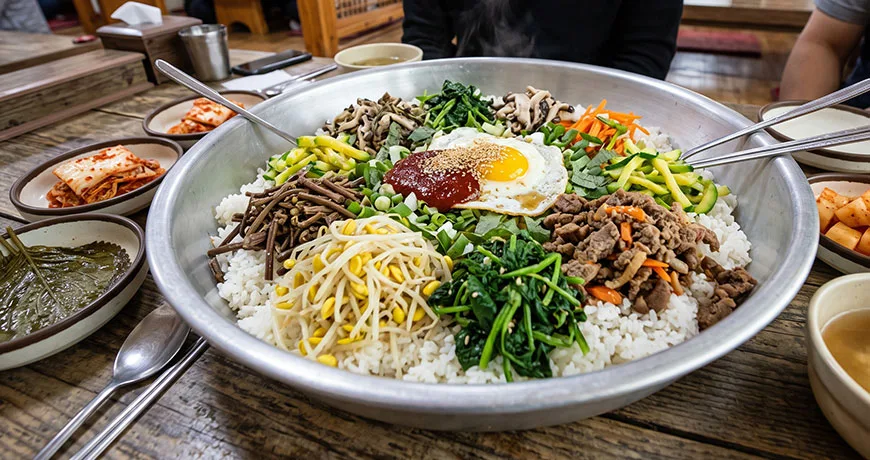
Yangpunbibimbap is a communal feat of culinary engineering that exploits the ultra-low thermal mass and vast surface area of a thin nickel-silver basin (Yangpun) to efficiently emulsify a massive volume of carbohydrates and fibrous matrices. Following a thermodynamic trajectory completely opposite to the heat-retaining Dolsot, the Yangpun acts as a rapid heat exchanger. The moment warm rice is spread across its wide metal bottom, kinetic heat is aggressively dissipated into the atmosphere. This critical thermal drop prevents the conductive heat from further hydrolyzing the pectin in the refrigerated vegetable toppings, thereby perfectly preserving their structural turgor pressure. The wide, flat basin provides the ideal physical arena for aggressive, multi-directional mechanical agitation by several spoons simultaneously, allowing the hypertonic gochujang and unsaturated sesame lipids to seamlessly coat the amylopectin starches without crushing the grains into paste.
⏱️ Total: 15 mins | Prep: 10 mins | Cook: 5 mins | 🍳 Difficulty: Low (Requires rapid heat dissipation and large-scale emulsion control) | 🌶️ Profile: Deeply Savory, Spicy, and Highly Textural | 🍚 Focus: Thermal Dissipation, Mechanical Agitation, & Multi-phase Rheology
Ingredients (3–4 servings)
- Starch Matrix: 3–4 bowls of warm, cooked white rice (spread thinly to maximize heat dissipation)
- Denatured Pectin & Turgor Matrix: 400g assorted leftover Namul (e.g., blanched spinach, seasoned bean sprouts, julienned radish, bracken – all kinetic moisture violently squeezed out)
- Lipid & Protein Matrix: 150g dry-fried minced beef, 2–3 sunny-side-up eggs (fried to a crisp Maillard edge)
- Hypertonic Emulsion Binder: 4–5 tbsp Gochujang (chili paste), 3 tbsp toasted sesame oil, 2 tbsp toasted sesame seeds
Allergy Information Contains: Beef, Egg, Soy, Wheat (from Gochujang)
Equipment Large Yangpun (Nickel-silver or thin stainless steel basin), Multiple mixing spoons
Cooking Instructions
- Thermal Dissipation (Cooling the Starch): Spread the warm rice evenly across the bottom of the Yangpun. The high thermal conductivity of the metal violently pulls heat away from the rice, causing the surface of the grains to slightly retrograde and firm up, preventing a mushy texture.
- Moisture Control & Assembly: Aggressively squeeze any remaining cellular sap or dressing from the assorted vegetables. If excess water pools into the bowl, it will dilute the viscosity of the gochujang emulsion. Arrange the dry vegetable fibers in a circle over the rice.
- Lipid & Emulsion Addition: Place the fried beef and eggs in the center. Liberally apply the hypertonic gochujang and sesame oil over the proteins.
- Mechanical Agitation: Utilizing the wide surface area, use multiple spoons to aggressively slice and fold the ingredients together. The lecithin in the egg yolks and the sesame oil act as potent hydrophobic lubricants, binding the sticky chili paste evenly across hundreds of thousands of rice grains.
💡 Professional Culinary Tips
- Thermodynamics of Nickel-Silver: A dented, old nickel-silver bowl is not just rustic aesthetics; it is a highly efficient thermodynamic tool. Its incredibly low thermal mass and high conductivity mean it absorbs and releases heat instantly. By dropping the rice’s temperature down to human body level (37°C/98°F), it prevents the residual heat from cooking the delicate, cold vegetable fibers and ruining their mechanical crunch.
- Rheology of Multi-Phase Fibers: Combining various leftover vegetables creates immense textural synergy. The tough cellulose of bracken, the high turgor pressure of raw radish, and the soft chlorophyll matrix of spinach all tangle together within a single lipid coating. This forces the jaws to process multiple distinct rheological states simultaneously, drastically elevating the sensory experience of chewing.
- High-Viscosity Emulsification: When mixing a massive volume of rice, liquid solvents (like broth) must be strictly avoided. The emulsion must be formed solely from the viscous polysaccharides of the gochujang, pure sesame lipids, and egg yolk. This high-viscosity paste acts as a buffer, ensuring the mechanical friction of the spoons coats the rice rather than mashing it into an over-gelatinized dough.
Nutrition Facts (Estimated)
Total Content : Approx. 900g (3 servings)
Calories : 1,450 kcal (Total)
– Sodium : 2,400mg (Combined Gochujang and vegetable seasoning)
– Total Carbohydrate : 210.0g
– Sugar : 18.0g
– Total Fat : 45.0g
– Saturated Fat : 10.0g
– Cholesterol : 450.0mg
– Protein : 55.0g
– Dietary Fiber : 24.0g
*Daily Values are based on a 2,000 calorie diet and standard Korean nutritional reference values.
**Nutritional values are calculated based on original ingredients; substitutions may alter specific macronutrients.
Origins and Food Culture of Large Brass Bowl Bibimbap (Yangpunbibimbap)
1. Agrarian Communal Heritage: From Field Meals (Deulbap) to Household Sharing
- Rooted in Korea’s traditional agrarian mutual-aid system (pumasi), where villagers gathered during arduous rice-planting or harvest seasons to share deulbap (field meals), tossing rice and side dishes brought from multiple households into a giant basin (yangpun) to eat together in the fields.
- Domestically, it evolved as a brilliant zero-waste culinary tradition following festive holidays (Chuseok, Seollal) or ancestral rites (jesa), where families pooled leftover ceremonial banchan, meats, and rice into one large vessel to mix with gochujang and sesame oil.
2. The Culinary Science of Wide Surface Aeration and Uniform Emulsion Mixing
- The wide, flat base of the traditional yangpun provides an optimal surface area that prevents the ingredients from becoming crushed or soggy, allowing ample air to circulate through the rice grains to maintain a light, resilient texture.
- Vigorous mixing with large metal spoons naturally emulsifies the moisture of the chili paste with the lipids of the toasted sesame oil, yielding a silky, uniform glaze that delicately coats every individual grain of rice and botanical fiber.
3. The Communal “Jeong” (Affection) Ritual and Pop-Culture Soul Food
- Defined by the informal tradition of multiple diners dipping their spoons directly into a single shared basin without dividing into individual bowls, it breaks down social barriers and embodies Korea’s deep cultural ethos of jeong (collective warmth, empathy, and bonding).
- Celebrated today as the ultimate late-night comfort food among family members, close friends, and college peers—and frequently featured in Korean dramas as a cathartic remedy for life’s stresses—Yangpunbibimbap represents the energetic, generous, and heartwarming spirit of Korean communal dining.
The Rhythmic Clatter of Shared Spoons in a Broad Basin and the Communal Warmth of Tossed Harvests: A Refined Portrait of Yangpunbibimbap
Yangpunbibimbap (Large Metallic Basin Bibimbap) stands as the uninhibited, deeply communal, and heartfelt pinnacle of Korean shared-table gastronomy. Steaming mounds of freshly fluffed white rice are gathered into a broad, flat-bottomed metallic basin (yangpun—traditionally fashioned from brass or durable nickel-silver alloy), then lavishly topped with a kaleidoscope of seasoned seasonal botanicals (namul—such as bean sprouts, spinach, spicy julienned radish, summer squash, and wild bracken) and savory minced beef stir-fried in sweet garlic-soy glaze. Finished with a generous dollop of sun-dried red chili paste (gochujang) and an abundant drizzle of cold-pressed toasted sesame oil, this communal centerpiece invites multiple diners to fold the ingredients together and feast directly from the same vessel. Bypassing the rigid symmetry of individual banquet plating, this dish celebrates the joyous, barrier-free fusion of agricultural abundance and shared human connection.
As multiple long metal spoons clatter rhythmically against the wide metal basin, lifting a generous mouthful overflowing with crimson-glazed rice, glistening vegetables, and tender beef awakens the senses immediately. The intoxicating perfume of toasted sesame oil mingles with the savory warmth of wok-charred beef and the crisp, clean aroma of garden greens. The first bite reveals rice grains slicked in a velvety chili-sesame emulsion that glide across the tongue, immediately met by the toothsome, savory chew of minced beef releasing concentrated bursts of amino acids. Sinking deeper reveals the lively auditory snap of bean sprouts and radishes, bursting with cool, hydrating juices that effortlessly temper the chili’s bold warmth. Bound by the laughter of dining companions, every mouthful delivers an exhilarating, unpretentious crescendo of shared culinary joy.
The enduring brilliance of Yangpunbibimbap lies in its transformative resourcefulness—elevating ordinary side dishes and warm rice into a festive, nutrient-dense feast within a single utilitarian vessel. Rooted in the cherished domestic memories of midnight family comfort food and the rustic fieldside meals shared by farmers during intensive seasonal harvests, a brimming basin of mixed rice remains a timeless monument of democratic hospitality, deep emotional warmth (jeong), and the enduring power of eating together.
Editor’s Review
1. A Dynamic Harmony of Crisp Botanical Turgor, Resilient Stir-Fried Beef Chew, and Sesame-Glazed Rice Grains
The textural cohesion within the broad basin offers exceptional vibrancy and balance. The contrasting structural properties of parboiled roots and sautéed greens retain distinct fibrous chews that harmonize with the fine, springy bounce of seasoned minced beef. The mechanical force of folding coats the firm rice kernels in an unctuous, savory sheen without turning them mushy, creating a smooth, velvety mouthfeel that finishes clean on the palate from the first collective bite to the last.
2. High-Shear Mixing Emulsification Kinetics, Metal Thermal Dissipation, and Inosinate-Glutamate Umami Synergism
Yangpunbibimbap represents an exacting study in fluid mechanics, metallurgical thermodynamics, and nucleotide synergy. The vigorous stirring action (shear force) across the broad, flat bottom of the metallic basin rapidly disperses the hydrophobic lipids of toasted sesame oil and rendered beef fat into the hydrophilic, sugar-rich matrix of the fermented chili paste, yielding a stable oil-in-water (O/W) emulsion that clings evenly to starch surfaces. Furthermore, the high thermal conductivity of the thin metallic basin rapidly cools boiling-hot rice down to the optimal mastication and volatile-release window (45–55°C), preventing oral burns while maximizing the headspace release of volatile aroma compounds such as sesamol and allium sulfites. Concurrently, muscle-bound inosinate (IMP) from the beef interacts synergistically with free glutamates in the fermented chili and soy sauces, dramatically multiplying overall umami perception.
3. The Communal Sanctity of Sikgu and the Democratic Soul of Korean Hearthside Feasting
Contrasting with the historical Confucian practice of individual table dining (doksang), Yangpunbibimbap captures the egalitarian spirit of sikgu—the foundational Korean concept of family defined literally as “those who share the same mouth and food.” Gathering around a single oversized bowl with spoons in hand strips away social pretense, transforming an unassuming meal into a powerful ritual of mutual affection, shared laughter, and heartwarming gastronomic solidarity.