
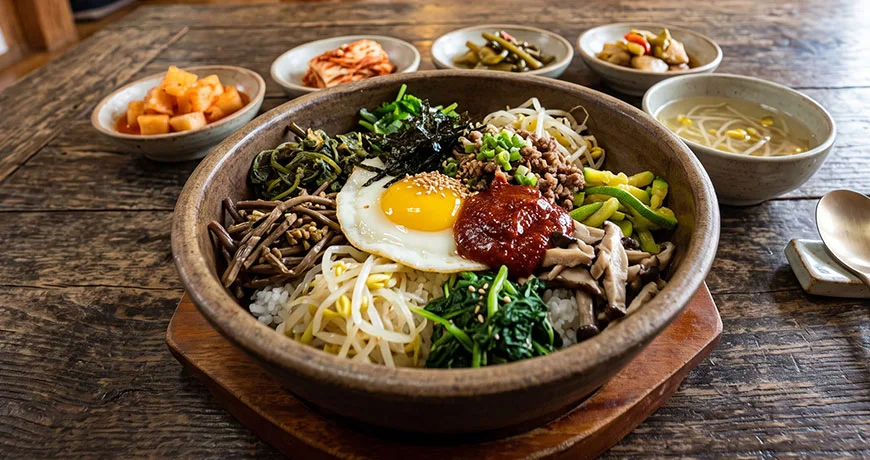
Sanchaebibimbap is a highly advanced plant biochemistry dish engineered to thermodynamically degrade the tough cellulose and lignin structures of wild mountain vegetables, extracting their intensely concentrated phytochemicals. The soul of this dish lies in the artisan’s painstaking labor of rehydrating foraged mountain herbs that have been sun-dried to near 0% moisture. Repeatedly boiling, soaking, and washing the herbs is a mandatory process that purges toxic natural alkaloids while miraculously resurrecting the cellular turgor pressure of the plants. The bitter saponins of the bellflower roots are forcefully extracted via osmotic salt pressure, while the volatile terpenes of the aster leaves (Chwinamul) and the guanylate of the shiitake mushrooms are locked in by a hydrophobic coating of unsaturated sesame lipids. When this meticulously controlled array of individual plant matrices is layered over warm amylopectin (rice) and emulsified with a hypertonic, amino-acid-dense Gochujang gel, the complex, earthy aromas gear together seamlessly in the mouth, delivering the pinnacle of vegan-friendly gastronomy.
⏱️ Total: 1 hr (excluding overnight hydration) | Prep: 30 mins | Cook: 30 mins | 🍳 Difficulty: High (Requires strict individual thermal hydration and alkaloid purging) | 🌶️ Profile: Earthy, Herbaceous, Spicy, and Deeply Savory | 🍚 Focus: Terpene Preservation, Alkaloid Purging, & Lignin Hydrolysis | 🍶 Pairing: Chilled, pine needle-infused traditional Solsongju (Pine wine)
Ingredients (2 servings)
- Amylopectin Matrix: 2 bowls cooked warm White Rice
- Polysaccharide & Aromatic Matrix: 100g Rehydrated Aster leaves (Chwinamul), 100g Rehydrated Fernbrake (Gosari), 100g Bellflower root (Doraji), 3 Dried Shiitake Mushrooms (hydrated in water for 3 hours, stems removed, sliced)
- Osmotic & Lipid Binders (Veggie Seasoning): 2 tbsp Soup Soy Sauce, 1 tbsp minced garlic, 1 tbsp minced green onion, 2 tbsp Toasted Sesame Oil, 1 tbsp Toasted Sesame Seeds, coarse salt, cooking oil
- Emulsifier & Capsaicin Binder (Sauce): 2 tbsp Gochujang (Korean chili paste), 1 tbsp Green Plum Extract (Maesil-cheong), 1 tbsp Toasted Sesame Oil
- Protein Catalyst: 2 fresh Eggs (fried sunny-side up)
Allergy Information Contains: Soy, Wheat (from soy sauce and Gochujang), Egg, Sesame
Equipment Multiple Mixing Bowls, Frying Pan, Cutting Board, Knife, Colander
Cooking Instructions
- Osmotic Purging & Hydration: Sprinkle coarse salt over the bellflower root (Doraji) and aggressively knead it by hand. This physical friction utilizes osmotic pressure to forcefully expel the bitter, water-soluble alkaloids (saponins). Rinse thoroughly in cold water. Squeeze the excess water from the hydrated shiitake mushrooms.
- Chemical Seasoning & Lipid Coating: Separately season the rehydrated aster leaves, fernbrake, and shiitake mushrooms with portions of soup soy sauce, minced garlic, and green onions. Knead firmly with your fingertips to inject the hypertonic seasoning deep into the cellular structures.
- Individual Thermal Hydrolysis: Heat a pan with a splash of cooking oil and sesame oil. Sauté each vegetable strictly separately:
- Fernbrake & Aster Leaves: Sauté over medium heat to thermally hydrolyze and soften the rigid mountain lignin bonds.
- Bellflower Root: Sauté briefly with just a pinch of salt to retain its crisp cellular turgor while degrading the tough pectin.
- Shiitake: Sauté until the porous fungal matrix fully absorbs the soy seasoning, concentrating its guanylate umami.
- Umami Emulsion Gel: In a small bowl, whisk the Gochujang, green plum extract, and sesame oil to create a highly viscous, lipid-capsaicin emulsion paste.
- Structural Assembly & Emulsification: Spread the warm rice in a wide bowl. Arrange the four prepared mountain vegetables radially, alternating colors for visual contrast. Place the Gochujang gel and the sunny-side-up egg in the center. Pierce the yolk and mix vigorously with chopsticks; the natural lecithin of the yolk and the Gochujang will emulsify to luxuriously coat the rice grains.
💡 Professional Culinary Tips
- Physics of Hydration & Detoxification: Rehydrating dried mountain herbs is not merely a cooking step; it is a critical biochemical detoxification process. The laborious cycle of boiling the herbs and soaking them in cold water for half a day is absolutely essential to diffuse and leach out the highly concentrated, astringent tannins and mild natural toxins (alkaloids) while meticulously restoring the cellular turgor pressure of the dried leaves.
- Individual Thermal Processing for Terpene Preservation: Sautéing all the mountain herbs together in a single pan is a catastrophic error that cross-contaminates their distinct aromatic compounds (terpenes, which provide the pine and earth notes) and pigments. Sautéing them individually with a sesame lipid coating traps their highly volatile aromatics inside the plant tissue and maximizes the textural contrast between soft and crunchy elements.
- Buffering Action of Green Plum Extract: Adding green plum extract (Maesil-cheong) to the Gochujang is not just for sweetness. The natural organic acids and reducing sugars act as a biochemical buffer, rounding off the aggressive, sharp heat of the capsaicin. Furthermore, it alters the rheological viscosity of the thick chili paste, transforming it into a fluid emulsion that perfectly penetrates the microscopic spaces between the rice grains via capillary action.
🍶 Gastronomic Pairing
- Biochemical Palate Cleansing: When the slightly bitter, earthy terpenes of the mountain herbs and the heavy sesame lipids complexly dominate your palate, pair this dish with a chilled glass of Solsongju (Traditional Pine Needle Wine). The refined alcohol molecules and the highly volatile pine essential oils (phytoncides) sweep through the mouth, cleanly washing away the heat and earthy residue, achieving an absolutely perfect, forest-like aromatic harmony.
Nutrition Facts (Estimated)
Total Content : Approx. 500g (1 serving)
Calories : 460 kcal
– Sodium : 980mg (Variable depending on Gochujang and soy sauce usage)
– Total Carbohydrate : 75.0g (High-density complex carbohydrates)
– Sugar : 6.0g
– Total Fat : 14.0g (Unsaturated lipids from sesame oil and egg yolk)
– Saturated Fat : 2.5g
– Cholesterol : 185.0mg
– Protein : 14.0g
– Dietary Fiber : 12.0g (Ultra-high fiber content, approx. 48% of daily value)
*Daily Values are based on a 2,000 calorie diet and standard Korean nutritional reference values.
**Nutritional values are calculated based on original ingredients; substitutions may alter specific macronutrients.
Origins and Food Culture of Wild Vegetable Bibimbap (Sanchaebibimbap)
1. Buddhist Monastic Lineage and the Foraging Culture of the Baekdudaegan Mountain Range
- Rooted deeply in the ancient Buddhist monastic tradition of Baru Gongyang (silent, mindful temple bowl dining) which rejects meat consumption and upholds reverence for nature, converging with the seasonal foraging traditions of high-altitude agrarian mountain communities along the Baekdudaegan mountain range.
- Historically perfected around prominent mountain monasteries—including Woljeongsa on Mount Odae, Shinheungsa on Mount Seorak, and Hwaeomsa on Mount Jiri—where foraging monks gathered wild edible sprouts, establishing a revered culinary tradition that travelers and pilgrims sought out for spiritual and physical cleansing.
- Developing an ingenious preservation methodology: wild spring leaves were par-boiled and sun-dried in mountain breezes (chin-chae or muk-eun namul), locking in concentrated micronutrients and allowing households to enjoy the forest’s healing vitality through the frozen depths of winter.
2. The Culinary Science of Rehydration, Leaching, and Perilla Lipid Emulsion
- The hallmark of authentic preparation lies in the rigorous treatment of dried wild greens: rehydrating them in nutrient-rich rice water, simmering them patiently, and soaking them in fresh water to leach out excess astringent tannins and harsh oxalates while unlocking a tender, supple texture.
- Seasoning the softened botanicals with aged soup soy sauce (guk-ganjang), minced alliums, and unrefined cold-pressed perilla oil (deul-gireum) creates a micro-emulsion barrier on each leaf surface, which locks in delicate volatile terpenes (forest aromas) and rounds out herbal bitterness without artificial flavor enhancers.
3. The Harmony of “Obangsaek” (Five Cardinal Colors) and Ecological Gastronomy
- Representing the ancient cosmological philosophy of Yin-Yang and the Five Elements (Eumyang-ohaeng), the bowl thoughtfully integrates the five cardinal colors (Obangsaek): Green (liver/wood via chwinamul), Red (heart/fire via chili paste), Yellow (spleen/earth via egg or sprouts), White (lung/metal via bellflower), and Black (kidney/water via fernbrake and shiitake).
- Standing as an enduring antidote to modern dietary excesses, Sanchaebibimbap remains an international monument to sustainable, compassionate slow food—a timeless masterpiece of Korean ecological dining that restores human wellness through absolute harmony with the natural earth.
The Primordial Resonance of Foraged Mountain Botanicals and the Sacred Restraint of Monastic Nourishment: A Refined Portrait of Sanchaebibimbap
Sanchaebibimbap (Wild Mountain Vegetable Bibimbap) stands as the serene, deeply aromatic, and ecologically harmonious summit of Korea’s botanical mixed-rice (bibimbap) gastronomy. Wild mountain greens (sannamul)—including fragrant aster (chwinamul), Gondre thistle (Cirsium setidens), bracken ferns (gosari), chamnamul (Pimpinella brachycarpa), king’s cow parsnip (eosuri), angelica tree shoots (dureup), and bonnet bellflower roots (deodeok)—are foraged from the misty, sun-drenched valleys of pristine mountain ranges. Sun-cured dried greens (muknamul) from previous harvests are meticulously rehydrated and simmered, while fresh seasonal shoots are flash-blanched in rolling water. Lightly seasoned with cold-pressed toasted perilla oil (deulgireum) and aged artisanal soup soy sauce (cheongjang) to safeguard their natural essence, the vegetables are artfully arranged atop a bed of steaming white rice. Deliberately casting aside the fiery dominance of heavy chili pastes and rich animal proteins, this dish marries the vibrant chlorophyll vitality and pine-kissed terpenoid perfumes of wild plants into an unmasked, transcendent thermodynamic equilibrium.
Presented in a heavy brass bowl or traditional ceramic dish, the sight of glistening mountain shoots arranged like a forest tapestry delivers an immediate, grounding serenity to the senses. As a brass spoon gently blends the ingredients without bruising the rice grains, a magnificent perfume billows forth: the deep, rustic nuttiness of cold-pressed perilla oil mingles effortlessly with the brisk, piney scent of forest undergrowth, damp earth, and clean mountain breezes. Rather than relying on assertive red chili paste, seasoning the bowl with a whisper of aged soy sauce or light doenjang allows the gentle, starchy sweetness of the rice to surface unhindered. Sinking your teeth into the vegetables unleashes a captivating choreography of natural textures: tender Gondre leaves yield like warm silk; mountain bracken offers a dense, toothsome chew; and crisp slivers of deodeok root fracture with a refreshing crunch, releasing streams of cool, mineral-rich vegetal hydration. The lingering, therapeutic bitterness of natural saponins awakens the salivary glands, while the golden film of perilla oil ensures an effortless, velvety glide across the palate, yielding an unforgettable ritual of total bodily and sensory restoration.
The enduring majesty of Sanchaebibimbap lies in its historical lineage—rooted in the sacred temple food (sachal eumsik) traditions of ancient Buddhist hermitages that championed mindfulness and non-violence (ahimsa), as well as the resourceful foraging wisdom of rural mountain dwellers who turned rugged flora into vital seasonal sustenance. Born along the mountain monastery trails of Odaesan, Jirisan, and Gayasan, a bowl of wild mountain vegetable bibimbap remains an irreplaceable cultural monument of environmental reverence, maternal tenderness, and the timeless brilliance of Korean plant-based gastronomy.
Editor’s Review
1. A Dynamic Harmony of Rehydrated Herb Chew, Crisp Root Fractures, Intact Grain Resilience, and Perilla Lipid Fluidity
The textural landscape inside the bowl delivers extraordinary structural diversity, physical lightness, and effortless mastication. The rehydrated dried mountain greens exhibit an elastic, spongy resilience that absorbs savory seasonings without softening into mush. This tenderness is punctuated by the brisk, auditory crunch of slivered bellflower and deodeok roots and the supple, delicate bite of flash-blanched shoots. The thin, hydrophobic film of cold-pressed perilla oil acts as an organic boundary-layer lubricant, preventing the grains from clumping while ensuring a continuous, non-fatiguing mouthfeel from the first spoonful to the last.
2. Polysaccharide Matrix Hydrothermal Rehydration Kinetics, Terpenoid Volatilization Control, and Perilla ALA Flavor-Encapsulation Dynamics
Sanchaebibimbap represents an exacting study in plant histology, natural product chemistry, and lipid flavor mechanics. During the dehydration of wild greens, cellular pectins and hemicelluloses contract into a dense, protective polymer matrix that locks in vital nutrients. The traditional method of rehydrating dried greens in simmering, mildly alkaline water selectively relaxes these ester linkages, restoring full cellular turgor and moisture holding capacity without degrading insoluble cellulose walls. The signature forest aromatics of wild herbs—governed by volatile monoterpenes and sesquiterpenes such as pinene, limonene, and myrcene—are stabilized within the hydrophobic hydrocarbon chains of the perilla oil’s alpha-linolenic acid (ALA, Omega-3). This lipid encapsulation suppresses premature evaporation and facilitates a sustained, temperature-triggered flavor release upon mastication. Furthermore, natural bitter glycosides (saponins) and polyphenolic acids present in wild mountain herbs interact synergistically with free glutamates from fermented soy sauce, modulating trigeminal bitterness and creating a deep, multi-tiered umami foundation without artificial enhancers.
3. The Buddhist Temple Food Ethos, Mountain Foraging Wisdom, and the Living Zenith of Korean Plant Gastronomy
Carrying the spiritual philosophy of Buddhist monastic dining, which honors the intrinsic life force of all living things, Sanchaebibimbap elevates wild foraging into a fine culinary art. Transforming humble leaves, roots, and shoots gathered from mountain ridges into an exquisite restorative feast through patient hydrothermal restoration and minimalist botanical seasoning, this iconic classic stands as an enduring sanctuary of ecological harmony, nutritional vitality, and brilliant Korean culinary restraint.