
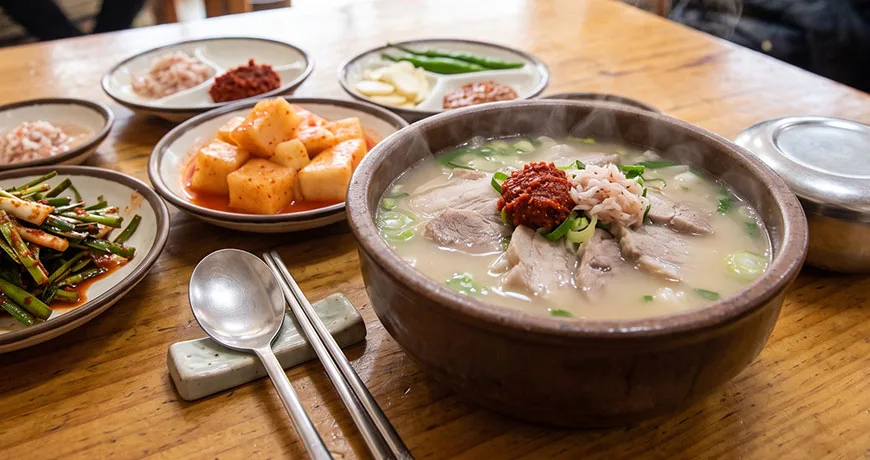
Dwaejigukbap is a colossal thermodynamic matrix that emulsifies mammalian pork leg bones and marrow lipids into a flawless, milky-white colloidal suspension using the intense convective energy of boiling water over many hours. Submerged within this thermally hydrolyzed broth is thinly sliced, tender pork meat. The dish is biochemically completed at the table with the addition of Saeujeot (salted fermented shrimp), which acts as a powerful enzymatic catalyst rich in protease, maximizing the body’s ability to digest the dense pork proteins. Fresh Asian chives (Buchu) are introduced at the very last second, utilizing their volatile allyl sulfides to sharply mask the heavy animal scent. As the hot broth is absorbed by the amylopectin starches of the rice inside the Ttukbaegi (earthenware pot), it creates a deeply satisfying rheological viscosity. This is the ultimate biochemical soul food of Korea’s southern coastal regions, engineered for instantaneous physical recovery.
⏱️ Total: 6 hrs | Prep: 2 hrs (Osmotic purging) | Cook: 4 hrs | 🍳 Difficulty: High (Requires bone marrow emulsification and enzymatic control) | 🌶️ Profile: Profoundly Savory, Unctuous, and Sharply Refreshing | 🍚 Focus: Colloidal Suspension, Protease Digestion, & Allyl Sulfide Masking | 🍶 Pairing: Chilled, highly carbonated unpasteurized Saeng-Makgeolli
Ingredients (3–4 servings)
- Colloidal Suspension Matrix: 1kg Pork Leg Bones (submerged in cold water for 2 hours to purge blood via osmotic pressure)
- Protein & Viscoelastic Matrix: 500g Pork Shoulder or Neck meat (for boiling)
- Enzymatic Amino Acid Binder: 2 tbsp Saeujeot (Korean salted fermented shrimp – dense with protease)
- Aromatic & Turgor Matrix: 1 handful Asian Chives (Buchu – cut into 5cm lengths), 1 stalk Green Onion (chopped)
- Capsaicin Emulsion (Dadaegi): 2 tbsp Gochugaru (chili flakes), 1 tbsp Soup Soy Sauce, 1 tbsp minced garlic, 2 tbsp pork bone broth (mixed into a thick gel)
- Amylopectin Matrix: 3–4 bowls warm cooked White Rice
Allergy Information Contains: Pork, Crustacean Shellfish (Shrimp), Soy, Wheat (from soy sauce)
Equipment Massive High Thermal Mass Cauldron or Stockpot, Earthenware Pot (Ttukbaegi), Cutting Board, Knife
Cooking Instructions
- Thermal Coagulation & Deodorization: Cover the blood-purged pork bones with water and boil violently for 15 minutes. The water-soluble blood proteins inside the marrow will thermally coagulate into dark, foamy scum. Discard this water entirely and physically scrub the bones under cold running water to remove all coagulated impurities.
- Extreme Thermal Hydrolysis & Emulsification: Place the cleaned bones into a large stockpot with 5L of purified water. Bring to a boil, cover, and boil aggressively over medium-high heat for 3 to 4 hours. The kinetic convective energy physically shatters the marrow lipids, emulsifying them into the water to form a permanent, milky-white colloidal dispersion.
- Pork Protein Thermal Coagulation: Drop the block of pork meat directly into the rolling, milky broth. Boil for 45–50 minutes until the muscle fibers achieve perfect viscoelastic yield. Remove the meat and, while it is still warm, use the artisan’s knife skills to slice it thinly.
- Rheological Assembly: Place a bed of warm rice in a blistering hot Ttukbaegi. Pile the sliced pork generously on top, and ladle the rolling boiling colloidal broth over the matrix.
- Biochemical Enzymatic Finish: At the dining table, the eater adds a generous handful of fresh chives, the protease-rich Saeujeot, and the capsaicin gel (Dadaegi). Agitating this mixture with a spoon allows the eater to personally control the final salinity and emulsion balance.
💡 Professional Culinary Tips
- Emulsification of Bone Marrow Lipids: The milky-white opacity of the broth is not melted bone. It is an emulsion. The intense kinetic energy of a rolling boil forcefully microscopic droplets of animal fat, suspending them permanently within the water molecules. Simmering on low heat yields a clear broth; you must maximize convection through high heat to forge the true, opaque colloidal broth typical of Busan.
- Biochemical Digestion via Saeujeot Protease: Adding fermented shrimp is not just for salinity. Long-fermented shrimp is packed with natural protease (protein-digesting) and lipase (fat-digesting) enzymes. These biological catalysts act as a powerful digestive aid, breaking down the dense pork proteins and heavy lipids within the human stomach, making the dish functionally restorative.
- Preserving Allyl Sulfides in Buchu: Throwing delicate Asian chives into the boiling cauldron destroys their cellular walls and vaporizes their volatile allyl sulfides entirely. Adding them raw at the table allows the residual radiant heat of the Ttukbaegi to gently wilt them. This preserves their crisp turgor (crunch) and releases their sharp, spicy aromatics exactly when needed to cut through the heavy animal fats.
🍶 Gastronomic Pairing
- Biochemical Palate Cleansing: When the heavy colloidal lipids and the fiery capsaicin gel thickly coat your mucosal membranes, pair this soup with a chilled bowl of unpasteurized Saeng-Makgeolli. The intense natural carbonation generated by active yeast, paired with its sharp organic acids, physically scrubs the heavy pork fat from your palate. The mild residual sweetness of the rice wine buffers the heat, perfectly resetting your mouth for the next hearty spoonful.
Nutrition Facts (Estimated)
Total Content : Approx. 750g (1 serving, including rice)
Calories : 650 kcal – Sodium : 1,050mg (Dietary load eased by enzymatic digestion from Saeujeot)
– Total Carbohydrate : 68.0g (Primarily amylopectin from rice)
– Sugar : 1.0g
– Total Fat : 28.0g (Emulsified marrow lipids and pork meat)
– Saturated Fat : 9.5g
– Cholesterol : 110.0mg
– Protein : 32.0g (Dense with highly bioavailable peptides)
– Dietary Fiber : 3.0g
*Daily Values are based on a 2,000 calorie diet and standard Korean nutritional reference values.
**Nutritional values are calculated based on original ingredients; substitutions may alter specific macronutrients.
Origins and Food Culture of Pork and Rice Soup (Dwaejigukbap)
1. Korean War Refugee Origins and the Convergence of Three Regional Lineages
- Tracing its roots to the Korean War (1950–1953), when Busan served as the temporary wartime capital for hundreds of thousands of displaced refugees from across the peninsula; local cooks salvaged inexpensive pork bones, offal, and butcher cuts discarded near military bases (such as Camp Hialeah) to stew rich, life-saving cauldrons of soup that nourished impoverished families.
- The modern dish represents the historic synthesis of three regional lineages: the clear, beef-bone-infused “Miryang style,” the rustic, offal-heavy “Daegu style,” and the dense, milky bone-emulsified “Busan style,” which eventually converged into the definitive culinary identity of the Yeongnam (southeastern) region.
2. The Thermodynamic Science of the “Rolling Boil” and the Art of “Toryeom”
- Unlike beef consommé (gomguk) which requires gentle simmering to maintain clarity, pork bone broth demands an aggressive, sustained “rolling boil” over roaring fires. The vigorous convective tumbling fractures the rendered marrow fats and water-soluble gelatin into microscopic droplets, generating a stable, opaque oil-in-water colloidal emulsion (yuhwa) that delivers a creamy, rich mouthfeel free of greasy separation.
- Practicing the time-honored technique of toryeom—repeatedly ladling hot broth over cold cooked rice and meat inside the earthenware bowl before draining it back into the cauldron—heats the rice grains evenly, coats them in savory gelatin, and serves the soup at the physiologically ideal, non-scalding temperature (around 75–80°C) for instant, comforting consumption.
3. The “Soul Food of Busan” and Working-Class Fast-Casual Gastronomy
- Functioning as the quintessential high-calorie, fast-casual fuel that powered the manual laborers of Busan Port, the shipbuilders of Yeongdo, and the fishmongers of Jagalchi Market throughout Korea’s rapid modern industrialization, served steaming-hot within minutes of ordering.
- The quintessential dining ritual of heaping fresh, unseasoned chive salad (jeongguji) directly into the bubbling bowl and stirring in salted baby shrimp reflects the warm, unpretentious hospitality and spirited character of Busan’s coastal heritage, remaining an enduring monument to Korean culinary resilience and working-class comfort.
The Torrential Emulsion of Porcine Marrow and the Tender Grace of Slow-Simmered Pork Slices: A Refined Portrait of Dwaejigukbap
Dwaejigukbap (Pork and Rice Soup) stands as the colossal, unapologetically hearty, and deeply comforting summit of southeastern Korea’s working-class (tangban) gastronomy. Dense porcine leg bones, vertebrae, and skull bones are steeped in running water to completely purge residual hemoglobin before being plunged into a roaring, massive cauldron. Simmered for tens of hours under relentless boiling convection, the bone marrow liquefies and microscopic lipid globules are sheared into a dense, milky-opaque (baektak) oil-in-water emulsion. Generously layered with tender, hand-carved slices of slow-poached pork belly, shoulder, jowl, or head meat, the bowl undergoes the traditional rhythm of toryeom—repeated ladle-tempering of cooked white rice in the boiling broth—before being crowned with salted fermented shrimp (saeujeot), spicy chili seasoning paste (dadaegi), and a crisp tangle of fresh, seasoned Asian chives (jeongguji). Moving beyond the austere, clear restraint of royal beef broths, this dish harnesses the untamed lipid power and bioavailable proteins of the pig to deliver an unvarnished, life-affirming concentration of thermal energy.
Confronting the ceramic bowl steaming with opaque, ivory broth and layered with succulent cuts of poached pork releases an immediate, intoxicating sensory charge: the rich, buttery perfume of slow-extracted porcine bone marrow mingles with the sharp, sulfurous brightness of fresh raw garlic, pungent chives, and toasted chili oils. Seasoning the broth with a spoonful of fermented baby shrimp and taking the first sip coats the palate in a luxurious, lip-clinging blanket of natural gelatin; the unctuous stock glides down the throat, delivering deep, restorative warmth to an exhausted digestive tract. Sinking your teeth into the slices of pork reveals an extraordinary structural tenderness: the meat fibers separate along the grain with zero resistance, bursting with sweet, clear juices and melting subcutaneous fats. The brisk, auditory crunch of freshly tossed chives cuts through the lipid density, while the pre-tempered grains of rice absorb the savory emulsion like micro-sponges, transforming every subsequent spoonful into an addictive, fatigue-banishing ritual of pure gastronomic catharsis.
The enduring brilliance of Dwaejigukbap lies in its tragic wartime heritage—crystallizing during the Korean War (1950–1953) in the chaotic refugee camps of Busan. Displaced survivors from northern provinces like Pyongan and Hamgyong adapted their ancestral blood-sausage (sundae) traditions to the scarce, inexpensive pork bones and offal discarded near U.S. military bases and local butcheries. Born from the market alleys of Beomil-dong, Seomyeon, and Yeongdo, a steaming bowl of pork and rice soup remains an irreplaceable monument of wartime resilience, egalitarian generosity, and the indomitable soul of southeastern Korean culinary craftsmanship.
Editor’s Review
1. A Dynamic Harmony of Lip-Coating Gelatinous Broth Viscosity, Melting Pork Slice Tenderness, and Crisp Chive Snap
The textural landscape inside the bowl delivers an extraordinary structural interplay between a dense colloidal fluid, supple muscle tissue, and crisp botanical fibers. The slow-poached pork slices, relaxed by gentle thermal conduction, collapse effortlessly under the teeth without dry, stringy resistance. The bone broth possesses an elevated dynamic viscosity that adheres gently to the lips and oral tissues, imparting a luxurious, velvety mouthfeel. This richness is dynamically counterbalanced by the brisk, auditory crunch of seasoned garlic chives (jeongguji), which provides clean textural friction. The tempered rice grains retain their distinct, plump geometry while drinking in the opaque broth, ensuring a cohesive, non-saturating mouthfeel from the first sip to the last.
2. Type I Collagen Hydrothermal Cleavage, Turbulent Boiling O/W Micro-Emulsification, IMP-Glutamate Synergism, and Allium Organosulfur Odor Control
Dwaejigukbap represents an exacting study in mammalian bone histology, colloidal interfacial thermodynamics, and lipid flavor biochemistry. The dense, insoluble Type I collagen within the porcine skeletal structure undergoes thermal denaturation above 95°C, cleaving its triple-helix peptide bonds into water-soluble gelatin. Concurrently, non-polar triglycerides liberated from the marrow cavitations are subjected to the violent shear forces of a rolling boil, which fractures the lipids into sub-micron droplets. The amphiphilic gelatin peptides adsorb onto the oil-water interface, stabilizing a robust oil-in-water (O/W) micro-emulsion that scatters incident light to produce the broth’s characteristic milk-white opacity and unctuous viscosity. Inosine monophosphate (IMP) extracted from the simmered pork muscle converges with the free glutamic acid and betaine derived from autolyzed fermented shrimp (saeujeot), triggering an exponential synergy across human oral T1R1/T1R3 umami heterodimers. Furthermore, volatile organosulfur compounds—principally allyl sulfides generated via alliinase activation in fresh garlic and chives—chemically sequester and mask trace porcine aldehydes (such as hexanal), while binding with pork thiamine to synthesize allithiamine, significantly enhancing vitamin B1 bioavailability and metabolic revitalization.
3. The Korean War Refugee Heritage and the Indomitable Heart of Gyeongsang Urban Gastronomy
Transforming discarded skeletal offal and humble cuts of pork into an iconic restorative tonic through sophisticated physical emulsification, Dwaejigukbap represents one of the most remarkable instances of survival culinary adaptation in East Asian history. Sustaining millions of dockworkers, factory laborers, and displaced families throughout the rapid industrialization of southeastern port cities, this monumental staple stands as an enduring sanctuary of working-class dignity, communal warmth, and brilliant culinary craftsmanship.
60년전통할매국밥
#굿모닝대한민국 #수요미식회 #신상출시편스토랑
경주박가국밥
#백년가게
광화문 국밥
#MICHELIN Guide
나막집
#MICHELIN Guide
밀양집
#백년가게
순천 건봉국밥
#백년가게
안목
#MICHELIN Guide
안암
#MICHELIN Guide
옥동식
#MICHELIN Guide
합천국밥집
#MICHELIN Guide