
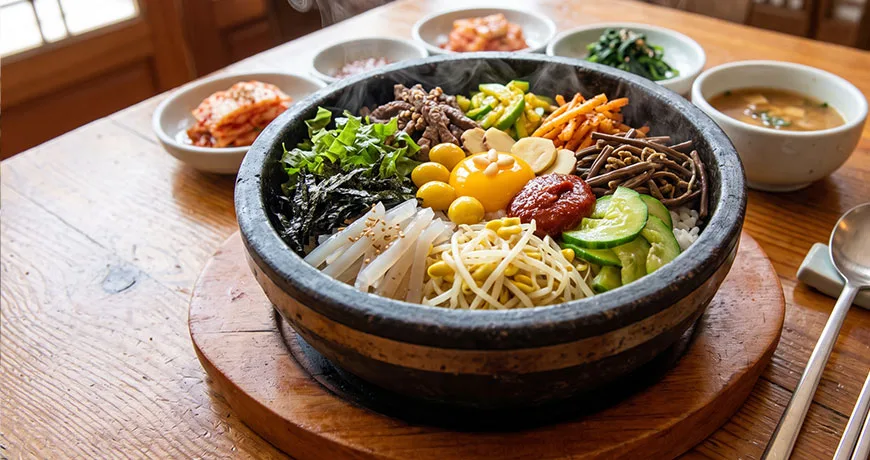
Dolsotbibimbap is a highly advanced thermodynamic fusion dish that utilizes a steatite (soapstone) vessel with immense specific heat capacity, heated past its 200°C (400°F) critical threshold. This allows the dish to undergo real-time moisture evaporation and the Maillard reaction directly on the dining table. When toasted sesame oil is applied to the scorching inner walls, the unsaturated fatty acids boil, forming a volatile lipid shield. Pressing amylopectin-rich warm rice against this blistering stone causes the surface moisture to violently evaporate, initiating an acoustic gastronomy experience (the signature sizzle) while forging a golden, crispy crust known as Nurungji. A meticulously structured matrix of colorful vegetables (retaining their cellular turgor), inosinate-rich sautéed beef, and hypertonic Gochujang is layered on top, crowned with a raw egg yolk. When aggressively agitated with a spoon by the diner, the massive radiant heat stored within the stone gradually thermally coagulates the raw proteins, while the yolk’s natural lecithin beautifully emulsifies the capsaicin and starches into a rich, creamy, in-situ fusion.
⏱️ Total: 30 mins (excluding prep for individual veggies) | Prep: 15 mins | Cook: 15 mins | 🍳 Difficulty: Moderate (Requires radiant heat control and Maillard crust engineering) | 🌶️ Profile: Nutty, Crispy, Spicy, and Intensely Savory | 🍚 Focus: Thermal Mass Radiant Heat, In-situ Emulsification, & Maillard Reaction | 🍶 Pairing: Ice-cold, lactic acid-fermented Dongchimi (Radish water kimchi) brine
Ingredients (1 serving)
- High Thermal Mass Vessel: Traditional Dolsot (Steatite/Soapstone pot) or cast-iron bowl
- Amylopectin & Maillard Matrix: 1 bowl cooked warm White Rice (slightly dry to maximize crust formation)
- Lipid & Emulsion Catalyst: 1 tbsp Toasted Sesame Oil (for coating the pot), 1 fresh Raw Egg Yolk
- Cellulose & Amino Acid Matrix: 50g sautéed minced Beef, and a handful each of prepared vegetables (Spinach, Bellflower root, Fernbrake, Soybean sprouts, julienned Carrots)
- Hypertonic Capsaicin Binder: 1–1.5 tbsp Gochujang (Korean chili paste), a pinch of Toasted Sesame Seeds
Allergy Information Contains: Beef, Soy, Wheat (from Gochujang/soy sauce), Egg, Sesame
Equipment Dolsot (Stone Pot) compatible with direct flame, Heat-resistant Spatula or Spoon, Oven Mitts
Cooking Instructions
- Thermodynamic Pre-heating & Lipid Shielding: Place the empty Dolsot directly over a medium flame. Allow it to absorb massive thermal energy until the surface temperature exceeds 150°C. Drizzle the toasted sesame oil inside, using a spoon to coat the bottom and walls evenly, creating a boiling lipid shield.
- Amylopectin Compression & Evaporation: Once the oil is smoking slightly, add the warm rice. Use the back of a spoon to press and compress the rice firmly against the bottom and sides of the pot. The surface moisture will rapidly evaporate, generating intense acoustic feedback (sizzling).
- Structural Assembly: While the bottom continues to crisp, neatly arrange the 5-6 prepared vegetable matrices and the sautéed beef in a radial, color-contrasting pattern over the rice.
- Emulsifier Addition: Place a generous dollop of Gochujang in the exact center, and carefully crown it with the fresh raw egg yolk.
- Maillard Crust Formation: Allow the pot to sit on the flame until the sizzling acoustic feedback becomes sharp and rapid (about 3–5 minutes), indicating a thick Maillard crust (Nurungji) has formed. Remove from the heat. Serve immediately. The diner must vigorously mix the ingredients, using the pot’s radiant heat to cook the egg yolk and scrape up the crispy crust, unifying the textures.
💡 Professional Culinary Tips
- Thermodynamics of Steatite (Soapstone): Dolsotbibimbap is unique because the cooking process finishes at the table. Steatite has a massive specific heat capacity; it takes a long time to heat up, but once saturated, it blasts 200°C+ radiant heat for over 20 minutes off the stove. This phenomenal heat retention is the driving force that sustains the Maillard reaction throughout the entire meal.
- The Physics of Nurungji (Crust) Formation: Pressing the rice firmly against the stone is not an aesthetic choice. It is a mechanical process designed to eliminate air pockets, maximizing thermal conduction efficiency. The boiling sesame lipids violently collide with the amylopectin starches, dehydrating them and caramelizing the sugars to forge a crust with ultimate mechanical crunch (Nurungji).
- In-situ Thermal Emulsification: Unlike regular cold bibimbap which uses a fried egg, a true Dolsotbibimbap utilizes a raw egg yolk for brilliant biochemical reasons. As you aggressively mix the boiling hot contents, the yolk’s natural lecithin acts as a powerful emulsifier. It binds with the lipids and starches, while the radiant heat slowly cooks it into a creamy, viscoelastic coating that perfectly rounds out the sharp heat of the capsaicin.
🍶 Gastronomic Pairing
- Biochemical Palate Cleansing: When the scorching radiant heat of the stone, the fiery capsaicin, and the heavy sesame lipids overwhelm your palate, pair this intense dish with a bowl of ice-cold Dongchimi (Radish Water Kimchi) brine. The extreme endothermic cooling effect of the icy liquid, combined with its refreshing, sharp lactic acid, acts as a chemical solvent that impeccably strips the heavy oils from your mucosal membranes, flawlessly resetting your taste receptors.
Nutrition Facts (Estimated)
Total Content : Approx. 550g (1 serving)
Calories : 560 kcal
– Sodium : 1,020mg (Variable depending on Gochujang and vegetable seasoning)
– Total Carbohydrate : 78.0g (Complex starches and plant fibers)
– Sugar : 4.5g
– Total Fat : 16.0g (Unsaturated lipids from sesame oil and egg yolk)
– Saturated Fat : 3.5g
– Cholesterol : 210.0mg (From egg and beef)
– Protein : 18.0g
– Dietary Fiber : 7.0g
*Daily Values are based on a 2,000 calorie diet and standard Korean nutritional reference values.
**Nutritional values are calculated based on original ingredients; substitutions may alter specific macronutrients.
Origins and Food Culture of Hot Stone Pot Bibimbap (Dolsotbibimbap)
1. Winter Thermal Innovation: The Birth of Sizzling Bibimbap in Jeonju
- While traditional Jeonju Bibimbap served in hand-forged brass bowls (yugi) was revered as the pinnacle of Joseon gastronomy, diners frequently lamented that the dish chilled too rapidly during the freezing winter months.
- To address this seasonal dilemma, visionary restaurateurs in Jeonju (such as the historic Banditbul eatery) during the late 1960s began ladling pre-assembled bibimbap into scorching-hot soapstone pots traditionally reserved for boiling stews and rice. The thermal innovation was an instant success, quickly popularized across Seoul bastions like Hanilkwan and transforming bibimbap from a room-temperature festive dish into a sizzling, year-round comfort staple.
2. The Thermodynamic Science of Jangsu Soapstone (Gobdol) and Scorched Rice (Nurungji)
- The authenticity of the vessel relies on natural soapstone (gobdol / agalmatolite) quarried from the mountainous mineral deposits of Jangsu-gun, Jeollabuk-do, celebrated for its exceptional thermal retention, resistance to thermal shock cracking, and natural emission of far-infrared radiation.
- Brushing the interior cavity with cold-pressed sesame oil before adding cooked rice prevents burning while initiating controlled Maillard reactions that yield a perfectly uniform, crispy bottom layer of scorched rice (nurungji). This elevated the preparation from simple passive assembly to an interactive “live cooking” ritual executed directly at the dining table by the diner.
3. A Synesthetic Masterpiece: “Obangsaek” Harmony and Global K-Food Icon
- Faithfully preserving the ancient cosmological philosophy of Yin-Yang and the Five Elements (Eumyang-ohaeng), the bowl features the five cardinal colors (Obangsaek): Blue/Green (spinach and water dropwort for the liver/wood), Red (chili paste and carrots for the heart/fire), Yellow (egg yolk and sprouts for the spleen/earth), White (rice and bellflower for the lungs/metal), and Black (bracken and shiitake for the kidneys/water).
- Uniting sizzling acoustics (auditory), brilliant color spectrums (visual), nutty toasted aromatics (olfactory), and contrasting crunchy-chewy mouthfeels (gustatory), Dolsotbibimbap offers an immersive synesthetic dining experience, reigning worldwide as one of the most beloved and celebrated cultural ambassadors of Korean culinary heritage.
The Incandescent Heat Capacity of Searing Soapstone and the Crackling Maillard Symphony of Sesame Scorched Rice: A Refined Portrait of Dolsotbibimbap
Dolsotbibimbap (Sizzling Hot Stone Pot Bibimbap) stands as the dynamic, thermodynamically charged, and sensory-rich summit of Korea’s mixed-rice (bibimbap) gastronomy. A thick vessel carved from natural soapstone or agalmatolite (gopdol) is heated directly over open flames until glowing with thermal mass. Its interior is lightly brushed with cold-pressed toasted sesame oil, forming a fine hydrophobic lipid barrier, before being packed with warm, dry-steamed white rice. A vibrant spectrum of seasoned wild and cultivated vegetables (namul—such as mountain bracken, bellflower root, spinach, zucchini, and carrots), savory minced beef, and artisanal red chili paste (gochujang) are arranged concentrically across the surface, crowned at the center with a raw golden egg yolk. Served while vigorously crackling and sizzling at the table, this dish transforms the traditionally static, room-temperature paradigm of bibimbap into an interactive performance of conductive heat transfer and real-time flavor creation.
Confronting the heavy stone cauldron as it erupts with an exhilarating acoustic sizzle releases an immediate, deeply comforting olfactory charge: the toasted nuttiness of high-heat sesame oil mingles with the rich, bready Maillard perfume of scorched rice crust (nurungji), the pungent lift of fermented chili paste, and the damp sweetness of gently wilted garden greens. Plunging a metal spoon into the depths to toss the ingredients sets off an enchanting chemical chain reaction: the central egg yolk breaks against the blistering stone walls, forming a silken, glossy emulsion that wraps the grains and fiery chili sauce in luxurious velvet. Sinking your teeth into the first mouthful delivers an exhilarating sensory duality: the caramelized rice crust along the pot’s bottom shatters with a satisfying, glass-like crunch, flooding the palate with concentrated, roasted starch sweetness. Immediately following, the tender moisture of the seasoned vegetables and the savory chew of marinated beef step forward, creating an impeccable textural balance. The initial warmth of the chili paste softens into the creamy yolk and nutty sesame oil, sustaining an addictive culinary momentum until the very last grain is scraped from the stone.
The enduring brilliance of Dolsotbibimbap lies in its evolutionary lineage—marrying the ancient, nutritionally complete elegance of courtly mixed rice (goldongban) with the ancient heating engineering of Korean stone craftsmanship, historically centered in regions like Jangsu. Transforming a quiet, bowl-bound meal into a multi-sensory theatrical experience where sound, aroma, tactile resistance, and lingering heat interact harmoniously until the meal’s conclusion, this iconic hot-stone staple remains an indispensable monument of thermal ingenuity, communal vitality, and brilliant Korean gastronomic craftsmanship.
Editor’s Review
1. A Dynamic Harmony of Shattering Nurungji Brittleness, Yielding Botanical Softness, and Silken Yolk Lubrication
The textural architecture inside the vessel delivers an extraordinary interplay between dry-heat, high-friction solid starches and tender, hydrated cellular components. The intense conductive heat from the stone floor rapidly desiccates the lower boundary of the rice bed, fusing the grains into a golden scorched crust (nurungji) that yields with an auditory, brittle fracture under the teeth. In contrast, the interior rice remains tender, protected from dryness by trapped convective steam. The wild greens, softened by the residual heat, offer a gentle fibrous yield that cushions the meat, while the mechanically stirred egg yolk creates a velvety, micro-thin fluid coating across oral tissues, ensuring a frictionless, non-saturating mouthfeel from the first sizzling spoonful to the final scraped bite.
2. Agalmatolite Far-Infrared Thermal Kinetics, Starch Pyrodextrinization, Lipid-Mediated Maillard Aromatics, and Lecithin Emulsion Thermodynamics
Dolsotbibimbap represents an exacting study in mineral thermal physics, carbohydrate thermal degradation, and lipid colloid chemistry. Natural soapstone (gopdol) possesses a high volumetric heat capacity and low thermal conductivity, allowing it to store extensive thermal energy and release it slowly via penetrating far-infrared radiation (FIR). This steady dissipation keeps the interior food within the ideal gastronomic window of 70–80°C throughout the dining experience. The thin layer of toasted sesame oil brushed onto the vessel’s interior functions as a thermal transfer medium, ensuring uniform heat distribution while preventing localized carbonization. At this high-heat interface, linear amylose polymers within the rice starches undergo dry-heat cleavage into soluble pyrodextrins and short-chain saccharides, generating intrinsic sweetness. Simultaneously, reducing sugars and amino acids from the beef and soy seasonings undergo intense Maillard reactions, synthesizing volatile alkylpyrazines and furans that yield its signature nutty, roasted aroma. Furthermore, the natural phospholipid lecithin in the raw egg yolk acts as an amphiphilic surfactant; during table-side stirring, it bridges the hydrophobic sesame oil phase and the hydrophilic chili-vegetable juices, stabilizing a rich oil-in-water (O/W) emulsion that prevents sauce separation under lingering heat.
3. The Courtly Lineage of Goldongban and the Climax of Tableside Interactive Korean Gastronomy
By synthesizing the nutritional balance of historic mixed-rice traditions with the ancient heat-retention properties of native Korean stonework, Dolsotbibimbap stands as one of the most inventive tableware evolutions in modern dining history. Transforming the dining vessel into an active, flavor-altering culinary instrument that rewards the diner’s personal participation, this sizzling masterpiece stands as an enduring sanctuary of domestic comfort, mineral engineering, and brilliant culinary craftsmanship.