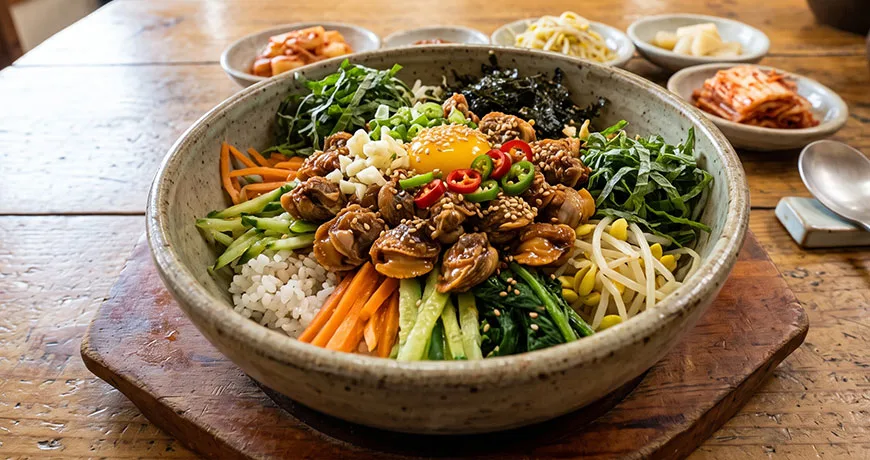
Kkomakbibimbap is a highly advanced marine biochemical dish engineered to perfectly thermally coagulate the red hemoglobin proteins and concentrated taurine of mudflat bivalves (cockles) at a strict critical temperature threshold. Following a lengthy osmotic purging process—where the bivalves sit in a dark, hypertonic saltwater solution to forcefully expel mud—the cockles are cooked not in boiling water, but gently at 85–90°C while being stirred continuously in one direction. This analog, unidirectional physical agitation harnesses centrifugal force to neatly bind the meat to one side of the shell, preventing irreversible, rubbery thermal contraction and preserving its extraordinary viscoelasticity and red, iron-rich juices. The laborious, manual artisan process of shucking the meat by hand guarantees zero juice loss. Piled atop warm, amylopectin-rich rice and emulsified with a hypertonic blend of water-soluble soy sauce aminos, unsaturated sesame lipids, and the sharp volatile allyl sulfides of chopped chives, the dish delivers an explosive fusion of oceanic depth and spicy-sweet terrestrial energy.
⏱️ Total: 40 mins (excluding 2 hrs purging) | Prep: 25 mins | Cook: 15 mins | 🍳 Difficulty: High (Requires critical temperature control and centrifugal stirring) | 🌶️ Profile: Deeply Savory, Briny, Iron-rich, and Spicy-Sweet | 🍚 Focus: Thermal Coagulation, Fluid Dynamics, & Redox Reaction | 🍶 Pairing: Chilled, highly acidic Plum Wine (Maesil-wonju)
Ingredients (2 servings)
- Marine Protein & Hemoglobin Matrix: 1kg Fresh Blood Cockles (Kkomak – for purging: 1L water, 2 tbsp coarse salt, a steel spoon)
- Amylopectin Matrix: 2 bowls warm cooked White Rice
- Lipid & Amino Acid Emulsion (Sauce): 3 tbsp Brewed Soy Sauce, 1.5 tbsp Gochugaru (chili flakes), 1 tbsp Green Plum Extract, 0.5 tbsp minced garlic, 2 tbsp Toasted Sesame Oil, 1 tbsp Toasted Sesame Seeds
- Aromatics & Turgor Matrix: 5 stalks Asian Chives (Jjokpa – finely chopped), 1 Cheongyang green chili, 1 Red Chili (finely diced)
Allergy Information Contains: Molluscan Shellfish (Cockles), Soy, Wheat (from soy sauce), Sesame
Equipment High Thermal Mass Pot, Mixing Bowls, Spoon (for shucking and purging), Cutting Board, Knife
Cooking Instructions
- Osmotic Purging & Redox Reaction: After washing the cockles vigorously, submerge them in a 3% saltwater solution with a stainless steel spoon. Cover with a black plastic bag and leave in a cool, dark place for 2 hours. The hypertonic environment and darkness relax the bivalves, causing them to expel mud and grit.
- Critical Thermal Coagulation: Bring a pot of water to a boil, then pour in half a cup of cold water to immediately drop the temperature to 85–90°C. Add the cockles. Using a spatula, stir slowly and continuously in only one direction. The moment 3 or 4 cockles pop their shells open, immediately scoop all of them out. Let the residual heat finish the cooking. (Never shock them in cold water.)
- Manual Shell Cleavage: While the cockles are still warm, place a spoon at the rear hinge of the closed shells and twist gently to pop them open. Shucking the meat entirely by hand ensures the delicate hemoglobin juices are not lost or the viscera ruptured.
- Umami Emulsion Matrix: Combine the soy sauce, chili flakes, plum extract, garlic, sesame oil, and sesame seeds. Fold in the massive volume of chopped chives and chilies to create a highly viscous lipid-amino acid emulsion.
- Structural Assembly & Lipid Coating: Place the warm rice in a bowl, top generously with the shucked cockle meat, and spoon the chive emulsion over the top. Mix gently so the sesame lipids seamlessly coat the amylopectin starches and the shellfish proteins.
💡 Professional Culinary Tips
- Fluid Dynamics of Unidirectional Agitation: Stirring boiling cockles in a figure-eight or back-and-forth motion violently tears the meat, sticking it to both sides of the shell. Maintaining a unidirectional current creates centrifugal force, beautifully locking the meat intact against one side of the shell. This ensures a flawless, unbroken extraction when shucking.
- Physics of the 85°C Threshold: Allowing cockles to boil at a violent 100°C until they all open completely destroys their structural integrity. The proteins irreversibly contract into a rubbery texture, and the precious red hemoglobin bleeds entirely into the water. Poaching them just below the boiling point and extracting them at the exact moment they begin to open is the paramount secret to preserving their succulent viscoelasticity.
- Redox Reaction of Metal in Purging: Placing a stainless steel spoon into the saltwater bath during the purging phase is not a folk myth. The iron (Fe) interacting with the sodium chloride (NaCl) triggers a microscopic redox reaction, generating a faint electrical current. This biochemical stimulation irritates the cockles’ muscles, forcing them to spit out their mud at a drastically accelerated and forceful rate.
🍶 Gastronomic Pairing
- Biochemical Palate Cleansing: When the heavy, iron-rich (hemoglobin) umami of the cockles, the sharp bite of the chives, and the thick sesame lipids dominate your palate, pair this dish with a deeply chilled Plum Wine (Maesil-wonju). The high concentration of natural organic acids (citric and malic acid) in the plum biochemically neutralizes the residual brininess of the shellfish, while the sharp, refined sweetness elegantly washes away the lipid coating, initiating a flawless reset of your taste receptors.
Nutrition Facts (Estimated)
Total Content : Approx. 450g (1 serving)
Calories : 480 kcal
– Sodium : 1,150mg (Variable depending on soy sauce)
– Total Carbohydrate : 68.0g (Primarily amylopectin from white rice)
– Sugar : 6.0g
– Total Fat : 14.0g (Unsaturated lipids from sesame oil)
– Saturated Fat : 2.0g
– Cholesterol : 45.0mg
– Protein : 22.0g (Rich in hemoglobin and bioavailable taurine)
– Dietary Fiber : 5.0g
*Daily Values are based on a 2,000 calorie diet and standard Korean nutritional reference values.
**Nutritional values are calculated based on original ingredients; substitutions may alter specific macronutrients.
Origins and Food Culture of Cockle Bibimbap (Kkomakbibimbap)
1. Southern Mudflat Terroir: Beolgyo, Yeoja Bay, and Jo Jung-rae’s Taebaek Mountains
- Rooted in the fertile, pristine tidal flats of Beolgyo in Boseong-gun and Yeoja Bay in Suncheon, Jeollanam-do—a unique geological inlet composed of fine, sand-free marine silt that produces the nation’s most prized cockles, officially protected under South Korea’s Geographical Indication (GI) System No. 1.
- Immortally depicted in Jo Jung-rae’s epic historic novel The Taebaek Mountains, where the flavor of Beolgyo cockles was celebrated as “saline yet sweet, exquisitely chewy, spicy, and intimately pungent,” reflecting centuries of southern dining heritage where seasoned cockles were indispensable on ancestral memorial tables, wedding feasts, and daily bapsang.
2. The Culinary Science of Unidirectional Stirring and Heme Retention
- The hallmark of authentic preparation lies in an ingenious thermal technique: dropping live cockles into water just before it reaches a rolling boil (approx. 85–90°C, when tiny bubbles begin rising) and stirring them steadily in a single clockwise direction with a wooden paddle.
- This unidirectional motion applies gentle centrifugal force, prompting the cockles to release their grip and settle with their meat neatly adhering to one half of the shell; this seals the shell openings, preventing the precious hemoglobin-rich bodily juices and iron from leaching out into the water and guaranteeing a plump, succulent, non-rubbery bite. Prying open the shells by twisting a spoon against the posterior hinge preserves the meat undamaged.
3. The Gangneung Tray Innovation and Contemporary Nationwide Phenomenon
- While traditionally served as a home-style seasonal side dish (kkomak-muchim) in the southern provinces, the dish underwent a revolutionary modern renaissance in the 2010s at Eomji-ne Pojangmacha in the coastal city of Gangneung, Gangwon-do.
- The restaurant popularized a dramatic round platter presentation: one half piled high with cockles tossed in scallions, garlic, and hot Cheongyang chilies, and the other half filled with rice pre-seasoned with cockle juices and sesame oil. This bold visual format and balanced spice transformed regional heritage into a nationwide culinary sensation, establishing Kkomakbibimbap as one of the most beloved contemporary icons of 21st-century Korean comfort gastronomy.
The Concentrated Hemoglobin Iron of Cold Mudflat Bivalves and the Incandescent Harmony of Sesame Allium Seasoning: A Refined Portrait of Kkomakbibimbap
Kkomakbibimbap (Seasoned Cockle and Rice Bibimbap) stands as the dynamic, intensely craveable, and biologically opulent summit of Korea’s southern intertidal (bibimbap) gastronomy. Freshly gathered mudflat cockles (ark shells—Tegillarca granosa or Scapharca subcrenata) harvested during their winter peak from the deep, nutrient-dense mudflats of Boseong, Beolgyo, and Yeosu are purged in clean seawater. Submerged in water just below the boiling point, they are stirred gently in a single direction to set the meat without shedding vital cellular fluids, then swiftly shucked by twisting the rear hinge. The plump cockle meats are vigorously tossed in an assertive dressing of Korean red pepper powder (gochugaru), aged soy sauce, minced garlic, finely sliced Cheongyang chilies, chives, and cold-pressed toasted sesame oil, then arranged lavishly alongside steaming, dry-cooked white rice. Deliberately steering clear of thick, ferment-masking paste sauces, this creation harmonizes the singular, iron-rich savor of red-blooded mollusks with the crisp vitality of raw alliums and warm grain starches into an exquisite thermodynamic and sensory equilibrium.
Presented across a wide ceramic platter where vibrant, ruby-red seasoned cockles and gleaming grains of seasoned rice sit side-by-side in visual equilibrium, lifting a deep metal spoon releases an intoxicating sensory charge: the nutty, roasted perfume of cold-pressed sesame oil mingles effortlessly with the sharp, sulfurous breath of fresh Asian chives, fiery chilies, and the clean, mineral ozone of low-tide mudflats. The first spoonful delivers an exhilarating tactile sensation: the plump bivalves burst against the teeth with a supple, springy chew (taenggeul), releasing streams of captured saline nectar, rich iron-tinged juices, and the lingering, honeyed sweetness of marine glycogen. The brisk, auditory snap of raw alliums cleanly slices through the cockle’s dense tissue, while the thin lipid veil of toasted sesame oil envelops each grain of rice, ensuring an effortless, frictionless glide across oral membranes and leaving a lingering, revitalizing finish that awakens every dormant sense.
The enduring brilliance of Kkomakbibimbap lies in its agrarian-maritime heritage—immortalized in Jo Jung-rae’s epic saga Taebaek Mountain Range as “savory, chewy, sweet, and wonderfully bracing,” capturing the indomitable life force of the southern coastal laborers who propelled wooden sleds (ppeolbae) across the mudflats. Evolving from a humble tavern accompaniment for rough bowls of milky makgeolli into a celebrated national dining icon, a plate of seasoned cockles and rice remains an irreplaceable monument of coastal resourcefulness, metabolic vitality, and dazzling Korean culinary craftsmanship.
Editor’s Review
1. A Dynamic Harmony of Plump Bivalve Elasticity, Crisp Allium Fractures, and Grain-Preserving Lipid Lubrication
The textural landscape inside the dish delivers an extraordinary, multi-layered interplay between invertebrate muscle tissue, crisp plant cell walls, and firm grain starches. Precise, sub-boiling hydrothermal cooking prevents the cockles from turning rubbery, yielding an unctuous, springy bite that collapses with clean, juicy resilience under the teeth. This is counterbalanced by the brisk, auditory crunch of diced Cheongyang peppers and wild chives. Cold-pressed sesame oil forms a hydrophobic boundary layer over the rice grains, shielding them from liquid seasonings to ensure they stay individually defined and pleasantly firm, guaranteeing an impeccably balanced, non-fatiguing mouthfeel from the first bite to the last.
2. Erythrocruorin/Hemoglobin Ferrous Flavor Binding, Unidirectional Thermal Convection Mechanics, and Glycogen-Glutamate Umami Synergism
Kkomakbibimbap represents an exacting study in invertebrate muscle histology, food thermal physics, and sensory neurochemistry. Unlike most mollusks, cockles of the family Arcidae contain respiratory pigments analogous to vertebrate hemoglobin—principally erythrocruorin—within their hemolymph, granting them a deep crimson color and an intense, iron-dense savory note. The traditional technique of stirring the cockles in a single direction in 80–85°C water creates a uniform laminar flow that forces the bivalve meat to contract against a single shell half while purging residual grit. This controlled temperature prevents actomyosin over-contraction and the irreversible water-loss (syneresis) typical of violent boiling, locking moisture and bioavailable nutrients securely within the muscle matrix. Furthermore, the cockle’s natural reserves of glycogen, betaine, and taurine join forces with free glutamates from aged soy sauce to stimulate human T1R1/T1R3 umami heterodimers, while sesame triglycerides and allium allyl sulfides chemically bind and mask potential metallic and fishy volatile aldehydes.
3. The Intertidal Mudflat Heritage of Beolgyo and the Living Summit of Korean Shellfish Gastronomy
Originating on the nutrient-dense tidal flats of Boseong and Yeosu, where navigating the mud required generations of specialized physical wisdom, Kkomakbibimbap embodies the deepest cultural connection between coastal ecology and daily nutrition. Elevating rough-hewn bivalves once consumed as rapid sustenance by local fishermen into a sophisticated, visually striking centerpiece of contemporary dining, this vibrant classic stands as an enduring sanctuary of ecological richness, regional pride, and brilliant culinary mastery.