
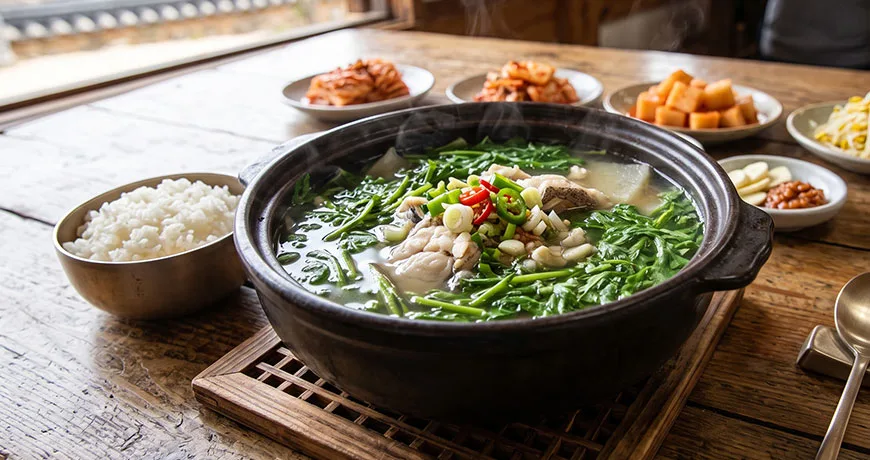
Dodarissukguk is the quintessential molecular matrix of Korean spring, fusing the highly volatile cineole (eucalyptol) terpenes of wild-foraged mugwort (Ssuk) with the delicate, amino-acid-rich myofibrils of spring flathead flounder (Dodari). Flatfish possess extremely loose connective tissues; if subjected to a violent 100°C boil, their flesh will hydrodynamically disintegrate into an unappetizing mush. The thermodynamic law of this dish requires a tranquil, sub-boiling poaching phase (85–90°C) within a light peptide solvent. Crucially, the broth employs a “micro-dosing” technique of traditional Doenjang (soybean paste)—just enough fermented peptides to chemically round off the bitter edges of the mugwort without overpowering its fragrance. The ultimate test of this dish is the thermal control of the mugwort. The herb must be introduced in the final 60 seconds of cooking. Prolonged heat causes thermal degradation of the cineole, transforming the vibrant spring herb into a lifeless, dull hay.
- ⏱️ Total: 30 mins | Prep: 10 mins (Blood purging & meticulous mugwort soil removal) | Cook: 20 mins
- 🍳 Difficulty: Medium-High (Requires precise hydrodynamic protection of flatfish myofibrils and strict terpene preservation)
- 🌶️ Profile: Deeply Earthy, Herbal, and Elegantly Savory
- 🍚 Focus: Doenjang Micro-dosing, Critical Flatfish Poaching, & Terpene Thermal Preservation
- 🍶 Pairing: Chilled Grüner Veltliner (White Wine) to resonate with the herbaceous, earthy terpenes
Ingredients (2–3 servings)
- Amino Acid & Protein Matrix: 1 Fresh Flathead Flounder (Dodari – approx. 600g, scaled and gutted. MUST vigorously scrub the bloodline inside the spinal cavity to prevent murky broth. Cut into bone-in thirds)
- Terpene & Cellulose Matrix: 100g Wild-Foraged Spring Mugwort (Ssuk – Must be gently swirled in cold water multiple times to physically purge fine soil trapped in the downy leaves)
- Pectin & Reducing Sugar Matrix: 150g Daikon Radish (sliced thinly into squares)
- Aqueous Umami Solvent: 1.2L Anchovy-Kelp Broth or Rice Water
- Fermented Peptide & Ionized Binder: 1 tbsp Traditional Soybean Paste (Doenjang – Must be strained for a purely clear solvent), 1 tsp Soup Soy Sauce, Coarse Sea Salt to taste
- Allyl & Capsaicin Catalyst: 1/2 white stalk Green Onion (diagonally sliced), 1 Cheongyang green chili, 1/2 Red chili, 1/2 tsp minced garlic (Strictly minimized to avoid overpowering the mugwort)
Allergy Information Contains: Fish (Flounder, Anchovy), Soy, Wheat (from Doenjang, Soy Sauce)
Cooking Instructions
- Solvent Extraction & Peptide Construction: In a wide pot, bring the anchovy broth and sliced radish to a boil. Once the radish softens and releases its sweet pectin, place a fine mesh strainer into the broth and dissolve exactly 1 tbsp of Doenjang through it. Discard the soybean particulate left in the strainer. This creates a hyper-clean, slightly fermented baseline designed to support, not dominate, the flounder.
- Critical Poaching: Once the light Doenjang broth boils, introduce the flounder chunks and the micro-dose of minced garlic. Leave the lid open and immediately reduce the heat to medium-low (85–90°C). Poach the delicate flatfish in this tranquil convection for 8–10 minutes to prevent the myofibrils from shredding apart.
- Salinity Calibration & Clarification: Constantly skim any grey protein foam that rises to the surface. Once the flounder flesh turns opaque and turgid, calibrate the final salinity using sea salt and soup soy sauce.
- Cineole Preservation & Finish: When the soup is completely done, exactly 1 minute before killing the heat, blanket the surface with the washed mugwort, scallions, and chilies.
- Thermodynamic Termination: The very moment the mugwort slightly wilts and releases its explosive, herbal cineole aroma into the steam, turn off the heat immediately. Boiling the mugwort further will cause catastrophic thermal degradation of its essential oils.
💡 Professional Culinary Tips
- Chemistry of Micro-dosing Doenjang: This is not a heavy soybean paste stew (Doenjang Jjigae). If you add too much paste, the heavy fermented aromatics will utterly crush the delicate sweetness of the flounder and the fragile scent of the spring herb. The Doenjang must act as an invisible chemical catalyst—providing just enough amino acids to round off the mugwort’s natural bitterness.
- Hydrodynamic Protection of Flatfish Myofibrils: Bottom-dwelling flatfish like flounder have minimal connective tissue. In a violent 100°C rolling boil, the turbulent kinetic energy will physically rip the meat from the bones, turning the clear broth into a cloudy slurry. A sub-boiling, calm poaching environment is mandatory to retain the meat’s structural integrity.
- Thermal Preservation of Cineole Terpenes: Eucalyptol (cineole), the primary volatile compound in mugwort, vaporizes at high temperatures. Mugwort should not be treated as a base ingredient to be “boiled down.” It must be treated as a delicate garnish, activated only by the residual heat in the final 60 seconds to lock the vibrant spring aroma into the matrix.
🍶 Gastronomic Pairing
- Biochemical Palate Cleansing: When the bitter, earthy terpenes of the mugwort and the incredibly tender, sweet white flesh of the flounder coat your oral mucosa, pair this spring masterpiece with a chilled, unoaked Austrian Grüner Veltliner. The wine’s signature white pepper and herbaceous green notes will molecularly resonate with the mugwort’s organic compounds, while its sharp tartaric acid cleanly slices through the light Doenjang broth, completing a perfect gastronomic tribute to spring.
Nutrition Facts (Estimated)
Total Content : Approx. 550g (1 serving, excluding bone weight)
Calories : 160 kcal (Excluding rice, ultra-low calorie, high-protein matrix)
– Sodium : 1,050mg (Attributed to Doenjang, Soy Sauce, and Sea Salt)
– Total Carbohydrate : 9.0g (Dietary fiber from mugwort and radish polysaccharides)
– Sugar : 2.5g
– Total Fat : 1.5g (High-quality trace unsaturated lipids from flounder)
– Saturated Fat : 0.3g
– Cholesterol : 55.0mg
– Protein : 28.0g (Highly bioavailable delicate myofibrillar protein)
– Dietary Fiber : 5.0g (Dense cellulose from wild mugwort)
*Daily Values are based on a 2,000 calorie diet and standard Korean nutritional reference values.
**Nutritional values are calculated based on original ingredients; substitutions may alter specific macronutrients.
Origins and Food Culture of Flounder and Mugwort Soup (Dodarissukguk)
1. Historical Lineage: Dongui Bogam, Jasanoebo, and the Lore of “Spring Flounder”
- Right-eyed flatfish (dodari) were historically categorized in Hanja texts as Jeop-eo (鰈魚), renowned as the premier catch of the southern coast during early spring when their meat becomes firm and savory.
- In Heo Jun’s 1613 medical compendium Dongui Bogam, flounder was documented as “balanced in nature, sweet, and non-toxic; it tonifies bodily deficiency, invigorates vital qi, and strengthens the stomach and intestines.” Concurrently, medicinal mugwort (Aeyeop, 艾葉) was praised for “warming the core, dispelling visceral chill, and resolving abdominal distress.” Furthermore, Jeong Yak-jeon’s 1814 Jasanoebo celebrated the sweet tenderness of spring flatfish, establishing centuries of culinary heritage where the sea’s premier fish was paired with the earth’s first wild botanical sprout to restore post-winter vitality.
2. Culinary Chemistry: Cineole Preservation and Delicate Fish Protein Thermodynamics
- Authentic Dodarissukguk avoids pungent chili pastes or heavy seasonings, relying instead on a very thin, strained soybean paste broth to preserve the delicate flavors of the fresh fish and herbs.
- Master cooks adhere to a strict thermodynamic sequence: bringing the cloudy rice water and kelp stock to a rolling boil, adding the bone-in flounder steaks to cook just until the meat turns opaque and flakes, and tossing in the fresh mugwort only during the final seconds before turning off the heat. Because prolonged boiling causes the delicate actomyosin fibers of the fish to disintegrate and evaporates the fragrant cineole monoterpenes—leaving the greens bitter and discolored—this flash-simmering technique locks in vibrant emerald color, tender flakiness, and intense springtime aromatics.
3. Tongyeong Coastal Heritage and the Sovereign Herald of Peninsular Spring
- Deeply anchored in the maritime culture of South Gyeongsang Province—most notably Tongyeong’s historic Seoho and Jungang markets and the surrounding islands of Geoje and Hansando—where fishermen and haenyeo divers gathered wild mugwort from windswept seaside cliffs to boil with fresh morning catches.
- Popularized across the nation since the 1990s, Dodarissukguk has become Korea’s undisputed gastronomic herald of spring, giving rise to the cultural saying that “spring has not truly arrived until one has savored a bowl of Dodarissukguk.” Representing the warmest traditions of southern coastal hospitality and seasonal balance, it remains an immortal monument to Korean coastal gastronomy and botanical wellness.
The Verdant Cineole Terpene Respiration of Coastal Spring Mugwort, the Velvet Flaking of Southern Sea Flounder, and the Starch-Cushioned Equilibrium of Rice Emulsion: A Refined Portrait of Dodarissukguk
Dodarissukguk (Flounder and Mugwort Soup) stands as the poetic, crystalline, and biologically astonishing summit of Korea’s early-spring marine-botanical (tangban) gastronomy. Centered upon the pristine ridged-eye flounder (Pseudopleuronectes yokohamae or Dodari)—returning from deep winter spawning grounds to fatten within the tidal channels of the southern coast—and wild young Korean mugwort (Artemisia princeps or Ssuk), gathered by hand as its downy rosettes brave the brisk sea winds along the sunlit cliffs of Tongyeong, Geoje, and Namhae, the dish begins with delicate preparatory discipline. The flounder is gently descaled, gutted to remove the bitter bile sac, and carved bone-in into thick steaks, followed by a brief cold-water rinse to leach peripheral hemoglobin. Concurrently, the young mugwort shoots, gathered before fibrous cauline stems develop, are carefully sorted and rinsed to preserve both their ethereal glandular trichomes and concentrated essential oils. Anchored inside an earthenware cauldron (ttukbaegi) or cast-iron pot, the broth is built not on plain water, but upon the starch-rich second-rinse water of raw white rice (tteumul), simmered alongside sun-dried anchovies and thick kelp (dasima). A sheer whisper of rustic artisanal soybean paste (doenjang) is strained through a fine sieve into the liquid—not to assert its own pungent identity, but solely to supply a savory baseline and neutralize fish volatiles. When the broth reaches a steady boil, the flounder steaks are introduced first, poaching between 80°C and 85°C to allow bone minerals and sweet fish juices to seep into the liquid. Moments before serving, a mound of fresh young mugwort and minced garlic are cast over the surface, gently wilting in the residual steam to capture its peak volatile aromatics without degrading its tender cellular walls. Completely rejecting fiery red chili pastes, this dish harmonizes the pristine white protein of the sea with the invigorating vitality of spring earth, soothing the palate and awakening dormant metabolic systems with radiant clarity.
Confronting the steaming earthenware pot as delicate golden vapors ascend to reveal vibrant jade mugwort rosettes floating over ivory flounder segments, lifting a deep spoonful of the broth releases an immediate, deeply electrifying olfactory charge: the piercing, pine-fresh perfume of 1,8-cineole and borneol terpenes from the spring mugwort mingles seamlessly with the clean, roasted sea savor of simmered flounder bones, the nutty warmth of rice starch, and the mellow, bready baseline of fermented paste. Taking the first sip delivers an unadorned revelation across the oral mucosa: devoid of any greasy surface tension, the clarified amino acid broth floods the tongue with silk-like softness, gliding effortlessly down the esophagus to soothe tired tissues and warm the digestive core with gentle, lingering heat. Sinking your teeth into the poached flounder reveals an extraordinary structural tenderness: free of tough perimysial sheaths, the lean white meat separates under minimal tooth pressure into colossal, succulent flakes that melt across the tongue with sweet, uncorrupted marine protein. In luxurious contrast, the gelatinous skin surrounding the fins (engawa) and cranial joints supplies an unctuous, viscoelastic chew (jjondeuk). Biting into the tender mugwort releases an invigorating burst of bittersweet botanical nectar, while the gentle starchy broth cushions the palate. Steeping a bowl of warm white rice into the aromatic broth and capping each spoonful with a crisp cube of aged radish kimchi completes an unforgettable ritual of seasonal renewal, coastal nostalgia, and profound gastronomic catharsis.
The enduring majesty of Dodarissukguk lies in its geographic pedigree—anchored in the time-honored fishing maxim “Spring Flounder, Autumn Gizzard Shad” (Bom Dodari, Gaeul Jeoneo) along the windswept southern fishing ports of Tongyeong, Geoje, Samcheonpo, and Yeosu. Celebrating that ephemeral window of early spring when the marine life of the sea and the wild herbs of the hillsides converge in perfect seasonal alignment, fishermen tossed freshly harvested flounders straight into cauldrons with wild mugwort to dispel late-winter chills and restore depleted stamina. Uniting the untamed vitality of coastal cliffs with the cold ocean’s sweetest marine proteins through minimalist thermal poaching, a steaming bowl of flounder and mugwort soup remains an irreplaceable monument of seasonal harmony, maternal comfort, and brilliant Korean culinary craftsmanship.
Editor’s Review
1. A Dynamic Harmony of Low-Resistance Flounder Flaking, Viscoelastic Fin Gelatin, Tender Mugwort Leaf Yield, and Starch-Lubricated Broth Fluidity
The structural architecture inside the vessel delivers an extraordinary, four-tiered choreography between delicate pleuronectid skeletal muscle bundles, heat-denatured dermal connective tissue sheets, hydrated plant leaf cell walls, and an ultra-low-viscosity aqueous matrix. Because the ridged-eye flounder possesses delicate myocommata connecting fragile myotomal sheets, the firm white meat separates under gentle tooth pressure into clean, leaf-like flakes that discharge trapped moisture with zero fibrous stringiness. Dynamic richness is supplied by the outer skin, fin bases (engawa), and opercular tissues, which undergo hydrothermal gelatinization to yield a supple, viscoelastic chew that clings lightly to the lips with rich oral lubrication. Counterbalancing this, the fresh young mugwort leaves—wilted only seconds in residual steam—yield with a soft, succulent give, while suspended amylose and amylopectin granules from the rice-washing water increase dynamic fluid viscosity, ensuring an impeccably balanced, non-fatiguing mouthfeel from the first steaming sip to the last.
2. Gentle Convective Poaching (80–85°C) for Actomyosin Syneresis Mitigation, Mugwort 1,8-Cineole and Thujone Volatilization Kinetics, IMP-Glutamate Umami Synergism, and Starch TMA Adsorption Deodorization
Dodarissukguk represents an exacting study in flatfish muscle biochemistry, plant terpene thermodynamics, and carbohydrate colloid physics. Flounder white muscle features an exceptionally low lipid profile (consistently under 2%) and high moisture; exposing the fillets to aggressive rolling boiling (>100°C) triggers violent contraction of myofibrillar actomyosin, causing extensive cellular moisture expulsion (syneresis) that leaves the fish chalky and fragmented. Poaching the flounder within a gentle convective window (80–85°C) preserves myofibrillar Water Holding Capacity (WHC), locking in cellular juices and tender flakiness. The signature aroma of the soup is governed by 1,8-cineole, alpha-thujone, and borneol concentrated within the mugwort’s glandular trichomes. Because these monoterpenes are highly volatile and thermally labile, prolonged boiling causes them to escape into the atmosphere or degrade into bitter artifacts; introducing the greens during the final moments of cooking locks in their vibrant aromatic bouquet. Broth savor is driven by an exponential biochemical synergy: muscle-derived inosine monophosphate (5′-IMP) from the flounder converges with natural free glutamates from the dried kelp, anchovies, and artisanal soybean paste, triggering an intense activation across human oral T1R1/T1R3 umami heterodimers. In the deodorization phase, micro-dispersed amylose colloids in the rice water physically adsorb volatile basic amines—principally trimethylamine (TMA)—while the intense terpene volatiles of mugwort chemically mask residual marine aromas, yielding an immaculate, pure seasonal consommé.
3. Southern Archipelago Terroir, Ephemeral Spring Convergence, and the Sovereign Apex of Marine-Botanical Tangban
Born out of the unique ecological convergence where the warm Tsushima Current revives coastal flatfish and sunlit cliffs bring forth wild sea-breeze mugwort, Dodarissukguk stands as the ultimate expression of seasonal terroir in Korean culinary history. Dispensing with heavy condiments to allow the unmasked sweetness of spring flounder and the medicinal vigor of wild herbs to shine in absolute clarity, this radiant, aromatic centerpiece captures the sacred transition from winter dormancy to spring renewal, standing as an enduring sanctuary of environmental authenticity, seasonal discipline, and brilliant Korean culinary artistry.