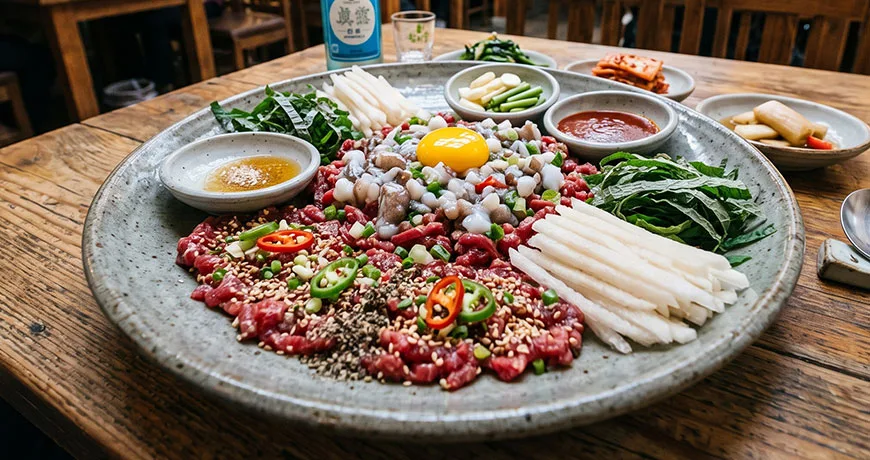
Nakji Yukhoe Tangtang-i is a radical biokinetic dish that harnesses the residual cellular energy (ATP) of a freshly dispatched cephalopod. Even after the central nervous system is severed, the octopus tentacles continue to forcefully contract. The rhythmic, heavy acoustic strike of a chef’s heavy knife against a thick wooden board—producing the eponymous “Tangtang” sound—is an analog tenderizing process that mechanically shatters the tough collagen bonds while preserving the bouncy viscoelasticity of the meat. To neutralize the dangerous vacuum suction of the acetabula (suction cups) in the oral cavity, the writhing tentacles are heavily coated in toasted sesame oil, acting as a crucial hydrophobic fluid lubricant. When this dynamic marine matrix is layered over a base of hypertonic raw beef tartare (Yukhoe), the terrestrial inosinate of the beef and the marine taurine and glycogen of the octopus physically collide. This generates an explosive, geometric multiplication of umami on the palate, bound together by the rich lecithin of a raw egg yolk.
⏱️ Total: 15 mins | Prep: 10 mins | Cook: 5 mins (Raw Prep) | 🍳 Difficulty: Moderate (Requires nerve severing and suction lipid coating control) | 🌶️ Profile: Deeply Savory, Nutty, and Biokinetically Chewy | 🍚 Focus: Residual ATP Biomechanics, Kinetic Tenderization, & Umami Synergy | 🍶 Pairing: Chilled, high-proof traditional distilled Soju
Ingredients (2 servings)
- Biokinetic Taurine Matrix: 2 Live Octopuses (San-nakji – aggressively massaged with coarse salt and flour to purge surface mucin)
- Inosinate & Protein Matrix: 200g Fresh Beef Rump (Yukhoe grade – julienned thinly against the grain)
- Lipid Shield & Gel Binder: 2 tbsp Toasted Sesame Oil, 1 fresh Egg Yolk (as a cholesterol emulsifier)
- Hypertonic Umami Binder (Beef Marinade): 1 tbsp Soup Soy Sauce, 1 tbsp Asian Pear juice, 0.5 tbsp minced garlic, 0.5 tsp sugar
- Aromatics & Turgor: 3 sprigs Chives (finely chopped), 1/4 Asian Pear (julienned), 1 tbsp Pine Nuts, 1 tbsp toasted Sesame Seeds
Allergy Information Contains: Molluscan Shellfish (Octopus), Beef, Egg, Soy, Wheat (from soy sauce)
Equipment Thick Wooden Cutting Board, Heavy and Sharp Knife (Cleaver recommended), Mixing Bowls
Cooking Instructions
- Protein Matrix Assembly: In a mixing bowl, combine the julienned beef with the soy sauce, pear juice, garlic, and sugar. Gently toss with your fingertips to allow the osmotic pressure to season the meat. Level this beef matrix onto a chilled plate. Surround the perimeter with julienned Asian pear for acoustic crunch (turgor).
- Mucin Depletion: Coat the live octopuses in flour and coarse salt. Knead them aggressively by hand. This intense physical friction strips away the muddy, slippery mucin proteins from the suction cups, neutralizing any unpleasant oceanic odors. Rinse thoroughly.
- Kinetic Tenderization (Tangtang): Invert the octopus head to remove the viscera, eyes, and beak. Place the tentacles on the thick wooden board. Using quick, vertical strikes with a heavy knife, chop the tentacles into 1–1.5cm segments. This analog, rhythmic hammering (“Tangtang”) severs the muscle fibers, breaking down the tough texture.
- Lipid Shield Coating: Immediately transfer the writhing tentacles into a bowl and douse them heavily with toasted sesame oil and sesame seeds. The unsaturated fatty acids coat the suction cups, forming a physical barrier that prevents vacuum adhesion to your throat or mouth.
- Structural Finish & Emulsion: Pile the heavily oiled, wriggling octopus on top of the seasoned beef tartare. Crown the exact center with the raw egg yolk, and scatter chives and pine nuts over the top. Just before eating, burst the yolk; its natural lecithin will emulsify the sesame lipids and the proteins into a luxurious, creamy texture.
💡 Professional Culinary Tips
- Biomechanics of Residual ATP: The mesmerizing movement of the chopped tentacles is driven by residual adenosine triphosphate (ATP) continuing to fire in the muscle cells. While visually striking, the active suction cups pose a choking hazard. The generous application of sesame oil is not just for nutty flavor; it acts as an essential biochemical safety mechanism, creating a fluid lubrication layer that prevents the suckers from achieving a vacuum seal on human mucosal tissue.
- The Physics of “Tangtang”: Processing octopus in a mechanical blender completely pulverizes the cell walls, draining all the kinetic moisture and rendering it into a paste. The artisan labor of manually driving a heavy knife down onto a wooden board utilizes blunt kinetic energy to sever the nerves while perfectly preserving the bouncy, elastic integrity of the cephalopod’s flesh.
- Umami Synergy: The terrestrial inosinate locked in the raw beef rump and the marine taurine/glycogen in the octopus do not merely add to each other; they multiply. Mixing them triggers a geometric expansion of umami on the tongue. The textural contrast—the soft, yielding gel of the beef yielding to the resilient, muscular resistance of the octopus—is a masterclass in rheological design.
🍶 Gastronomic Pairing
- Biochemical Palate Cleansing: When the raw, biokinetic energy of the octopus and the heavy, emulsified lipids of the sesame oil and egg yolk coat your palate, pair this intense dish with a thoroughly chilled, high-proof traditional distilled Soju. The cleanly distilled ethanol molecules act as a chemical solvent, slicing sharply through the fat and raw proteins, beautifully cleansing your palate and prepping your taste receptors for the next dynamic bite.
Nutrition Facts (Estimated)
Total Content : Approx. 350g (1 serving)
Calories : 320 kcal – Sodium : 680mg
– Total Carbohydrate : 12.0g
– Sugar : 6.0g
– Total Fat : 16.0g (Primarily unsaturated from sesame oil and egg yolk)
– Saturated Fat : 3.5g
– Cholesterol : 240.0mg
– Protein : 32.0g
– Dietary Fiber : 2.0g
*Daily Values are based on a 2,000 calorie diet and standard Korean nutritional reference values.
**Nutritional values are calculated based on original ingredients; substitutions may alter specific macronutrients.
Origins and Food Culture of Minced Raw Octopus and Beef Tartare (Nakji Yukhoe Tangtang-i)
1. Southern Heritage: Uniting Mudflat Cephalopods and Inland Raw Beef Traditions
- Born from the geographic convergence of the southwestern coast of Jeollanam-do (Mokpo, Yeongam, and Muan)—famed for its tender long-armed mudflat octopuses (sebal-nakji)—and the inland agricultural hubs (Gwangju and Naju) celebrated for their fresh, same-day slaughtered raw beef (saeng-gogi or mungtigi).
- Deeply tied to the historic folk proverb that “feeding two or three exhausted plow cows a few live octopuses makes them leap back to their feet,” southern gastro-taverns eventually united these two iconic restorative powerhouses onto a single communal plate, giving rise to an iconic regional delicacy that swept the nation.
2. The Culinary Science of Kinetic Tenderization and Viscoelasticity
- The name Tangtang-i is a vibrant onomatopoeia derived from the sharp, percussive “tang, tang, tang” sound echoing through open kitchens as chefs rapidly strike the live octopus with heavy cleavers against thick wooden blocks.
- This precise kinetic process does not pulverize the meat into a puree; rather, it strategically snaps the stubborn collagenous sheaths while preserving the cellular ATP responsible for post-mortem muscle contractions, achieving a distinctively bouncy, tender chew that is safe to swallow.
3. The Pinnacle of Southern Hospitality, Feast Dining, and Pristine Raw Gastronomy
- Because both components demand uncompromising freshness—live mudflat octopus harvested at dawn and Hanwoo beef butchered within hours—the dish has long stood as the ultimate testament to a host’s generosity, culinary standards, and regional pride.
- Displaying a stunning visual spectrum of crimson beef, translucent sea tentacles, and a golden yolk sun, Nakji Yukhoe Tangtang-i transcends ordinary street fare to represent an enduring monument of Korean raw dining (hoe) and the unyielding culinary spirit of the southern coast.
The Rhythmic Kinetic Percussion of Heavy Cleavers, the Residual Bio-Kinetic Energy of Cephalopod Muscle, and the Crimson Depth of Native Beef: A Refined Portrait of Nakji Yukhoe Tangtang-i
Nakji Yukhoe Tangtang-i (Minced Live Octopus and Raw Beef Tartare) stands as the colossal, exhilarating, and fiercely dynamic summit of Korea’s living raw (saengsik) gastronomy. Vital small-octopus (nakji—Octopus minor), harvested live from the nutrient-dense tidal mudflats of the southwestern coast, is pinned to a thick wooden chopping board. Two heavy iron blades strike down perpendicularly with furious, rhythmic cadence—echoing the iconic “tang! tang!” percussion—mechanically tenderizing the muscular tentacles. The writhing cephalopod is instantly amalgamated in a golden 1:1 ratio with ultra-fresh native Hanwoo beef top round (udunsal), delicately hand-julienned along the grain on the very day of slaughter before rigor mortis fully sets. Liberally dressed with cold-pressed toasted sesame oil, sea salt, minced garlic, finely sliced Cheongyang chilies, and roasted sesame seeds, and crowned with a pristine raw egg yolk, this dish elevates the fleeting micro-seconds of post-mortem cellular vitality into the highest echelon of unadorned culinary artistry.
Presented on a wide porcelain plate, the visceral choreography of crimson beef threads intertwined with glistening, snow-white octopus segments still writhing from autonomous nerve potentials delivers an immediate, electric charge to the senses. The nutty, roasted perfume of cold-pressed sesame oil cuts through the air, perfectly harmonizing with the sweet, iron-rich breath of pristine raw beef and the crisp, mineral vapor of open tidal flats. Placed upon the palate, the autonomous suction cups along the tentacle segments seize oral tissues in a tactile, micro-vacuum embrace. Instantly, the hydrophobic sesame lipid coat acts as an organic fluid buffer, smoothing away mucosal shear stress and ensuring a gliding, velvety slip. The teeth descend to encounter a brilliant binary texture: the resilient, snap-back viscoelasticity of the live muscle tissue fractures with a clean pop (odok), followed seamlessly by the melting, buttery yield of raw beef fibers. As mastication continues, the sweet cellular glycogen of the octopus floods the tastebuds, marrying the slow-blooming inosine monophosphate (IMP) of native beef and the creamy emulsion of egg yolk into a brain-igniting crescendo of unvarnished umami ecstasy.
The enduring majesty of Nakji Yukhoe Tangtang-i lies in its profound therapeutic folklore—immortalized in the Joseon-era marine treatise Jasan Eobo, which notes that “feeding three or four tired, collapsed oxen a few live octopus causes them to spring instantly back to their feet.” By uniting the high-octane taurine and minerals of coastal cephalopods with the bioavailable iron and complete proteins of pristine land mammals, this Southwestern folk delicacy served as the ultimate vitality restorer for weary mudflat fishermen and agrarian laborers. Born from the tavern culture of coastal ports like Mokpo and Muan, a plate of live minced octopus and raw beef tartare remains a magnificent cultural monument of primal vitality, anatomical intuition, and exhilarating Korean gastronomic craftsmanship.
Editor’s Review
1. A Dynamic Harmony of Cephalopod Suction Cavitation, Yielding Beef Fiber Tenderness, and Fluidic Lipid Slip The textural landscape across the palate delivers an extraordinary, tactile choreography found nowhere else in world gastronomy. The autonomous contractions of severed radial muscles grant the octopus pieces a vibrant, spring-loaded viscoelastic bounce that demands deliberate mechanical chew. This muscular resilience is cushioned by the silken, yielding grain of the raw Hanwoo top round, which collapses without stringy resistance. The enveloping film of toasted sesame oil functions as a boundary-layer lubricant, preventing the microscopic vacuum cups from clinging dangerously to oral mucosa while facilitating an effortless, frictionless glide from the first mouthful to the last.
2. Kinetic Cleaver Tenderization, Cephalopod Residual ATP-Glycogen Cleavage, and Cross-Phylum Nucleotide Umami Synergism Nakji Yukhoe Tangtang-i represents an exacting study in neuromuscular physiology, impact mechanics, and nucleotide receptor biophysics. The relentless vertical impact energy (Kinetic Impact) delivered by twin heavy cleavers physically shears through the dense, insoluble collagen sheaths enclosing the octopus muscle bundles, achieving immediate structural softening (mechanical tenderization) without the protein denaturation of cooking. Following decapitation, residual intracellular adenosine triphosphate (ATP) and cellular glycogen within the peripheral motor circuits break down during mastication into free glucose, lactic acid, and high concentrations of bioavailable taurine and betaine. These marine osmolytes interface directly with muscle-derived inosine monophosphate (IMP) concentrated within the fresh raw beef and free glutamates from the raw egg yolk, exponentially stimulating human T1R1/T1R3 umami heterodimers into a multi-tiered savoriness. Simultaneously, the hydrophobic triglycerides of the sesame oil form an immiscible barrier across the octopus’s mucin surface layer, impeding the formation of a hermetic vacuum seal within the suction cups and neutralizing mucosal trauma.
3. The Convergence of Intertidal Foraging and Inland Pastoral Traditions in Korean Raw Gastronomy Born at the geographical nexus where the tidal mudflats of Mokpo converge with the fertile cattle-grazing plains of Yeongam and Hampyeong, Nakji Yukhoe Tangtang-i captures the boundary-pushing adaptability of Southwestern Korean cuisine. Harnessing pure raw vitality without the intervention of flame, relying strictly on the physical velocity of the blade and the biochemical harmony of terrestrial and marine proteins, this monumental dish stands as an enduring sanctuary of restorative wellness, visceral energy, and brilliant culinary intuition.