
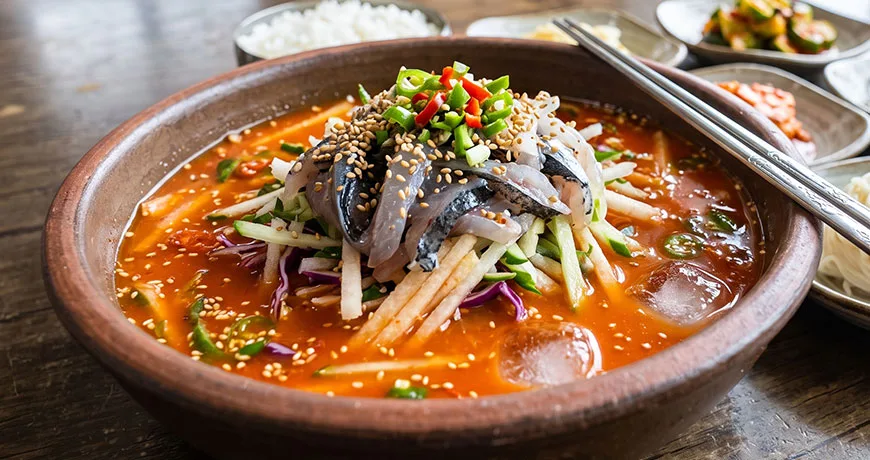
Jari Mulhoe is a quintessential Jeju-style chilled regional soup where jaridom (damselfish), a robust fish caught in Jeju’s rough seas, is sliced bone-in (sekoshi) and infused within the savory depth and heavy salinity of traditional fermented soybean paste (doenjang). The core of this dish lies in the culinary mechanics: the powerful volatile aromatics of crushed zanthoxylum (sichuan pepper/sansho) powder and the rich lipids of doenjang completely mask the fishy undertones, while ice-cold water and ice cubes contract the fish’s muscle fibers to the extreme, yielding a firm, intensely savory chew.
Featuring fresh damselfish sliced bone-in, generous heaps of crisp vegetables, and a rich soybean paste broth, Jari Mulhoe is Jeju’s ultimate refreshing tonic soup designed to instantly wash away the sweltering summer heat and lethargy. The harmony of the fresh Jeju ocean flavor and the earthy depth of doenjang instantly awakens a lagging appetite, while the uniquely crunchy, nutty texture of the bones delivers an unforgettable gastronomic thrill.
Beyond its culinary brilliance, Jari Mulhoe boasts exceptional nutritional value. Rich in taurine—a key fatigue-recovery compound—and high-quality animal proteins, damselfish vigorously stimulates energy metabolism to restore vitality to a weary body. In particular, consuming the fish bone-in supplies abundant calcium and phosphorus to strengthen bones and teeth, while the beneficial components of fermented doenjang gently soothe the gastrointestinal tract and promote smooth digestion.
Combined with a bounty of fresh vegetables providing rich vitamins and dietary fiber, alongside the piquant kick of sansho, this dish boosts metabolism, swiftly replenishing moisture depleted by the heat while firmly supporting immunity. A bowl of Jari Mulhoe, born from the deep regional craftsmanship of Jeju and flawless scientific synergy, stands as the ultimate delicacy that will infuse your body and mind with pristine vitality and wholesome energy.
⏱️ Total: 20 mins | Prep: 20 mins | Cook: 0 mins (Raw) | 🍳 Difficulty: High (Requires specialized knife work for bone-in slicing and broth balance) | 🌶️ Profile: Deeply Savory, Earthy, and Icy | 🍚 Focus: High Calcium (Bone-in), Fermentation Umami, & Thermal Shock
Ingredients (2 servings)
- Main Ingredients: 6–8 fresh sashimi-grade damselfish (jaridom) (approx. 250g, scaled and eviscerated)
- Vegetables & Herbs: 1/2 onion, 1/2 cucumber, 2 green chilies, 5 perilla leaves, a pinch of ground jepi (Sichuan pepper / wild prickly ash) for authentic Jeju aroma
- Jeju-Style Doenjang Broth Medium: 3 tbsp traditional Korean soybean paste (doenjang), 1 tbsp minced garlic, 1–2 tbsp vinegar, 0.5 tbsp sugar (or agave syrup), 2 cups (400ml) water, ice cubes
- (Optional: 0.5 tbsp gochugaru for a mild kick)
Allergy Information Contains: Fish (Damselfish), Soy
Equipment Highly sharpened Sashimi Knife, Sanitized Cutting Board, Large Mixing Bowl, Absorbent Food-grade Paper
Cooking Instructions
- Sanitation & Moisture Extraction: Scale the damselfish from tail to head, remove the gills and viscera, and rinse thoroughly under cold running water. Wrap the fish tightly in absorbent paper to extract 100% of the surface and internal moisture, which prevents mushiness and locks in the clean flavor.
- Bone-in Slicing Mechanics (Sekkosi): Place the dried damselfish on the cutting board. Because the bones are sturdy, tilt your knife to a shallow angle and slice across the body into ultra-thin (2–3mm) diagonal pieces. This microscopic slicing mechanically shortens the bone matrix, transforming a potential hazard into a pleasant, crunchy texture.
- Jeju-Style Doenjang Emulsion: In a large bowl, press the traditional doenjang through a fine mesh strainer to create a smooth base. Whisk in the minced garlic, vinegar, and sugar (or agave syrup). Vigorously emulsify the soy proteins and salinity with the water until a uniform, savory suspension is formed.
- Broth Chilling & Vegetable Prep: Add ice cubes to the prepared doenjang broth to drop its temperature near the freezing point (0°C). Julienne the cucumber, onion, green chilies, and perilla leaves to a uniform thickness.
- Assembly: Construct a bed of the julienned vegetables in chilled bowls. Mound the bone-in sliced damselfish over the vegetables. Pour the hyper-chilled doenjang broth over the dish just before serving, and garnish with a pinch of jepi powder for the traditional herbal finish.
💡 Professional Culinary Tips
- Mechanics of Bone-in Slicing (Sekkosi): Damselfish have exceptionally tough bones. Slicing them flat and thin diagonally extends the surface area of the bone matrix, allowing it to fracture gracefully upon chewing rather than posing a hard hazard.
- Chemical Masking via Doenjang and Jepi: The savory soybean proteins bind to and neutralize oceanic off-flavors, while the volatile monoterpenes in wild Sichuan pepper (jepi) provide the distinct herbal kick characteristic of Jeju coastal cuisine.
- Thermal Shock & Texture Retention: Submerging the fish in a near-freezing doenjang broth forces the muscle and bone structures to contract, ensuring that the snappy, crunchy texture remains intact until the very last bite.
Nutrition Facts (Estimated)
Total Content : Approx. 450g (1 serving, including broth)
Calories : 210 kcal
– Sodium : 1,180mg
– Total Carbohydrate : 15.0g
– Sugar : 6.0g
– Total Fat : 6.0g
– Saturated Fat : 1.0g
– Cholesterol : 75.0mg
– Protein : 24.0g
– Calcium : 320.0mg (High calcium content from bone-in consumption)
*Daily Values are based on a 2,000 calorie diet and standard Korean nutritional reference values
**Nutritional values are calculated based on original ingredients; substitutions may alter specific macronutrients.
The Earthy, Sea-Washed Soul of Jeju Island: A Lyrical Masterpiece of Bone-In Damselfish Doenjang Mulhoe
Jari-mulhoe stands as the rustic, profound, and deeply traditional pinnacle of Jeju Island coastal gastronomy, where fresh damselfish (jaridom)—harvested from the brisk, stone-walled coastal waters of Jeju and meticulously sliced bone-in (sekossi) for a delightful crunch—meets a rich, earthy soybean paste (doenjang) broth brimming with crisp, garden-fresh vegetables. Diverging from the bright red, gochujang-based cold soups of the mainland, this beloved island specialty harnesses the deep, fermented umami of traditional Jeju doenjang and the refreshing snap of sea-kissed produce to deliver an extraordinarily grounding and restorative culinary experience.
The moment a spoonful of the cool, soybean-paste-infused broth touches the palate, an immediate wave of mellow, savory depth envelops the senses. This is swiftly followed by the satisfying, crisp crunch of the tender fish bones and the savory richness of the damselfish flesh, creating a multi-dimensional sensory rhythm that bridges sea and earth. As the natural sweetness of the fish marries the earthy broth and the refreshing crunch of sliced vegetables, the dining table is instantly transformed into a tranquil Jeju coastal breeze.
True gastronomy does not rely on ostentatious artifice; it flourishes in the ancestral wisdom of coastal communities who transformed simple, resilient ingredients into a reservoir of nourishment and comfort. Savoring a chilled bowl of Jeju-style damselfish cold soup today is an elegant and sacred ritual—clearing away the rush of modern life and filling the spirit with unpretentious warmth, island heritage, and timeless solace.
Editor’s Review
1. An Exhilarating Cadence of Bone-In Damselfish Crunch, Earthy Doenjang Depth, and Crisp Vegetable Freshness
The moment a cool, soybean-paste-infused spoonful of Jari-mulhoe coats the palate, an immediate wave of mellow, rustic doenjang umami awakens the taste buds with comforting depth. This earthy richness is swiftly balanced by the delightful, crisp crunch of the bone-in fish (sekossi) and the refreshing snap of garden vegetables, orchestrating an endlessly refreshing, multi-layered sensory thrill that captivates from start to finish.
2. Bone-In Calcium Bioavailability Mechanics and Traditional Jeju Doenjang Fermentation Kinetics
Jari-mulhoe represents an exacting study in island nutritional physics and traditional fermentation biochemistry. The traditional practice of slicing the damselfish bone-in ensures the direct ingestion of high-density natural calcium and trace minerals, establishing an optimal nutritional matrix for skeletal integrity. Concurrently, the bioactive organic acids and peptides generated through traditional doenjang fermentation stimulate digestive enzyme activity, ensuring that the nutrient-dense meal is exceptionally bioavailable and easy on the digestive system.
3. The Jeju Coastal Heritage and the Grounding Sanctuary of Rustic Summer Relief
Found gracing the historic coastal villages and family dining tables of Jeju Island as the ultimate expression of island resilience and culinary heritage, a modest bowl of damselfish cold soup serves as an enduring emotional haven against daily weariness. Revered for generations as an essential seasonal restorative tonic that cools the core and honors local traditions, enjoying this honest, reliable dish washes away modern stress, granting a timeless sanctuary of stillness, coastal heritage, and grounded culinary happiness.