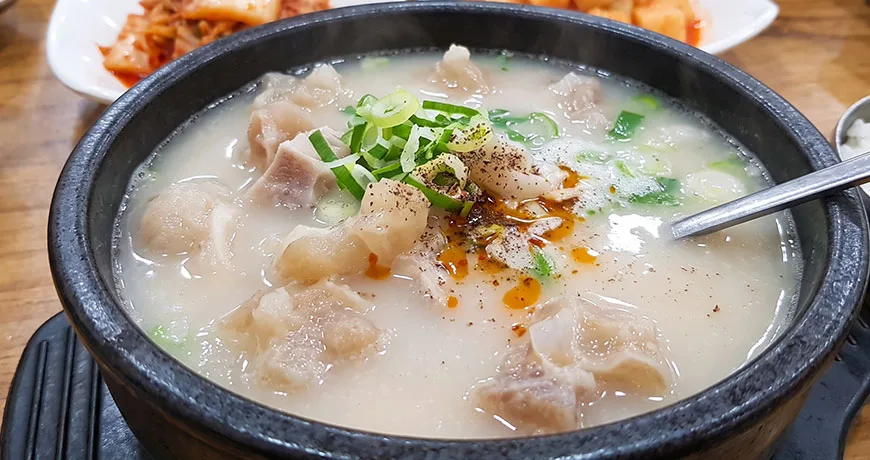
Ujoktang is a high-viscosity biochemical colloidal extraction engineered to transmute the high-density cartilage and connective tissues of a vertebrate’s load-bearing extremities (ox trotters) into a sticky, liquefied gelatin matrix via extreme, prolonged thermal hydrolysis. As the thermodynamic kinetic energy of boiling water molecules ruthlessly degrades the rigid collagen matrix of the trotters, the proteins extracted from the bone and cartilage bind with the rendered animal lipids from the marrow. This creates a flawlessly opaque, milky-white emulsification. This heavy, sticky liquid matrix boasts an intense rheological viscosity that literally glues the lips together. Upon serving, the volatile allyl compounds of freshly chopped green onions are introduced to sharply strike and mask the heavy, gamey aromatics, restoring gustatory balance. In times of extreme cold or physical exhaustion, this is an overwhelming, highly efficient amino acid and lipid fusion energy source designed to instantly coat and absorb into the digestive mucosa.
- ⏱️ Total: 6 hrs 30 mins | Prep: 2 hrs (Osmotic blood purging) | Cook: 4 hrs 30 mins
- 🍳 Difficulty: Extreme (Requires extreme collagen denaturation and emulsion control)
- 🌶️ Profile: Lip-smacking Viscous, with Dense Marrow Richness
- 🍚 Focus: Colloidal Emulsion, Thermal Hydrolysis, & Rheological Viscosity
- 🍶 Pairing: High-proof traditional distilled Andong Soju (>40% ABV)
Ingredients (3–4 servings)
- Collagen & Cartilage Matrix: 1.5kg Cut Ox Feet (Cow Trotters – submerged in cold water for 2 hours to purge blood proteins and impurities via osmotic pressure)
- Deodorization Catalyst: 6L Purified Water (replenish as it evaporates), 10 Whole Garlic Cloves, 1 slice Fresh Ginger, 1 tsp Whole Black Peppercorns
- Aromatic & Allyl Finish: 2 stalks Green Onion (finely chopped, introduced at serving)
- Ionized Sodium & Amino Acid Dipping: Coarse Sea Salt (to taste, individual serving), 2 tbsp Soy Sauce, 1 tbsp Vinegar, 0.5 tsp Hot Mustard (Karashi/Yeon-gyeoja)
Allergy Information
- Contains: Beef, Soy, Wheat (from soy sauce)
Equipment
- Massive High Thermal Mass Cauldron or Stockpot, Cutting Board, Knife, Mixing Bowl
Cooking Instructions
- Thermal Coagulation & Initial Deodorization (Blanching): Pour boiling water over the purged ox feet and boil aggressively for 15 minutes. The water-soluble blood proteins (myoglobin) and impurities trapped between the cartilage and bone marrow will thermally coagulate, erupting into dark, murky foam. Discard this water entirely. Vigorously scrub the ox feet under cold running water to physically obliterate any remaining bone dust and residue.
- Primary Thermal Hydrolysis: Place the cleaned ox feet into a large pot with 6L of fresh water, garlic, ginger, and black peppercorns. Bring to a rapid boil, then cover and simmer over medium heat for 2 hours. The kinetic heat energy begins to systematically sever the rigid collagen chains of the dense bone and cartilage, releasing them into the aqueous solvent.
- Secondary Colloidal Emulsification: As the water reduces, replenish with boiling water and continue to simmer for at least another 2 hours. The continuous convective energy violently collides the rendered lipids and gelatinous proteins extracted from the bone, forging a stable, opaque milky-white emulsion.
- Aromatic Impact & Ionic Serving: Transfer the maximized, ultra-viscous milky broth and the now-jiggling, tender ox feet into a Ttukbaegi (earthenware pot) and bring to a final aggressive boil. Right before serving, introduce a massive amount of chopped green onions. The diner must manually introduce sea salt (NaCl) to the broth, ionizing the sodium to chemically detonate the umami payload.
💡 Professional Culinary Tips
- Colloidal Emulsification Kinetics: The milky white broth of Ujoktang is not a pigment, but a microscopic emulsion of water, fat, and protein. Achieving this requires a continuous, rolling boil that generates strong convection currents. If the thermodynamic temperature drops too low, the lipids and water will separate into a clear, greasy broth, utterly failing to form the signature milky matrix.
- Importance of Sodium Chloride Ionization: Never introduce salt during the cooking process. Premature salting alters the osmotic pressure, severely hindering the extraction of soluble compounds from the bones. Salt must be introduced into the high-temperature broth immediately upon serving, allowing the sodium (Na+) and chloride (Cl-) ions to instantly dissociate and bind with the gelatin’s amino acids, maximizing the umami.
- Biochemical Buffering of Dipping Sauce: The prolonged hydrolysis renders the ox feet intensely sticky, which can quickly induce palate fatigue. A dipping sauce engineered with acetic acid (vinegar) and sinigrin molecules (mustard) acts as a crucial biochemical buffer. It chemically cleaves through the heavy lipid chains, crisply resetting the heavy mucosal coating in the oral cavity.
🍶 Gastronomic Pairing
- Biochemical Palate Cleansing: When the ultra-concentrated gelatin compounds and marrow lipids thickly coat your oral mucosa and esophagus, pair this dish with a shot of 45% ABV Andong Soju (a traditional rice-based distilled spirit). The highly concentrated ethanol molecules physically dissolve the animal fats clumping on your tongue’s surface, flawlessly resetting your taste receptors.
Nutrition Facts (Estimated)
Total Content : Approx. 800g (1 serving, excluding bone weight)
Calories : 520 kcal (Excluding rice)
– Sodium : 150mg
– Total Carbohydrate : 2.0g
– Sugar : 0.5g
– Total Fat : 34.0g
– Saturated Fat : 14.0g
– Cholesterol : 95.0mg
– Protein : 45.0g
– Dietary Fiber : 1.0g
*Daily Values are based on a 2,000 calorie diet and standard Korean nutritional reference values.
**Nutritional values are calculated based on original ingredients; substitutions may alter specific macronutrients.
Origins and Food Culture of Ox Feet Soup (Ujoktang)
1. Joseon Court Medicine, Postpartum Recovery, and Classical Compendiums
- Deeply rooted in the historic medicinal dining traditions of the Joseon Dynasty royal court and noble scholar (yangban) households, where the cow—the nation’s most vital agricultural asset—was utilized from head to hoof with profound culinary and therapeutic reverence.
- Documented in 19th-century encyclopedias such as Lady Bingheogak Yi’s Gyuhap Chongseo and Seo Yu-gu’s Imwon Gyeongjeji, ox feet were prized as the supreme medicinal restorative (yakseon). They were systematically prescribed to postpartum mothers to replenish depleted blood, promote abundant lactation, and prevent postpartum joint aches (sanhupung), while regularly served to elderly clan patriarchs to fortify brittle bones and stiff knees.
2. The Culinary Science of Desanguination, Singeing, and Hydrothermal Gelatinization
- The hallmark of authentic preparation lies in an arduous cleaning and extraction process: thoroughly singeing the hair from the hooves over flame (somo), scraping the hide clean, and soaking the feet in flowing cold water for over twelve hours to leach out deep-seated heme iron and bone impurities.
- After a rapid initial blanching to discard the bitter first broth, the ox feet are simmered over a low, steady flame for six to eight hours. This controlled thermodynamic extraction allows the collagenous skin and tendons to detach cleanly from the bones while preserving their plump, springy chewiness without dissolving into liquid mush.
3. The Culture of “Lip-Sticking” Broth and the Legacy of Jeonju Ujoktang
- Distinct from milkier Seolleongtang or clear Gomtangguk, authentic Ujoktang is celebrated for its extraordinary collagen density, giving rise to the famous Korean gastronomic criterion that “if the broth doesn’t make your lips stick together, it isn’t true Ujoktang.”
- Anchoring prominent culinary hubs near historic regional cattle markets—most notably in Jeonju, Jeollabuk-do (famed for its century-old Jeonju Ujoktang alleys), as well as Suwon and Pyeongtaek in Gyeonggi-do—this noble soup remains an enduring cultural monument to Korean slow-food heritage, dedicated to soothing worn joints and restoring vital life energy across generations.
The Monumental Extraction of Bovine Pedal Collagen and the Viscoelastic Majesty of Simmered Tendons: A Refined Portrait of Ujoktang
Ujoktang (Simmered Ox Feet Soup) stands as the deeply restorative, unctuously rich, and structurally majestic summit of Korea’s bovine bone (tangban) gastronomy. The four lower trotters of the ox—anatomical pillars designed to bear massive skeletal tonnage across years of terrestrial exertion—are steeped in running cold water for hours to thoroughly leach deep-bone hemoglobin and residual myoglobin. Subjected to a preliminary rolling blanch with whole garlic cloves, fresh ginger root, and refined rice wine to strip away surface coagulants and volatile tallow off-odors, the feet are transferred to a massive, roaring iron cauldron. Simmered across tens of hours of patient heat convection as fresh water is continuously replenished, the dense fibrous cartilage, thick epidermal dermis, and subterranean Achilles tendons break down. Moving far beyond the lean clarity of common beef soups, Ujoktang harnesses the complete hydrothermal breakdown of structural mammalian collagen, yielding an ivory-opaque, lip-coating elixir brimming with bioavailable vitality.
Confronting the boiling earthenware pot (ttukbaegi) as clouds of rich white steam billow across its surface, lifting a large, glistening segment of ox trotter with a heavy ceramic spoon releases an immediate, deeply comforting sensory charge: the primal, buttery perfume of slow-extracted bovine marrow mingles seamlessly with the brisk, sulfurous freshness of freshly sliced Welsh onions and cracked black pepper. Seasoned transparently with sea salt and sipped directly from the vessel, the broth coats oral tissues in a dense, velvety film of natural gelatin; the unctuous stock glides effortlessly down the esophagus, delivering deep, restorative warmth to an exhausted digestive tract and tired joints. Sinking your teeth into the trotter reveals an exhilarating textural revelation: the thick, gelatinous skin and dense tendon bundles yield with a firm, springy bounce (jjondeuk) before melting smoothly under tooth pressure, releasing streams of captured cellular nectar and marrow minerals. Dipped into an assertive chive-and-mustard soy sauce to sharpen the palate, and followed by a spoonful of broth-soaked rice capped with a crisp cube of aged radish kimchi (kkakdugi), the meal resolves into an unforgettable ritual of physical rejuvenation and profound gastronomic catharsis.
The enduring majesty of Ujoktang lies in its noble lineage within Korean medicinal food therapy (sikchi)—celebrated across centuries of royal court records and aristocratic domestic manuals as a sovereign restorative for postpartum maternal recovery, bone replenishment, and joint longevity. Reflecting the ancient agrarian ethos of utilizing every extremity of the sacred draft ox without waste, a steaming cauldron of ox feet soup remains an irreplaceable monument of zero-waste anatomical stewardship, patient thermodynamics, and brilliant Korean culinary craftsmanship.
Editor’s Review
1. A Dynamic Harmony of Springy Epidermal Viscoelasticity, Melting Tendon Give, and Lip-Coating Broth Lubrication
The textural landscape inside the vessel delivers an extraordinary, tactile choreography derived entirely from the dense connective anatomy of the lower bovine limb. The thick epidermal skin and the robust tendon bundles (principally the Achilles tendon complex), relaxed by hours of controlled hydrothermal cooking, exhibit a buoyant, elastic chew that resists the teeth with an unctuous spring before collapsing cleanly. Tender strands of meat adhering to the ankle bones pull away with delicate, juicy softness, providing textural contrast. Concurrently, the extracted gelatin elevates the dynamic viscosity of the broth, creating a luxurious, micro-thin fluid boundary over the oral mucosa and steeped rice grains that ensures a smooth, non-fatiguing mouthfeel from the first steaming sip to the last.
2. Type I Collagen Hydrothermal Gelatinization, Marrow Lipid O/W Micro-Emulsification, Hydroxyproline-Driven Viscoelasticity, and Scallion Allicin Volatilization Mechanics
Ujoktang represents an exacting study in connective tissue biophysics, macromolecular thermodynamics, and lipid colloid dynamics. The dermal layers, periosteum, and dense regular connective tissues of the ox feet are composed almost entirely of insoluble Type I collagen, characterized by a tight, triple-helical structure reinforced by repeating Glycine-Proline-Hydroxyproline motifs. Sustained convective heat between 85°C and 100°C irreversibly cleaves the inter- and intra-molecular covalent cross-links, hydrolyzing the rigid collagen fibers into water-soluble gelatin polypeptides. As the broth cools below 60°C, these gelatin molecules begin to form weak, transient network junctions (the basis of the gel-sol transition), creating the soup’s distinctive lip-clinging tackiness. Concurrently, neutral lipids liberated from spongy cancellous bones and marrow cavitations are subjected to the violent shear forces of the rolling boil, where amphiphilic gelatin fragments act as natural surfactants, encapsulating the lipid droplets into a stable oil-in-water (O/W) micro-emulsion that scatters incident light into an opaque, milk-white turbidity. Inosine monophosphate (IMP) from residual skeletal muscle converges with free amino acids leached from the bone matrix to stimulate oral T1R1/T1R3 umami heterodimers, while organosulfur volatiles from sliced scallions sequester lipid-derived aldehydes (such as hexanal) to preserve a pristine, pure bovine aroma.
3. Royal Court Sikchi (Food Therapy) Lineage and the Sovereign Zenith of Whole-Carcass Bovine Gastronomy
Distinct from meat-centric broths or simple skeletal bone extractions, Ujoktang’s dedication to the hoof and lower extremities highlights the historic sophistication of Korean culinary medicine. Documented in classical texts like the 15th-century Sikryo-chanyo as an elite remedy for replenishing vital fluids, stimulating maternal lactation, and fortifying skeletal joints, this unmasked masterpiece elevates a challenging, fibrous cut into a monumental restorative tonic, standing as an enduring sanctuary of sustainable whole-animal resourcefulness, domestic care, and brilliant culinary mastery.