
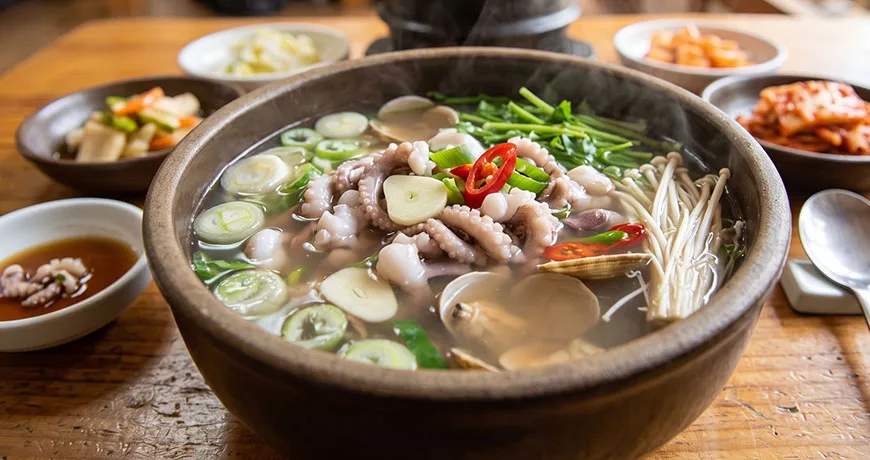
Yeonpotang is the ultimate clear biochemical soup engineered to poach the extremely delicate, soft muscle fibers of cephalopods (octopus) into a state of flawless viscoelasticity within a boiling aqueous solvent. The artisan begins by utilizing coarse salt to mechanically strip away the viscous mucin proteins from the live octopus. This pristine, writhing matrix is then introduced into a clear solvent infused with cooling reducing sugars (from the thermal hydrolysis of daikon radish pectin) and volatile allyl sulfides from green onions. Because cephalopod proteins aggressively contract and turn to tough rubber the moment temperatures exceed 85°C (185°F), strict critical temperature control is mandatory: the octopus must be plunged into the rolling broth and extracted or sliced the exact second it puffs up plump and pink (roughly 1 to 2 minutes). The succinic acid leached from the radish and seafood creates a profound, refreshing oceanic umami entirely devoid of harsh capsaicin, making this the premier restorative matrix for soothing a liver fatigued by alcohol metabolism.
⏱️ Total: 30 mins | Prep: 15 mins | Cook: 15 mins | 🍳 Difficulty: Moderate (Requires strict cephalopod thermal control and clear broth extraction) | 🌶️ Profile: Clean, Deeply Refreshing, Briny, and Garlic-Aromatic | 🍚 Focus: Critical Thermal Coagulation, Pectin Hydrolysis, & Mucin Depletion | 🍶 Pairing: Chilled, refined traditional clear Cheongju (Rice Wine)
Ingredients (2 servings)
- Biokinetic Taurine Matrix: 2 Live Octopuses (San-nakji – aggressively massaged with flour and coarse salt to purge surface mucin slime)
- Pectin & Reducing Sugar Matrix: 150g Daikon Radish (sliced into squares)
- Aqueous Umami Solvent: 1.2L Anchovy-Kelp Broth or Purified Water
- Aromatic & Allyl Sulfide Catalyst: 1 stalk Green Onion (diagonally sliced), 1 tbsp minced garlic, 1 Cheongyang green chili, 1 Red Chili (diagonally sliced), 1 handful Water Dropwort (Minari) or Crown Daisy
- Baseline Osmotic Binder: Coarse Sea Salt (to taste), a pinch of black pepper
Allergy Information Contains: Molluscan Shellfish (Octopus), Fish (if using anchovy broth)
Equipment Deep, Wide Pot, Cutting Board, Knife, Mixing Bowl (for octopus washing)
Cooking Instructions
- Mucin Depletion: Dump flour and coarse salt over the live octopuses and knead them violently by hand. This mechanical friction strips away the slippery mucin proteins and grit from the suction cups. Rinse thoroughly under cold water.
- Pectin Hydrolysis: Place the purified water (or anchovy broth) and the square-cut radish into a deep pot and heat over high flame. Starting from cold allows the rigid pectin walls of the radish to gradually undergo thermal hydrolysis, smoothly leaching its sweet, cooling reducing sugars into the solvent.
- Osmotic Baseline & Aromatic Extraction: Once the broth reaches a rolling boil, add the minced garlic, green onions, and green chilies. Season the baseline osmotic pressure lightly with sea salt. The volatile allyl sulfides of the green onions dissolve into the liquid, establishing a clean, aromatic foundation.
- Critical Temperature Control: The exact moment the clear broth is rolling at a violent boil, submerge the clean live octopuses whole into the pot. The second the octopus puffs up into a pale pink, plump form with its tentacles curling gracefully (about 1 to 1.5 minutes), immediately use kitchen shears to cut it into manageable pieces and remove it from the heat, or lower the flame instantly. Overboiling will render it tough and rubbery.
- Aromatic Finish: After extracting or softening the octopus, toss the Minari into the pot and turn off the heat. Utilize the massive radiant radiant heat of the pot to gently wilt the greens, locking in their fresh terpene aromas to maximize the clarity and refreshing finish of the soup.
💡 Professional Culinary Tips
- Kinetics of Irreversible Cephalopod Thermal Contraction: The muscle proteins (actin and myosin) of cephalopods are exceptionally sensitive to heat. Exposing them to temperatures exceeding 85–90°C for more than a couple of minutes causes them to expel their internal moisture, knot together violently, and turn into rubber. The essence of Yeonpotang is not a long-simmered stew, but rather a shabu-shabu-style fluid dish designed to be flash-poached for ultimate tenderness.
- Designing a Clear Umami Solvent: By completely omitting heavy pastes like Gochujang or chili flakes and relying entirely on radish and green onions, the dish honors the pure, sweet glycogen and taurine of the octopus. The clear solvent laden with radish pectin acts as a natural digestive buffer that gently coats the mucosal lining of the stomach without irritation.
- Preserving Minari Terpenes: Boiling water dropwort (Minari) from the very beginning destroys its volatile terpene compounds, leaving behind only tough, stringy fibers. Adding it at the very last second and letting it wilt strictly via residual heat preserves both its crisp turgor (crunch) and its forest-fresh aromatics.
🍶 Gastronomic Pairing
- Biochemical Palate Cleansing: When the tender, bouncy octopus meat and the cooling reducing sugars of the radish clean your palate, pair this dish with a thoroughly chilled glass of traditional clear Cheongju (Rice Wine). The refined ethanol molecules highlight the clean, delicate sweetness of the seafood protein while leaving a crisp, refreshing finish that perfectly resets your taste receptors.
Nutrition Facts (Estimated)
Total Content : Approx. 500g (1 serving)
Calories : 180 kcal
– Sodium : 850mg (Variable based on salting)
– Total Carbohydrate : 10.0g (Primarily reducing sugars from radish)
– Sugar : 3.0g
– Total Fat : 1.5g (Ultra-low fat, high protein matrix)
– Saturated Fat : 0.0g
– Cholesterol : 120.0mg (From octopus)
– Protein : 28.0g (Dense with bioavailable taurine and lean protein)
– Dietary Fiber : 3.5g
*Daily Values are based on a 2,000 calorie diet and standard Korean nutritional reference values.
**Nutritional values are calculated based on original ingredients; substitutions may alter specific macronutrients.
Origins and Food Culture of Bean Curd and Soft Octopus Soup (Yeonpotang)
1. The Joseon Scholar Tradition of “Yeonpohui” and the Bean Curd (Tofu) Etymology
- Historically, the Hanja name Yeon-po (軟泡) literally translates to “soft bean curd” (po 泡 being an archaic literary term for tofu 豆腐); the dish originated as an elite Joseon Dynasty restorative broth prepared by simmering fresh tofu in rich chicken or beef stock.
- Documented in 19th-century seasonal records such as Hong Seok-mo’s Dongguk Sesigi and the Annals of the Joseon Dynasty, Confucian scholars and royal officials in Hanyang historically held autumn and winter gatherings known as Yeonpohui (軟泡會); they traveled to scenic mountain Buddhist monasteries famed for artisanal tofu making to compose poetry while sharing cauldrons of simmering tofu soup, cementing its identity as a noble, high-protein wellness staple.
2. The Southwestern Mudflat Convergence and the “Lotus Blossom” (蓮苞) Poaching Science
- During the mid-to-late 20th century, the dish underwent a culinary transformation along the southwestern mudflat ports of Jeollanam-do (Yeongam, Muan, and Mokpo), where cooks began introducing live mudflat octopus (nakji) into the ancestral clear tofu broth.
- The name poetically shifted to evoke the visual imagery of a blooming lotus (Yeon-po / 蓮苞), as the eight octopus tentacles curl outward into a flower-like rosette upon contact with boiling broth. Because cephalopod muscle fibers (actin and myosin) denature rapidly, prolonged boiling toughens the meat into rubber; authentic master kitchens practice flash-poaching (saljjak dechigi), submerging the live octopus into the seasoned vegetable broth for merely one to two minutes before extinguishing the heat to preserve an exquisitely tender, velvety texture.
3. The Pinnacle of “White Hangover Relief” and Southern Slow-Food Elegance
- In stark contrast to fiery crimson stews (Maeuntang or Nakji-bokkeum) laden with heavy chili paste, Yeonpotang champions the minimalist elegance of Korea’s clear broth (baektang) tradition, relying solely on natural sea salt, light soy sauce, and botanical extraction.
- Celebrated nationwide as the gentlest, most restorative hangover elixir and stamina tonic, it harmonizes the regenerative taurine of mudflat octopuses with the alkaline comfort of wholesome tofu. Anchoring celebrated destinations like the Yeongam Dokcheon Octopus Alley and Muan Mudflat Market, Yeonpotang remains an enduring cultural monument to Korean maritime gastronomy, motherly comfort, and restorative wellness.
The Gossamer Elasticity of Cloud-Like Bean Curds and the Aristocratic Clarity of Simmered Capon Broth: A Refined Portrait of Yeonpotang
Yeonpotang (Clear Simmered Soft Bean Curd Soup) stands as the pristine, tranquil, and intellectually elevated summit of Korea’s classical noble (yangban) tofu gastronomy. Prime harvest yellow soybeans are pulverized on a water-fed millstone and brought to a slow convective boil in cast-iron cauldrons before being gently cross-linked with mineral sea bittern (gansu). The fragile, snow-white curds (yeonpo—literally “soft froth” or “lotus curds”) are ladled off at the exact moment of curdling, bypassing heavy mechanical pressing. Arranged inside a white porcelain vessel or traditional brass hot pot alongside translucent thin sheets of winter radish, shiitake and umbilicaria tree mushrooms (seogi), wild water parsley, and scallions, the delicate curds are immersed in a pristine poultry or brisket stock seasoned transparently with aged soup soy sauce and solar sea salt. Long before the 20th-century coastal emergence of southern octopus-based stews sharing the same phonetic name, the historical, Joseon-era Yeonpotang reigned as the supreme celebration of legume protein—suspending an uncompressed, fully hydrated soy gel within a crystalline broth to soothe internal organs with serene, restorative warmth.
Confronting the steaming porcelain bowl as clouds of ivory steam carry delicate ripples between dark woodland mushrooms and verdant greens, lifting a fragile square of bean curd with a deep ceramic spoon releases an immediate, deeply calming olfactory charge: the savory, comforting perfume of slow-clarified poultry essence mingles seamlessly with the clean, cereal sweetness of freshly set soy curds, the earthy forest musk of tree lichen, and the brisk, sulfurous warmth of sliced scallions. Taking the first sip delivers an unadorned revelation: the pristine, amber-gold stock, illuminated by the natural succinic and glutamic acids of slow-braised radish and poultry bones, glides over the palate with zero greasiness, washing down the throat to unlock an exhilarating sensation of internal clarity. Sinking your teeth into the trembling bean curd requires virtually zero mastication; the silken matrix collapses across the tongue like warm morning mist, releasing trapped cellular sweet milk and pristine plant starches. The tender, translucent radish yields with a refreshing burst of vegetable moisture, beautifully framed by the toothsome chew of woodland mushrooms, leaving behind an exceptionally clean, resonant finish that embodies the highest ideals of gastronomic and spiritual peace.
The enduring majesty of Yeonpotang lies in its classical literati heritage—crystallized during the late Joseon Dynasty in the seasonal gathering known as Yeonpogye (軟泡契). During the tenth lunar month, noble scholars trekked into mountain valleys to visit Buddhist temple monasteries—the master artisans of the craft (joposo)—to share freshly made bean curds simmered in hot cauldrons with local monks. Documented in historical chronicles such as the Yeolyang Sesigi (1819) and classical cookbooks as an elite restorative for the onset of winter, this unadorned bowl represents the noble synthesis of monastic soy craftsmanship and aristocratic broth-clearing technique, remaining an irreplaceable cultural monument of philosophical restraint, seasonal harmony, and dazzling Korean culinary refinement.
Editor’s Review
1. A Dynamic Harmony of Cloud-Like Bean Curd Dissolution, Tender Radish Yield, and Frictionless Clear Broth Fluidity
The textural landscape inside the vessel delivers an extraordinary, high-register choreography between an uncompressed protein hydrogel, tender hydrated root fibers, and an ultra-low-viscosity fluid matrix. The gently set yeonpo (soft bean curd), retaining an exceptionally high water content, collapses under the slightest tongue pressure without chalky resistance, offering a cloud-like, melting oral cushion. This ethereal lightness is anchored by the thin sheets of winter radish, which yield with a tender, juicy bite that floods the palate with cool vegetable nectar. The supple, toothsome chew of rehydrated tree lichen and shiitake introduces subtle mechanical friction, while the completely defatted, clarified stock glides effortlessly across oral membranes, ensuring an impeccably balanced, non-fatiguing mouthfeel from the first steaming spoonful to the last.
2. Soy 11S Glycinin Divalent Cation (Ca2+, Mg2+) Ionic Gelation, Micro-Porous Water Holding Capacity (WHC) Dynamics, and Triple Nucleotide Umami Synergism (IMP-Glutamate-GMP)
Yeonpotang represents an exacting study in plant seed globulin biophysics, hydrocolloid porosity, and nucleotide umami receptor kinetics. Pulverizing soaked soybeans liberates major storage globulins—predominantly hexameric 11S glycinin and trimeric 7S beta-conglycinin. Thermal heating between 85°C and 90°C unfolds these globular structures, exposing buried hydrophobic residues. Introducing natural solar bittern introduces divalent cations (Mg2+, Ca2+) that bridge the negatively charged carboxyl groups of adjacent polypeptides, forming an open, three-dimensional viscoelastic gel network. Because the curds are not subjected to heavy pressing weights, their internal capillary micro-pores remain intact, endowing them with an exceptionally high Water Holding Capacity (WHC) that allows the curds to absorb the hot broth like microscopic sponges. Muscle-derived inosine monophosphate (IMP) from the clarified capon broth converges with the soybean’s native free glutamic acid and the guanosine monophosphate (GMP) extracted from shiitake mushrooms, triggering an exponential triple synergy across oral T1R1/T1R3 heterodimers. Convective heat must be strictly regulated below 90°C (gentle simmering); rapid boiling would vaporize trapped interstitial water within the tofu, creating coarse internal vacuoles and tearing the pristine, velvety surface.
3. The Joseon Literati Yeonpogye Heritage, Temple Joposo Monastic Alchemy, and the Sovereign Summit of Classical Soy Gastronomy
Far from being a mere precursor to contemporary seafood stews, the historical bean-curd Yeonpotang represents the absolute zenith of Korean philosophical cookery. By wedding the sacred, non-violent soybean alchemy of Buddhist monastic workshops with the courtly refinement of clarified ancestral broths, this dish achieved the highest possible tier of nutritional and structural purity. Standing as a luminous testament to seasonal gratitude, culinary subtraction, and holistic bodily restoration, this ivory-and-crystal classic remains an enduring sanctuary of aristocratic elegance, agrarian stewardship, and brilliant Korean culinary craftsmanship.