Eomukkkochi is a masterclass in the hydration and thermal stabilization of highly refined fish myofibrillar protein (Surimi). Using premium fishcakes with an overwhelming concentration of fish meat rather than cheap wheat flour ensures that the cross-linked protein matrix remains structurally sound, resisting hydrodynamic disintegration even when fully saturated with broth. The soul of this dish is its uncompromising, MSG-free aqueous umami solvent. By orchestrating a ternary umami synergy—merging the glutamate from dried kelp, the inosinate (IMP) from large anchovies, and the guanylate from dried shiitake mushrooms—an exponentially powerful consommé is constructed. The skewered fishcakes are carefully introduced into this solvent not to be boiled, but to be gently poached at a critical 85–90°C. This specific thermodynamic control allows the starches within the fishcake to undergo precise gelatinization while the protein matrix swells osmotically, achieving peak viscoelasticity without collapsing into a soggy, gelatinous mush.
- ⏱️ Total: 45 mins | Prep: 15 mins (Cold-water umami extraction & mechanical skewering) | Cook: 30 mins
- 🍳 Difficulty: Medium (Requires thermodynamic convection control to prevent surimi matrix syneresis and broth clouding)
- 🌶️ Profile: Crystalline Marine Umami, Deeply Savory, with a Bouncy Viscoelastic Chew
- 🍚 Focus: Ternary Umami Synergy Extraction, Surimi Osmotic Hydration, & Critical Thermal Poaching
- 🍶 Pairing: Chilled, crisp Traditional Cheongju or warm, dry Sake (Atsukan)
Ingredients (3–4 servings)
- High-Density Viscoelastic Surimi Matrix: 4–6 sheets Premium Rectangular Fishcakes (Eomuk – strictly requiring 70%+ fish content. Folded in a zig-zag accordion style and threaded onto bamboo skewers for physical structural integrity)
- Pectin & Reducing Sugar Matrix: 200g Daikon Radish (sliced thickly into squares)
- Ternary Umami Solvent: 1.5L Purified Water, 2 pieces Dried Kelp (Kombu – Glutamate source), 15 Large Dried Anchovies (heads and internal organs strictly removed to prevent bitterness – IMP source), 2 Dried Shiitake Mushrooms (Guanylate source)
- Ionized Sodium Binder: 2 tbsp Traditional Soup Soy Sauce (Guk-ganjang), Coarse Sea Salt to taste (Dark soy sauce is forbidden to preserve optical clarity)
- Aromatic & Allyl Catalyst: 1 stalk Green Onion (diagonally sliced), 1 Cheongyang green chili, 1 Red chili
Allergy Information Contains: Fish (Surimi, Anchovy), Soy, Wheat (from Soy Sauce, trace starches in fishcake)
Equipment High Thermal Mass Earthenware Pot (Ttukbaegi) or Wide Shallow Pan, Bamboo Skewers, Fine Skimmer, Cutting Board, Knife
Cooking Instructions
- Cold-Water Extraction (Glutamate): Place the purified water and dried kelp into a pot. Let it steep cold for 15 minutes to proactively leach the glutamate. Apply medium heat. Just before the water reaches a rolling boil (approx. 80°C), promptly remove and discard the kelp. Prolonged boiling of kelp extracts slimy alginic acid, which irreparably clouds the consommé.
- IMP & Guanylate Fusion: Into the clear glutamate solvent, introduce the gutted anchovies, shiitake mushrooms, and square-cut radish. Simmer gently over medium-low heat for 20 minutes. This sustained kinetic energy fuses the inosinate and guanylate with the glutamate, executing a flawless ternary umami synergy. Remove the anchovies and mushrooms to finalize the pristine broth.
- Critical Thermal Poaching & Hydration: Precisely calibrate the sodium ion concentration using soup soy sauce and sea salt. Once the broth comes to a boil, introduce the skewered fishcakes. Immediately reduce the heat to a gentle simmer (85–90°C). Do not allow a rolling boil. Poach the fishcakes for 5–7 minutes, allowing them to osmotically absorb the broth and swell like sponges.
- Turgor Pressure Stabilization: As the internal starches gelatinize and the surimi matrix expands to its maximum bouncy, viscoelastic state, kill the heat immediately to prevent the proteins from over-denaturing and turning flabby.
- Allyl & Capsaicin Finish: While the broth remains hot, scatter the scallions and sliced chilies over the surface. This final infusion of volatile allyl compounds and capsaicin provides a crisp, refreshing accent against the deep marine umami.
💡 Professional Culinary Tips
- Preventing Hydrodynamic Collapse of Surimi: Boiling fishcakes violently at 100°C for over 10 minutes destroys the protein bonds. The internal starches leach out, polluting the clear broth into a cloudy, glue-like paste, while the fishcake itself turns into an unappetizing, rubbery mush (syneresis). Fishcakes are not meant to create the broth; they are designed to absorb it. Gentle 85°C poaching is the absolute law for preserving their bouncy texture.
- Ternary Umami Synergy: Unlike commercial broths reliant on artificial MSG, the combination of Kelp (Glutamate), Anchovy (IMP), and Shiitake (Guanylate) creates a biochemical reaction on the palate. When these three molecules intersect in an aqueous solution, the perception of umami does not just add mathematically—it multiplies exponentially, striking the taste receptors with profound depth.
- The Physics of Mechanical Structuring: Folding the flat fishcake sheets into a zig-zag accordion shape before skewering is not merely aesthetic. This physical structuring prevents the delicate sheets from tearing as they expand under heat. Furthermore, the overlapping layers create a capillary action, trapping the umami-rich broth between the folds so that every bite releases a localized explosion of soup.
🍶 Gastronomic Pairing
- Biochemical Palate Cleansing: When the bouncy, lipid-rich surimi and the profound ternary umami broth completely coat your oral mucosa, pair this street-food masterpiece with a crisp, chilled Traditional Cheongju, or a warm, dry Sake (Atsukan). The highly refined ethanol and tartaric acid act as a gentle astringent, cleanly slicing through the slick marine lipids on your tongue and refreshing your palate for the geometrically amplified umami of the very next skewer.
Nutrition Facts (Estimated)
Total Content : Approx. 550g (1 serving)
Calories : 240 kcal
– Sodium : 1,350mg (Elevated due to soy sauce/salt calibration and inherent sodium in surimi)
– Total Carbohydrate : 18.0g (Starches from fishcake and reducing sugars from radish)
– Sugar : 3.0g
– Total Fat : 8.5g (Natural unsaturated marine lipids and trace frying oils from premium fishcake processing)
– Saturated Fat : 1.5g
– Cholesterol : 45.0mg
– Protein : 22.0g (Highly bioavailable myofibrillar fish protein)
– Dietary Fiber : 3.0g
*Daily Values are based on a 2,000 calorie diet and standard Korean nutritional reference values.
**Nutritional values are calculated based on original ingredients; substitutions may alter specific macronutrients.
Origins and Food Culture of Rolled Ginseng Chicken Soup (Roll Samgyetang)
1. Lineage: From Royal Court Baeksuk to 20th-Century Samgyetang and Contemporary Innovation
- The lineage of Roll Samgyetang traces back to ancient peninsular poultry decoctions (Baeksuk) and the early 20th-century practice of simmering whole young chickens with powdered ginseng (Samgyejeong), which evolved during the 1960s into ubiquitous whole-bird Samgyetang—the definitive canine-day (Sambok) summer restorative bowl.
- Entering the 21st century, contemporary Korean chefs sought to reimagine the dish for modern diners, international banquet guests, and younger generations who found navigating bone fragments and the visual presentation of a whole boiled fowl cumbersome. This prompted the development of a refined, boneless interpretation that preserves every medicinal compound of the traditional soup within a sophisticated, contemporary format.
2. The Culinary Science of Roulade Architecture and Precision Low-Temperature Poaching
- Roll Samgyetang represents a masterly synthesis of traditional Korean soupcraft with the classical French techniques of the roulade and galantine. Artisans completely debone the chicken, butterfly the meat to an even thickness, tightly encase the medicinal stuffing using food-grade wrap or butcher’s twine, and poach the roll via precision steam or sous-vide water baths at 65–70°C.
- This thermodynamic decoupling solves the classic flaw of conventional whole-bird stewing, where lean breast meat overcooks and dries out while waiting for the thigh joints to soften. Meanwhile, the discarded skeletal frame is simmered separately over high heat to extract collagen and bone marrow into an immaculate amber broth; joining the two components immediately prior to service ensures both peak meat tenderness and pristine broth clarity.
3. Modern Fine Dining, Global Banquets, and the Era of “Boneless Wellness”
- Today, Roll Samgyetang anchors tasting menus across Michelin-starred modern Korean fine dining establishments, luxury hotel banquet halls, and international diplomatic state dinners, serving as an ambassador of elevated Korean culinary artistry.
- Transforming a rustic, hands-on tavern dish into an elegant soup enjoyed comfortably with only a soup spoon, it has also gained prominence as a premium restorative care food for children and elderly individuals. Roll Samgyetang stands as an enduring monument to the dynamic evolution of Korean gastronomy, marrying ancestral medicinal wisdom with cutting-edge culinary craftsmanship.
The Architectonic Roulade of Deboned Poultry Flesh, the Earthy Core of Sun-Kissed Ginseng and Sticky Rice, and the Crystalline Warmth of Aromatic Avian Consommé: A Refined Portrait of Roll Samgyetang
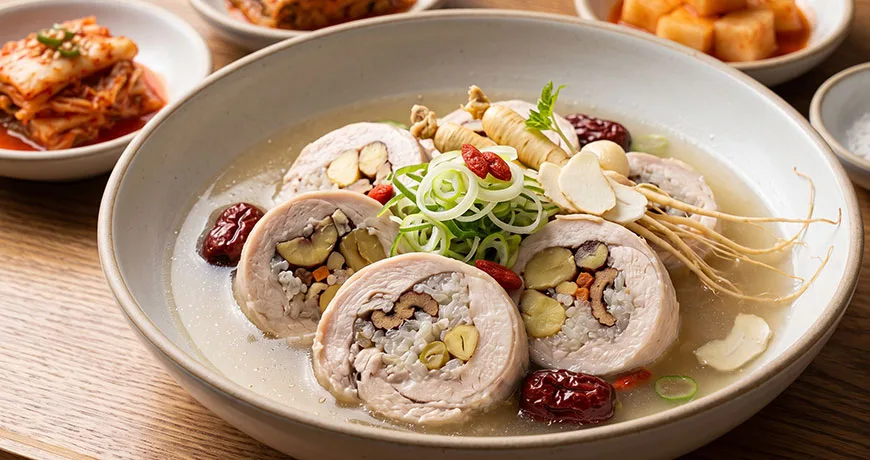
Roll Samgyetang (Rolled Ginseng Chicken Soup) stands as the avant-garde, pristine, and biologically sublime summit of Korea’s contemporary fine-dining (tangban) gastronomy. Reinterpreting the century-old summer dog-days (Sambok) restorative tradition through the lens of modern culinary physics, this dish completely transcends the rustic awkwardness of picking through small bones and the uneven thermal gradients typical of boiling whole young fowl. The preparation begins with architectural butchery: tender spring chickens are meticulously deboned, unrolling the breast and thigh muscles into a singular, uniform protein canvas. Layered across this canvas is a harmonious filling: julienned roots of fresh Geumsan ginseng (susam) exuding earthy dampness, soaked sweet glutinous rice, finely sliced sweet Boeun jujubes, peeled Gapyung chestnuts, toasted ginkgo nuts, and crushed garlic. Rolled tightly inside its own skin into an immaculate cylindrical roulade (or ballotine), the chicken cylinder is vacuum-sealed and cooked with low-temperature sous-vide precision (65–72°C), allowing the myofibrillar proteins to cross-link into a succulent, sliceable matrix with zero moisture loss. Concurrently, the extracted skeletal bones, neck, and wing joints are simmered separately alongside mature ginseng rootlets, milk vetch (hwanggi), Siberian ginseng bark, and sweet alliums across hours of gentle convection, releasing structural gelatin and bitter-sweet saponins into an amber stock. Following exhaustive chilling and defatting to remove all poultry tallow, the broth is clarified into a glistening, diamond-pure consommé. Plated inside a warm celadon bowl or minimalist earthenware vessel, thick medallions of the rolled chicken are submerged in the piping-hot ginseng consommé, anointed with droplets of cold-pressed ginseng oil, and crowned with gossamer threads of dried jujube and scallions, achieving absolute thermodynamic harmony between ancient restorative alchemy and modern haute cuisine.
Confronting the steaming white porcelain bowl as delicate golden steam ascends from around the jewel-like chicken medallions, lifting a deep spoon of the broth releases an immediate, deeply calming sensory charge: the bitter-sweet, noble perfume of fresh ginsenosides mingles seamlessly with the clean, roasted savor of slow-simmered poultry bones, the warm honeyed fragrance of dried jujubes, and the woody sharpness of white pepper. Taking the first sip delivers an unadorned revelation across the oral mucosa: devoid of greasy surface tension, the clarified peptide broth floods the tongue with silk-like softness, gliding effortlessly down the esophagus to soothe fatigued tissues and infuse the empty body with deep, serene warmth. Gently carving a medallion with the edge of a spoon reveals chicken whose perimysial boundaries have relaxed under low-temperature poaching; the meat parts with effortless, cloud-like tenderness, discharging sweet trapped juices. At the core, the steamed glutinous rice yields with an unctuous, viscoelastic chew (jjolgit), while the crisp matchsticks of fresh ginseng fracture with an energetic, auditory snap that releases bursts of bitter-sweet botanical nectar. The soft, floury chestnut and sweet jujube cushion the chew, uniting all the iconic elements of classic Samgyetang into a single, perfectly proportioned bite. Bypassing the mess of deboning at the table, enjoying this pristine elixir becomes an unforgettable ritual of modern metabolic renewal, aesthetic pleasure, and profound gastronomic catharsis.
The enduring majesty of Roll Samgyetang lies in its historical transformation—evolving from the early 20th-century Gyesamtang, an elite medicinal soup prepared in traditional taverns with powdered ginseng, into the definitive national summer tonic of the 1960s, and now into an iconic masterpiece of contemporary Korean fine dining. Deconstructing the rustic, bone-strewn ritual into an ergonomic, visually captivating format without sacrificing the core holistic philosophy of Iyeolchiyeol (governing summer heat with internal heat) and Sikchi (food as medicine), Roll Samgyetang remains an irreplaceable monument of culinary modernization, structural precision, and brilliant Korean gastronomic craftsmanship.
Editor’s Review
1. A Dynamic Harmony of Low-Temperature Poultry Flaking, Viscoelastic Glutinous Rice Give, Crisp Ginseng Snap, and Frictionless Consommé Fluidity
The structural architecture inside the vessel delivers an extraordinary, four-tiered choreography between a heat-set poultry muscle cylinder, gelatinized glutinous rice starch, crisp dicotyledonous root matrices, and an ultra-low-viscosity aqueous matrix. Cooked sous-vide between 65°C and 72°C, the combined breast and thigh muscles achieve uniform myofibrillar tenderization, parting under gentle tooth pressure with a velvety, juicy flakiness. Anchoring this lean protein, the core of soaked glutinous rice absorbs internal cooking juices, supplying a buoyant, viscoelastic chew (elasticity) that enriches oral friction. Thinly julienned fresh ginseng rootlets introduce a crisp, auditory crunch that contrasts the yielding meats, while the floury softness of steamed chestnuts and chewy jujube skin complete the spectrum. The completely defatted, clear ginseng broth forms a frictionless lubricating fluid layer across oral membranes, ensuring an impeccably balanced, non-fatiguing mouthfeel from the first steaming sip to the last.
2. Low-Temperature Sous-Vide Kinetics (65–72°C) for Syneresis Suppression, Myosin Gelation Binding Rheology, Skeletal Type I Collagen Hydrolysis, IMP-Glutamate-Fructose Umami Synergy, and Ginsenoside Saponin Emulsification
Roll Samgyetang represents an exacting study in avian muscle thermodynamics, protein gelation mechanics, and phytonutrient fluid chemistry. Avian white muscle (pectoralis major) undergoes violent contraction and massive water expulsion (syneresis) above 70°C, leaving it stringy and dry, whereas leg muscle (iliotibialis) requires prolonged heat to soften its connective tissues. Deboning and forming the cuts into a tight roulade cooked in a precision water bath at 65–72°C initiates myosin denaturation, inducing intermolecular hydrophobic and disulfide bonding that forms a stable protein hydrogel (thermal gelation) that binds the cylinder seamlessly while preserving over 90% of intracellular Water Holding Capacity (WHC). Concurrently, simmering the extracted bones separately above 90°C cleaves insoluble Type I collagen into water-soluble gelatin polypeptides, endowing the clarified consommé with a delicate, lip-clinging dynamic viscosity. Broth savor is governed by a profound multi-pathway synergy: muscle-derived inosine monophosphate (5′-IMP) converges with natural free glutamates from milk vetch (hwanggi) and scallions, alongside reducing sugars (fructose and glucose) from jujubes and chestnuts, triggering an exponential activation across human oral T1R1/T1R3 umami heterodimers. Furthermore, ginsenosides (saponins Rg1 and Rb1) from the fresh ginseng act as natural amphiphilic glycosides, reducing interfacial tension to micro-disperse trace essential lipids into the broth for a silky mouthfeel, while allicin metabolites from garlic chemically sequester and mask trace lipid aldehydes (hexanal), securing an immaculate, noble herbal-avian aroma.
3. Modernist Deconstruction of Centenary Boknal Lore and the Sovereign Peak of Haute Korean Tangban
By translating the messy, bone-strewn etiquette of 20th-century dog-days restorative dining into an elegant, single-utensil centerpiece fit for global gastronomy, Roll Samgyetang stands as the premier symbol of culinary modernization in Korean food history. Uniting every anatomical and medicinal virtue of traditional Samgyetang within an immaculate, circular medallion bathed in diamond-clear ginseng consommé, this sophisticated classic captures the living evolution of Korean cuisine, standing as an enduring sanctuary of ancestral wisdom, technical mastery, and brilliant culinary artistry.