
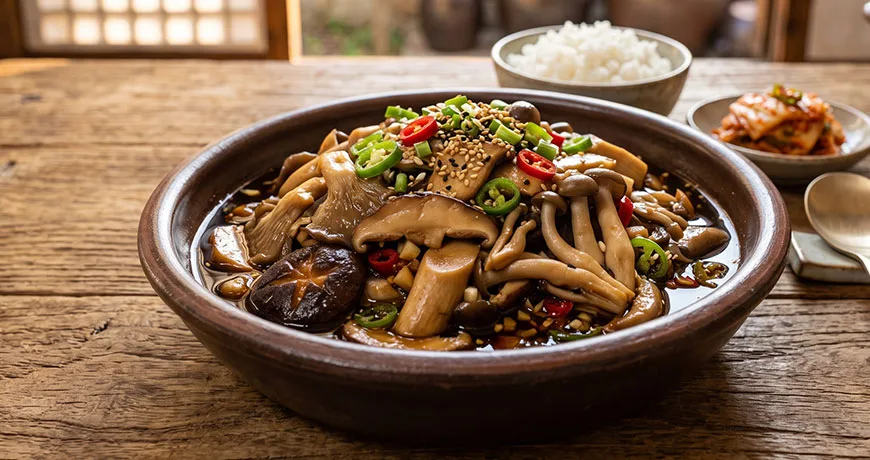
Beoseotjangajji is a sublime tribute to the forest, capturing the deep, damp earthiness and vibrant energy of the woods within an elegantly simmered soy broth. Because mushrooms absorb liquid like a sponge, simply soaking them in brine would ruin their integrity. The secret lies in a meticulous dry-roasting process before they ever touch the broth. Searing them in a dry pan evaporates excess water, triggers a magnificent Maillard reaction, and condenses their texture into a deeply satisfying, meat-like chew. When these roasted mushrooms finally embrace the savory soy marinade, they unleash an explosive umami synergy that gracefully elevates any dining experience.
- ⏱️ Total Time: 1–2 Days | Prep: 20 Mins (Delicate cleansing without water and dry roasting) | Cook & Ferment: Slow-simmering broth and 24–48 hours of cold aging
- 🍳 Difficulty: Medium (Requires strict moisture control and masterful dry-roasting techniques)
- 🌶️ Profile: A mouth-filling, deep forest aroma followed by a heavy, profound, and lingering sweet umami
- 🍚 Core Process: Delicate Cleansing, Dry Roasting, Lukewarm Infusion
- 🍶 Pairing: Charcoal-grilled Hanwoo tenderloin, steaming stone-pot rice with a pat of butter, warm tofu
Physicochemical & Sensory Matrix
- Baseline Salinity: 4.5% ~ 5.5% (A balanced salinity that amplifies the umami without masking the mushroom’s delicate aromas)
- pH Equilibrium: 4.8 ~ 5.2 (A very mild acidity used only to lift the heavy, earthy notes, not to dominate them)
- Textural Crunch Index: [■■■■□] (A remarkably resilient, meat-like chew achieved through intense moisture evaporation)
- Umami Density: 9.8 / 10 (An overwhelming, explosive synergy between the mushroom’s natural guanylate and the soy’s glutamate)
- Shelf Stability: Peaks after 24 hours; retains its deep flavor and resilient texture for 2 weeks refrigerated
- Aroma Profile: Deep Earthy Forest (1-Octen-3-ol) | Roasted Mushroom Caramelization | Aromatic Brewed Soy
Ingredients (Yields 1 Medium Airtight Glass Container)
- Primary Plant Matrix: 300g Dense King Oyster Mushrooms (Saesongi), 100g Fragrant Shiitake Mushrooms, 100g Tender Brown Button Mushrooms
- Aromatic Broth Matrix: 1.5 Cups Brewed Soy Sauce, 1.5 Cups Purified Water, 0.5 Cup Cooking Wine, 1 Cup Rice Syrup (Jocheong) or Unrefined Sugar, 3 tbsp Apple Vinegar
- Aromatic Catalyst: 1 Sheet Dried Kelp (10x10cm), 5 Cloves Garlic, 1 Scallion (White part), 1 Dried Red Chili, 1 Slice of Fresh Lemon
Allergy Information
- Contains: Soy, Wheat (inherent in brewed soy sauce)
Equipment Cast Iron Skillet (or thick-bottomed stainless steel pan), Stainless Steel Saucepan, Heat-resistant Glass Airtight Container, Damp Cotton Cloth
Cooking Instructions
- Delicate Cleansing: Never wash mushrooms under running water. Use a damp cloth or a soft brush to meticulously wipe away any soil from the surface. Slice the King Oyster and Shiitake mushrooms thickly to preserve their meaty texture, and halve the Button mushrooms to maintain their elegant shape.
- Dry Roasting: Heat a dry cast-iron skillet without any oil. Place the mushrooms in the pan over high heat, tossing them quickly. This crucial step sears a beautiful, deep brown crust (Maillard reaction) onto the mushrooms while violently evaporating their internal moisture. Once deeply fragrant and slightly shriveled, transfer them to a wire rack to cool.
- Slow-simmering the Broth: In a saucepan, combine the water, soy sauce, cooking wine, rice syrup, kelp, garlic, scallion, and red chili. Simmer gently over medium heat to extract a deep, resonant base flavor without overpowering the forest notes. Once fragrant, remove and discard the kelp and aromatics.
- Preservation of Mild Acidity: Turn off the heat. As the intense boiling subsides, stir in the apple vinegar. The goal is not a sharp sourness, but rather a subtle acidic veil that gracefully lifts the heavy, earthy profile of the broth.
- Lukewarm Infusion & Aging: Pack the beautifully roasted mushrooms into the glass container. Pour the soy broth—cooled to a comforting lukewarm temperature (approx. 60°C)—over them. Tuck in the lemon slice for a final touch of brightness. Cover and age peacefully in the refrigerator for 24 to 48 hours.
💡 Professional Culinary Tips
- 1. The Taboo of Washing: Mushrooms are highly porous networks of mycelium. The moment they touch running water, they aggressively absorb it like a sponge. Pickling water-logged mushrooms results in a severely diluted broth and a thoroughly unappetizing, mushy texture. Wiping them gently with a damp cloth is an absolute necessity in professional kitchens.
- 2. Texture Control via Dry Roasting: Pouring boiling soy broth directly over raw mushrooms causes them to instantaneously dump massive amounts of water, ruining the brine. By aggressively dry-roasting them beforehand, you expel this excess water and condense the plant proteins. This masterstroke yields an intensely chewy, meat-like texture and unlocks profound roasted aromas.
- 3. Maximizing Guanylate Synergy: Mushrooms are extraordinarily rich in guanylate, a nucleotide that, when combined with the glutamate found in brewed soy sauce, magnifies umami exponentially. Introducing too much vinegar would shatter this delicate, elegant synergy. By intentionally restraining the acidity, the chef directs the diner’s full attention to the explosive, mouth-coating savory depth.
🍶 Gastronomic Pairing
- A Flawless Marriage of Earth and Fire: Serve this deeply savory preserve alongside a beautifully seared, charcoal-grilled Hanwoo beef tenderloin. The juicy richness of the beef intertwines with the meaty chew and explosive umami of the mushrooms, creating an immaculate culinary ensemble. For a simpler yet equally luxurious experience, finely chop the pickled mushrooms and fold them into a steaming bowl of freshly cooked stone-pot rice with a small pat of premium butter—an unforgettable testament to the power of high-end pantry staples.
Nutrition Facts (Estimated)
Total Content : Approx. 30g
Calories : 25 kcal (High-density mushroom fiber and broth polysaccharides)
– Sodium : 380mg (A profound, savory salinity)
– Total Carbohydrate : 5.0g
– Sugar : 3.0g
– Total Fat : 0.1g
– Saturated Fat : 0.0g
– Cholesterol : 0.0mg
– Protein : 1.2g (Plant-based proteins concentrated through roasting)
– Dietary Fiber : 2.0g
*Daily Values are based on a 2,000 calorie diet and standard Korean nutritional reference values.
**Nutritional values are calculated based on original ingredients; substitutions may alter specific macronutrients.
Origins and Food Culture of Pickled Mushrooms (Beoseotjangajji)
1. Buddhist Temple Gastronomy and the Heritage of “San-gogi” (Mountain Meat) in Classical Texts
- Foraging and consuming wild mushrooms dates back over a millennium on the Korean peninsula. With the prominence of Buddhism during the Goryeo Dynasty and its strict prohibition against taking animal life (ahimsa), mushrooms evolved into the supreme restorative substitute for meat—celebrated in monastic gastronomy as San-gogi (mountain meat) or San-yuk (山肉).
- Late Joseon agrarian encyclopedias, including Seo Yu-gu’s early 19th-century Imwon Gyeongjeji (Jeongjo-ji) and Yu Jung-im’s Jeungbo Sallim Gyeongje (1766), documented techniques for preserving mushrooms in fermented pastes and brines under classical Hanja entries such as Gojang (菰醬), Ijang (栮醬), or Hyangseonjang (香蕈醬). Because fresh mushrooms rot rapidly in humid weather, steaming or drying the harvest and immersing it in boiled soy-vinegar syrup was an essential preservation strategy for noble banquets and ancestral rites.
2. The Science of Fungal Chitin Preservation and Parboiling Pretreatment
- The technical craftsmanship of authentic Beoseotjangajji lies in preventing the spongy fungal caps from becoming waterlogged or turning sour during cellar storage.
- Plunging raw mushrooms directly into cold marinade leaves trapped air inside the hyphae, causing them to float to the surface and spoil from exposure to ambient wild yeasts. Ancestors resolved this through a rapid salted blanching step, followed by gentle manual pressing. This evacuated internal gas and surplus free water while stabilizing the structural chitin-glucan lattice. When subsequent cold, hypertonic soy marinades were introduced, the seasoned liquid filled the evacuated micro-voids, locking in a permanent, springy chew that resists bacterial degradation across seasons.
3. Hardwood Foraging Lore of Mount Jiri and Jeju Island, and Scholar Table Culture
- Historically, the premier terroir for peninsular shiitake foraging spanned the pristine oak-covered slopes of Mount Jiri (across Gurye, Namwon, and Sancheong) and the primeval slopes surrounding Mount Halla on Jeju Island. Forest-grown shiitake and rock-tripe mushrooms (seogi-beoseot) harvested from these alpine valleys were prized as royal court tributes and central offerings in clan ancestral shrines (bulcheonwi).
- Joseon Confucian scholars praised the clean, ascetic savor of pickled mushrooms, viewing their unpretentious yet profound flavor as an emblem of moral purity, often featuring them on refined drinking tables accompanied by clear herbal wines. Capturing the pure essence of ancient mountain forests through patient earthenware curing, Pickled Mushrooms stand as an enduring monument to Korean temple cooking wisdom, mycological preservation, and holistic slow-food heritage.
The Dense, Fibrous Flesh of Forest Fungi Bursting from Oak Stumps in Shaded Mist, Purging Surface Mucilage with a Scalding Blanch, and Submerging the Spongy Matrix into Chilled Soy-Vinegar Brine: A Refined Portrait of Traditional Beoseotjangajji
Beoseotjangajji (Pickled Mushrooms in Seasoned Soy Sauce) stands as an aromatic, intellectually brilliant monument within Korea’s temple and mountain preservation gastronomy. Centered upon thick-fleshed, edible forest fungi—principally wood-ear, shiitake (Lentinula edodes), king oyster (Pleurotus eryngii), and cluster oyster mushrooms—cut into thick ribbons and subjected to a rapid water blanch, this preserve is steeped in a boiled-and-cooled marinade of brewed soy sauce, kelp broth, fermented vinegar, grain syrup, and dried chilies. Unlike terrestrial vegetables walled by cellulose or meats framed by muscle actomyosins, mushrooms belong to the fungal kingdom: their structural architecture is woven from a dense matrix of chitin—akin to the exoskeleton of crustaceans—and branching beta-glucans. This biological trait endows them with an elastic, springy resilience while acting as microscopic fluid sponges. However, fresh mushrooms leach out viscous polysaccharides if immersed raw, quickly spoiling the brine. Ancestral cooks resolved this fragility through a swift thermal blanch: boiling water drives out interior air, coagulates slimy surface exudates, and contracts the fungal hyphae. Cooled and bathed in a hypertonic soy liquor, the microscopic capillary voids draw in savory peptides, transmuting a perishable woodland gift into an enduring, springy table treasure.
Lifting an amber-stained cap of pickled shiitake with chopsticks reveals a glossy, translucent exterior that holds trapped marinade through strong capillary forces. Approaching the nose, the deep, malty peptide perfume of brewed soy sauce is lightened by a volatile breeze of fermented vinegar, underlaid by the primordial, damp-earth aroma of 1-octen-3-ol and the smoky, toasted woodland esters characteristic of cured fungi. Clamping down with the molars yields a startling tactile sensation: completely removed from the limp yield of canned mushrooms or the mushy collapse of boiled vegetables, an authoritative, chewy resistance (jjolgit-jjolgit) pushes back against dental pressure. The pressurized, porous hyphal chambers rupture under tooth shear, discharging trapped pockets of chilled, savory broth across the oral cavity like culinary marrow. The bright acidity of the vinegar cuts through first, followed immediately by an overwhelming wave of concentrated umami as the mushroom’s natural guanylates pair with the soy sauce’s free glutamates, blanketing the lingual mucosa in deep, resonant savor. Stationed beside marbled slices of grilled beef short ribs, unctuous broiled eel, or a modest bowl of rice porridge, it anchors the palate with forest serenity and luxurious depth.
The cultural identity of Beoseotjangajji lies in the contemplative culinary discipline of Korean Buddhist temple gastronomy, which eschewed animal flesh yet sought profound satiety through the bounty of the mountains. By mastering the delicate chitinous turgor of wild fungi through heat and osmotic immersion, traditional cooks forged a dish that rivals the savory intensity of meat while retaining the quiet grace of the forest floor. A glistening saucer of pickled mushrooms remains an enduring testament to cellular preservation, nucleotide synergy, and the timeless sophistication of the Korean hearth.
Editor’s Review
1. Fungal Hyphal Chitin-Glucan Architecture and Capillary Sponge Masticatory Kinetics
Beoseotjangajji exhibits a dense, non-collapsing chew rooted in fungal cell wall morphology:
- Thermal Incompressibility of the Chitin Matrix: The fungal cell wall is composed of cross-linked polymers of beta-glucans and crystalline chitin (poly-N-acetylglucosamine). Unlike plant pectins that degrade under thermal or acidic conditions, chitin remains insoluble and structurally intact across cooking and prolonged brining, delivering an authoritative, rubbery elasticity (jjolgit-jjolgit) that firmly resists dental shear.
- Capillary Fluid Retention and Hydraulic Burst: The interwoven network of vegetative hyphae forms a multi-porous microscopic scaffold. When chewed, tooth compression expels the trapped, incompressible soy-vinegar marinade abruptly from these capillary chambers, producing an authentic hydraulic release that mimics the succulent mouthfeel of roasted animal proteins.
2. 5′-Guanylate-Glutamate Umami Hyper-Synergy and Polyphenol Oxidase Inactivation
The extraordinary savory depth and clear mahogany hue of Beoseotjangajji stem from enzymatic ribonucleotide generation and thermal enzyme arrest:
- Cross-Modal Nucleotide-Amino Acid Potentiation: Thermal blanching of fresh mushrooms activates endogenous nucleases that break down fungal RNA into free 5′-guanosine monophosphate (5′-GMP). When this purine nucleotide encounters the free L-glutamic acid of brewed soy sauce, it alters the binding conformation of the oral T1R1/T1R3 umami receptors, triggering an allosteric synergy that amplifies perceived umami intensity by up to eightfold compared to solitary glutamate.
- Complete Polyphenol Oxidase (PPO) Denaturation: Freshly harvested mushrooms contain high titers of polyphenol oxidase, which rapidly oxidizes phenolic precursors into dark, muddy melanins in the presence of oxygen. A brief 100°C water blanch permanently denatures PPO, arresting enzymatic browning and preserving the translucent amber-brown hue of the fungal caps throughout storage.
- Water Activity (Aw) Stabilization: The hypertonic soy-syrup marinade depresses internal water activity (Aw) to 0.82–0.85, establishing a robust microbial barrier that ensures long-term preservation without chemical stabilizers.
3. Lipid Cleaving and Systemic Bile Chelation Physiology
Beoseotjangajji serves as an agile physiological counterbalance against fat-heavy banquets:
- Interfacial Lipid Emulsification: Saturated animal fats (beef tallow, pork lard) coat lingual papillae with a hydrophobic film that dulls sensory receptors. The organic acetic acid in the marinade (pH 3.8–4.2) drastically lowers interfacial tension, dispersing and stripping away grease films to reset the palate.
- Cholesterol Sequestration via Beta-Glucans: The soluble and insoluble beta-glucans concentrated in the mushroom cell walls physically trap mixed bile salt-cholesterol micelles in the small intestine, facilitating their clearance and buffering the metabolic impact of rich feasts.